Results by title
131 books match the query 'Sex role in literature' and 6 start with r
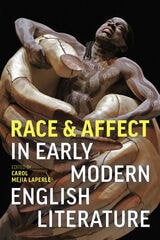
Race and Affect in Early Modern English Literature
Carole Mejia LaPerle
Arizona Center for Medieval and Renaissance Studies, 2021
Race and Affect in Early Modern English Literature puts the fields of critical race studies and affect theory into dialogue. Doing so opens a new set of questions: What are the emotional experiences of racial formation and racist ideologies? How do feelings—through the physical senses, emotional passions, or sexual encounters—come to signify race? What is the affective register of anti-blackness that pervades canonical literature? How can these visceral forms of racism be resisted in discourse and in practice? By investigating how race feels, this book offers new ways of reading and interpreting literary traditions, religious differences, gendered experiences, class hierarchies, sexuality, and social identities. So far scholars have shaped the discussion of race in the early modern period by focusing on topics such as genealogy, language, economics, religion, skin color, and ethnicity. This book, however, offers something new: it considers racializing processes as visceral, affective experiences.
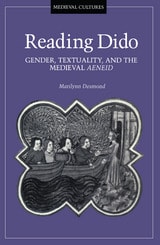
Reading Dido
Gender, Textuality, and the Medieval AeneidMarilynn Desmond
University of Minnesota Press, 1994
Describes the variations in the figure of Dido as she emerges from ancient literary texts.
If we view the Aeneid—the poem of empire, conquest, and male hierarchy-as the West's quintessential canonical text and Latin primer, then the history of Virgil readership should tell us much about the concept of education in the West. In this book, Marilynn Desmond reveals how a constructed and mediated tradition of reading Virgil has conditioned various interpretations among readers responding to medieval cultural and literary texts. In particular, she shows how the story of Dido has been marginalized within canonical readings of the Aeneid. Reaching back to the Middle Ages and vernacular poetic readings of Dido, Desmond recovers an alternative Virgil from historical tradition and provides another paradigm for reading the Aeneid.
Desmond follows the figure of Dido as she emerges from ancient historical and literary texts (from Timaeus and Justin to Virgil and Ovid) and circulates in medieval textual cultures. Her study ranges from the pedagogical discourses of Latin textual traditions (including Servius, Augustine, Bernard Silvestris, and John of Salisbury) to the French and English vernacular cultures inscribed in the Roman d'Eneas, the Histoire ancienne jusqu'à César, and the work of Dante, Chaucer, Gavin Douglas, Caxton, and Christine de Pizan. The positions of all these readers point to the cultural specificity and historical contingency of all traditions of reading; thus, this book demonstrates how medieval traditions of reading Dido offer the modern reader a series of countertraditions that support feminist, antihomophobic, and postcolonial interpretive gestures.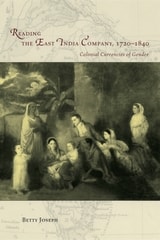
Reading the East India Company 1720-1840
Colonial Currencies of GenderBetty Joseph
University of Chicago Press, 2003
Drawing on the British East India Company's records as well as novels, memoirs, portraiture and guidebooks, Joseph shows how the company's economic and archival practices intersected to produce colonial "fictions" or "truth-effects" that strictly governed class and gender roles—in effect creating a "grammar of power" that kept the far-flung empire intact. And while women were often excluded from this archive, Joseph finds that we can still hear their voices at certain key historical junctures. Attending to these voices, Joseph illustrates how the writing of history belongs not only to the colonial project set forth by British men, but also to the agendas and mechanisms of agency—of colonized Indian, as well as European women. In the process, she makes a valuable and lasting contribution to gender studies, postcolonial theory, and the history of South Asia.
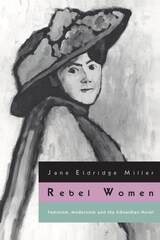
Rebel Women
Feminism, Modernism and the Edwardian NovelJane Eldridge Miller
University of Chicago Press, 1996
"Miller's is the best account we have, not only of Edwardian women novelists, but of early 20th-century women novelists; the measure of her achievement is that the distinction no longer seems workable." —David Trotter, The London Review of Books
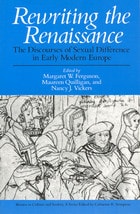
Rewriting the Renaissance
The Discourses of Sexual Difference in Early Modern EuropeEdited by Margaret W. Ferguson, Maureen Quilligan, and Nancy Vickers
University of Chicago Press, 1986
Throughout, the essays focus on the structures of Renaissance patriarchy that organized power relations both in the state and in the family. They explore the major conequences of patriarchy for women—their marginalization and lack of identity and power—and the ways in which individual women or groups of women broke, or in some cases deliberately circumvented, the rules that defined them as a secondary sex. Topics covered include representations of women in literature and art, the actual work done by women both inside and outside of the home, and the writings of women themselves. In analyzing the rhetorical strategies that "marginalized" historical and fictional women, these essays counter scholarly and critical traditions that continue to exhibit patriarchal biases.
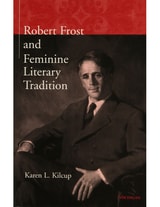
Robert Frost and Feminine Literary Tradition
Karen L. Kilcup
University of Michigan Press, 1998