Results by title
66 books match the query 'Signs' and 2 start with r
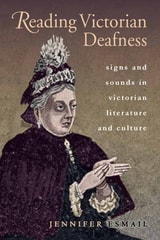
Reading Victorian Deafness
Signs and Sounds in Victorian Literature and CultureJennifer Esmail
Ohio University Press, 2013
Winner of the 2013 Sonya Rudikoff Award for best first book in Victorian Studies
Short-listed for the 2013 British Society for Literature and Science Book Prize.
Reading Victorian Deafness is the first book to address the crucial role that deaf people, and their unique language of signs, played in Victorian culture. Drawing on a range of works, from fiction by Charles Dickens and Wilkie Collins, to poetry by deaf poets and life writing by deaf memoirists Harriet Martineau and John Kitto, to scientific treatises by Alexander Graham Bell and Francis Galton, Reading Victorian Deafness argues that deaf people’s language use was a public, influential, and contentious issue in Victorian Britain.
The Victorians understood signed languages in multiple, and often contradictory, ways: they were objects of fascination and revulsion, were of scientific import and literary interest, and were considered both a unique mode of human communication and a vestige of a bestial heritage. Over the course of the nineteenth century, deaf people were increasingly stripped of their linguistic and cultural rights by a widespread pedagogical and cultural movement known as “oralism,” comprising mainly hearing educators, physicians, and parents.
Engaging with a group of human beings who used signs instead of speech challenged the Victorian understanding of humans as “the speaking animal” and the widespread understanding of “language” as a product of the voice. It is here that Reading Victorian Deafness offers substantial contributions to the fields of Victorian studies and disability studies. This book expands current scholarly conversations around orality, textuality, and sound while demonstrating how understandings of disability contributed to Victorian constructions of normalcy. Reading Victorian Deafness argues that deaf people were used as material test subjects for the Victorian process of understanding human language and, by extension, the definition of the human.
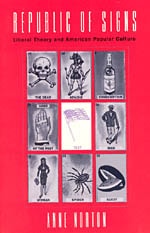
Republic of Signs
Liberal Theory and American Popular CultureAnne Norton
University of Chicago Press, 1993
The author ranges over a wide expanse of popular activities (e.g. wrestling, roller derby, lotteries, shopping sprees, and dining out), as well as conventional political topics (e.g., the Constitution, presidency, news media, and centrality of law). Yet the argument is pointed and probling, never shallow or superficial. Fred and Wilma Flintstone are as vital to the republic as Franklin and Eleanor Roosevelt.
"In discussions that range from the Constitution and the presidency to money and shopping, voting, lotteries, and survey research, Norton discerns and imaginatively invents possibilities that exceed recognized actualities and already approved opportunities."—Richard E. Flathman, American Political Science Review
"[S]timulating and stylish exploration of political theory, language, culture, and shopping at the mall . . . popular culture at its best, informed by history and theory, serious in purpose, yet witty and modest in tone."—Bernard Mergen, American Studies International