168 books match the query 'Social Theory' and 9 start with r
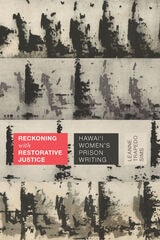
cover of Reckoning with Restorative Justice: Hawai'i Women's Prison Writing

Reckoning with Restorative Justice

Hawai'i Women's Prison Writing

Leanne Trapedo Sims

Duke University Press, 2023
In Reckoning with Restorative Justice, Leanne Trapedo Sims explores the experiences of women who are incarcerated at the Women’s Community Correctional Center, the only women’s prison in the state of Hawai‘i. Adopting a decolonial and pro-abolitionist lens, she focuses particularly on women’s participation in the Kailua Prison Writing Project and its accompanying Prison Monologues program. Trapedo Sims argues that while the writing project served as a vital resource for the inside women, it also remained deeply embedded within carceral logics at the institutional, state, and federal levels. She foregrounds different aspects of these programs, such as the classroom spaces and the dynamics that emerged between performers and audiences in the Prison Monologues. Blending ethnography, literary studies, psychological analysis, and criminal justice critique, Trapedo Sims centers the often-overlooked stories of incarcerated Native Hawaiian and Pacific Islander women in Hawai‘i in ways that resound with the broader American narrative: the disproportionate incarceration of people of color in the prison-industrial complex.
[more]
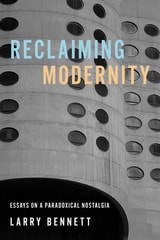
cover of Reclaiming Modernity: Essays on a Paradoxical Nostalgia

Reclaiming Modernity

Essays on a Paradoxical Nostalgia

Larry Bennett

University of Illinois Press, 2025

Why do we seek to return to the past or rescue pieces of the past that may have value in the present? Why does nostalgia attach to an approach to the world, social rules, and material products that willfully rejected the past?

Larry Bennett explores the complexities of nostalgia with considerations of the historic preservation of brutalist architecture, specifically Bertrand Goldberg’s Prentice Women’s Hospital in Chicago; the memoirs and recollections of early and mid-twentieth-century Brooklyn and Detroit; and the turntable’s rebirth as a musical instrument alongside the vinyl LP’s resurgence as a prized way of consuming music. Bennett tracks modernity as expressed through ideas, artistic products, and widespread social practices. His consideration of nostalgia focuses on our inclination to rediscover value in people, places, and social habits diminished by the passage of time.

Provocative and multidisciplinary, Reclaiming Modernity delves into the paradox of how we feel nostalgia for ideas and times that emerged from an impulse to shun nostalgia.

[more]
cover of Red Tape: Bureaucracy, Structural Violence, and Poverty in India

Red Tape

Bureaucracy, Structural Violence, and Poverty in India

Akhil Gupta

Duke University Press, 2012

Red Tape presents a major new theory of the state developed by the renowned anthropologist Akhil Gupta. Seeking to understand the chronic and widespread poverty in India, the world's fourth largest economy, Gupta conceives of the relation between the state in India and the poor as one of structural violence. Every year this violence kills between two and three million people, especially women and girls, and lower-caste and indigenous peoples. Yet India's poor are not disenfranchised; they actively participate in the democratic project. Nor is the state indifferent to the plight of the poor; it sponsors many poverty amelioration programs.

Gupta conducted ethnographic research among officials charged with coordinating development programs in rural Uttar Pradesh. Drawing on that research, he offers insightful analyses of corruption; the significance of writing and written records; and governmentality, or the expansion of bureaucracies. Those analyses underlie his argument that care is arbitrary in its consequences, and that arbitrariness is systematically produced by the very mechanisms that are meant to ameliorate social suffering. What must be explained is not only why government programs aimed at providing nutrition, employment, housing, healthcare, and education to poor people do not succeed in their objectives, but also why, when they do succeed, they do so unevenly and erratically.
[more]
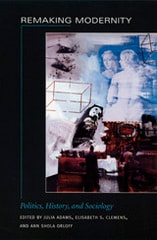
cover of Remaking Modernity: Politics, History, and Sociology

Remaking Modernity

Politics, History, and Sociology

Julia Adams, Elisabeth S. Clemens, Ann Shola Orloff, eds.

Duke University Press, 2005

A state-of-the-field survey of historical sociology, Remaking Modernity assesses the field’s past accomplishments and peers into the future, envisioning changes to come. The seventeen essays in this collection reveal the potential of historical sociology to transform understandings of social and cultural change. The volume captures an exciting new conversation among historical sociologists that brings a wider interdisciplinary project to bear on the problems and prospects of modernity.

The contributors represent a wide variety of theoretical orientations and a broad spectrum of understandings of what constitutes historical sociology. They address such topics as religion, war, citizenship, markets, professions, gender and welfare, colonialism, ethnicity, bureaucracy, revolutions, collective action, and the modernist social sciences themselves. Remaking Modernity includes a significant introduction in which the editors consider prior orientations in historical sociology in order to analyze the field’s resurgence. They show how current research is building on and challenging previous work through attention to institutionalism, rational choice, the cultural turn, feminist theories and approaches, and colonialism and the racial formations of empire.

Contributors. Julia Adams, Justin Baer, Richard Biernacki, Bruce Carruthers, Elisabeth Clemens, Rebecca Jean Emigh, Russell Faeges, Philip Gorski, Roger Gould, Meyer Kestnbaum, Edgar Kiser, Ming-Cheng Lo, Zine Magubane, Ann Shola Orloff, Nader Sohrabi, Margaret Somers, Lyn Spillman, George Steinmetz
[more]
cover of Requirements for Certification of Teachers, Counselors, Librarians, Administrators for Elementary and Secondary Schools, Ninetieth Edition, 2025–2026

Requirements for Certification of Teachers, Counselors, Librarians, Administrators for Elementary and Secondary Schools, Ninetieth Edition, 2025–2026

Edited by Alain Park

University of Chicago Press, 2025

The authoritative annual guide to the requirements for certification of teachers.

This annual volume offers the most complete and current listings of the requirements for certification of a wide range of educational professionals at the elementary and secondary levels. Requirements for Certification is a valuable resource, making much-needed knowledge available in one straightforward volume.
[more]
cover of Rethinking Sex: Social Theory and Sexuality Research

Rethinking Sex

Social Theory and Sexuality Research

R. Connell

Temple University Press, 1993
Sex and Gender Section Award for Distinguished Contribution to the Study of Sex and Gender, American Sociological Association, 1995 This volume of essays sharply questions current knowledge and ideas about sexuality, social theory, and public policy research on sexuality. The contributors, internationally recognized scholars and activists from Australia, examine the dominant research models from the United States and Western Europe and propose a new perspective, one sensitive to the social construction of sexuality and its research and to variation in sexual practices across cultures. Addressing the debates over sexual conduct from contraception to AIDS prevention, Rethinking Sex provides a systematic examination of the social dimensions of sexuality. Social theory, public policy analysis, and historical and survey research are applied to issues ranging from AIDS and gay identity to perceptions of women's sexuality and relations between the state and private sexual behavior. "Sexuality is a major theme in our culture, from the surf video to the opera stage to the papal encyclical. It is, accordingly, one of the major themes of the human sciences, and figures as weighty as Darwin and Freud have made major contributions to it. Social research has, over the last hundred years, produced crucially important evidence for the understanding of sexuality. But social theory has been slow to grapple with the issue, to give it the sophisticated attention that has been devoted to questions of production or of communication. "We are convinced that an adequate social theory of sexuality is essential for progress on 'applied' issues, such as the design of research on the social transmission of human immunodefiency virus (HIV). This chapter attempts a mapping exercise, sorting out the major intellectual frameworks that have governed Western thinking about sexuality. We discuss first the religious and scientific nativism that dominated the field into the twentieth century, the problems this approach ran into, and the rise of social construction approaches to sexuality. We discuss the impasse that social constructionism has reached. In the final part of the chapter we sketch the outline of an approach which can move past these difficulties." --From Chapter 3, "'The Unclean Motion of the Generative Parts': Frameworks in Western Thought on Sexuality"
[more]
cover of Revolution Squared: Tahrir, Political Possibilities, and Counterrevolution in Egypt

Revolution Squared

Tahrir, Political Possibilities, and Counterrevolution in Egypt

Atef Shahat Said

Duke University Press, 2024
In Revolution Squared Atef Shahat Said examines the 2011 Egyptian Revolution to trace the expansive range of liberatory possibilities and containment at the heart of every revolution. Drawing on historical analysis and his own participation in the revolution, Said outlines the importance of Tahrir Square and other physical spaces as well as the role of social media and digital spaces. He develops the notion of lived contingency—the ways revolutionary actors practice and experience the revolution in terms of the actions they do or do not take—to show how Egyptians made sense of what was possible during the revolution. Said charts the lived contingencies of Egyptian revolutionaries from the decade prior to the revolution’s outbreak to its peak and the so-called transition to democracy to the 2013 military coup into the present. Contrary to retrospective accounts and counterrevolutionary thought, Said argues that the Egyptian Revolution was not doomed to defeat. Rather, he demonstrates that Egyptians did not fully grasp their immense clout and that limited reformist demands reduced the revolution’s potential for transformation.
[more]
cover of Rise Of Social Theory

Rise Of Social Theory

Johan Heilbron

University of Minnesota Press, 1995
[more]
cover of Rubbish Theory: The Creation and Destruction of Value - New Edition

Rubbish Theory

The Creation and Destruction of Value - New Edition

Michael Thompson

Pluto Press, 2017

How do objects that are worth little to nothing become valuable? Who is behind the creation of value, and which types of people find value and comfort in transient, durable, and rubbish objects?
 
When his highly influential Rubbish Theory, first published in 1979, Michael Thompson launched the discipline of waste studies. It remains the most comprehensive analysis on the culture of waste to date. Thompson argues that there are two mutually exclusive cultural categories that are socially imposed on the world of objects: a transient category and a durable category. However, he identifies a region of flexibility, wherein a transient object that declines in value and life span can linger in a valueless and timeless limbo of rubbish, until it is discovered by a creative individual and transferred into something deemed durable. He links stability and change on one hand, with materiality on the other, providing a rich analysis of social and cultural dynamics. His instrumental theory of rubbish draws on case studies and anthropological fieldwork to highlight the ever-changing subtleties of object value and our complex relationship to waste.
 
Bringing Rubbish Theory back into print, this updated edition includes a new introduction, preface, foreword, and afterword, thoroughly exploring how Thompson’s key theories have affected our world in the four decades since it was first published and placing it in a contemporary context that shines light on the continued relevance of the book today. 
 
[more]