Results by title
322 books match the query 'Social change' and 13 start with r
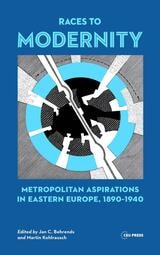
Races to Modernity
Metropolitan Aspirations in Eastern Europe, 1890–1940Martin Kohlrausch
Central European University Press, 2014
Reading History Sideways
The Fallacy and Enduring Impact of the Developmental Paradigm on Family LifeArland Thornton
University of Chicago Press, 2005
In Reading History Sideways, leading family scholar Arland Thornton demonstrates how this approach, though long since discredited, has permeated Western ideas and values about the family. Further, its domination of social science for centuries caused the misinterpretation of Western trends in family structure, marriage, fertility, and parent-child relations. Revisiting the "developmental fallacy," Thornton here traces its central role in changes in the Western world, from marriage to gender roles to adolescent sexuality. Through public policies, aid programs, and colonialism, it continues to reshape families in non-Western societies as well.
Reclaiming Haiti's Futures
Returned Intellectuals, Placemaking, and Radical ImaginationDarlène Elizabeth Dubuisson
Rutgers University Press, 2025
Winner of the 2024 Annual Book Award from the Society for Latin American and Caribbean Anthropology (SLACA)
Co-winner of the Isis Duarte Book Prize from the Latin American Studies Association
Haiti was once a beacon of Black liberatory futures, but now it is often depicted as a place with no future where emigration is the only way out for most of its population. But Reclaiming Haiti's Futures tells a different story. It is a story about two generations of Haitian scholars who returned home after particular crises to partake in social change. The first generation, called jenerasyon 86, were intellectuals who fled Haiti during the Duvalier dictatorship (1957–1986). They returned after the regime fell to participate in the democratic transition through their political leadership and activism. The younger generation, dubbed the jenn doktè, returned after the 2010 earthquake to partake in national reconstruction through public higher education reform. An ethnography of the future, the book explores how these returned scholars resisted coloniality's fractures and displacements by working toward and creating inhabitability or future-oriented places of belonging through improvisation, rasanblaj (assembly), and radical imagination. By centering on Haiti and the Caribbean, the book offers insights not just into the Haitian experience but also into how fractures have come to typify more aspects of life globally and what we might do about it.
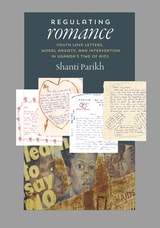
Regulating Romance
Youth Love Letters, Moral Anxiety, and Intervention in Uganda’s Time of AIDSShanti Parikh
Vanderbilt University Press, 2016
Parikh also examines the unintended consequences of Uganda's aggressive HIV campaigns that thrust sexuality and anxieties about it into the public sphere. In a context of economic precarity and generational tension that constantly complicates young people's notions of consumption-based romance, communities experience the dilemmas of protecting and policing young people from reputational and health dangers of sexual activity. "They arrested me for loving a school girl" is the title of a chapter on controlling delinquent daughters and punishing defiant boyfriends for attempting to undermine patriarchal authority by asserting their adolescent romantic agency. Sex education programs struggle between risk and pleasure amidst morally charged debates among international donors and community elders, transforming the youthful female body into a platform for public critique and concern. The many sides of this research constitute an eloquently executed critical anthropology of intervention.
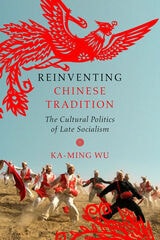
Reinventing Chinese Tradition
The Cultural Politics of Late SocialismKa-ming Wu
University of Illinois Press, 2015
Ka-ming Wu's ethnographic account of contemporary Yan'an documents how people have reworked the revival of three rural practices--paper-cutting, folk storytelling, and spirit cults--within (and beyond) the socialist legacy. Moving beyond dominant views of Yan'an folk culture as a tool of revolution or object of market reform, Wu reveals how cultural traditions become battlegrounds where conflicts among the state, market forces, and intellectuals in search of an authentic China play out. At the same time, she shows these emerging new dynamics in the light of the ways rural residents make sense of rapid social change.
Alive with details, Reinventing Chinese Tradition is an in-depth, eye-opening study of an evolving culture and society within contemporary China.
Rejuvenating the Humanities
Ray B. Browne
University of Wisconsin Press, 1992
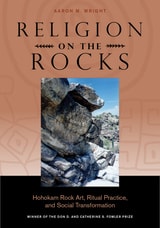
Religion on the Rocks
Hohokam Rock Art, Ritual Practice, and Social TransformationAaron M. Wright
University of Utah Press, 2014
We are nearly all intrigued by the petroglyphs and pictographs of the American Southwest, and we commonly ask what they “mean”. Religion on the Rocks redirects our attention to the equally important matter of what compelled ancient peoples to craft rock art in the first place. To examine this question, Aaron Wright presents a case study from Arizona's South Mountains, an area once flanked by several densely populated Hohokam villages. Synthesizing results from recent archaeological surveys, he explores how the mountains' petroglyphs were woven into the broader cultural landscape and argues that the petroglyphs are relics of a bygone ritual system in which people vied for prestige and power by controlling religious knowledge. The features and strategic placement of the rock art suggest this dimension of Hohokam ritual was participatory and prominent in village life. Around AD 1100, however, petroglyph creation and other ritual practices began to wane, denoting a broad transformation of the Hohokam social world. Wright’s examination of the South Mountains petroglyphs offers a novel narrative of how Hohokam villagers negotiated a concentration of politico-religious authority around platform mounds. Readers will come away with a better understanding of the Hohokam legacy and a greater appreciation for rock art's value to anthropology.
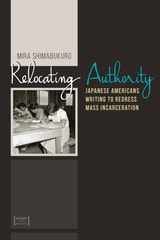
Relocating Authority
Japanese Americans Writing to Redress Mass IncarcerationMira Shimabukuro
University Press of Colorado, 2015
Relocating Authority examines the ways Japanese Americans have continually used writing to respond to the circumstances of their community’s mass imprisonment during World War II. Using both Nikkei cultural frameworks and community-specific history for methodological inspiration and guidance, Mira Shimabukuro shows how writing was used privately and publicly to individually survive and collectively resist the conditions of incarceration.
Examining a wide range of diverse texts and literacy practices such as diary entries, note-taking, manifestos, and multiple drafts of single documents, Relocating Authority draws upon community archives, visual histories, and Asian American history and theory to reveal the ways writing has served as a critical tool for incarcerees and their descendants. Incarcerees not only used writing to redress the “internment” in the moment but also created pieces of text that enabled and inspired further redress long after the camps had closed.
Relocating Authority highlights literacy’s enduring potential to participate in social change and assist an imprisoned people in relocating authority away from their captors and back to their community and themselves. It will be of great interest to students and scholars of ethnic and Asian American rhetorics, American studies, and anyone interested in the relationship between literacy and social justice.
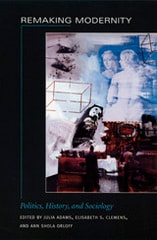
Remaking Modernity
Politics, History, and SociologyJulia Adams, Elisabeth S. Clemens, Ann Shola Orloff, eds.
Duke University Press, 2005
The contributors represent a wide variety of theoretical orientations and a broad spectrum of understandings of what constitutes historical sociology. They address such topics as religion, war, citizenship, markets, professions, gender and welfare, colonialism, ethnicity, bureaucracy, revolutions, collective action, and the modernist social sciences themselves. Remaking Modernity includes a significant introduction in which the editors consider prior orientations in historical sociology in order to analyze the field’s resurgence. They show how current research is building on and challenging previous work through attention to institutionalism, rational choice, the cultural turn, feminist theories and approaches, and colonialism and the racial formations of empire.
Contributors. Julia Adams, Justin Baer, Richard Biernacki, Bruce Carruthers, Elisabeth Clemens, Rebecca Jean Emigh, Russell Faeges, Philip Gorski, Roger Gould, Meyer Kestnbaum, Edgar Kiser, Ming-Cheng Lo, Zine Magubane, Ann Shola Orloff, Nader Sohrabi, Margaret Somers, Lyn Spillman, George Steinmetz
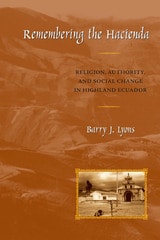
Remembering the Hacienda
Religion, Authority, and Social Change in Highland EcuadorBy Barry J. Lyons
University of Texas Press, 2006
From the colonial period through the mid-twentieth century, haciendas dominated the Latin American countryside. In the Ecuadorian Andes, Runa—Quichua-speaking indigenous people—worked on these large agrarian estates as virtual serfs. In Remembering the Hacienda: Religion, Authority, and Social Change in Highland Ecuador, Barry Lyons probes the workings of power on haciendas and explores the hacienda's contemporary legacy.
Lyons lived for three years in a Runa village and conducted in-depth interviews with elderly former hacienda laborers. He combines their wrenching accounts with archival evidence to paint an astonishing portrait of daily life on haciendas. Lyons also develops an innovative analysis of hacienda discipline and authority relations. Remembering the Hacienda explains the role of religion as well as the reshaping of Runa culture and identity under the impact of land reform and liberation theology.
This beautifully written book is a major contribution to the understanding of social control and domination. It will be valuable reading for a broad audience in anthropology, history, Latin American studies, and religious studies.
Revolution
Modern Uprisings in Ancient TimeMiriam Leonard
University of Chicago Press, 2025
Despite its Latin etymology, “revolution” in its modern understanding arguably did not exist in antiquity, and revolution as we know it today is considered by many theorists to be a term born in modernity. While they certainly had times of momentous political upheaval, the Greeks and Romans tended to understand such events as part of a narrative of political continuity rather than novelty or rupture. Nevertheless, modern revolutions have repeatedly appropriated tropes of classical discourse, such as freedom, tyranny, tragedy, and fraternity.
With this book, Miriam Leonard offers a conceptual history of revolution, unraveling modernity’s yearning for the new and questioning why ancient concepts continue to play such an important role in political uprisings. Leonard looks at examples of appeals to antiquity during the French and Haitian Revolutions, in anticolonial struggles, and feminist and queer movements and considers works of theorists such as Karl Marx, Hannah Arendt, and Sigmund Freud that foreground an engagement with antiquity.

Revolutionary Social Change in Colombia
The Origin and Direction of the FARC-EPJames J. Brittain
Pluto Press, 2010
This book presents an insider's account of Columbia's internal conflict. At the forefront are the Revolutionary Armed Forces of Colombia-People's Army (FARC-EP).
Although they are one of the most powerful military forces in Latin American history, little is known about the FARC-EP. James J. Brittain explains where and why this political military movement came into existence and assesses whether the methods employed by the insurgency have the potential to free those marginalised in Colombia.
As democratic socialism develops in Venezuela and Bolivia, Brittain's fascinating study assesses the relevance of armed struggle to 21st century Latin American politics. This is an essential title for those wishing to develop a full understanding of the continent.
By evaluating the FARC-EP's actions, ideological construction, and their theoretical placement, the book gauges how this guerrilla movement relates to revolutionary theory and practice and through what tangible mechanisms, if any, they are creating a new Colombia.
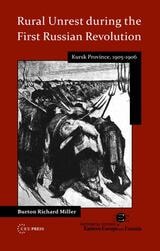
Rural Unrest during the First Russian Revolution
Kursk Province, 1905-1906Burton Richard Miller
Central European University Press, 2013