Results by title
158 books match the query 'Social justice' and 13 start with r
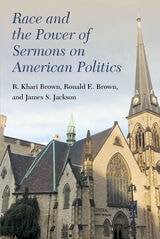
Race and the Power of Sermons on American Politics
R. Khari Brown, Ronald E. Brown, and James S. Jackson
University of Michigan Press, 2021
This book examines the intersection of race, political sermons, and social justice. Religious leaders and congregants who discuss and encourage others to do social justice embrace a form of civil religion that falls close to the covenantal wing of American civil religious thought. Clergy and members who share this theological outlook frame the nation as being exceptional in God’s sight. They also emphasize that the nation’s special relationship with the Creator is contingent on the nation working toward providing opportunities for socioeconomic well-being, freedom, and creative pursuits. God’s covenant, thus, requires inclusion of people who may have different life experiences but who, nonetheless, are equally valued by God and worthy of dignity. Adherents to such a civil religious worldview would believe it right to care for and be in solidarity with the poor and powerless, even if they are undocumented immigrants, people living in non-democratic and non-capitalist nations, or members of racial or cultural out-groups. Relying on 44 national and regional surveys conducted between 1941 and 2019, Race and the Power of Sermons on American Politics explores how racial experiences impact the degree to which religion informs social justice attitudes and political behavior. This is the most comprehensive set of analyses of publicly available survey data on this topic.
Radical Roots
Public History and a Tradition of Social Justice ActivismDenise D. Meringolo
Amherst College Press, 2021
"This is a much-needed recalibration, as professional organizations and practitioners across genres of public history struggle to diversify their own ranks and to bring contemporary activists into the fold." — Catherine Gudis, University of California, Riverside.
"Taken all together, the articles in this volume highlight the persistent threads of justice work that has characterized the multifaceted history of public history as well as the challenges faced in doing that work."—Patricia Mooney-Melvin, The Public Historian
Rape, Agency, and Carceral Solutions
From Criminal Justice to Social JusticeLeland G. Spencer
University of Massachusetts Press, 2023
Winner of the 2023 National Communication Association's American Studies Division Outstanding Book Award
News media and popular culture in the United States have produced a conventional narrative of the outcomes of sexual abuse: someone perpetrates sexual violence, goes to trial, and is then punished with prison time. Survivors recede into the background, becoming minor characters in their own stories as intrepid prosecutors, police officers, and investigators gather evidence and build a case.
Leland G. Spencer explains how the stories we tell about sexual assault serve to reinforce rape culture, privileging criminal punishment over social justice and community-based responses to sexual violence. Examining a broad range of popular media, including news coverage of the Brock Turner case, Naomi Iizuka’s popular play Good Kids, the television program Criminal Minds, and the book turned television show 13 Reasons Why, Spencer demonstrates how these representations shore up the carceral state, perpetuate rape myths, blame victims, and excuse those who harm. While increased discussion about sexual violence represents feminist progress, these narratives assume that policing and prosecution are the only means of achieving justice, sidelining other potential avenues for confronting perpetrators and supporting victims.
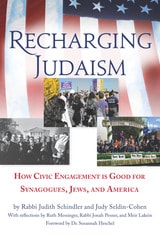
Recharging Judaism
How Civic Engagement Is Good for Synagogues, Jews, and AmericaRabbi Judith Schindler and Judy Seldin-Cohen
Central Conference of American Rabbis, 2018
Recharging Judaism is the essential and timely guide for every synagogue and community seeking to strengthen the bonds of Jewish communal life through advocating for social justice. This volume delves into the enriching civic engagement and acts of righteousness already undertaken by Jews and Jewish communities across the country, and further explores the positive differences we can all affect upon the future of America. There are a myriad of ways in which advocating for social justice and participating in civic engagement can create lasting change. Those inspired to affect such change will find new meaning in the texts and history of our tradition. Using real examples from both small and large congregations across the country, Recharging Judaism offers a framework to guide us through our journey of civic responsibility and social duty and into a brighter future for our country.

Reinventing Cities
Equity Planners Tell Their StoriesNorman Krumholz and Pierre Clavel
Temple University Press, 1994
Reinventing Cities emphasizes the extraordinary accomplishments of eleven urban planners who work for the needs of low income and working class people. Through the voices of equity planners who have worked "in the trenches" of city halls, Norman Krumholz and Pierre Clavel explore the inner dimensions of social change, economic development, community organizing, and the dynamics of implementing and producing fair housing. Preceded by "snapshots" that describe the demographics, politics, and economics of each specific city or region, the editors' interviews with these leading progressive planners highlight productive strategies, disquieting failures, and the cities in which the fought for equity.
Included are conversations with Rick Cohen, former director of Jersey City's Department of Housing and Economic Development; Dale F. Bertsch, former first director of the Miami Valley Regional Planning Commission, Dayton, Ohio; Robert Mier, former commissioner of the Department of Economic Development (DED); Kari J. Moe, former deputy commissioner of Research and Development, DED'; Arturo Vazquez, former director of Mayor Washington's Office of Employment and Training, Chicago; Margaret D. Strachan, former city commissioner, Portland, Oregon; Peter Dreier, former housing director, Boston Redevelopment Authority, and policy aide to Mayor Raymond Flynn; Billie Bramhall, planning staff, Mayor Federico Pena, Denver, Colorado; Howard Stanback, city manager, Hartford, Connecticut; Derek Shearer, former Planning Commission chairman, Santa Monica, California; and Kenneth Grimes, senior planning analyst, San Diego Housing Commission.
In the series Conflicts in Urban and Regional Development, edited by John R. Logan and Todd Swanstrom.
Religion and Social Justice For Immigrants
Hondagneu-Sotelo, Pierrette
Rutgers University Press, 2006
Religion has jumped into the sphere of global and domestic politics in ways that few would have imagined a century ago. Some expected that religion would die as modernity flourished. Instead, it now stares at us almost daily from the front pages of newspapers and television broadcasts. Although it is usually stories about the Christian Right or conservative Islam that grab headlines, there are many religious activists of other political persuasions that are working quietly for social justice. This book examines how religious immigrants and religious activists are working for equitable treatment for immigrants in the United States.
The essays in this book analyze the different ways in which organized religion provides immigrants with an arena for mobilization, civic participation, and solidarity. Contributors explore topics including how non-Western religious groups such as the Vietnamese Caodai are striving for community recognition and addressing problems such as racism, economic issues, and the politics of diaspora; how interfaith groups organize religious people into immigrant civil rights activists at the U.S.–Mexican border; and how Catholic groups advocate governmental legislation and policies on behalf of refugees.
Relocating Authority
Japanese Americans Writing to Redress Mass IncarcerationMira Shimabukuro
University Press of Colorado, 2015
Relocating Authority examines the ways Japanese Americans have continually used writing to respond to the circumstances of their community’s mass imprisonment during World War II. Using both Nikkei cultural frameworks and community-specific history for methodological inspiration and guidance, Mira Shimabukuro shows how writing was used privately and publicly to individually survive and collectively resist the conditions of incarceration.
Examining a wide range of diverse texts and literacy practices such as diary entries, note-taking, manifestos, and multiple drafts of single documents, Relocating Authority draws upon community archives, visual histories, and Asian American history and theory to reveal the ways writing has served as a critical tool for incarcerees and their descendants. Incarcerees not only used writing to redress the “internment” in the moment but also created pieces of text that enabled and inspired further redress long after the camps had closed.
Relocating Authority highlights literacy’s enduring potential to participate in social change and assist an imprisoned people in relocating authority away from their captors and back to their community and themselves. It will be of great interest to students and scholars of ethnic and Asian American rhetorics, American studies, and anyone interested in the relationship between literacy and social justice.
Remembrance, History, and Justice
Coming to terms with traumatic pasts in democratic societiesBogdan C. Iacob
Central European University Press, 2015

Reparations and the Human
David L. Eng
Duke University Press, 2025
Replace the State
How to Change the World When Elections and Protests FailSasha Davis
University of Minnesota Press, 2025
A practical call to action against oppression
Across the globe, millions of people have participated in protests and marches, donated to political groups, or lobbied their representatives with the aim of creating lasting social change, overturning repressive laws, or limiting environmental destruction. Yet very little seems to improve for those affected by rapacious governments. Replace the State brings new hope for social justice movements by looking to progressive campaigns that have found success by unconventional, and more direct, means.
Sasha Davis, an activist and scholar of radical environmental advocacy, focuses on the strategies of movements, many of them Indigenous, that have occupied contested sites and demonstrated their effectiveness at managing or governing them. Including case studies of resistance to development on Indigenous lands in Hawai‘i, nuclear testing in the Nevada desert, and the U.S. military occupation of Okinawa, he offers insight and direction for activists, students, academics, and others dedicated to protecting and improving the well-being of their communities and beyond.
It would be easy to succumb to pessimism and political apathy in the face of governing institutions that are increasingly unresponsive to calls for change and repressive in response to protest, even as they violate human rights, ignore existential climate catastrophes, and concentrate power into fewer and fewer hands. Instead, Davis finds inspiration for genuine political change through social movements that are successfully “replacing the state” and taking over the day-to-day governance of threatened places. From contesting environmental abuse to reasserting Indigenous sovereignty, these social movements demonstrate how people can collectively wrest control over their communities from oppressive governments and manage them with a more egalitarian ethics of care.
Retail e-book files for this title are screen-reader friendly with images accompanied by short alt text and/or extended descriptions.
Responding to Rapid Change in Libraries
A User Experience ApproachLauren Stara and Callan Bignoli
American Library Association, 2020
In the face of rapid change and an ever-widening constellation of challenges, it’s crucial for library leaders to pull back to the question of “why?” Plotting a sustainable way forward depends upon recommitting ourselves to our underlying values, such as customer service and community-building, while fostering the improvements that change makes possible. With passion, patience, and fortitude, libraries can stride confidently into the future. In this book, noted speakers and consultants Bignoli and Stara speak directly to library directors, managers, administrators, and technology staff, offering concrete guidance on setting or resetting strategic priorities. Taking an interconnected and specific approach to planning for and strengthening the library environment as a whole, their book
- discusses why libraries should embrace change as a fundamental part of library life;
- explores how to harness rapid change to provide more responsive, user-centered library service;
- addresses the ways in which libraries straddle the physical and the digital, in areas such as service provision and collections, illuminating how they overlap and can be improved using similar philosophies;
- presents both a comprehensive overview of library technologies as well as related team and change management advice, all grounded in user experience principles;
- shows how the concepts of sustainability and flexibility apply to physical space planning and design, from furniture selection and arrangement to infrastructure; and
- provides sound guidance on project management, problem solving, preparing for future challenges, personal reflection and self-care, and other leadership topics.
Revolutionary Parks
Conservation, Social Justice, and Mexico’s National Parks, 1910–1940Emily Wakild
University of Arizona Press, 2011
Revolutionary Parks tells the surprising story of how forty national parks were created in Mexico during the latter stages of the first social revolution of the twentieth century. By 1940 Mexico had more national parks than any other country. Together they protected more than two million acres of land in fourteen states. Even more remarkable, Lázaro Cárdenas, president of Mexico in the 1930s, began to promote concepts akin to sustainable development and ecotourism.
Conventional wisdom indicates that tropical and post-colonial countries, especially in the early twentieth century, have seldom had the ability or the ambition to protect nature on a national scale. It is also unusual for any country to make conservation a political priority in the middle of major reforms after a revolution. What emerges in Emily Wakild’s deft inquiry is the story of a nature protection program that takes into account the history, society, and culture of the times. Wakild employs case studies of four parks to show how the revolutionary momentum coalesced to create early environmentalism in Mexico.
According to Wakild, Mexico’s national parks were the outgrowth of revolutionary affinities for both rational science and social justice. Yet, rather than reserves set aside solely for ecology or politics, rural people continued to inhabit these landscapes and use them for a range of activities, from growing crops to producing charcoal. Sympathy for rural people tempered the radicalism of scientific conservationists. This fine balance between recognizing the morally valuable, if not always economically profitable, work of rural people and designing a revolutionary state that respected ecological limits proved to be a radical episode of government foresight.
Rights and Goods
Justifying Social ActionVirginia Held
University of Chicago Press, 1989
Seeking a morality based on actual experience, Held offers a method of inquiry with which to deal with the specific moral problems encountered in daily life. She argues that the division between public and private morality is misleading and shows convincingly that moral judgment should be contextual. She maps out different approaches and positions for various types of issues, including membership in a state, legal decisions, political activities, economic transactions, interpersonal relations, diplomacy, journalism, and determining our obligation to future generations. Issues such as these provide the true test of moral theory, since its success is seen in the willingness of conscientious persons to commit themselves to it by acting on it in their daily lives.