Results by title
226 books match the query 'Southwest, New' and 11 start with r
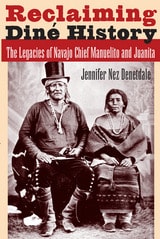
Reclaiming Diné History
The Legacies of Navajo Chief Manuelito and JuanitaJennifer Nez Denetdale
University of Arizona Press, 2007
Here she presents a thought-provoking examination of the construction of the history of the Navajo people (Diné, in the Navajo language) that underlines the dichotomy between Navajo and non-Navajo perspectives on the Diné past. Reclaiming Diné History has two primary objectives. First, Denetdale interrogates histories that privilege Manuelito and marginalize Juanita in order to demonstrate some of the ways that writing about the Diné has been biased by non-Navajo views of assimilation and gender. Second, she reveals how Navajo narratives, including oral histories and stories kept by matrilineal clans, serve as vehicles to convey Navajo beliefs and values.
By scrutinizing stories about Juanita, she both underscores the centrality of women’s roles in Navajo society and illustrates how oral tradition has been used to organize social units, connect Navajos to the land, and interpret the past. She argues that these same stories, read with an awareness of Navajo creation narratives, reveal previously unrecognized Navajo perspectives on the past. And she contends that a similarly culture-sensitive re-viewing of the Diné can lead to the production of a Navajo-centered history.
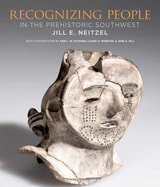
Recognizing People in the Prehistoric Southwest
Jill E Neitzel with contributions by Ann L. W. Stodder, Laurie Webster, and Jane H. Hill
University of Utah Press, 2016
In the prehistoric Southwest, if you traveled from one community to another, you would have observed tremendous diversity in how people looked and spoke. This volume is the first to look at how prehistoric people’s appearance and speech conveyed their identities. Previously, Southwest archaeologists have studied identity using architecture, ceramics, textiles, and jewelry. This book uses a holistic, comparative approach to consider all aspects of appearance. Advocating a people-centered perspective for studying the past, Neitzel and her colleagues show how these characteristics conveyed information about an individual’s social status, cultural affiliation, inter-group connections, religious beliefs, and ceremonial roles.
Contributors: Ann L. W. Stodder, Museum of New Mexico, and Department of Anthropology, The University of New Mexico; Laurie Webster, University of Arizona; and Jane H. Hill, School of Anthropology, University of Arizona (emerita)
Reconstructing a Chicano/a Literary Heritage
Hispanic Colonial Literature of the SouthwestEdited by María Herrera-Sobek
University of Arizona Press, 1993
Contributors:
Juan Bruce-Novoa
Ramón Gutiérrez
María Herrera-Sobek
Enrique Lamadrid
Luis Leal
Francisco A. Lomelí
Genaro Padilla
Tey Diana Rebolledo
Tino Villanueva
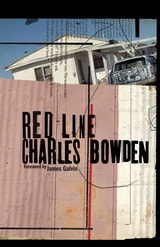
Red Line
By Charles Bowden, foreword by James Galvin
University of Texas Press, 2018
“At its best, Red Line can read like an original synthesis of Peter Matthiessen and William Burroughs . . . a brave and interesting book.”
—David Rieff, Los Angeles Times Book Review
“Charles Bowden’s Red Line is a look at America through the window of the southwest. His vision is as nasty, peculiar, brutal, as it is intriguing and, perhaps, accurate. Bowden offers consciousness rather than consolation, but in order to do anything about our nightmares we must take a cold look and Red Line casts the coldest eye in recent memory.”
—Jim Harrison
One of Charles Bowden’s earliest books, Red Line powerfully conveys a desert civilization careening over the edge—and decaying at its center. Bowden’s quest for the literal and figurative truth behind the assassination of a murderous border-town drug dealer becomes a meditation on the glories of the desert landscape, the squalors of the society that threatens it, and the contradictions inherent in trying to save it.
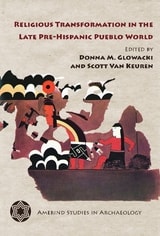
Religious Transformation in the Late Pre-Hispanic Pueblo World
Edited by Donna M. Glowacki and Scott Van Keuren
University of Arizona Press, 2012
The mid-thirteenth century AD marks the beginning of tremendous social change among Ancestral Pueblo peoples of the northern US Southwest that foreshadow the emergence of the modern Pueblo world. Regional depopulations, long-distance migrations, and widespread resettlement into large plaza-oriented villages forever altered community life. Archaeologists have tended to view these historical events as adaptive responses to climatic, environmental, and economic conditions. Recently, however, more attention is being given to the central role of religion during these transformative periods, and to how archaeological remains embody the complex social practices through which Ancestral Pueblo understandings of sacred concepts were expressed and transformed.
The contributors to this volume employ a wide range of archaeological evidence to examine the origin and development of religious ideologies and the ways they shaped Pueblo societies across the Southwest in the centuries prior to European contact. With its fresh theoretical approach, it contributes to a better understanding of both the Pueblo past and the anthropological study of religion in ancient contexts This volume will be of interest to both regional specialists and to scholars who work with the broader dimensions of religion and ritual in the human experience.
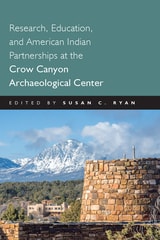
Research, Education and American Indian Partnerships at the Crow Canyon Archaeological Center
Susan C. Ryan
University Press of Colorado, 2024
Research, Education, and American Indian Partnerships at the Crow Canyon Archaeological Center guides Southwestern archaeology and public education beyond current practices—particularly regarding Indigenous partnerships—and provides a strategic handbook for readers into and through the mid-twenty-first century.
Open access edition supported by the Crow Canyon Archaeological Center King Family Fund and subvention supported in part by the Crow Canyon Archaeological Center and the Arizona Archaeological and Historical Society.

Riding
Pardis Mahdavi
Duke University Press, 2025
Rim of Christendom
A Biography of Eusebio Francisco Kino, Pacific Coast PioneerHerbert Eugene Bolton; Foreword by John L. Kessell
University of Arizona Press, 1984
"This is truly an epic work, an absolute standard for any Southwestern collection."—Book Talk
Select maps from the 1984 edition of Rim of Christendom are now available online through the UA Campus Repository.
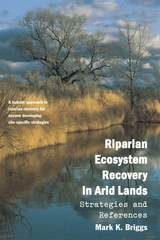
Riparian Ecosystem Recovery in Arid Lands
Strategies and ReferencesMark K. Briggs
University of Arizona Press, 1996
The book opens with a review of watershed characteristics and an examination of drainage systems, then proceeds to determining the causes of riparian decline. It introduces five factors that have a significant effect on the results of riparian rehabilitation--natural regeneration, water availability, channel stability, direct impacts such as livestock grazing and recreational activities, and soil salinity--and offers case studies that demonstrate how revegetation has been used both effectively and ineffectively.
It also discusses strategies other than revegetation that may be effective in improving the ecological condition of a site. Many of the strategies presented are also relevant to nonarid climates and to urban areas. By emphasizing evaluation of riparian ecosystems, so that the causes of degradation can be understood, and by offering general approaches that can be tailored to specific situations, Riparian Ecosystem Recovery in Arid Lands takes a holistic approach to riparian recovery that will enable users to better judge whether recovery expenditures are likely to produce desired results. An unprecedented work, it will substantially add to efforts across the Southwest and elsewhere to restore these unique and priceless ecosystems.
CONTENTS
1 An Overview: Background on Riparian Ecosystems / Lessons Learned from Past Riparian Recovery Efforts / An Evaluation Strategy / Defining Some Important Terms
2 Considering the Damaged Riparian Area from a Watershed Perspective: Case Study 1: Rincon Creek / Taking Advantage of Available Information / Getting to Know the Watershed / Getting to Know the Stream
3 Impacts within the Riparian Zone: Livestock / Case Study 2: Sheepshead Spring / Recreation / Competition from Nonnative Species / Wildlife
4 Natural Recovery in Riparian Ecosystems: Case Study 3: Aravaipa Creek / Factors Influencing Natural Recovery / Case Study 4: McEuen Seep / Autoecology of Selected Southwestern Riparian Tree Species / Case Study 5: Boulder Creek
5 Water Availability: Case Study 6: Box Bar / How Groundwater Decline Occurs / Evaluating Groundwater Conditions / Revegetating Riparian Ecosystems Characterized by Groundwater Decline
6 The Drainageway: Channel Instability and Riparian Ecosystems / Case Study 7: Babocomari River / Channel Dynamics / Strategies for Evaluating Channel Stability / Developing Recovery Projects along Unstable Alluvial Stream Channels
7 Soil Salinity and Riparian Ecosystems: Effects of Soil Salinity on Plant Growth / The Soil Survey / Soil Salinity and Revegetation
8 Developing the Recovery Plan: Developing Project Objectives / Selecting the Best Site / Local, State, and Federal Permit Requirements / Identifying Model Areas / Critical Components of the Recovery Plan / Community Involvement / Demonstration Sites / Postproject Evaluation and Monitoring
Rod Penner
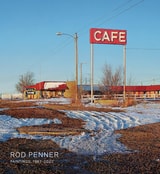
Paintings, 1987–2022Rod Penner
The Artist Book Foundation, 2022
Rod Penner infuses his photorealistic paintings of the American southwest with a cinematic quality in the first major monograph on this contemporary realist artist.
The abandoned and forgotten landscapes of rural southwestern towns are the favored subjects of Rod Penner's paintings. His deft use of contrasts in his images—despondency and hope, isolation and nostalgia—evokes memories of The Last Picture Show and elicits complex responses from viewers. "I'm interested in the look of things and the quality of being there," he says. "A moment that is completely frozen with all the variety of textures; rust on poles, crumbling asphalt, light hitting the grass."
Penner's works are based on his photographs, digital video stills, and his experience of the rural landscapes of Texas and New Mexico. He depicts desolate, often deserted locations, the character of old houses and abandoned buildings, weather, and unique geography. His chosen scenes are infused with a cinematic quality that is the result of the exquisite light that he captures with his meticulous process. "The finished paintings should evoke contrasting responses of melancholy and warmth, desolation and serenity," he says.
Penner's hyperrealistic technique meticulously records both the iconic imagery and the beauty in the ashes of these once-prosperous streets and nighborhoods that still endure. The incredible poignant scenes evoke a universalism, a collective experience seen through the lens of Americana. "You won't find any hidden or overt socio-political meaning in my work and at the same time I hope that by utilizing what I find in the American landscape I'm able to connect to viewers on a deeper psychological level."
Ruins and Rivals
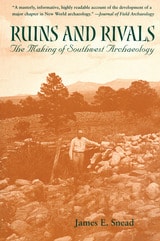
The Making of Southwest ArchaeologyJames E. Snead
University of Arizona Press, 2001
William P. Clements Center for Southwest Studies, Southern Methodist University
Ruins are as central to the image of the American Southwest as are its mountains and deserts, and antiquity is a key element of modern southwestern heritage. Yet prior to the mid-nineteenth century this rich legacy was largely unknown to the outside world. While military expeditions first brought word of enigmatic relics to the eastern United States, the new intellectual frontier was seized by archaeologists, who used the results of their southwestern explorations to build a foundation for the scientific study of the American past.
In Ruins and Rivals, James Snead helps us understand the historical development of archaeology in the Southwest from the 1890s to the 1920s and its relationship with the popular conception of the region. He examines two major research traditions: expeditions dispatched from the major eastern museums and those supported by archaeological societies based in the Southwest itself. By comparing the projects of New York's American Museum of Natural History with those of the Southwest Museum in Los Angeles and the Santa Fe-based School of American Archaeology, he illustrates the way that competition for status and prestige shaped the way that archaeological remains were explored and interpreted. The decades-long competition between institutions and their advocates ultimately created an agenda for Southwest archaeology that has survived into modern times.
Snead takes us back to the days when the field was populated by relic hunters and eastern "museum men" who formed uneasy alliances among themselves and with western boosters who used archaeology to advance their own causes. Richard Wetherill, Frederic Ward Putnam, Charles Lummis, and other colorful characters all promoted their own archaeological endeavors before an audience that included wealthy patrons, museum administrators, and other cultural figures. The resulting competition between scholarly and public interests shifted among museum halls, legislative chambers, and the drawing rooms of Victorian America but always returned to the enigmatic ruins of Chaco Canyon, Bandelier, and Mesa Verde.
Ruins and Rivals contains a wealth of anecdotal material that conveys the flavor of digs and discoveries, scholars and scoundrels, tracing the origins of everything from national monuments to "Santa Fe Style." It rekindles the excitement of discovery, illustrating the role that archaeology played in creating the southwestern "past" and how that image of antiquity continues to exert its influence today.