52 books match the query 'Structure' and 5 start with r

cover of Red, White & Black: Cinema and the Structure of U.S. Antagonisms

Red, White & Black

Cinema and the Structure of U.S. Antagonisms

Frank B. Wilderson III

Duke University Press, 2010

Red, White & Black is a provocative critique of socially engaged films and related critical discourse. Offering an unflinching account of race and representation, Frank B. Wilderson III asks whether such films accurately represent the structure of U.S. racial antagonisms. That structure, he argues, is based on three essential subject positions: that of the White (the “settler,” “master,” and “human”), the Red (the “savage” and “half-human”), and the Black (the “slave” and “non-human”). Wilderson contends that for Blacks, slavery is ontological, an inseparable element of their being. From the beginning of the European slave trade until now, Blacks have had symbolic value as fungible flesh, as the non-human (or anti-human) against which Whites have defined themselves as human. Just as slavery is the existential basis of the Black subject position, genocide is essential to the ontology of the Indian. Both positions are foundational to the existence of (White) humanity.

Wilderson provides detailed readings of two films by Black directors, Antwone Fisher (Denzel Washington) and Bush Mama (Haile Gerima); one by an Indian director, Skins (Chris Eyre); and one by a White director, Monster’s Ball (Marc Foster). These films present Red and Black people beleaguered by problems such as homelessness and the repercussions of incarceration. They portray social turmoil in terms of conflict, as problems that can be solved (at least theoretically, if not in the given narratives). Wilderson maintains that at the narrative level, they fail to recognize that the turmoil is based not in conflict, but in fundamentally irreconcilable racial antagonisms. Yet, as he explains, those antagonisms are unintentionally disclosed in the films’ non-narrative strategies, in decisions regarding matters such as lighting, camera angles, and sound.

[more]
cover of Relativistic Astrophysics, 2: The Structure and Evolution of the Universe

Relativistic Astrophysics, 2

The Structure and Evolution of the Universe

Ya. B. Zel'dovich and I. D. Novikov

University of Chicago Press, 1983

Though the kinematics of the evolving universe became known decades ago, research into the physics of processes occurring in the expanding universe received a reliable observational and theoretical basis only in more recent years. These achievements have led in turn to the emergence of new problems, on which an unusually active assault has begun.

This second volume of Relativistic Astrophysics provides a remarkably complete picture of the present state of cosmology. It is a synthesis of the theoretical foundations of contemporary cosmology, which are derived from work in relativity, plasma theory, thermodynamics, hydrodynamics, and particle physics. It presents the theoretical work that explains, describes, and predicts the nature of the universe, the physical process that occur in it, the formation of galaxies, the synthesis of the light elements, and the cosmological singularity and the theory of gravitation.

This book, long and eagerly awaited, is essential for everyone whose work is related to cosmology and astrophysics.
[more]
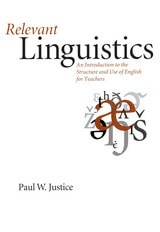
cover of Relevant Linguistics: An Introduction to the Structure and Use of English for Teachers

Relevant Linguistics

An Introduction to the Structure and Use of English for Teachers

Paul W. Justice

CSLI, 2001

As linguistic diversity in schools continues to rise, more educators find themselves studying linguistics in teacher training programs. Unfortunately, the vast majority of introductory linguistics texts do not address their needs; such teachers are likely to find the texts inaccessible and irrelevant. Relevant Linguistics, written with teachers and future teachers in mind, provides a straightforward, accessible introduction to the basics of phonetics, phonology, morphology, and syntax.
[more]
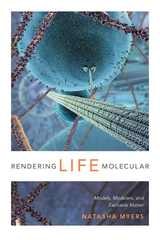
cover of Rendering Life Molecular: Models, Modelers, and Excitable Matter

Rendering Life Molecular

Models, Modelers, and Excitable Matter

Natasha Myers

Duke University Press, 2015

What are living bodies made of? Protein modelers tell us that our cells are composed of millions of proteins, intricately folded molecular structures on the scale of nanoparticles. Proteins twist and wriggle as they carry out the activities that keep cells alive. Figuring out how to make these unruly substances visible, tangible, and workable is a challenging task, one that is not readily automated, even by the fastest computers. Natasha Myers explores what protein modelers must do to render three-dimensional, atomic-resolution models of these lively materials. Rendering Life Molecular shows that protein models are not just informed by scientific data: model building entangles a modeler’s entire sensorium, and modelers must learn to feel their way through the data in order to interpret molecular forms. Myers takes us into protein modeling laboratories and classrooms, tracking how gesture, affect, imagination, and intuition shape practices of objectivity. Asking, ‘What is life becoming in modelers' hands?’ she tunes into the ways they animate molecules through their moving bodies and other media. In the process she amplifies an otherwise muted liveliness inflecting mechanistic accounts of the stuff of life.
[more]
cover of Revolution: Structure and Meaning in World History

Revolution

Structure and Meaning in World History

Saïd Amir Arjomand

University of Chicago Press, 2019

A revolution is a discontinuity: one political order replaces another, typically through whatever violent means are available. Modern theories of revolutions tend neatly to bracket the French Revolution of 1789 with the fall of the Soviet Union two hundred years later, but contemporary global uprisings—with their truly multivalent causes and consequences—can overwhelm our ability to make sense of them.

In this authoritative new book, Saïd Amir Arjomand reaches back to antiquity to propose a unified theory of revolution. Revolution illuminates the stories of premodern rebellions from the ancient world, as well as medieval European revolts and more recent events, up to the Arab Spring of 2011. Arjomand categorizes revolutions in two groups: ones that expand the existing body politic and power structure, and ones that aim to erode—but paradoxically augment—their authority. The revolutions of the past, he tells us, can shed light on the causes of those of the present and future: as long as centralized states remain powerful, there will be room for greater, and perhaps forceful, integration of the politically disenfranchised.
 
[more]