Results by title
67 books match the query 'Students' and 7 start with r
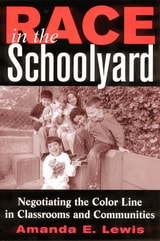
Race in the Schoolyard
Negotiating the Color Line in Classrooms and CommunitiesLewis, Amanda E
Rutgers University Press, 2003
"Race in the Schoolyard is a wonderful book for social scientists studying race, education, and childhood studies. The book showcases the talents of a gifted fieldworker whose theoretically rich work sits on the cutting edge of a growing body of scholarship examining the social worlds of children. School officials, parents, and, most especially, a new generation of teachers will benefit from these lessons on race."-American Journal of Sociology
"Instructors may recommend this book to students to whom the topic is surely vital and engrossing and for whom the text will be lively and engaging."-Contemporary Sociology
"Lewis moves beyond traditional research methods used to examine achievement gaps and differences in test scores to look closely at the realities of schooling. I highly recommend this work for every person involved in teaching and learning."-Multicultural Review
"Through eloquent case studies of three California elementary schools-a white-majority 'good' school, a mostly minority 'tough' school, and an integrated 'alternative' school-[Lewis] demonstrates that schools promote racial inequalities through their daily rituals and practices. Even the notion of a "color-blind" America-an especially popular ideal in the white school-perpetuates racism, Lewis argues, because it denies or dismisses the very real constraints that schools place on minorities. Lewis is nevertheless an optimist, insisting that schools can change ideas of race. . . . Highly recommended. Undergraduate collections and above."-Choice
"In this pioneering ethnography in elementary schools, Lewis shows brilliantly how racism is taught and learned in the small places of everyday life."-Joe Feagin, University of Florida and author of Racist America
"A wonderful and timely book. Ethnographically rich, theoretically sophisticated, and clearly written, this book addresses the ubiquitous issue of race in all its complexity."-Michèle Foster, author of Black Teachers on Teaching
"A compelling ethnography of the racial landscape of contemporary schools."-Barrie Thorne, author of Gender Play: Girls and Boys in School
Could your kids be learning a fourth R at school: reading, writing, 'rithmatic, and race?
Race in the Schoolyard takes us to a place most of us seldom get to see in action¾ our children's classrooms¾ and reveals the lessons about race that are communicated there. Amanda E. Lewis spent a year observing classes at three elementary schools, two multiracial urban and one white suburban. While race of course is not officially taught like multiplication and punctuation, she finds that it nonetheless insinuates itself into everyday life in schools.
Lewis explains how the curriculum, both expressed and hidden, conveys many racial lessons. While teachers and other school community members verbally deny the salience of race, she illustrates how it does influence the way they understand the world, interact with each other, and teach children. This eye-opening text is important reading for educators, parents, and scholars alike.
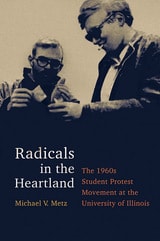
Radicals in the Heartland
The 1960s Student Protest Movement at the University of IllinoisMichael V. Metz
University of Illinois Press, 2019
Positioning the events in the context of their time, Michael V. Metz delves into the lives and actions of activists at the center of the drama. A participant himself, Metz draws on interviews, archives, and newspaper records to show a movement born in demands for free speech, inspired by a movement for civil rights, and driven to the edge by a seemingly never-ending war. If the sudden burst of irrational violence baffled parents, administrators, and legislators, it seemed inevitable to students after years of official intransigence and disregard. Metz portrays campus protesters not as angry, militant extremists but as youthful citizens deeply engaged with grave moral issues, embodying the idealism, naiveté, and courage of a minority of a generation.
Reconstructing Response to Student Writing
A National Study from across the CurriculumDan Melzer
Utah State University Press, 2023
Presenting the results of a national study of teacher and peer response and student self-assessment at institutions of higher education across the United States, Melzer analyzes teacher and peer response to over 1,000 pieces of student writing as well as 128 student portfolio reflection essays. He draws on his analysis and on a comprehensive review of the literature on response to introduce a constructivist heuristic for response aimed at both composition instructors and instructors across disciplines. Melzer argues that teachers and researchers should focus less on teacher response to individual pieces of student writing and more on engaging in dialogue with student self-assessment and peer response, focusing on growth and transfer rather than products and grades.
Reconstructing Response to Student Writing, especially when taken together with Melzer’s previous book Assignments across the Curriculum, provides a comprehensive and large-scale view of college writing and responding across the curriculum in the United States.
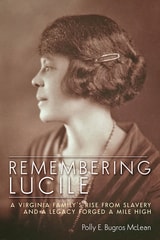
Remembering Lucile
A Virginia Family's Rise from Slavery and a Legacy Forged a Mile HighPolly E. Bugros McLean
University Press of Colorado, 2021
The first-born daughter of emancipated slaves, Lucile refused to be defined by the racist and sexist climate of her times, settling on a career path in teaching that required great courage in the face of pernicious Jim Crow laws. Embracing her sister’s dream for higher education and W. E. B. Du Bois’s ideology, she placed education and intelligence at the forefront of her life, teaching in places where she could most benefit African American students. Over her 105 years she was an eyewitness to spectacular, inspiring, and tragic moments in American history, including horrific lynchings and systemic racism in housing and business opportunities, as well as the success of women's suffrage and Black-owned businesses and educational institutions.
Remembering Lucile employs a unique blend of Black feminist historiography and wider discussions of race, gender, class, religion, politics, and education to illuminate major events in African American history and culture, as well as the history of the University of Colorado and its relationship to Black students and alumni, as it has evolved from institutional racism to welcoming acceptance. This extensive biography paints a vivid picture of a strong, extraordinary Black woman who witnessed an extraordinary time in America and rectifies her omission from CU’s institutional history. The book fills an important gap in the literature of the history of Blacks in the Rocky Mountain region and will be of significance to anyone interested in American history.
Media:
Denver Post
Daily Camera
Colorado Arts & Sciences Magazine
Remembrances in Black
Personal Perspectives of the African American Experience at the University of Arkansas, 1940s–2000sCharles F. Robinson II
University of Arkansas Press, 2015
Returning Home
Diné Creative Works from the Intermountain Indian SchoolFarina King, Michael P. Taylor, and James R. Swensen With Contributions by Robert Dodson, Rena Dunn, Terence Wride, and Students of the Intermountain Indian School
University of Arizona Press, 2021
This book works to recover the lived experiences of Native American boarding school students through creative works, student interviews, and scholarly collaboration. It shows the complex agency and ability of Indigenous youth to maintain their Diné culture within the colonial spaces that were designed to alienate them from their communities and customs. Returning Home provides a view into the students’ experiences and their connections to Diné community and land. Despite the initial Intermountain Indian School agenda to send Diné students away and permanently relocate them elsewhere, Diné student artists and writers returned home through their creative works by evoking senses of Diné Bikéyah and the kinship that defined home for them.
Returning Home uses archival materials housed at Utah State University, as well as material donated by surviving Intermountain Indian School students and teachers throughout Utah, Arizona, and New Mexico. Artwork, poems, and other creative materials show a longing for cultural connection and demonstrate cultural resilience. This work was shared with surviving Intermountain Indian School students and their communities in and around the Navajo Nation in the form of a traveling museum exhibit, and now it is available in this thoughtfully crafted volume. By bringing together the archived student arts and writings with the voices of living communities, Returning Home traces, recontextualizes, reconnects, and returns the embodiment and perpetuation of Intermountain Indian School students’ everyday acts of resurgence.
Rutgers since 1945
A History of the State University of New JerseyPaul G. E. Clemens with an essay by Carla Yanni
Rutgers University Press, 2015