Results by title
206 books match the query 'Study & Teaching' and 11 start with r
Readings from Classical Rhetoric
Edited by Patricia P. Matsen, Philip Rollinson, and Marion Sousa
Southern Illinois University Press, 1990
Here, for the first time in one volume, are all the extant writings focusing on rhetoric that were composed before the fall of Rome.
This unique anthology of primary texts in classical rhetoric contains the work of 24 ancient writers from Homer through St. Augustine, including Herodotus, Thucydides, Plato, Aristotle, Cicero, Quintilian, Tacitus, and Longinus.
Along with many widely recognized translations, special features include the first English translations of works by Theon and Nicolaus, as well as new translations of two works by important sophists, Gorgias’ encomium on Helen and Alcidamas’ essay on composition.
The writers are grouped chronologically into historical periods, allowing the reader to understand the scope and significance of rhetoric in antiquity. Introductions are included to each period, as well as to each writer, with writers’ biographies, major works, and salient features of excerpts.
Reclaiming Accountability
Improving Writing Programs through Accreditation and Large-Scale AssessmentsWendy Sharer
Utah State University Press, 2016
Reclaiming Accountability brings together a series of critical case studies of writing programs that have planned, implemented, and/or assessed the impact of large-scale accreditation-supported initiatives. The book reimagines accreditation as a way to leverage institutional or programmatic change.
Contributions to the volume are divided into three parts. Part 1 considers how specialists in composition and rhetoric can work most productively with accrediting bodies to design assessments and initiatives that meet requirements while also helping those agencies to better understand how writing develops and how it can most effectively be assessed. Parts 2 and 3 present case studies of how institutions have used ongoing accreditation and assessment imperatives to meet student learning needs through programmatic changes and faculty development. They provide concrete examples of productive curricular (part 2) and instructional (part 3) changes that can follow from accreditation mandates while providing guidance for navigating challenges and pitfalls that WPAs may encounter within shifting and often volatile local, regional, and national contexts.
In addition to providing examples of how others in the profession might approach such work, Reclaiming Accountability addresses assessment requirements beyond those in the writing program itself. It will be of interest to department heads, administrators, writing program directors, and those involved with writing teacher education, among others.
Contributors: Linda Adler-Kassner, William P. Banks, Remica Bingham-Risher, Melanie Burdick, Polina Chemishanova, Malkiel Choseed, Kyle Christiansen, Angela Crow, Maggie Debelius, Michelle F. Eble, Jonathan Elmore, Lorna Gonzalez, Angela Green, Jim Henry, Ryan Hoover, Rebecca Ingalls, Cynthia Miecznikowski, Susan Miller-Cochran, Cindy Moore, Tracy Ann Morse, Joyce Magnotto Neff, Karen Nulton, Peggy O’Neill, Jessica Parker, Mary Rist, Rochelle Rodrigo, Tulora Roeckers, Shirley K. Rose, Iris M. Saltiel, Wendy Sharer, Terri Van Sickle, Jane Chapman Vigil, David M. Weed
Rehearsing New Roles
How College Students Develop as WritersLee Ann Carroll
Southern Illinois University Press, 2002
In Rehearsing New Roles: How College Students Develop as Writers, Lee Ann Carroll argues for a developmental perspective to counter the fantasy held by many college faculty that students should, or could, be taught to write once so that ever after, they can write effectively on any topic, any place, any time. Carroll demonstrates in this volume why a one- or two-semester, first-year course in writing cannot meet all the needs of even more experienced writers. She then shows how students’ complex literacy skills develop slowly, often idiosyncratically, over the course of their college years, as they choose or are coerced to take on new roles as writers.
As evidence, Carroll offers a longitudinal study of a group of students and the literacy environment they experienced in a midsize, independent university. Her study follows the experiences that altered their conception of writing in college and fostered their growing capacities as writers.
Carroll’s analysis of the data collected supports a limited but still useful role for first-year composition, demonstrates how students do learn to write differently across the curriculum in ways that may or may not be recognized by faculty, and evaluates the teaching and learning practices that promote or constrain students’ development.
Reimagining Popular Notions of American Intellectualism
Literacy, Education, and ClassKelly Susan Bradbury
Southern Illinois University Press, 2016
Bradbury begins by tracing the origins and evolution of the narrow views of intellectualism that are common in the United States today. Then, applying a more inclusive and egalitarian definition of intellectualism, she examines the literacy and learning practices of three nonelite sites of adult public education in the United States: the nineteenth-century lyceum, a twentieth-century labor college, and a twenty-first-century GED writing workshop. Bradbury argues that together these three case studies teach us much about literacy, learning, and intellectualism in the United States over time and place. She concludes the book with a reflection on her own efforts to aid students in recognizing and resisting the rhetoric of anti-intellectualism that surrounds them and that influences their attitudes and actions.
Drawing on case studies as well as Bradbury’s own experiences with students, Reimagining Popular Notions of American Intellectualism demonstrates that Americans have engaged and do engage in the process and exercise of intellectual inquiry, contrary to what many people believe. Addressing a topic often overlooked by rhetoric, composition, and literacy studies scholars, it offers methods for helping students reimagine what it means to be intellectual in the twenty-first century.
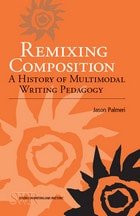
Remixing Composition
A History of Multimodal Writing PedagogyJason Palmeri
Southern Illinois University Press, 2012
Using the concept of the remix, Palmeri outlines practical pedagogical suggestions for how writing teachers can build upon this heritage with digital activities, assignments, and curricula that meet the needs of contemporary students. He details a pluralist vision of composition pedagogy that explains the ways that writing teachers can synthesize expressivist, cognitive, and social-epistemic approaches.
Palmeri reveals an expansive history of now forgotten multimodal approaches to composing moving images and sounds and demonstrates how current compositionists can productively remix these past pedagogies to address the challenges and possibilities of the contemporary digital era. A strikingly original take on the recent history of composition, Remixing Composition is an important work for the future of writing instruction in a digital age.
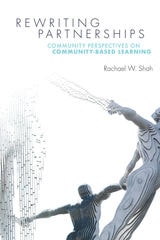
Rewriting Partnerships
Community Perspectives on Community-Based LearningRachael W. Shah
Utah State University Press, 2020
Winner of the IARSLCE 2021 Publication of the Year Award and the Coalition for Community Writing Outstanding Book Award.
Community members are rarely tapped for their insights on engaged teaching and research, but without these perspectives, it is difficult to create ethical and effective practices. Rewriting Partnerships calls for a radical reorientation to the knowledges of community partners. Emphasizing the voices of community members themselves—the adult literacy learners, secondary students, and youth activists who work with college students—the book introduces Critical Community-Based Epistemologies, a deeply practical approach to knowledge construction that centers the perspectives of marginalized participants.
Drawing on interviews with over eighty community members, Rewriting Partnerships features community knowledges in three common types of community-engaged learning: youth working with college students in a writing exchange program, nonprofit staff who serve as clients for student projects, and community members who work with graduate students. Interviewees from each type of partnership offer practical strategies for creating more ethical collaborations, including how programs are built, how projects are introduced to partners, and how graduate students are educated. The book also explores three approaches to partnership design that create space for community voices at the structural level: advisory boards, participatory evaluation, and community grading.
Immediately applicable to teachers, researchers, community partners, and administrators involved in community engagement, Rewriting Partnerships offers concrete strategies for creating more community-responsive partnerships at the classroom level as well as at the level of program and research design. But most provocatively, the book challenges common assumptions about who can create knowledge about community-based learning, demonstrating that community partners have the potential to contribute significantly to community engagement scholarship and program decision-making.
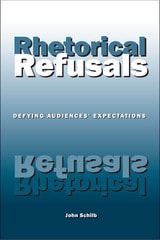
Rhetorical Refusals
Defying Audiences' ExpectationsJohn Schilb
Southern Illinois University Press, 2007
The first book to explore rhetorical refusals—instances in which speakers and writers deliberately flout the conventions of rhetoric and defy their audiences’ expectations— Rhetorical Refusals: Defying Audiences’ Expectations challenges the reader to view these acts of academic rebellion as worthy of deeper analysis than they are commonly accorded, as rhetorical refusals can simultaneously reveal unspoken assumptions behind the very conventions they challenge, while also presenting new rhetorical strategies.
Through a series of case studies, John Schilb demonstrates the deeper meanings contained within rhetorical refusals: when dance critic Arlene Croce refused to see a production that she wrote about; when historian Deborah Lipstadt declined to debate Holocaust deniers; when President Bill Clinton denied a grand jury answers to their questions; and when Frederick Douglass refused to praise Abraham Lincoln unequivocally. Each of these unexpected strategies revealed issues of much greater importance than the subjects at hand. By carefully laying out an underlying framework with which to evaluate these acts, Schilb shows that they can variously point to the undue privilege of authority; the ownership of truth; the illusory divide between public and private lives; and the subjectivity of honor.
According to Schilb, rhetorical refusals have the potential to help political discourse become more inventive. To demonstrate this potential, Schilb looks at some notable cases in which invitations have led to unexpected results: comedian Stephen Colbert’s brazen performance at the White House Press Association dinner; poet Sharon Olds’s refusal to attend the White House Book Fair, and activist Cindy Sheehan’s display of an anti-war message at the 2006 State of the Union Address.
Rhetorical Refusals explores rhetorical theories in accessible language without sacrificing complexity and nuance, revealing the unspoken implications of unexpected deviations from rhetorical norms for classic political concepts like free debate and national memory. With case studies taken from art, politics, literature, and history, this book will appeal to scholars and students of English, communication studies, and history.
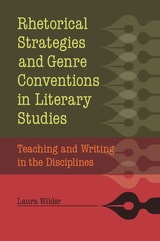
Rhetorical Strategies and Genre Conventions in Literary Studies
Teaching and Writing in the DisciplinesLaura Wilder
Southern Illinois University Press, 2012
Laura Wilder fills a gap in the scholarship on writing in the disciplines and writing across the curriculum with this thorough study of the intersections between scholarly literary criticism and undergraduate writing in introductory literature courses. Rhetorical Strategies and Genre Conventions in Literary Studies is the first examination of rhetorical practice in the research and teaching of literary study and a detailed assessment of the ethics and efficacy of explicit instruction in the rhetorical strategies and genre conventions of the discipline.
Using rhetorical analysis, ethnographic observation, and individual interviews, Wilder demonstrates how rhetorical conventions play a central, although largely tacit, role in the teaching of literature and the evaluation of student writing. Wilder follows a group of literature majors and details their experiences. Some students received experimental, explicit instruction in the special topoi, while others received more traditional, implicit instruction.
Arguing explicit instruction in disciplinary conventions has the potential to help underprepared students, Wilder explores how this kind of instruction may be incorporated into literature courses without being overly reductive. Taking into consideration student perspectives, Wilder makes a bold case for expanding the focus of research in writing in the disciplines and writing across the curriculum in order to grasp the full complexity of disciplinary discourse.
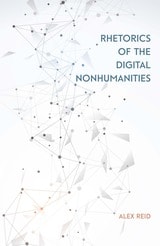
Rhetorics of the Digital Nonhumanities
Alex Reid
Southern Illinois University Press, 2021
In Rhetorics of the Digital Nonhumanities, author Alex Reid fashions a potent vocabulary from new materialist theory, media theory, postmodern theory, and digital rhetoric to rethink the connections between humans and digital media. Addressed are the familiar concerns that scholars have with digital culture: how technologies affect attention spans, how digital media are used to compose, and how digital rhetoric is taught.
Rhetoric is now regularly defined as including human and nonhuman actors. Each actor influences the thoughts, arguments, and sentiments that journey through systems of processors, algorithms, humans, air, and metal. The author’s arguments, even though they are unnerving, orient rhetorical practices to a more open, deliberate, and attentive awareness of what we are truly capable of and how we become capable. This volume moves beyond viewing digital media as an expression of human agency. Humans, formed into new collectives of user populations, must negotiate rather than command their way through digital media ecologies.
Chapters centralize the most pressing questions: How do social media algorithms affect our judgment? How do smart phones shape our attention? These questions demand scholarly practice for attending the world around us. They explore attention and deliberation to embrace digital nonhuman composition. Once we see this brave new world, Reid argues, we are compelled to experiment.
Rural Literacies
Kim Donehower, Charlotte Hogg, and Eileen Schell
Southern Illinois University Press, 2006

Rutgers since 1945
A History of the State University of New JerseyPaul G. E. Clemens with an essay by Carla Yanni
Rutgers University Press, 2015