Results by title
53 books match the query 'Success' and 3 start with r

Ragged Dicks
Masculinity, Steel, and the Rhetoric of the Self-Made ManJames V. Catano
Southern Illinois University Press, 2001
Portraits of self-made men are rife in Western culture, as James V. Catano observes. Positive and negative, admittedly fictional and ostensibly factual, these portraits endure because the general rhetorical practice embodied in the myth of the self-made man enacts both the need and the very means for making oneself masculine: verbal power and prowess. The myth of the self-made man, in short, is part of ongoing rhetorical practices that constitute society, culture, and subjects.
To explain those practices and their effectiveness, Catano argues that the basic narrative achieves much of its effectiveness by engaging and enacting the traditional psychological dynamics of the family romance: preoedipal separation, oedipal conflict, and “proper” postoedipal self-definition and socialization.
To focus on the combined social, psychological, and rhetorical dynamics that constitute the ongoing activity he calls masculine self-making, Catano emphasizes a particular strand: masculinity and steelmaking. Pursuing that strand, he argues that these representations of masculine self-making are rhetorical enactments of cultural needs and desires, and that they are ongoing and formative arguments about what society and its individuals either are or should be.

Reading Up
Middle-Class Readers and the Culture of Success in the Early Twentieth-Century United StatesAmy Blair
Temple University Press, 2011
A person who reads a book for self-improvement rather than aesthetic pleasure is “reading up.” Reading Up is Amy Blair's engaging study of popular literary critics who promoted reading generally and specific books as vehicles for acquiring cultural competence and economic mobility. Combining methodologies from the history of the book and the history of reading, to mass-cultural studies, reader-response criticism, reception studies, and formalist literary analysis, Blair shows how such critics influenced the choices of striving readers and popularized some elite writers.
Framed by an analysis of Hamilton Wright Mabie's role promoting the concept of “reading up” during his ten-year stint as the cultivator of literary taste for the highly popular Ladies' Home Journal, Reading Up reveals how readers flocked to literary works that they would be expected to dislike. Blair shows that while readers could be led to certain books by a trusted adviser, they frequently followed their own path in interpreting them in unexpected ways.
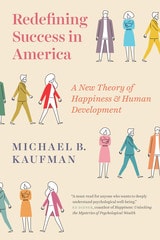
Redefining Success in America
A New Theory of Happiness and Human DevelopmentMichael Kaufman
University of Chicago Press, 2019
Returning to the legendary Harvard Student Study of undergraduates from the 1960s and interviewing participants almost fifty years later, Kaufman shows that formative experiences in family, school, and community largely shape a future adult’s worldview and well-being by late adolescence, and that fundamental change in adulthood, when it occurs, is shaped by adult family experiences, not by ever-greater competitive success. Published research on general samples shows that these patterns, and the book’s findings generally, are broadly applicable to demographically varied populations in the United States.
Leveraging biography-length clinical interviews and quantitative evidence unmatched even by earlier landmark studies of human development, Redefining Success in America redefines the conversation about the nature and origins of happiness, and about how adults develop. This longitudinal study pioneers a new paradigm in happiness research, developmental science, and personality psychology that will appeal to scholars and students in the social sciences, psychotherapy professionals, and serious readers navigating the competitive journey.