Results by title
461 books match the query 'Teaching' and 19 start with r
Race and Biblical Studies
Antiracism Pedagogy for the ClassroomTat-siong Benny Liew
SBL Press, 2022
Classrooms as communities are temporary, but the racial effects can be long term.
The biblical studies classroom can be a site of personal and social transformation. To make it a space for positive change, the contributors to this volume question and reevaluate traditional teaching practices and assessment tools that foreground white, Western scholarship in order to offer practical guidance for an antiracist pedagogy. The introduction and fifteen essays provide tools for engaging issues of social context and scriptural authority, nationalism and religious identities, critical race theory, and how race, gender, and class can be addressed empathetically. Contributors Sonja Anderson, Randall C. Bailey, Eric D. Barreto, Denise Kimber Buell, Greg Carey, Haley Gabrielle, Wilda C. Gafney, Julián Andrés González Holguín, Sharon Jacob, Tat-siong Benny Liew, Francisco Lozada Jr., Shelly Matthews, Roger S. Nam, Wongi Park, Jean-Pierre Ruiz, Abraham Smith, and Kay Higuera Smith share their experience creating classrooms that are spaces that enable the production of new knowledge without reproducing a white subject of the geopolitical West.

Radical Collections
Re-examining the roots of collections, practices and information professionsEdited by Jordan Landes
University of London Press, 2018
Reach Everyone, Teach Everyone
Universal Design for Learning in Higher EducationThomas J. Tobin
West Virginia University Press, 2018
Advocates for the rights of people with disabilities have worked hard to make universal design in the built environment “just part of what we do.” We no longer see curb cuts, for instance, as accommodations for people with disabilities, but perceive their usefulness every time we ride our bikes or push our strollers through crosswalks.
This is also a perfect model for Universal Design for Learning (UDL), a framework grounded in the neuroscience of why, what, and how people learn. Tobin and Behling show that, although it is often associated with students with disabilities, UDL can be profitably broadened toward a larger ease-of-use and general diversity framework. Captioned instructional videos, for example, benefit learners with hearing impairments but also the student who worries about waking her young children at night or those studying on a noisy team bus.
Reach Everyone, Teach Everyone is aimed at faculty members, faculty-service staff, disability support providers, student-service staff, campus leaders, and graduate students who want to strengthen the engagement, interaction, and performance of all college students. It includes resources for readers who want to become UDL experts and advocates: real-world case studies, active-learning techniques, UDL coaching skills, micro- and macro-level UDL-adoption guidance, and use-them-now resources.
Reading Chinese Fortune Cookie
The Making of Chinese American RhetoricLuMing Mao
Utah State University Press, 2006
ecent scholarship tends to explain such influences as contributing to language hybridity---an advance over the traditional "deficit model." But Mao suggests that the "hybridity" approach is perhaps too arid or sanitized, missing rich nuances of mutual exchange, resistance, or even subversion. Through his concept of "togetherness in difference, Mao suggests that speakers of hybrid discourse may not be attempting the standard (and failing), but instead may be deliberately importing cultural material to create a distance between themselves and the standard. This practice, over time, becomes a process that transforms English, enriching and enlarging it through the infusion of non-Western discourse features, subverting power structures, and even providing unique humorous touches.
Of interest to scholars in composition, cultural studies, and linguistics as well, Reading Chinese Fortune Cookie leads in an important new direction for both our understanding and our teaching of English.
Reading Randomised Controlled Trials
Opening the BookRobert Savage, Amy Fox, Anneka Dawson, Helen Gray, and Clare Huxley
University College London, 2025
Reading Randomised Controlled Trials presents an illuminating exploration of how large-scale educational trials unfold in real-world settings, displaying the often-overlooked human decisions that shape their outcomes. Using the Flexible Phonics trial—an ambitious study involving nearly 3,000 children in 118 schools across England—as a case study, the authors examine the practical and ethical problems with conducting randomized controlled trials (RCTs) in education. Unlike pharmaceutical trials, educational RCTs operate in dynamic environments where factors such as teacher decision-making and school culture play a crucial role.
This book depicts the inner workings of education research and also underlines its broader significance, particularly in the wake of school closures during the COVID-19 pandemic. By focusing on early childhood literacy and the long-term impact of evidence-based interventions, Reading Randomised Controlled Trials provides important insights for educators and researchers seeking to bridge the gap between rigorous research and meaningful classroom practice. A must-read for those invested in improving educational outcomes, this book contests assumptions about what works in education—and why.
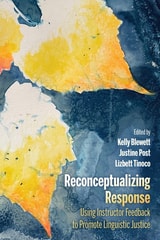
Reconceptualizing Response
Using Instructor Feedback to Promote Linguistic JusticeKelly Blewett
Utah State University Press, 2026
Reconceptualizing Response reframes instructor feedback, one of the most consequential practices in rhetoric and writing studies, as a site of linguistic justice. Instructor response is not merely technical commentary; it is contested terrain where students’ identities, experiences, and language varieties must be named, supported, and celebrated.
Contributors represent a wide range of institutional contexts—including two-year colleges, four-year universities, HBCUs, HSIs, SLACs, and PWIs—and write from diverse positionalities, amplifying current debates and productive tensions in the field. Organized around four key moves—looking back, looking within, looking up, and looking around—the book invites readers to critically examine the ideologies underlying feedback practices; recognize how instructors' positionality, values, and beliefs are communicated through feedback; align feedback with students’ needs; and reconsider the broader classroom ecology required for justice. Bridging linguistic justice and feedback studies, this collection provides concrete tools and frameworks, as well as sample rubrics, course policies, and fresh approaches to assessment.
Ideal for graduate students, writing program administrators, faculty teaching future writing instructors, and anyone seeking to transform classroom practice, Reconceptualizing Response offers guiding questions for reflection and practical strategies for change. This volume reimagines instructor response as a catalyst for equity, consciousness-raising, and transformation, calling instructors not only to comment on writing but also to use feedback to dismantle oppressive logics and foster linguistic justice.
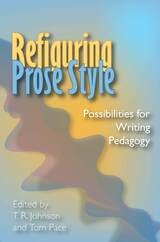
Refiguring Prose Style
Possibilities For Writing Pedagogyedited by T. R. Johnson & Thomas Pace
Utah State University Press, 2005
For about two decades, say Johnson and Pace, the discussion of how to address prose style in teaching college writing has been stuck, with style standing in as a proxy for other stakes in the theory wars.
The traditional argument is evidently still quite persuasive to some—that teaching style is mostly a matter of teaching generic conventions through repetition and practice. Such a position usually presumes the traditional view of composition as essentially a service course, one without content of its own. On the other side, the shortcomings of this argument have been much discussed—that it neglects invention, revision, context, meaning, even truth; that it is not congruent with research; that it ignores 100 years of scholarship establishing composition's intellectual territory beyond "service."
The discussion is stuck there, and all sides have been giving it a rest in recent scholarship. Yet style remains of vital practical interest to the field, because everyone has to teach it one way or another.
A consequence of the impasse is that a theory of style itself has not been well articulated. Johnson and Pace suggest that moving the field toward a better consensus will require establishing style as a clearer subject of inquiry.
Accordingly, this collection takes up a comprehensive study of the subject. Part I explores the recent history of composition studies, the ways it has figured and all but effaced the whole question of prose style. Part II takes to heart Elbow's suggestion that composition and literature, particularly as conceptualized in the context of creative writing courses, have something to learn from each other. Part III sketches practical classroom procedures for heightening students' abilities to engage style, and part IV explores new theoretical frameworks for defining this vital and much neglected territory.
The hope of the essays here—focusing as they do on historical, aesthetic, practical, and theoretical issues—is to awaken composition studies to the possibilities of style, and, in turn, to rejuvenate a great many classrooms.
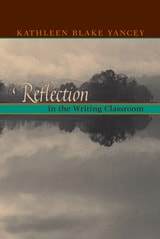
Reflection In The Writing Classroom
Kathleen Blake Yancey
Utah State University Press, 1998
Yancey explores reflection as a promising body of practice and inquiry in the writing classroom. Yancey develops a line of research based on concepts of philosopher Donald Schon and others involving the role of deliberative reflection in classroom contexts. Developing the concepts of reflection-in-action, constructive reflection, and reflection-in-presentation, she offers a structure for discussing how reflection operates as students compose individual pieces of writing, as they progress through successive writings, and as they deliberately review a compiled body of their work-a portfolio, for example. Throughout the book, she explores how reflection can enhance student learning along with teacher response to and evaluation of student writing.
Reflection in the Writing Classroom will be a valuable addition to the personal library of faculty currently teaching in or administering a writing program; it is also a natural for graduate students who teach writing courses, for the TA training program, or for the English Education program.

Reflective Teaching, Effective Learning
Instructional Literacy for Library EducatorsChar Booth
American Library Association, 2011
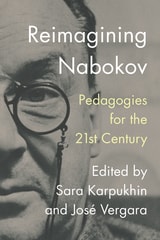
Reimagining Nabokov
Pedagogies for the 21st CenturyJosé Vergara
Amherst College Press, 2022
“It is both timely and refreshing to have an influx of teacher-scholars who engage Nabokov from a variety of perspectives… this volume does justice to the breadth of Nabokov’s literary achievements, and it does so with both pedagogical creativity and scholarly integrity."—Dana Dragunoiu, Carleton University
"[A] valuable study for any reader, teacher, scholar, or student of Nabokov. Amongst specific and urgent insights on the potential for digital methods, the relevance of Nabokov for students today, and how to reconcile issues of identity with an author who disavowed history and politics, are much wider and timeless questions of authorial control and the ability to access reality."—Anoushka Alexander-Rose, Nabokov Online Journal
Contributions by Galya Diment, Tim Harte, Robyn Jensen, Sara Karpukhin, Yuri Leving, Roman Utkin, José Vergara, Meghan Vicks, Olga Voronina, Lisa Ryoko Wakamiya, and Matthew Walker.
Remembering and Forgetting in the Age of Technology
Teaching, Learning, and the Science of Memory in a Wired WorldMichelle D Miller
West Virginia University Press, 2022
Human minds are made of memories, and today those memories have competition. Biological memory capacities are being supplanted, or at least supplemented, by digital ones, as we rely on recording—phone cameras, digital video, speech-to-text—to capture information we’ll need in the future and then rely on those stored recordings to know what happened in the past. Search engines have taken over not only traditional reference materials but also the knowledge base that used to be encoded in our own brains. Google remembers, so we don’t have to. And when we don’t have to, we no longer can. Or can we?
Remembering and Forgetting in the Age of Technology offers concise, nontechnical explanations of major principles of memory and attention—concepts that all teachers should know and that can inform how technology is used in their classes. Teachers will come away with a new appreciation of the importance of memory for learning, useful ideas for handling and discussing technology with their students, and an understanding of how memory is changing in our technology-saturated world.

Removing the Educational Silos
Models of Interdisciplinary and Multi-disciplinary EducationEdited by Wiline Pangle, et al.
Intellect Books, 2025
This book is designed as a source of inspiration, replication, and adaptation. Each chapter, in varying modalities, addresses interdisciplinary course development and implementation in institutions of higher education. The essays focus on common issues like navigating administrative systems and solving the challenges encountered when crossing departments or colleges, whether regarding course listings or the intricacies of course loads on each professor. Chapters also provide detailed information on the nuts and bolts of the specific course or courses taught, including syllabi, lesson examples, and both formal and informal assessments implemented.
Contributors candidly offer discussions of the failures and successes of their interdisciplinary collaborations, including course design, lesson planning, or complications brought in by unforeseen pandemics. Most chapters end with a summary of lessons learned, where experiences from the field provide opportunities for growth and continued exploration. An excellent resource for educators, this volume offers readers guidance and encouragement to implement the approaches described and inspiration to forge their own paths in the world of multi- and interdisciplinary teaching and research.
Representations of Working in Arts Education
Stories of Learning and TeachingNarelle Lemon, Susanne Garvis, and Christopher Klopper
Intellect Books, 2014

Responding to Writing
A Practical Sourcebook for InstructorsDana R. Ferris, Grant Eckstein, and Betsy Gilliland
University of Michigan Press, 2027
Responding to Writing brings together practical, cutting-edge ideas from teachers who spend their days working with student writers and trying to make feedback genuinely useful. The book shares classroom approaches that have been tested in real courses, from high school settings to college and graduate programs. It shows how teachers, peers, and students themselves can make feedback a more collaborative and manageable part of writing instruction.
Each chapter presents a student‑centered approach that helps writers feel supported and more in control of their own writing and revision process. In addition to a summary of the approach with light background and context, readers will find straightforward examples, tools, and routines they can adapt to their own classrooms, including ways to use technology, build reflection into assignments, and support writers with varied backgrounds and needs. This book offers working instructors a set of dependable methods for helping students improve as writers while keeping feedback purposeful and humane.
Response to Reform
Composition and the Professionalization of TeachingMargaret J. Marshall
Southern Illinois University Press, 2003
Response to Reform: Composition and the Professionalization of Teaching critiques the politics of labor and gender biases inherent in the composition workplace that prevent literacy teachers from attaining professional status and respect. Scrutinizing the relationship between scholarship and teaching, Margaret J. Marshall calls for a reconceptualization of what it means to prepare for and enter the field of composition instruction.
Interrogating the approach the education system takes to certify teachers without actually “professionalizing” their careers, Marshall contends that these programs rely on outdated rhetorics of labor that only widen the gap between teaching and other professional jobs. Such attempts to re-educate literacy teachers exploit and marginalize their work, and thus prevent them from claiming the status of academic professionals. In providing an overview of the history of and language used to literacy instruction, she also points out that while women are overrepresented in composition instruction, they are underrepresented in tenure track and administrative positions.
To correct and combat these inequities, Marshall advocates an alternate alignment of power structures and rhetorical choices. In a wide-ranging survey that sheds new light on the composition workplace as well as higher education at large, Response to Reform: Composition and the Professionalization of Teaching boldly asks us to do away with the reductive language we inherit from the past that characterize teaching and professionalization, as well as our customary responses to public criticism of education. The result is a new articulation of composition as a meritorious profession.
Rethinking Class Size
The Complex Story of Impact on Teaching and LearningPeter Blatchford and Anthony Russell
University College London, 2020
Drawing on twenty years of systematic classroom observations, surveys of practitioners, detailed case studies, and extensive reviews of research, Peter Blatchford and Anthony Russell contend that common ways of researching the impact of class size are limited and sometimes misguided. While class size may have no direct effect on pupil outcomes, it can have a significant impact on interconnections within classroom processes. In describing these connections, the book opens up the everyday world of the classroom and shows that the influence of class size is felt everywhere.
Rewriting
How To Do Things With TextsJoseph Harris
Utah State University Press, 2006
"Like all writers, intellectuals need to say something new and say it well. But unlike many other writers, what intellectuals have to say is bound up with the books we are reading . . . and the ideas of the people we are talking with."
What are the moves that an academic writer makes? How does writing as an intellectual change the way we work from sources? In Rewriting, a textbook for the undergraduate classroom, Joseph Harris draws the college writing student away from static ideas of thesis, support, and structure, and toward a more mature and dynamic understanding. Harris wants college writers to think of intellectual writing as an adaptive and social activity, and he offers them a clear set of strategies—a set of moves—for participating in it.
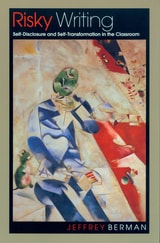
Risky Writing
Self-Disclosure and Self-Transformation in the ClassroomJeffrey Berman
University of Massachusetts Press, 2001
This is the final volume in a trilogy of works that examine the impact of writing and reading about traumatic subjects. Diaries to an English Professor (1994) explores the ways in which undergraduate students use psychoanalytic diaries to probe conflicted issues in their lives. Surviving Literary Suicide (1999) investigates how graduate students respond to suicidal literature—novels and poems that portray and sometimes glorify self-inflicted death.
In Risky Writing, Jeffrey Berman builds on those earlier studies, describing ways teachers can encourage college students to write safely on a wide range of subjects often deemed too personal or too dangerous for the classroom: grieving the loss of a beloved relative or friend, falling into depression, coping with the breakup of one's family, confronting sexual abuse, depicting a drug or alcohol problem, encountering racial prejudice. Berman points out that nearly everyone has difficulty talking or writing about such issues because they arouse shame and tend to be enshrouded in secrecy and silence. This is especially true for college students, who are just emerging from adolescence and find themselves at institutions that rarely promote self-disclosure.
Recognizing the controversial nature of his subject, Berman confronts academic opposition to personal writing head on. He also discusses the similarities between the “writing cure” and the “talking cure,” the role of the teacher and audience in the self-disclosing classroom, and the pedagogical strategies necessary to minimize risk, including the importance of empathy and other befriending skills.
Rubrics
What Every Teacher Needs to KnowDeborah Crusan and Robyn Brinks Lockwood
University of Michigan Press, 2026
As workloads and work responsibilities continue to increase, assessment often causes teachers anxiety. Rubrics: What Every Teacher Needs to Know is a handbook that combines theory and pragmatism in clear language to help pre- and in-service teachers and teacher trainers obtain assessment information quickly and efficiently. While many teachers do not realize that creating an assignment is creating an assessment, they should go hand in hand. This book highlights both the value of rubrics and the value of assessment literacy, which is the knowledge, skills, and abilities needed to create, administer, and understand the results of assessments to improve student learning.
Rubrics provides new and experienced teachers with the tools to become more transparent assessors of their students’ writing, reading, listening, speaking, grammar, and vocabulary. Deborah Crusan and Robyn Brinks Lockwood bring their expertise in assessment and English for academic purposes to address the challenges teachers face in writing clear assignments and grading them fairly. They emphasize that teachers need to think about what they want their students to be able to do, clarify their expectations to their students, and convey those expectations on a rubric/scoring guide. While transparent, step-by-step instructions are included in the book to help teachers create their own assignments and assessments, the appendix materials containing ready-made assignments and their accompanying rubrics will be sure to delight busy teachers.