Results by title
660 books match the query 'Texas' and 29 start with r

Race Talk in a Mexican Cantina
Tatcho Mindiola
Michigan State University Press, 2021

Rawhide Ranger, Ira Aten
Enforcing Law on the Texas FrontierBob Alexander
University of North Texas Press, 2011
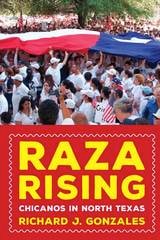
Raza Rising
Chicanos in North TexasRichard J. Gonzales
University of North Texas Press, 2016
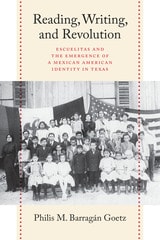
Reading, Writing, and Revolution
Escuelitas and the Emergence of a Mexican American Identity in TexasBy Philis M. Barragán Goetz
University of Texas Press, 2020
2022 National Association for Chicana and Chicano Studies Book Award
Tejas Foco Non-fiction Book Award, National Association for Chicana and Chicano Studies
2021 Tejano Book Prize, Tejano Genealogy Society of Austin
2021 Jim Parish Award for Documentation and Publication of Local and Regional History, Webb County Heritage Foundation
2021 Runner-up, Ramirez Family Award for Most Significant Scholarly Book
The first book on the history of escuelitas, Reading, Writing, and Revolution examines the integral role these grassroots community schools played in shaping Mexican American identity.
Language has long functioned as a signifier of power in the United States. In Texas, as elsewhere in the Southwest, ethnic Mexicans’ relationship to education—including their enrollment in the Spanish-language community schools called escuelitas—served as a vehicle to negotiate that power. Situating the history of escuelitas within the contexts of modernization, progressivism, public education, the Mexican Revolution, and immigration, Reading, Writing, and Revolution traces how the proliferation and decline of these community schools helped shape Mexican American identity.
Philis M. Barragán Goetz argues that the history of escuelitas is not only a story of resistance in the face of Anglo hegemony but also a complex and nuanced chronicle of ethnic Mexican cultural negotiation. She shows how escuelitas emerged and thrived to meet a diverse set of unfulfilled needs, then dwindled as later generations of Mexican Americans campaigned for educational integration. Drawing on extensive archival, genealogical, and oral history research, Barragán Goetz unravels a forgotten narrative at the crossroads of language and education as well as race and identity.
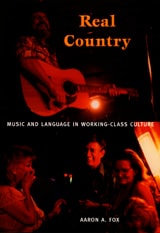
Real Country
Music and Language in Working-Class CultureAaron A. Fox
Duke University Press, 2004
Fox spent hundreds of hours observing, recording, and participating in talk and music-making in homes, beer joints, and garage jam sessions. He renders the everyday life of Lockhart’s working-class community in detail, right down to the ice cold beer, the battered guitars, and the technical skills of such local musical legends as Randy Meyer and Larry “Hoppy” Hopkins. Throughout, Fox focuses on the human voice. His analyses of conversations, interviews, songs, and vocal techniques show how feeling and experience are expressed, and how local understandings of place, memory, musical aesthetics, working-class social history, race, and gender are shared. In Real Country, working-class Texans re-imagine their past and give voice to the struggles and satisfactions of their lives in the present through music.

Recent Vertebrate Carcasses and Their Paleobiological Implications
Johannes Weigelt
University of Chicago Press, 1989
Weigelt spent sixteen months on the Gulf Coast in the mid-1920s, gathering evidence from the carcasses of cattle and other animals in the early stages of preservation. This book reports his observations. He discusses death and decomposition; classifies various modes of death (drowning, cold, dehydration, fire, mud, quicksand, oil slicks, etc.); documents and analyzes the positions of carcasses; presents detailed data on carcass assemblages at the Smither's Lake site in Texas; and, in a final chapter, makes comparisons to carcass assemblages from the geologic past. He raises questions about whether much of the fossil record is a product of unusual events and, if so, what the implications are for paleoecological studies.
The English edition of Recent Vertebrate Carcasses includes a foreword and a translator's note that comment on Weigelt's life and the significance of his work. The original bibliography has been brought up to date, and, where necessary, updated scientific and place names have been added to the text in brackets. An index of names, places, and subjects is included, and Weigelt's own photographs of carcasses and drawings of skeletons illustrate the text.
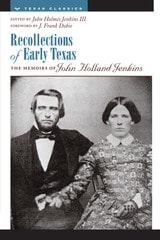
Recollections of Early Texas
Memoirs of John Holland JenkinsEdited by John Holmes Jenkins III
University of Texas Press, 1958
“[These reminiscences] light up for whoever will read the earliest days of early English-speaking Texas.” —J. Frank Dobie, from the foreword
A firsthand account of pioneer life in east Texas.
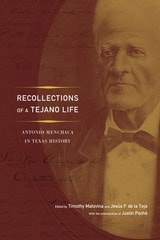
Recollections of a Tejano Life
Antonio Menchaca in Texas HistoryEdited by Timothy Matovina and Jesús F. de la Teja
University of Texas Press, 2013
San Antonio native, military veteran, merchant, and mayor pro tem José Antonio Menchaca (1800–1879) was one of only a few Tejano leaders to leave behind an extensive manuscript of recollections. Portions of the document were published in 1907, followed by a “corrected” edition in 1937, but the complete work could not be published without painstaking reconstruction. At last available in its entirety, Menchaca’s book of reminiscences captures the social life, people, and events that shaped the history of Texas’s tumultuous transformation during his lifetime. Highlighting not only Menchaca’s acclaimed military service but also his vigorous defense of Tejanos’ rights, dignity, and heritage, Recollections of a Tejano Life charts a remarkable legacy while incorporating scholarly commentary to separate fact from fiction.
Revealing how Tejanos perceived themselves and the revolutionary events that defined them, this wonderfully edited volume presents Menchaca’s remembrances of such diverse figures as Antonio López de Santa Anna, Jim Bowie, Davy Crockett, Sam Houston, General Adrián Woll, Comanche chief “Casamiro,” and Texas Ranger Jack Hays. Menchaca and his fellow Tejanos were actively engaged in local struggles as Mexico won her independence from Spain; later many joined the fight to establish the Republic of Texas, only to see it annexed to the United States nine years after the Battle of San Jacinto. This first-person account corrects important misconceptions and brings previously unspoken truths vividly to life.
Reconstruction in Texas
By Charles William Ramsdell
University of Texas Press, 1970
A reprint of the 1910 study, Reconstruction in Texas examines the events that still impact upon Texas and the South.
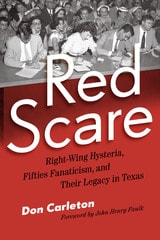
Red Scare
Right-Wing Hysteria, Fifties Fanaticism, and Their Legacy in TexasBy Don Carleton
University of Texas Press, 2014
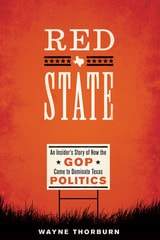
Red State
An Insider's Story of How the GOP Came to Dominate Texas PoliticsBy Wayne Thorburn
University of Texas Press, 2014
In November 1960, the Democratic party dominated Texas. The newly elected vice president, Lyndon Johnson, was a Texan. Democrats held all thirty statewide elective positions. The state legislature had 181 Democrats and no Republicans or anyone else. Then fast forward fifty years to November 2010. Texas has not voted for a Democratic president since 1976. Every statewide elective office is held by Republicans. Representing Texas in Washington is a congressional delegation of twenty-five Republicans and nine Democrats. Republicans control the Texas Senate by a margin of nineteen to twelve and the Texas House of Representatives by 101 to 49.
Red State explores why this transformation of Texas politics took place and what these changes imply for the future. As both a political scientist and a Republican party insider, Wayne Thorburn is especially qualified to explain how a solidly one-party Democratic state has become a Republican stronghold. He analyzes a wealth of data to show how changes in the state’s demographics—including an influx of new residents, the shift from rural to urban, and the growth of the Mexican American population—have moved Texas through three stages of party competition, from two-tiered politics, to two-party competition between Democrats and Republicans, and then to the return to one-party dominance, this time by Republicans. His findings reveal that the shift from Democratic to Republican governance has been driven not by any change in Texans’ ideological perspective or public policy orientation—even when Texans were voting Democrat, conservatives outnumbered liberals or moderates—but by the Republican party’s increasing identification with conservatism since 1960.
Reflections on the Neches
A Naturalist's Odyssey along the Big Thicket's Snow RiverGeraldine Ellis Watson
University of North Texas Press, 2003

Rehab on the Range
A History of Addiction and Incarceration in the American WestHolly M. Karibo
University of Texas Press, 2024
2026 Texas Christian University (TCU) Texas Book Award Winner
2025 Coral Horton Tullis Memorial Prize, Texas State Historical Association
2025 Outstanding Academic Title, CHOICE
The first study of the Fort Worth Narcotic Farm, an institution that played a critical role in fusing the War on Drugs, mass incarceration, and public health in the American West.
In 1929, the United States government approved two ground-breaking and controversial drug addiction treatment programs. At a time when fears about a supposed rise in drug use reached a fevered pitch, the emergence of the nation’s first “narcotic farms” in Fort Worth, Texas, and Lexington, Kentucky, marked a watershed moment in the treatment of addiction. Rehab on the Range is the first in-depth history of the Fort Worth Narcotic Farm and its impacts on the American West. Throughout its operation from the 1930s to the 1970s, the institution was the only federally funded drug treatment center west of the Mississippi River. Designed to blend psychiatric treatment, physical rehabilitation, and vocational training, the Narcotic Farm, its proponents argued, would transform American treatment policies for the better. The reality was decidedly more complicated.
Holly M. Karibo tells the story of how this institution—once framed as revolutionary for addiction care—ultimately contributed to the turn towards incarceration as the solution to the nation’s drug problem. Blending an intellectual history of addiction and imprisonment with a social history of addicts’ experiences, Rehab on the Range provides a nuanced picture of the Narcotic Farm and its cultural impacts. In doing so, it offers crucial historical context that can help us better understand our current debates over addiction, drug policy, and the rise of mass incarceration.

Reinventing Texas Government
By Michael Lauderdale
University of Texas Press, 1999
The Survey of Organizational Excellence is revolutionizing the operation of Texas state agencies and other governmental and private organizations. Developed and refined over the last twenty years by a team of researchers led by Michael Lauderdale, the survey is a proven tool for improving the effectiveness of state government services through surveys of employee attitudes toward their organizations.
In this book, Lauderdale gives a history of the survey and its use under four governors, including George W. Bush. He explains what the survey is, how to use it, and how to apply its results to organizational change and improvement. Step-by-step instructions for planning, implementing, and evaluating the survey are enhanced with real-life case studies from the 140,000 surveys that have been distributed and used by more than 75 different organizations. Lauderdale also sets the survey in a broader perspective by identifying some of the forces currently impelling change in organizations throughout our society and exploring where this push for change is taking us.
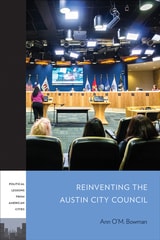
Reinventing the Austin City Council
Ann O'M. Bowman
Temple University Press, 2020
Reinventing the Austin City Council explores the puzzle that was Austin’s reluctance to alter its at-large system and establish a geographically-based, single-member district system. Ann Bowman chronicles the repeated attempts to change the system, the eventual decision to do so, and the consequences of that change. In the process, she explores the many twists and turns that occurred in Austin as it struggled to design a fair system of representation. Reinventing the Austin City Council assesses the impact of the new district system since its inception in 2014.
Austin’s experience ultimately offers a political lesson for creating institutional change.

Remarkable Plants of Texas
Uncommon Accounts of Our Common NativesBy Matt Warnock Turner
University of Texas Press, 2009
With some 6,000 species of plants, Texas has extraordinary botanical wealth and diversity. Learning to identify plants is the first step in understanding their vital role in nature, and many field guides have been published for that purpose. But to fully appreciate how Texas's native plants have sustained people and animals from prehistoric times to the present, you need Remarkable Plants of Texas.
In this intriguing book, Matt Warnock Turner explores the little-known facts—be they archaeological, historical, material, medicinal, culinary, or cultural—behind our familiar botanical landscape. In sixty-five entries that cover over eighty of our most common native plants from trees, shrubs, and wildflowers to grasses, cacti, vines, and aquatics, he traces our vast array of connections with plants. Turner looks at how people have used plants for food, shelter, medicine, and economic subsistence; how plants have figured in the historical record and in Texas folklore; how plants nourish wildlife; and how some plants have unusual ecological or biological characteristics. Illustrated with over one hundred color photos and organized for easy reference, Remarkable Plants of Texas can function as a guide to individual species as well as an enjoyable natural history of our most fascinating native plants.
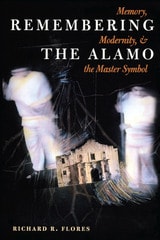
Remembering the Alamo
Memory, Modernity, and the Master SymbolBy Richard R. Flores
University of Texas Press, 2002
"Remember the Alamo!" reverberates through Texas history and culture, but what exactly are we remembering? Over nearly two centuries, the Mexican victory over an outnumbered band of Alamo defenders has been transformed into an American victory for the love of liberty. Why did the historical battle of 1836 undergo this metamorphosis in memory and mythology to become such a potent master symbol in Texan and American culture?
In this probing book, Richard Flores seeks to answer that question by examining how the Alamo's transformation into an American cultural icon helped to shape social, economic, and political relations between Anglo and Mexican Texans from the late nineteenth to the mid-twentieth centuries. In the first part of the book, he looks at how the attempts of heritage society members and political leaders to define the Alamo as a place have reflected struggles within Texas society over the place and status of Anglos and Mexicans. In the second part, he explores how Alamo movies and the transformation of Davy Crockett into an Alamo hero/martyr have advanced deeply racialized, ambiguous, and even invented understandings of the past.
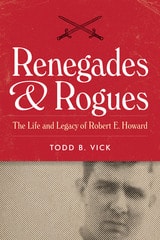
Renegades and Rogues
The Life and Legacy of Robert E. HowardBy Todd B. Vick
University of Texas Press, 2021
2022 Atlantean Award, Robert E. Howard Foundation
You may not know the name Robert E. Howard, but you probably know his work. His most famous creation, Conan the Barbarian, is an icon of popular culture. In hundreds of tales detailing the exploits of Conan, King Kull, and others, Howard helped to invent the sword and sorcery genre.
Todd B. Vick delves into newly available archives and probes Howard’s relationships, particularly with schoolteacher Novalyne Price, to bring a fresh, objective perspective to Howard's life. Like his many characters, Howard was an enigma and an outsider. He spent his formative years visiting the four corners of Texas, experiences that left a mark on his stories. He was intensely devoted to his mother, whom he nursed in her final days, and whose impending death contributed to his suicide in 1936 when he was just thirty years old.
Renegades and Rogues is an unequivocal journalistic account that situates Howard within the broader context of pulp literature. More than a realistic fantasist, he wrote westerns and horror stories as well, and engaged in avid correspondence with H. P. Lovecraft and other pulp writers of his day. Vick investigates Howard’s twelve-year writing career, analyzes the influences that underlay his celebrated characters, and assesses the afterlife of Conan, the figure in whom Howard's fervent imagination achieved its most durable expression.

Reverberations of Racial Violence
Critical Reflections on the History of the BorderEdited by Sonia Hernández and John Morán González
University of Texas Press, 2021
Between 1910 and 1920, thousands of Mexican Americans and Mexican nationals were killed along the Texas border. The killers included strangers and neighbors, vigilantes and law enforcement officers—in particular, Texas Rangers. Despite a 1919 investigation of the state-sanctioned violence, no one in authority was ever held responsible.
Reverberations of Racial Violence gathers fourteen essays on this dark chapter in American history. Contributors explore the impact of civil rights advocates, such as José Tomás Canales, the sole Mexican-American representative in the Texas State Legislature between 1905 and 1921. The investigation he spearheaded emerges as a historical touchstone, one in which witnesses testified in detail to the extrajudicial killings carried out by state agents. Other chapters situate anti-Mexican racism in the context of the era's rampant and more fully documented violence against African Americans. Contributors also address the roles of women in responding to the violence, as well as the many ways in which the killings have continued to weigh on communities of color in Texas. Taken together, the essays provide an opportunity to move beyond the more standard Black-white paradigm in reflecting on the broad history of American nation-making, the nation’s rampant racial violence, and civil rights activism.

Rick Perry
A Political LifeBrandon Rottinghaus
University of Texas Press, 2024
How Rick Perry navigated and shaped Texas politics as the state’s longest serving governor.
Rick Perry, the charming rancher, pilot, and politician from West Texas who was governor from 2000 to 2015, is one of the most important but polarizing figures in the state's history. Over the nearly forty years he spent in the political arena, his political instincts served as a radar primed to sense future political opportunities. Hugging the arc of Texas political change, he shifted from a rural, “blue dog” Democrat to one of the most conservative politicians the state had elected up to that time, overseeing the enactment of controversial redistricting, voting, and abortion measures. Yet his evolution was complicated and incomplete, as his stands on such topics as immigration, vaccine requirements, and the use of state funds to attract business ran into opposition from a growing and ever-more conservative wing of the Republican Party in Texas—and the nation.
Rick Perry is both a biography of Perry as a politician and a study of the shifts in state politics that took place during his time in office. Demonstrating that Perry ranks among the most consequential governors in Texas history, Brandon Rottinghaus chronicles the profound ways he accumulated power and shaped the governorship.

Riding Lucifer's Line
Ranger Deaths along the Texas-Mexico BorderBob Alexander
University of North Texas Press, 2013
Riding for the Lone Star
Frontier Cavalry and the Texas Way of War, 1822-1865Nathan A. Jennings
University of North Texas Press, 2016

Rip Ford’s Texas
By John Salmon Ford
University of Texas Press, 1963
The Republic of Texas was still in its first exultation over independence when John Salmon "Rip" Ford arrived from South Carolina in June of 1836. Ford stayed to participate in virtually every major event in Texas history during the next sixty years. Doctor, lawyer, surveyor, newspaper reporter, elected representative, and above all, soldier and Indian fighter, Ford sat down in his old age to record the events of the turbulent years through which he had lived. Stephen Oates has edited Ford's memoirs to produce a clear and vigorous personal history of Texas.
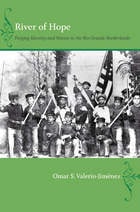
River of Hope
Forging Identity and Nation in the Rio Grande BorderlandsOmar S. Valerio-Jiménez
Duke University Press, 2012
Diverse influences transformed the borderlands as Spain, Mexico, and the United States competed for control of the region. Indian slaves joined Spanish society; Mexicans allied with Indians to defend river communities; Anglo Americans and Mexicans intermarried and collaborated; and women sued to confront spousal abuse and to secure divorces. Drawn into multiple conflicts along the border, Mexican nationals and Mexican Texans (tejanos) took advantage of their transnational social relations and ambiguous citizenship to escape criminal prosecution, secure political refuge, and obtain economic opportunities. To confront the racialization of their cultural practices and their increasing criminalization, tejanos claimed citizenship rights within the United States and, in the process, created a new identity.
Published in cooperation with the William P. Clements Center for Southwest Studies, Southern Methodist University.
Roadside Crosses in Contemporary Memorial Culture
Holly Everett
University of North Texas Press, 2002
Robert E. Howard
The Life and Times of a Texas AuthorWillard P. Oliver
University of North Texas Press, 2025
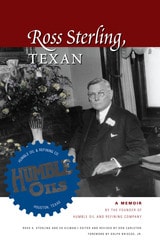
Ross Sterling, Texan
A Memoir by the Founder of Humble Oil and Refining CompanyBy Ross S. Sterling and Ed Kilman
University of Texas Press, 2007
Born on a farm near Anahuac, Texas, in 1875 and possessed of only a fourth-grade education, Ross Sterling was one of the most successful Texans of his generation. Driven by a relentless work ethic, he become a wealthy oilman, banker, newspaper publisher, and, from 1931 to 1933, one-term governor of Texas. Sterling was the principal founder of the Humble Oil and Refining Company, which eventually became the largest division of the ExxonMobil Corporation, as well as the owner of the Houston Post.
Eager to "preserve a narrative record of his life and deeds," Ross Sterling hired Ed Kilman, an old friend and editorial page editor of the Houston Post, to write his biography. Though the book was nearly finished before Sterling's death in 1949, it never found a publisher due to Kilman's florid writing style and overly hagiographic portrayal of Sterling.
In this volume, by contrast, editor Don Carleton uses the original oral history dictated by Ross Sterling to Ed Kilman to present the former governor's life story in his own words. Sterling vividly describes his formative years, early business ventures, and active role in developing the Texas oil industry. He also recalls his political career, from his appointment to the Texas Highway Commission to his term as governor, ending with his controversial defeat for reelection by "Ma" Ferguson. Sterling's reminiscences constitute an important primary source not only on the life of a Texan who deserves to be more widely remembered, but also on the history of Houston and the growth of the American oil industry.
Rotten Boroughs, Political Thickets, and Legislative Donnybrooks
Redistricting in TexasEdited by Gary A. Keith
University of Texas Press, 2013
Every ten years, the Texas legislature redistricts itself and the state’s congressional districts in an attempt to ensure equality in representation. With a richly textured cultural fabric, Texas often experiences redistricting battles that are heated enough to gain national attention. Collecting a variety of voices, including legislators themselves, in addition to lawyers, community organizers, political historians, and political scientists, Rotten Boroughs, Political Thickets, and Legislative Donnybrooks delivers a multidimensional picture of how redistricting works in Texas today, and how the process evolved.
In addition to editor Gary Keith’s historical narrative, which emphasizes the aftermath of the Warren Court’s redistricting decisions, longtime litigators David Richards and J. D. Pauerstein describe the contentious lines drawn from the 1970s into the 2000s. Former state legislator and congressman Craig Washington provides an insider’s view, while redistricting attorney and grassroots organizer Jose Garza describes the repercussions for Mexican Americans in Texas. Balancing these essays with a quantitative perspective, political scientists Seth McKee and Mark McKenzie analyze the voting data for the 2000 decade to describe the outcomes of redistricting. The result is a timely tour that provides up-to-date context, particularly on the role of the Voting Rights Act in the twenty-first century. From local community engagement to the halls of the Capitol, this is the definitive portrait of redistricting and its repercussions for all Texans.
Rounded Up in Glory
Frank Reaugh, Texas Renaissance ManMichael Grauer
University of North Texas Press, 2016