Results by title
131 books match the query 'Texts' and 7 start with r

Rabbi's Manual
David Polish
Central Conference of American Rabbis, 1988
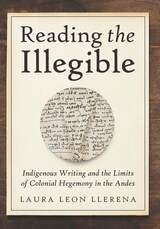
Reading the Illegible
Indigenous Writing and the Limits of Colonial Hegemony in the AndesLaura Leon Llerena
University of Arizona Press, 2023
The concept of legibility allows us to reconsider this unique manuscript within the intertwined histories of literacy, knowledge, and colonialism. Reading the Illegible shows that the anonymous author(s) of the Huarochirí Manuscript, along with two contemporaneous Andean-authored texts by Joan de Santa Cruz Pachacuti and Felipe Guaman Poma de Ayala, rewrote the history of writing and the notion of Christianity by deploying the colonizers’ technology of alphabetic writing.
Reading the Illegible weaves together the story of the peoples, places, objects, and media that surrounded the creation of the anonymous Huarochirí Manuscript to demonstrate how Andean people endowed the European technology of writing with a new social role in the context of a multimedia society.
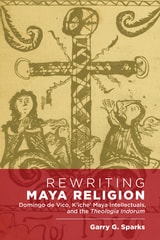
Rewriting Maya Religion
Domingo de Vico, K’iche’ Maya Intellectuals, and the Theologia IndorumGarry G. Sparks
University Press of Colorado, 2019
Centered on the specific work of Dominicans among the Highland Maya of Guatemala in the decades prior to the arrival of the Catholic Reformation in the late sixteenth century, the book focuses on the various understandings of religious analyses—Hispano-Catholic and Maya—and their strategic exchanges, reconfigurations, and resistance through competing efforts of religious translation. Sparks historically contextualizes Vico’s theological treatise within both the wider set of early literature in K’iche’an languages and the intellectual shifts between late medieval thought and early modernity, especially the competing theories of language, ethnography, and semiotics in the humanism of Spain and Mesoamerica at the time.
Thorough and original, Rewriting Maya Religion serves as an ethnohistorical frame for continued studies on Highland Maya religious symbols, discourse, practices, and logic dating back to the earliest documented evidence. It will be of great significance to scholars of religion, ethnohistory, linguistics, anthropology, and Latin American history.
Rewriting
How To Do Things With TextsJoseph Harris
Utah State University Press, 2006
"Like all writers, intellectuals need to say something new and say it well. But unlike many other writers, what intellectuals have to say is bound up with the books we are reading . . . and the ideas of the people we are talking with."
What are the moves that an academic writer makes? How does writing as an intellectual change the way we work from sources? In Rewriting, a textbook for the undergraduate classroom, Joseph Harris draws the college writing student away from static ideas of thesis, support, and structure, and toward a more mature and dynamic understanding. Harris wants college writers to think of intellectual writing as an adaptive and social activity, and he offers them a clear set of strategies—a set of moves—for participating in it.
Rewriting
How to Do Things with Texts, Second EditionJoseph Harris
Utah State University Press, 2017
“Like all writers, intellectuals need to say something new and say it well. But for intellectuals, unlike many other writers, what we have to say is bound up with the books we are reading . . . and the ideas of the people we are talking with.”
What are the moves that an academic writer makes? How does writing as an intellectual change the way we work from sources? In Rewriting, Joseph Harris draws the college writing student away from static ideas of thesis, support, and structure, and toward a more mature and dynamic understanding. Harris wants college writers to think of intellectual writing as an adaptive and social activity, and he offers them a clear set of strategies—a set of moves—for participating in it. Introducing remixing as an additional signature move and updated with new attention to digital writing, the second edition both extends and rethinks the ideas of the original.
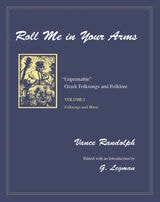
Roll Me in Your Arms
"Unprintable" Ozark Folksongs and Folklore, Volume I, Folksongs and MusicVance Randolph
University of Arkansas Press, 1992
Collected in the field from 1915 through 1955, these tales and songs were considered by the publisher at the time to be too salacious for inclusion in Vance Randolph’s Ozark Folksongs. Randolph came to doubt that they would ever appear in print, and they did not in his lifetime.
Roll Me in Your Arms, Volume I of “Unprintable” Ozark Folksongs and Folklore, includes 180 unexpurgated songs collected by Randolph with tunes transcribed from the original singers. Volume II, Blow the Candle Out, contains rhymes and songs without music as well as other unexpurgated Ozark folk materials, including children’s lore, elements in speech, graffiti, riddles, dance calls, and beliefs.
G. Legman’s painstaking and patient editing, annotating, and crossreferencing richly complement the Randolph collection. The result is a look into a previously neglected area in the study of folksong and folklore in the Ozarks and further evidence of Randolph’s preeminence in the field.
The late Vance Randolph lived in the Ozark Mountains from 1920 until his death in 1980. Although he taught folklore at the University of Arkansas in Fayetteville, he is best remembered for his many years of field research resulting in the national bestseller Pissing in the Snow & Other Ozark Folktales and more than a dozen other books on American folklore.
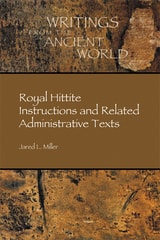
Royal Hittite Instructions and Related Administrative Texts
Jared L. Miller
SBL Press, 2013