Results by title
248 books match the query 'Theology' and 11 start with r
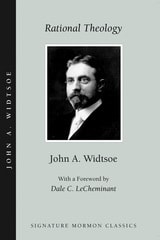
Rational Theology
John A. Widtsoe
Signature Books, 1998
In keeping with the times, it is not surprising that former professor of chemistry and university president John A. Widtsoe was called to the LDS Quorum of Twelve Apostles in 1921. An inheritor and promoter of “reasonable” religion, his popular book, Joseph Smith as Scientist, and his influential LDS Melchizedek priesthood manual (later released as a book), Rational Theology, underscored his and other Mormon leaders’ positivist assumptions about the world—that science was good, that Mormonism would be proven true, and, drawing from Herbert Spencer’s application of evolution to ethics, that society would be perfected.
Like Widtsoe’s secular books (published nationally and internationally by Macmillan, Webb, and J. Wiley & Sons), Rational Theology would enjoy multiple printings domestically and several foreign translations. Although his other church writings (Evidences and Reconciliations, The Gospel in the Service of Man, Guide Posts to Happiness: The Right to Personal Satisfaction, and others) proved to be influential, none so thoroughly summarized his embrace of science and Mormonism as Rational Theology.
John Andreas Widtsoe was born in Dalöe, Island of Fröyen, Norway, in 1872. He immigrated to Utah in 1883 and graduated from Brigham Young College in 1891 and from Harvard with high honors in 1894. Widtsoe married Leah Eudora Dunford, daughter of Susa Young Gates, in 1898 and had seven children. In 1899 he was awarded a Ph.D. with high honors from the University of Göttingen, Germany. He both taught at and served as president of Utah State Agricultural College and the University of Utah. He was elected to the Victoria Institute in England, an honor received by only one other Mormon scholar—James E. Talmage. Widtsoe served as editor of the Improvement Era and wrote more than thirty books, including religious, autobiographical, and professional publications. His essay on LDS temple worship has been included in the new edition of The House of the Lord: A Study of Holy Sanctuaries Ancient and Modern. He was an apostle from 1921 until his death in 1952.
Reading Ezra 9-10 Tu'a-wise
Rethinking Biblical Interpretation in OceaniaNasili Vaka'uta
SBL Press, 2011
An alternative approach to biblical interpretation from a Tongan standpoint
In Reading Ezra 9–10 Tu'a-wise, Nasili Vaka'uta establishes a theoretical framework for reading that is informed by Tongan cultural perspectives—in this case the “eye-/I-s” of a Tongan commoner (tu’a). She applies a methodology for analysis of biblical texts based on the established theoretical framework and tests the methodology on Ezra 9–10. The book emphasizes contextualizing the task of biblical interpretation (using contextual or specifically indigenous categories of analysis) rather than contextualizing the Bible (applying the insights from one’s reading to one’s situation).Features
- Oceanic way of reading the Biblical texts
- Critical engagement with contextual biblical interpretation
- Practice-based interpretation
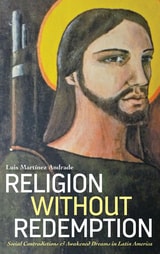
Religion Without Redemption
Social Contradictions and Awakened Dreams in Latin AmericaLuis Martinez Andrade
Pluto Press, 2015
Martínez Andrade focuses on the central role of religion in the region and how it influences people’s interaction with changes in modern economics. Capitalism in Latin America, Martínez Andrade argues, has taken on religious characteristics, with places of worship—shopping malls and department stores—as well as its own prophets. This form of cultural religion is often contradictory in surprising ways: not only does it legitimate oppression, it can also be a powerful source of rebellion, unveiling a subversive side to the status quo. Religion Without Redemption advances the ideas of liberation theory, and challenges the provincialism to which many Latin American thinkers are usually consigned.
Religious Imaginations
How Narratives of Faith are Shaping Today’s WorldEdited by James Walters
Gingko, 2018

Religious Objects as Psychological Structures
Moshe Halevi Spero
University of Chicago Press, 1992
By constructing a halakhic metapsychology within which psychological phenomena can be given specific halakhic identities, Spero arrives at a unique perspective on the development of religious objects and God representations. He traces two lines of development: one for relationships between humans, anthropocentric, and another for relationships between God and humans, deocentric. The second aspect of his argument is that these two distinct but parallel lines allow one to conceptualize the revolutionary possibility of transference displacements—the shift of religious symbology—not only from interpersonal relationships onto the God concept (Freud's model) but also from an objective human-God relationship onto interpersonal relationships. Filled with clinical as well as theoretical illustrations, Spero's work is a rich resource for both the religious patient and the religious therapist.
In the last few decades, a great deal of literature has been written on the relationship between theology and psychotherapy; none of this work, however, has addressed its subject using Judaism as a point of reference. Spero successfully takes up the task of bridging this gap in previous scholarship.
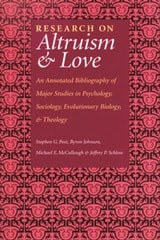
Research On Altruism & Love
An Annotated Bibliography of Major Studies in Psychology, Sociology, Evolutionary Biology, and TheologyStephen Post
Templeton Press, 2003
Research on Altruism and Love is a compendium of annotated bibliographies reviewing literature and research studies on the nature of love. An essay introduces each of the annotated bibliographies.
A variety of literature directly related to science-and-love issues or supporting those issues is covered in the Religious Love Interfaces with Science section. This annotated bibliography is unique in that it approaches the field from a decidedly religious perspective. It includes classical expositions of love that continue to influence contemporary scholars, including Platos' work on eros, the work and words of Jesus, Aristotle, Augustine of Hippo, Martin Luther, Kierkegaard, and Ghandi, among others. The contemporary discussion includes Anders Nygren's theological arguments in his classic, Agape and Eros; Pitirim Sorokin; and others. An issue that often emerges in this literature is the question of the nature and definition of love.
A second annotated bibliography features current empirical research in the field of Personality and Altruism, with a focus on social psychology. Among the topics covered are the altruistic personality, altruistic behavior, empathy, helping behavior, social responsibility, and volunteerism. Methodologies are diverse, and studies include experiments, local and national surveys, naturalistic observation, and combinations of these.
The Evolutionary Biology annotated bibliography covers the most significant works on altruism and love in the field of biology and evolutionary psychology.
The fourth and final annotated bibliography in this volume is entitled Sociology of Faith-Based Volunteerism. Here the focus is on literature on the interface of helping behavior and religious organizations, as well as major pieces on voluntary associations.
Restoring Nature
Essays Thomistic Philosophy & TheologyMichael M. Waddell
St. Augustine's Press, 2023
Resurrection in Paul
Cognition, Metaphor, and TransformationFrederick S. Tappenden
SBL Press, 2016
Explore the embodied foundations of Paul's resurrection ideals
It is commonly recognized that Paul's resurrection ideals are bodily ideals, though this dictum is usually configured along literal and metaphorical lines. The realism of future resurrected bodies is disconnected from the metaphoricity of bodily transformation in the present. Drawing on cognitive linguistics, this fresh and innovative study addresses this problem. By eschewing the opposition of metaphor and realism, Tappenden explores the concepts and metaphors Paul uses to fashion notions of resurrection, and the uses to which those notions are put. Rather than asserting resurrection as a disembodied, cognicentric proposition, this book illuminates the body's central role in shaping and grounding the apostle's thought and writings.
Features:
- Close examination of Paul's letters within multiple, interlocking cultural contexts
- Provides a novel and fresh approach to assessing (in)coherence across the undisputed letters
- Addresses the materialist nature of early Christian and Judean resurrection ideals without compromising the metaphoricity of those ideals
Rewriting the Word "God"
In the Arc of Converging Lines between Innovative Theory, Theology, and PoetryRomana Huk
University of Alabama Press, 2025
Innovative poetry, philosophy, theology and new sciences converge in the project of rewriting the word “God”
In Rewriting the Word “God,” Romana Huk examines the substantive connections between innovative poetry of the last century and contemporary theology and philosophy. Along the way, we encounter ten poets who have, without abandoning their inherited or chosen faith traditions, radically rethought conceptualizations of divinity, human ontology, and the real.
From the startlingly proto-phenomenological encounters with nature by Gerard Manley Hopkins to the post-deconstructive pursuit of “oracular” speech in Fanny Howe, these poets have found inspiration in a wide range of sources, from ancient religious texts to modern philosophical movements. But what unites them is their willingness to continually change, experiment and challenge the status quo, both in their religious beliefs and their poetic practice.
Huk shows how these poets have used their work to explore ultimate questions of life and death, meaning and purpose, and the relationship between humans and materiality, humans and other humans, which for these poets sheds light on humanity’s relationship with the divine. She also highlights the ways in which they have engaged with social and political issues in their poetry to speak out against injustice and oppression.
Rewriting the Word “God” is a thought-provoking and inspiring work that will challenge current perceptions of both religion and poetry from new positions at the intersection of faith, art, philosophy, science, literary theory, and culture.
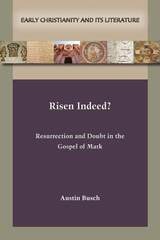
Risen Indeed? Resurrection and Doubt in the Gospel of Mark
Austin Busch
SBL Press, 2022
Risen Indeed? Resurrection and Doubt in the Gospel of Mark traces the literary dynamics and explores the theological dimensions of the Gospel of Mark’s thematization of skepticism regarding resurrection. In every place where it seems to depict resurrection—Jesus's and others'—Mark evades the issue of whether resurrection actually occurs. Austin Busch argues that, despite Mark's abbreviated and ambiguous conclusion, this gospel does not downplay resurrection but rather foregrounds it, imagining Jesus’s death and restoration to life as a divine plot to overcome Satan through cunning deception. Risen Indeed? constitutes a careful literary reading of Mark's Gospel, as well as an assessment of Mark's impact on the traditions of Christian literature and theology that emerged in its wake.
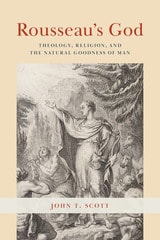
Rousseau's God
Theology, Religion, and the Natural Goodness of ManJohn T. Scott
University of Chicago Press, 2023
John T. Scott offers a comprehensive interpretation of Rousseau’s theological and religious thought, both in its own right and in relation to Rousseau’s broader oeuvre. In chapters focused on different key writings, Scott reveals recurrent themes in Rousseau’s views on the subject and traces their evolution over time. He shows that two concepts—truth and utility—are integral to Rousseau’s writings on religion. Doing so helps to explain some of Rousseau’s disagreements with his contemporaries: their different views on religion and theology stem from different understandings of human nature and the proper role of science in human life. Rousseau emphasizes not just what is true, but also what is useful—psychologically, morally, and politically—for human beings. Comprehensive and nuanced, Rousseau’s God is vital to understanding key categories of Rousseau’s thought.