Results by title
83 books match the query 'Treatment' and 4 start with r

Racing Uphill
Confronting a Life with EpilepsyStacia Kalinoski
University of Minnesota Press, 2025
The candid, inspiring story of a woman’s experience with a chronic, unpredictable neurological condition
When twenty-nine-year-old reporter Stacia Kalinoski regained consciousness on a couch at the TV station where she worked, she assumed that she’d had another seizure. But the electrical storm that had just torn through her brain was more destructive than she could have imagined, and the broadcast journalism career she loved swiftly came to an end. Forced to confront the reality of her medical condition, Kalinoski made the risky decision to undergo brain surgery, targeting the epilepsy that was ravaging her life.
In Racing Uphill, Kalinoski describes the seizures that occurred while she was running, which led to her pursuit of an uncertain cure. Rallying the grit she developed as an athlete and engaging the research and reporting skills she acquired as a journalist, she gives us a rare inside look at the ways epilepsy can change a life. Moving beyond her own personal experience, Kalinoski interviews prominent epileptologists to understand how seizures can spread, steal memories, and create strange behaviors and mood disorders. She seamlessly joins what she learned from her research with her own story, offering valuable insight into the experience of grappling with a relentless neurological disease.
The vivid auras that preceded seizures and the damage that followed; the toll of her epilepsy on her family and loved ones; the extraordinary determination her reckoning required—these are all part of Kalinoski’s story of adversity, denial, acceptance, and resilience. In sharing the remarkable opportunity that epilepsy presented for her courage and growth, Stacia Kalinoski speaks to anyone facing an uphill battle and offers inspiration for taking control of one’s own health.
Refusing Care
Forced Treatment and the Rights of the Mentally IllElyn R. Saks
University of Chicago Press, 2002
Focusing on overinterventionist approaches, Refusing Care explores when, if ever, the mentally ill should be treated against their will. Basing her analysis on case and empirical studies, Elyn R. Saks explores dilemmas raised by forced treatment in three contexts—civil commitment (forced hospitalization for noncriminals), medication, and seclusion and restraints. Saks argues that the best way to solve each of these dilemmas is, paradoxically, to be both more protective of individual autonomy and more paternalistic than current law calls for. For instance, while Saks advocates relaxing the standards for first commitment after a psychotic episode, she also would prohibit extreme mechanical restraints (such as tying someone spread-eagled to a bed). Finally, because of the often extreme prejudice against the mentally ill in American society, Saks proposes standards that, as much as possible, should apply equally to non-mentally ill and mentally ill people alike.
Mental health professionals, lawyers, disability rights activists, and anyone who wants to learn more about the way the mentally ill are treated—and ought to be treated—in the United States should read Refusing Care.
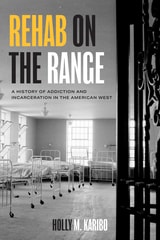
Rehab on the Range
A History of Addiction and Incarceration in the American WestHolly M. Karibo
University of Texas Press, 2024
2026 Texas Christian University (TCU) Texas Book Award Winner
2025 Coral Horton Tullis Memorial Prize, Texas State Historical Association
2025 Outstanding Academic Title, CHOICE
The first study of the Fort Worth Narcotic Farm, an institution that played a critical role in fusing the War on Drugs, mass incarceration, and public health in the American West.
In 1929, the United States government approved two ground-breaking and controversial drug addiction treatment programs. At a time when fears about a supposed rise in drug use reached a fevered pitch, the emergence of the nation’s first “narcotic farms” in Fort Worth, Texas, and Lexington, Kentucky, marked a watershed moment in the treatment of addiction. Rehab on the Range is the first in-depth history of the Fort Worth Narcotic Farm and its impacts on the American West. Throughout its operation from the 1930s to the 1970s, the institution was the only federally funded drug treatment center west of the Mississippi River. Designed to blend psychiatric treatment, physical rehabilitation, and vocational training, the Narcotic Farm, its proponents argued, would transform American treatment policies for the better. The reality was decidedly more complicated.
Holly M. Karibo tells the story of how this institution—once framed as revolutionary for addiction care—ultimately contributed to the turn towards incarceration as the solution to the nation’s drug problem. Blending an intellectual history of addiction and imprisonment with a social history of addicts’ experiences, Rehab on the Range provides a nuanced picture of the Narcotic Farm and its cultural impacts. In doing so, it offers crucial historical context that can help us better understand our current debates over addiction, drug policy, and the rise of mass incarceration.
Rethinking Hypothyroidism
Why Treatment Must Change and What Patients Can DoAntonio C. Bianco, MD
University of Chicago Press, 2022
Hypothyroidism, also commonly referred to as Hashimoto’s disease, affects millions in the United States alone. It occurs when the thyroid—the butterfly-shaped gland that sits in your neck right above the front of your shirt collar—malfunctions or after thyroid surgery, causing thyroid hormone levels in circulation to drop below normal. Thus, treatment is aimed at bringing these hormone levels back to normal. This is done with daily tablets of thyroxine or T4. Because hypothyroidism is so common, we likely know someone who is on this type of medication. While most patients respond well to this standard treatment, about ten to twenty percent (some two to three million individuals in the United States) are far from living a typical life. They exhibit “foggy brain”—low energy, confusion, and poor memory. Many doctors have shrugged off their complaints, believing these symptoms to be unrelated to the thyroid disease. In Rethinking Hypothyroidism, Dr. Antonio C. Bianco, a physician and a scientist who has studied hypothyroidism and thyroid hormones for decades, offers an accessible overview of the disease’s treatment and the role of big pharma in shaping it, making the case that the current approach is failing many patients. But more than this, Bianco calls for alternatives to improve lives, and he equips patients and their families with the tools to advocate for other treatments.