Results by title
124 books match the query 'Twenty - First Century' and 10 start with r
RSF
The Russell Sage Foundation Journal of the Social Sciences: The Legal Landscape of U.S. Immigration in the Twenty-First CenturyKatharine M. Donato
Russell Sage Foundation, 2020
Donato and Amuedo-Dorantes outline American immigration policies from 1880 to the present and consider the impact of the COVID-19 pandemic on immigration. They underscore the fact that many recent immigration policies have been a result of presidential executive orders rather than legislative acts, making families and workers who enter the country without proper documentation especially vulnerable. They also examine how and why these orders are often racist and xenophobic, privileging some racial and ethnic groups and excluding others.
Contributors to the issue investigate the various ways in which immigrants secure visas, working permits, and citizenship in the United States, including through employment and family ties, as well as special statuses for military veterans, refugees, asylum seekers, and unaccompanied minors. Daniel Costa writes about how temporary migrant workers’ precarious immigration status makes them particularly likely to experience workplace abuse because they fear losing their jobs and being deported if they complain about unfair labor practices. Pia Orrenius and Madeline Zavodny consider the substantial increase in employer demand for temporary work visas, demonstrating how improved economic conditions have led to this surge, creating a viable alternative to hiring unauthorized workers. Julia Gelatt uses employment and economic data analysis to compare multiple classes of legal immigrants. Her research demonstrates that employer-sponsored immigrants are better educated, exhibit higher English proficiency, and work in more highly skilled jobs than other types of immigrants (including family-sponsored, humanitarian, and diversity visa immigrants).
Other contributors examine the experiences of immigrants with special statuses, including veterans. Cara Wong and Jonathan Bonaguro find that Americans are more likely to support a path to citizenship via military service for immigrants who entered the country with the appropriate documentation, and that many Americans believe that undocumented migrants should be barred from the military, Peace Corps, AmeriCorps and firefighting. Van C. Tran and Francisco Lara-García find little variation in early socioeconomic outcomes between refugee groups from various countries. They show that schooling and employment, along with strategic financial, community building, and other support services, are critical factors in the successful integration and improved socioeconomic outcomes of refugees. Luis Edward Tenorio finds that the patchwork of legal systems, including family, immigration, and federal courts that adjudicate the laws for children with special immigrant juvenile status, make for the uneasy and uneven integration of unaccompanied minors into key social institutions.
This issue of RSF is a timely contribution that will invigorate the field of scholarly work on the American legal immigration system.
Race and Displacement
Nation, Migration, and Identity in the Twenty-First CenturyEdited by Maha Marouan and Merinda Simmons
University of Alabama Press, 2013
Reading Patristic Texts on Social Ethics
Issues and Challenges for the Twenty-First CenturyJohan Leemans
Catholic University of America Press, 2011
Reading and Writing Instruction in the Twenty-First Century
Recovering and Transforming the Pedagogy of Robert ScholesEllen C. Carillo
Utah State University Press, 2021
In this volume, Scholes’s scholarship is included alongside original essays, providing a resource for those considering everything from the place of the English major in the twenty-first century to best practices for helping students navigate misinformation and disinformation. Reading and Writing Instruction in the Twenty-First Century not only keeps Scholes’s legacy alive but carries it on through a commitment, in Scholes’s (1998) own words, to “offer our students . . . the cultural equipment they are going to need when they leave us.”
Contributors:
Angela Christie, Paul T. Corrigan, Lynée Lewis Gaillet, Doug Hesse, Alice S. Horning, Emily J. Isaacs, Christopher La Casse, Robert Lestón, Kelsey McNiff, Thomas P. Miller, Jessica Rivera-Mueller, Christian Smith, Kenny Smith
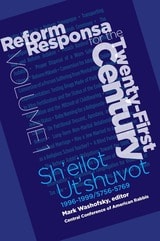
Reform Responsa for the Twenty-First Century, Volume 1
Sh'eilot Ut'shuvotRabbi Mark Washofsky, PhD
Central Conference of American Rabbis, 2010
Reform Responsa for the Twenty-First Century: Sh'eilot Ut'shuvot is the latest in an ongoing series of Reform Responsa. Drawing from the breadth of traditional and modern Jewish texts, law, and ideology, this two volumes set addresses over seventy contemporary topics, including conversion of adopted children, fertility treatments, patrilineal descent, issues of synagogue management, social justice activism, interfaith marriage, and rituals of death and mourning.
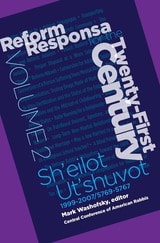
Reform Responsa for the Twenty-First Century, Volume 2
Sh'eilot Ut'shuvotRabbi Mark Washofsky, PhD
Central Conference of American Rabbis, 2010
Reform Responsa for the Twenty-First Century: Sh'eilot Ut'shuvot is part of an ongoing series of Reform Responsa. Drawing from the breadth of traditional and modern Jewish texts, law, and ideology, this two volumes set addresses over seventy contemporary topics, including conversion of adopted children, fertility treatments, patrilineal descent, issues of synagogue management, social justice activism, interfaith marriage, and rituals of death and mourning.
Reform Responsa for the Twenty-First Century, vols 1+2
Mark Washofsky
Central Conference of American Rabbis, 2010
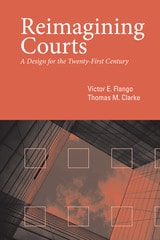
Reimagining Courts
A Design for the Twenty-First CenturyVictor E Flango
Temple University Press, 2017
Reimagining Courts recommends a triage process based upon case characteristics, litigant goals, and resolution processes. Courts must fundamentally reorganize their business processes around the concept of the litigant as a customer. Each adjudication process that the authors propose requires a different case management process and different amounts of judicial, staff, and facility resources.
Reimagining Courts should spark much-needed debate. This book will be of significant interest to lawyers, judges, and professionals in the court system as well as to scholars in public administration and political science.
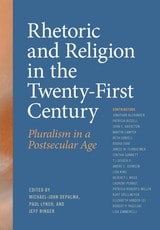
Rhetoric and Religion in the Twenty-First Century
Pluralism in a Postsecular AgeEdited by Michael-John DePalma, Paul Lynch, and Jeff Ringer
Southern Illinois University Press, 2023
Expanding the scope of religious rhetoric
Over the past twenty-five years, the intersection of rhetoric and religion has become one of the most dynamic areas of inquiry in rhetoric and writing studies. One of few volumes to include multiple traditions in one conversation, Rhetoric and Religion in the Twenty-First Century engages with religious discourses and issues that continue to shape public life in the United States.
This collection of essays centralizes the study of religious persuasion and pluralism, considers religion’s place in U.S. society, and expands the study of rhetoric and religion in generative ways. The volume showcases a wide range of religious traditions and challenges the very concepts of rhetoric and religion. The book’s eight essays explore African American, Buddhist, Christian, Indigenous, Islamic, and Jewish rhetoric and discuss the intersection of religion with feminism, race, and queer rhetoric—along with offering reflections on how to approach religious traditions through research and teaching. In addition, the volume includes seven short interludes in which some of the field’s most accomplished scholars recount their experiences exploring religious rhetorics and invite readers to engage these exigent lines of inquiry.
By featuring these diverse religious perspectives, Rhetoric and Religion in the Twenty-First Century complicates the field’s emphasis on Western, Hellenistic, and Christian ideologies. The collection also offers teachers of writing and rhetoric a range of valuable approaches for preparing today’s students for public citizenship in our religiously diverse global context.

Russian Theater
The Twenty-first Century, Volume 36Tom Sellar and Yana Ross, eds.
Duke University Press, 0
In the first English-language collection to examine twenty-first-century Russian theater, this special issue of Theater also includes the complete texts of two new Russian plays, published for the first time in English. Ivan Vyrypaev’s Oxygen is a poetic panorama of new Russian identity set to techno music, and Danila Privalov’s 5-25 explores traditional Dostoyevskian existential themes in the language of a new generation. One contributor chronicles the sweeping cultural and institutional changes in the Russian theater since 2000, while another provides an overview of the regional theater system in the world’s most geographically vast country. Another essay explores the development of the new playwriting movement, identifying its key writers and producers. This special issue also includes interviews with the movement’s directors and producers. Additionally, it contains letters, previously unpublished in English, from the Moscow Art Theater’s Olga Bokshanskaya to the Russian theatrical titan Vladimir Nemirovich-Danchenko, reporting on the Moscow Art Theater’s legendary U.S. tour in 1920–22, which was recorded in theater history as a turning point for American acting.
Contributors. AKHE, Dmitri Chernikov, Nina Chusova, Marina Dmitrievskaya, Sasha Dugdale, John Freedman, Elena Gremina, Nina Karpova, Mindaugus Korbauskis, Ryan McKittrick, Arkady Ostrovsky, Danila Privalov, Victor Rizhakov, Yana Ross, Tom Sellar, Kirill Serebrennikov, Anatoly Smeliansky, Julia Smeliansky, Ivan Vyrypaev