Results by title
147 books match the query 'Urban & Land Use Planning' and 11 start with r
Races to Modernity
Metropolitan Aspirations in Eastern Europe, 1890–1940Martin Kohlrausch
Central European University Press, 2014
Re-Centring the City
Urban Mutations, Socialist Afterlives and the Global EastEdited by Jonathan Bach and Michal Murawski
University College London, 2019
By drawing our attention back to the center as an object of analytical and empirical study, this book counters a long-term trend in both planning and urban scholarship that emphasizes decentralization as the hallmark of the twenty-first-century city. It argues that such a “centrifugal” turn in urban studies is neither empirically accurate nor normatively incontestable, especially when one looks beyond the West. Rather, as the contributions to this volume show, decentering obscures the ways in which the center continues to exert a powerful influence on cities of today. The concise chapters, situated at the intersection of urban studies, social anthropology, architecture, and art theory, provide new perspectives on the role of the center in defining the city’s terrain. Together, they constitute a collection of sharp, provocative interventions into debates about the transformation of global urban forms in the twenty-first century.
Reading Bangkok
Ross King
National University of Singapore Press, 2011
The author structures the book around external intrusions and local resistance. Geographically, this process is seen in movement from centre to periphery (Thonburi, Rattanakosin, Ratchadamnoen, Sukhumvit, Ratchadapisek, Khlong Toei, the universities). Chronologically, the city underwent various forms of colonization: incorporation of the periphery, which in turn colonized Bangkok; the economic colonization of the 19th and 20th centuries; colonization by consumption brought on in large part by globalized tourism; colonization by the "better" ideas of others (typically from the West); and finally colonization by "better" ways of thinking - notably the intrusions of the universities and of popular democracy.
This exceptionally innovative study draws on urban planning and development, history, anthropology, and political economy, and a rich body of empirical data to provide insights into the maze of power relations, inequalities and global influences that is normally hidden from view. Reading Bangkok is that rare thing, a study that genuinely changes the way its subject is seen and understood.

Reconstructing Architecture
Critical Discourses and Social PracticesThomas A. Dutton and Lian Hurst Mann, Editors
University of Minnesota Press, 1996
Reconstructing Architecture was first published in 1996. Minnesota Archive Editions uses digital technology to make long-unavailable books once again accessible, and are published unaltered from the original University of Minnesota Press editions.
To create architecture is an inherently political act, yet its nature as a social practice is often obscured beneath layers of wealth and privilege. The contributors to this volume question architecture's complicity with the status quo, moving beyond critique to outline the part architects are playing in building radical social movements and challenging dominant forms of power.
The making of architecture is instrumental in the construction of our identities, our differences, the world around us-much of what we know of institutions, the distribution of power, social relations, and cultural values is mediated by the built environment. Historically, architecture has constructed the environments that house the dominant culture. Yet, as the essays in Reconstructing Architecture demonstrate, there exists a strong tradition of critical practice in the field, one that attempts to alter existing social power relations. Engaging the gap between modernism and postmodernism, each chapter addresses an oppositional discourse that has developed within the field and then reconstructs it in terms of a new social project: feminism, social theory, environmentalism, cultural studies, race and ethnic studies, and critical theory.
The activists and scholars writing here provide a clarion call to architects and other producers of culture, challenging them to renegotiate their political allegiances and to help reconstruct a viable democratic life in the face of inexorable forces driving economic growth, destroying global ecology, homogenizing culture, and privatizing the public realm. Reconstructing Architecture reformulates the role of architecture in society as well as its capacity to further a progressive social transformation.
Contributors: Sherry Ahrentzen, U of Wisconsin, Milwaukee; Bradford C. Grant, California Polytechnic State U, San Luis Obispo; Richard Ingersoll, Rice U; Margaret Soltan, George Washington U; Anthony Ward, U of Auckland, New Zealand.
Thomas A. Dutton is an architect and professor of architecture at Miami University, Ohio. He is editor of Voices in Architectural Education (1991) and is associate editor of the Journal of Architectural Education.
Lian Hurst Mann is an architect and editor of Architecture California. A founding member of the Labor/Community Strategy Center in Los Angeles, she is editor of its bilingual quarterly Ahora Now and a coauthor of Reconstructing Los Angeles from the Bottom Up (1993).
Regional Planning for a Sustainable America
How Creative Programs Are Promoting Prosperity and Saving the EnvironmentMontgomery, Carleton K
Rutgers University Press, 2012
Regional Planning for a Sustainable America is the first book to represent the great variety of today’s effective regional planning programs, analyzing dozens of regional initiatives across North America.
The American landscape is being transformed by poorly designed, sprawling development. This sprawl—and its wasteful resource use, traffic, and pollution—does not respect arbitrary political boundaries like city limits and state borders. Yet for most of the nation, the patterns of development and conservation are shaped by fragmented, parochial local governments and property developers focused on short-term economic gain. Regional planning provides a solution, a means to manage human impacts on a large geographic scale that better matches the natural and economic forces at work. By bringing together the expertise of forty-two practitioners and academics, this book provides a practical guide to the key strategies that regional planners are using to achieve truly sustainable growth.
Repurposing the Green Belt in the 21st Century
Peter Bishop, Alona Martinez, Rob Roggema, and Lesley Williams
University College London, 2020
Through an examination of practice in the UK, the Netherlands, Spain, and Germany, Repurposing the Green Belt in the 21st Century proposes a framework for a reconsideration of the critical relationship between the city and its hinterlands. It will be useful for undergraduate and postgraduate students of planning, landscape architecture, urban design, architecture, and land economics, as well as practitioners in design, planning, and real estate.
Resurrecting Tenochtitlan
Imagining the Aztec Capital in Modern Mexico CityDelia Cosentino and Adriana Zavala
University of Texas Press, 2023
Honorable Mention, ALAA-Arvey Foundation Book Award, Association of Latin American Art
Finalist, 2024 Charles Rufus Morey Book Award, College Art Association
How Mexican artists and intellectuals created a new identity for modern Mexico City through its ties to Aztec Tenochtitlan.
After archaeologists rediscovered a corner of the Templo Mayor in 1914, artists, intellectuals, and government officials attempted to revive Tenochtitlan as an instrument for reassessing Mexican national identity in the wake of the Revolution of 1910. What followed was a conceptual excavation of the original Mexica capital in relation to the transforming urban landscape of modern Mexico City.
Revolutionary-era scholars took a renewed interest in sixteenth century maps as they recognized an intersection between Tenochtitlan and the foundation of a Spanish colonial settlement directly over it. Meanwhile, Mexico City developed with modern roads and expanded civic areas as agents of nationalism promoted concepts like indigenismo, the embrace of Indigenous cultural expressions. The promotion of artworks and new architectural projects such as Diego Rivera’s Anahuacalli Museum helped to make real the notion of a modern Tenochtitlan. Employing archival materials, newspaper reports, and art criticism from 1914 to 1964, Resurrecting Tenochtitlan connects art history with urban studies to reveal the construction of a complex physical and cultural layout for Mexico’s modern capital.
Rethinking Urban Risk and Resettlement in the Global South
Edited by Cassidy Johnson, Garima Jain, and Allan Lavell
University College London, 2021
Environmental changes impact everyone, but the burden is especially heavy upon the lives and livelihoods of the urban poor and those living in informal settlements. In an effort to reduce urban residents’ exposure to climate change and natural disasters, resettlement programs are becoming widespread across the Global South. Yet, while resettlement may reduce a region’s future climate-related disaster risk, it can also often increase poverty and vulnerability. This volume collates the findings from a research project that examined urban areas across the globe, including case studies from India, Uganda, Peru, Colombia, Mexico, Cambodia, and the Philippines. The book offers a unique approach to resettlement, providing an opportunity for urban planners to re-think how disaster risk management can better address the accumulation of urban risks in the era of climate change.
Revitalization in Asia
Adaptive Reuse in Macao, Mumbai, and PenangEdited by Lavina Ahuja and Lynne D. DiStefano
Hong Kong University Press, 2025
Revitalization in Asia offers a clear understanding of the value of sustainable adaptive reuse within an Asian context. Three highly urbanized places—Macao, Mumbai, and Penang —are considered in detail through essays and timelines that examine both conservation and planning perspectives. Six essays look at the connection between adaptive reuse and the three dimensions of sustainability regarding the United Nations' Sustainable Development Goals. Additionally, for each location, five case studies offer a comparative framework for understanding similarities and differences between adaptive reuse projects.
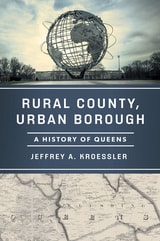
Rural County, Urban Borough
A History of QueensJeffrey A. Kroessler
Rutgers University Press, 2025
Rural County, Urban Borough is a history of place, charting the rapid transformation of the Queens landscape. It identifies what drove the borough’s development, from public infrastructure, architecture, and transportation to technological innovation and urban planning. New York historian Jeffrey A. Kroessler takes us inside the backrooms and boardrooms where local powerbrokers shaped the borough’s future, chronicling how its relationship with the city has evolved. He also shows the steps Queens residents from all backgrounds took to care for their neighborhoods and build their communities. Richly illustrated, this book underscores why Queens is integral to New York City and the wider world and reveals how, in its evolution, we see the whole arc of American urban history.
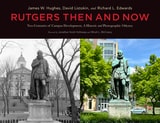
Rutgers Then and Now
Two Centuries of Campus Development: A Historic and Photographic OdysseyJames W. Hughes
Rutgers University Press, 2025
Rutgers, Then and Now tells this story, proceeding through ten sequential development phases of College Avenue and Piscataway campus expansions—each with its own buildings and physical layouts—that took place over the course of 250 years. It delivers stunning photographic and historic documentation of the growth of the university, showing “what it was and appeared originally” versus “what it is and looks like today.” Among other in-depth analyses, the book compares the diminutive geographic scale of today’s historical College Avenue Campus—once the entirety of Rutgers—to the much larger-sized (in acreage) Busch Campus. Replete with more than 500 images, the book also considers the Rutgers campuses that might have been, examining plans that were changed or abandoned. Shedding light on the sacrifices and gifts that transformed a small college into a vital hub for research and beloved home for students, it explores how Rutgers grew to become a world-class university.