Results by title
368 books match the query 'West' and 12 start with r

Rage and Carnage in the Name of God
Religious Violence in NigeriaAbiodun Alao
Duke University Press, 2022
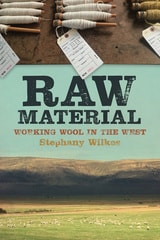
Raw Material
Working Wool in the WestStephany Wilkes
Oregon State University Press, 2018
What begins as a search for local yarn becomes a dirty, unlikely, and irresistible side job. Wilkes leaves her high tech job for a way of life considered long dead in the American West. Along the way, she meets ornery sheep that weigh more than she does, carbon-sequestering ranchers, landless grazing operators, rare breed stewards, and small-batch yarn makers struggling with drought, unfair trade agreements, and faceless bureaucracies as they work to bring eco-friendly fleece to market.
Raw Material demonstrates that the back must break to clothe the body, and that excellence often comes by way of exhaustion. With humor and humility, Wilkes follows wool from the farm to the factory, through the hands of hardworking Americans trying to change the culture of clothing. Her story will appeal to anyone interested in the fiber arts or the textile industry, and especially to environmentally conscious consumers, as it extends the concerns of the sustainable food movement to fleece, fiber, and fashion.
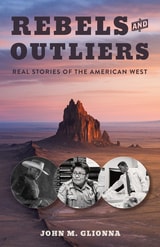
Rebels and Outliers
Real Stories of the American WestJohn M Glionna
University of Nevada Press, 2025
This vibrant collection invites readers to journey through the rugged landscapes and tight-knit communities that define the American West. Along the way, you’ll meet individuals whose grit, resilience, and pioneering spirit embody the heart of this region’s legacy.
A captivating follow-up to Glionna’s 2022 book, Outback Nevada: Real Stories of the Silver State, Rebels and Outliers is a testament to the untamed, enduring character of the people who call the West home.

Religion and the Making of Nigeria
Olufemi Vaughan
Duke University Press, 2016
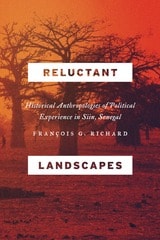
Reluctant Landscapes
Historical Anthropologies of Political Experience in Siin, SenegalFrancois G. Richard
University of Chicago Press, 2018
Reluctant Landscapes is an exploration of the making and remaking of political experience and physical landscapes among rural communities in the Siin province of Senegal between the late 1500s and the onset of World War II. By recovering the histories of farmers and commoners who made up African states’ demographic core in this period, Richard shows their crucial—but often overlooked—role in the making of Siin history. The book also delves into the fraught relation between the Seereer, a minority ethnic and religious group, and the Senegalese nation-state, with Siin’s perceived “primitive” conservatism standing at odds with the country’s Islamic modernity. Through a deep engagement with oral, documentary, archaeological, and ethnographic archives, Richard’s groundbreaking study revisits the four-hundred-year history of a rural community shunted to the margins of Senegal’s national imagination.
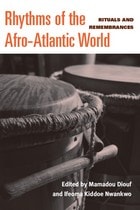
Rhythms of the Afro-Atlantic World
Rituals and RemembrancesEdited by Mamadou Diouf and Ifeoma Kiddoe Nwankwo
University of Michigan Press, 2010
"Collecting essays by fourteen expert contributors into a trans-oceanic celebration and critique, Mamadou Diouf and Ifeoma Kiddoe Nwankwo show how music, dance, and popular culture turn ways of remembering Africa into African ways of remembering. With a mix of Nuyorican, Cuban, Haitian, Kenyan, Senegalese, Trinidagonian, and Brazilian beats, Rhythms of the Afro-Atlantic World proves that the pleasures of poly-rhythm belong to the realm of the discursive as well as the sonic and the kinesthetic."
---Joseph Roach, Sterling Professor of Theater, Yale University
"As necessary as it is brilliant, Rhythms of the Afro-Atlantic World dances across, beyond, and within the Black Atlantic Diaspora with the aplomb and skill befitting its editors and contributors."
---Mark Anthony Neal, author of Soul Babies: Black Popular Culture and the Post-Soul Aesthetic
Along with linked modes of religiosity, music and dance have long occupied a central position in the ways in which Atlantic peoples have enacted, made sense of, and responded to their encounters with each other. This unique collection of essays connects nations from across the Atlantic---Senegal, Kenya, Trinidad, Cuba, Brazil, and the United States, among others---highlighting contemporary popular, folkloric, and religious music and dance. By tracking the continuous reframing, revision, and erasure of aural, oral, and corporeal traces, the contributors to Rhythms of the Afro-Atlantic World collectively argue that music and dance are the living evidence of a constant (re)composition and (re)mixing of local sounds and gestures.
Rhythms of the Afro-Atlantic World distinguishes itself as a collection focusing on the circulation of cultural forms across the Atlantic world, tracing the paths trod by a range of music and dance forms within, across, or beyond the variety of locales that constitute the Atlantic world. The editors and contributors do so, however, without assuming that these paths have been either always in line with national, regional, or continental boundaries or always transnational, transgressive, and perfectly hybrid/syncretic. This collection seeks to reorient the discourse on cultural forms moving in the Atlantic world by being attentive to the specifics of the forms---their specific geneses, the specific uses to which they are put by their creators and consumers, and the specific ways in which they travel or churn in place.
Mamadou Diouf is Leitner Family Professor of African Studies, Director of the Institute of African Studies, and Professor of History at Columbia University.
Ifeoma Kiddoe Nwankwo is Associate Professor of English at Vanderbilt University.
Jacket photograph by Elias Irizarry
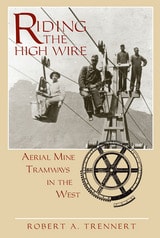
Riding the High Wire
Aerial Mine Tramways in the WestRobert A. Trennert
University Press of Colorado, 2001
Aerial mine tramways proved to have a special fascination; people often rode them for a thrill, sometimes with disastrous results. They were also very temperamental, needed constant attention, and were prone to accidents. The years between 1900 and 1920 saw the operation of some of the west's most spectacular tramways, but the decline in high-country mining beginning in the 1920s--coupled with the development of more efficient means of transportation--made this technology all but obsolete by the end of the Second World War.
Historians and the general reader will be equally enthralled by Trennert's fascinating story of the rise and fall of aerial mine tramways.
"Professor Trennert has explored a new area of mining history, and is to be commended for his pioneering work." --Liston Leyendecker, author of The Griffith Family and the Founding of Georgetown.
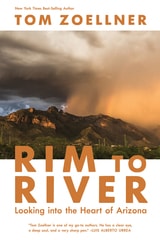
Rim to River
Looking into the Heart of ArizonaTom Zoellner
University of Arizona Press, 2023
Rim to River is the story of this extraordinary journey through redrock country, down canyons, up mesas, and across desert plains to the obscure valley in Mexico that gave the state its enigmatic name. The trek is interspersed with incisive essays that pick apart the distinctive cultural landscape of Arizona: the wine-colored pinnacles and complex spirituality of Navajoland, the mind-numbing stucco suburbs, desperate border crossings, legislative skullduggery, extreme politics, billion-dollar copper ventures, dehydrating rivers, retirement kingdoms, old-time foodways, ghosts of old wars, honky-tonk dreamers, murder mysteries, and magical Grand Canyon reveries.
In Rim to River, Zoellner does for Arizona what Larry McMurtry did for Texas in In a Narrow Grave and what Wallace Stegner did for Utah in Mormon Country: paint an enduring portrait of a misunderstood American state. An indictment, a love letter, and a homecoming story all at once.
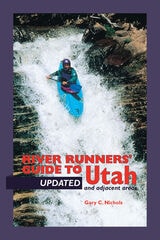
River Runners' Guide To Utah and Adjacent Areas
Gary C Nichols
University of Utah Press, 1986
A fully revised and updated edition of Gary Nichols’ widely used guide to river running in Utah. Major changes have occurred on Big and Little Cottonwood Creeks, which have many new drops with dangerous hydraulics. This edition accounts for these and other alterations in the state’s waterways over the past fifteen years. Also, several of the original river access points are now on private land. Alternative access points are presented and users are alerted to the necessity of requesting permission. All this and much more will once again make A River Runners’ Guide to Utah and Adjacent Areas the one source for vital and reliable information on more than ninety river trips for beginner and expert alike. It includes:
-Over 90 river trips with descriptions and maps
-Location of access and take-out points
-Instructions for all skill levels
-Ratings of all waterways by levels of difficulty
-Identification of danger areas and obstacles
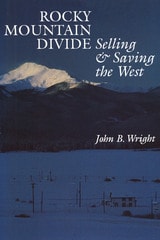
Rocky Mountain Divide
Selling and Saving the WestBy John B. Wright
University of Texas Press, 1993
The opposing forces of conservation and development have shaped and will continue to shape the natural environment and scenic beauty of the American West. Perhaps nowhere are their opposite effects more visible than in the neighboring states of Colorado and Utah, so alike in their spectacular mountain environments, yet so different in their approaches to land conservation. This study explores why Colorado has over twenty-five land trusts, while Utah has only one.
John Wright traces the success of voluntary land conservation in Colorado to the state’s history as a region of secular commerce. As environmental consciousness has grown in Colorado, people there have embraced the businesslike approach of land trusts as simply a new, more responsible way of conducting the real estate business.
In Utah, by contrast, Wright finds that Mormon millennialism and the belief that growth equals success have created a public climate opposed to the formation of land trusts. As Wright puts it, "environmentalism seems to thrive in the Centennial state within the spiritual vacuum which is filled by Mormonism in Utah." These findings remind conservationists of the power of underlying cultural values that affect their efforts to preserve private lands.
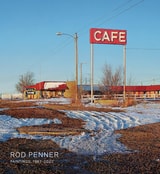
Rod Penner
Paintings, 1987–2022Rod Penner
The Artist Book Foundation, 2022
Rod Penner infuses his photorealistic paintings of the American southwest with a cinematic quality in the first major monograph on this contemporary realist artist.
The abandoned and forgotten landscapes of rural southwestern towns are the favored subjects of Rod Penner's paintings. His deft use of contrasts in his images—despondency and hope, isolation and nostalgia—evokes memories of The Last Picture Show and elicits complex responses from viewers. "I'm interested in the look of things and the quality of being there," he says. "A moment that is completely frozen with all the variety of textures; rust on poles, crumbling asphalt, light hitting the grass."
Penner's works are based on his photographs, digital video stills, and his experience of the rural landscapes of Texas and New Mexico. He depicts desolate, often deserted locations, the character of old houses and abandoned buildings, weather, and unique geography. His chosen scenes are infused with a cinematic quality that is the result of the exquisite light that he captures with his meticulous process. "The finished paintings should evoke contrasting responses of melancholy and warmth, desolation and serenity," he says.
Penner's hyperrealistic technique meticulously records both the iconic imagery and the beauty in the ashes of these once-prosperous streets and nighborhoods that still endure. The incredible poignant scenes evoke a universalism, a collective experience seen through the lens of Americana. "You won't find any hidden or overt socio-political meaning in my work and at the same time I hope that by utilizing what I find in the American landscape I'm able to connect to viewers on a deeper psychological level."
Romancing Nevada's Past
Ghost Towns And Historic Sites Of Eureka, Lander, And White Pine CountiesShawn Hall
University of Nevada Press, 1993