Results by title
295 books match the query 'Zoology' and 5 start with r
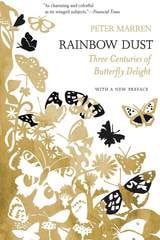
Rainbow Dust
Three Centuries of Butterfly DelightPeter Marren
University of Chicago Press, 2016
At the age of five, Marren had his “Nabokov Moment,” catching his first butterfly and feeling the dust of its colored scales between his fingers. It was a moment that would launch a lifetime’s fascination rivaling that of the famed novelist—a fascination that put both in good company. From the butterfly collecting and rearing craze that consumed North America and Europe for more than two hundred years (a hobby that in some cases bordered on madness), to the potent allure of butterfly iconography in contemporary advertisements and their use in spearheading calls to conserve and restore habitats (even though butterflies are essentially economically worthless), Marren unveils the many ways in which butterflies inspire us as objects of beauty and as symbols both transient and transcendent.
Floating around the globe and through the whole gamut of human thought, from art and literature to religion and science, Rainbow Dust is a cultural history rather than merely a natural one, a tribute to butterflies’ power to surprise, entertain, and obsess us. With a sway that far surpasses their fragile anatomy and gentle beat, butterfly wings draw us into the prismatic wonders of the natural world—and, in the words of Marren, these wonders take flight.
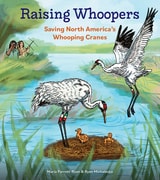
Raising Whoopers
Saving North America’s Whooping CranesMaria Parrott-Ryan
Wisconsin Historical Society Press, 2027
The inspiring story of ingenuity and dedication that saved a remarkable bird from the brink of extinction.
The distinctive whoop-whoop call of the whooping crane could once be heard across North America. By the middle of the twentieth century, however, habitat loss and hunting pushed these towering birds—the tallest on the continent—to the brink of extinction, with only fifteen individuals left in the wild. In the 1970s, two young visionaries founded the International Crane Foundation in Baraboo, Wisconsin, launching innovative efforts that would help change the species’ future and bring “whoopers” back into our wetlands.
Rich with fascinating natural history, larger-than-life personalities, and unforgettable adventures, Raising Whoopers tells the remarkable true story of one of North America’s most ambitious wildlife conservation efforts. Young readers will meet unforgettable cranes with names like Gee Whiz and Whoopsie, along with conservation heroes who hatched chicks by hand, performed crane courtship dances, and piloted ultralight aircraft across hundreds of miles to teach young birds how and where to migrate. Through triumphs, setbacks, and decades of perseverance, these wildlife conservationists demonstrated how creativity, science, and dedication can make a difference for endangered wildlife.
Geared toward ages 10–14, this engaging and accessible book, written in conjunction with the International Crane Foundation, introduces young readers to the captivating world of whooping cranes—and the scientists and ordinary citizens who worked together to ensure these birds had a future. The book concludes by showing that conservation is not just the work of experts—it’s something anyone can be part of. By connecting the story of whooping cranes to wildlife and habitats in our own communities, Raising Whoopers inspires the next generation to look more closely at the natural world and consider the role they can play in protecting it.
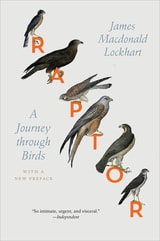
Raptor
A Journey through BirdsJames Macdonald Lockhart
University of Chicago Press, 2017
Taking as his guide the nineteenth-century Scottish naturalist and artist William MacGillivray, Lockhart loosely follows the historical trail forged by MacGillivray as he ventured from Aberdeen to London filling his pockets with plants and writing and illustrating the canonical A History of British Birds. Linking his journey to that of his muse, Lockhart shares his own encounters with raptors ranging from the scarce osprey to the successfully reintroduced red kite, a species once protected by medieval royal statute, revealing with poetic immediacy the extraordinary behaviors of these birds and the extreme environments they call home.
Creatures both worshipped and reviled, raptors have a talon-hold on the human heart and imagination. With his book, Lockhart unravels these complicated ties in a work by turns reverent and euphoric—an interweaving of history, travel, and nature writing at its best. A hymn to wanderers, to the land and to the sky, and especially to the birds, Raptor soars.
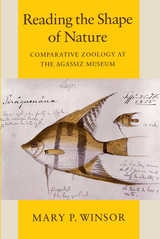
Reading the Shape of Nature
Comparative Zoology at the Agassiz MuseumMary P. Winsor
University of Chicago Press, 1991
In 1859, Louis Agassiz established the Museum of Comparative Zoology to house research on the ideal types that he believed were embodied in all living forms. Agassiz's vision arose from his insistence that the order inherent in the diversity of life reflected divine creation, not organic evolution. But the mortar of the new museum had scarcely dried when Darwin's Origin was published. By Louis Agassiz's death in 1873, even his former students, including his son Alexander, had defected to the evolutionist camp. Alexander, a self-made millionaire, succeeded his father as director and introduced a significantly different agenda for the museum.
To trace Louis and Alexander's arguments and the style of science they established at the museum, Winsor uses many fascinating examples that even zoologists may find unfamiliar. The locus of all this activity, the museum building itself, tells its own story through a wonderful series of archival photographs.
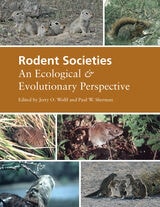
Rodent Societies
An Ecological and Evolutionary PerspectiveEdited by Jerry O. Wolff and Paul W. Sherman
University of Chicago Press, 2007
Rodent Societies synthesizes and integrates the current state of knowledge about the social behavior of rodents, providing ecological and evolutionary contexts for understanding their societies and highlighting emerging conservation and management strategies to preserve them. It begins with a summary of the evolution, phylogeny, and biogeography of social and nonsocial rodents, providing a historical basis for comparative analyses. Subsequent sections focus on group-living rodents and characterize their reproductive behaviors, life histories and population ecology, genetics, neuroendocrine mechanisms, behavioral development, cognitive processes, communication mechanisms, cooperative and uncooperative behaviors, antipredator strategies, comparative socioecology, diseases, and conservation. Using the highly diverse and well-studied Rodentia as model systems to integrate a variety of research approaches and evolutionary theory into a unifying framework, Rodent Societies will appeal to a wide range of disciplines, both as a compendium of current research and as a stimulus for future collaborative and interdisciplinary investigations.