Results by title
18284 books match the query 'United States' and 833 start with r
Rules versus Relationships
The Ethnography of Legal DiscourseJohn M. Conley and William M. O'Barr
University of Chicago Press, 1990
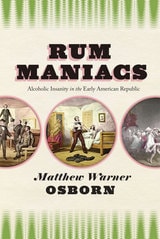
Rum Maniacs
Alcoholic Insanity in the Early American RepublicMatthew Warner Osborn
University of Chicago Press, 2014
In Rum Maniacs, Matthew Warner Osborn reveals how and why pathological drinking became a subject of medical interest, social controversy, and lurid fascination in the early American republic. At the heart of that story is the disease that Poe suffered: delirium tremens. First described in 1813, delirium tremens and its characteristic hallucinations inspired sweeping changes in how the medical profession saw and treated the problems of alcohol abuse. Based on new theories of pathological anatomy, human physiology, and mental illness, the new diagnosis founded the medical conviction and popular belief that habitual drinking could become a psychological and physiological disease. By midcentury, delirium tremens had inspired a wide range of popular theater, poetry, fiction, and illustration. This romantic fascination endured into the twentieth century, most notably in the classic Disney cartoon Dumbo, in which a pink pachyderm marching band haunts a drunken young elephant. Rum Maniacs reveals just how delirium tremens shaped the modern experience of alcohol addiction as a psychic struggle with inner demons.

Run For The Wall
Remembering Vietnam on a Motorcycle PilgrimageMichalowski, Raymond J
Rutgers University Press, 2001
Every May, for more than a decade, an ever-increasing number of motorcyclists have made the “Run for the Wall,” a cross-country journey from Southern California to the “Wall,” the Vietnam war memorial in Washington, D.C. While the journey’s avowed purpose is political — to increase public awareness about those who remain either prisoners of war or missing in action in Southeast Asia — it also serves as a healing pilgrimage for its participants and as a “welcome-home” ritual many veterans feel they never received.
Run for the Wall is a highly readable ethnographic account of this remarkable American ritual. The authors, themselves motorcyclists as well as Run participants, demonstrate that the event is a form of secular pilgrimage. Here key concepts in American culture— “freedom,” and “brotherhood,” for example—are constructed and deployed in a variety of rituals and symbols to enable participants to come to terms with the consequences of the Vietnam war. While the focus is the journey itself, the book also explores other themes related to American culture and history, including the nature of community, the Vietnam war, and the creation of American secular ritual.
In moving, first-hand accounts, the book tells how participation in the POW-MIA social movement helps individuals find personal and collective meaning in America’s longest and most divisive conflict. Above all, this is a story of a uniquely American form of political action, ritual, pilgrimage, and the social construction of memory.
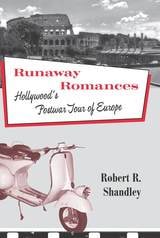
Runaway Romances
Hollywood's Postwar Tour of EuropeRobert R. Shandley
Temple University Press, 2009
In the 1950s and early 1960s, America imagined itself young and in love in Europe. And Hollywood films of the era reflected this romantic allure. From a young and naïve Audrey Hepburn falling in love with Gregory Peck inRoman Holiday to David Lean’s Summertime, featuring Katherine Hepburn’s sexual adventure in Venice, these glossy travelogue romances were shot on location, and established an exciting new genre for Hollywood.
As Robert Shandley shows in Runaway Romances, these films were not only indicative of the ideology of the American-dominated postwar world order, but they also represented a shift in Hollywood production values. Eager to capture new audiences during a period of economic crisis, Hollywood’s European output utilized the widescreen process to enhance cinematic experience. The films—To Catch a Thief, Three Coins in the Fountain, and Funny Face among them—enticed viewers to visit faraway places for romantic escapades. In the process, these runaway romances captured American fantasies for a brief, but intense, period that ended as audiences grew tired of old World splendors, and entered into a new era of sexual awakening.

Runes Of The North
Sigurd F. Olson
University of Minnesota Press, 1997
Running the Numbers
Race, Police, and the History of Urban GamblingMatthew Vaz
University of Chicago Press, 2020
How the politics of gambling became snarled in disputes over race, power, and law enforcement.
Every day in the United States, people test their luck in numerous lotteries, from state-run games to massive programs like Powerball and Mega Millions. Yet few are aware that the origins of today’s lotteries can be found in an African American gambling economy that flourished in urban communities in the mid-twentieth century. In Running the Numbers, Matthew Vaz reveals how the politics of gambling became enmeshed in disputes over racial justice and police legitimacy.
As Vaz highlights, early urban gamblers favored low-stakes games built around combinations of winning numbers. When these games became one of the largest economic engines in nonwhite areas like Harlem and Chicago’s south side, police took notice of the illegal business—and took advantage of new opportunities to benefit from graft and other corrupt practices. Eventually, governments found an unusual solution to the problems of illicit gambling and abusive police tactics: coopting the market through legal state-run lotteries, which could offer larger jackpots than any underground game. By tracing this process and the tensions and conflicts that propelled it, Vaz brilliantly calls attention to the fact that, much like education and housing in twentieth-century America, the gambling economy has also been a form of disputed terrain upon which racial power has been expressed, resisted, and reworked.

Running the Numbers
Race, Police, and the History of Urban GamblingMatthew Vaz
University of Chicago Press, 2020
How the politics of gambling became snarled in disputes over race, power, and law enforcement.
Every day in the United States, people test their luck in numerous lotteries, from state-run games to massive programs like Powerball and Mega Millions. Yet few are aware that the origins of today’s lotteries can be found in an African American gambling economy that flourished in urban communities in the mid-twentieth century. In Running the Numbers, Matthew Vaz reveals how the politics of gambling became enmeshed in disputes over racial justice and police legitimacy.
As Vaz highlights, early urban gamblers favored low-stakes games built around combinations of winning numbers. When these games became one of the largest economic engines in nonwhite areas like Harlem and Chicago’s south side, police took notice of the illegal business—and took advantage of new opportunities to benefit from graft and other corrupt practices. Eventually, governments found an unusual solution to the problems of illicit gambling and abusive police tactics: coopting the market through legal state-run lotteries, which could offer larger jackpots than any underground game. By tracing this process and the tensions and conflicts that propelled it, Vaz brilliantly calls attention to the fact that, much like education and housing in twentieth-century America, the gambling economy has also been a form of disputed terrain upon which racial power has been expressed, resisted, and reworked.
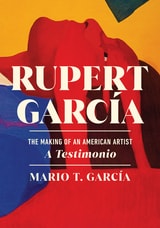
Rupert García
The Making of an American Artist, a TestimonioMario T. García
Rutgers University Press, 2026
This is the first biography of the renowned American Chicano visual artist and activist Rupert García, drawing on fifty hours of interviews conducted over thirty years and accompanied by eighty images. This in-depth oral history gives an unparalleled look at García’s life and work, tracing his evolution as an artist and the political upheavals that shaped his life and worldview.
Mario T. García’s testimonio places Rupert García’s art in historical perspective, from his beginnings as a working-class Mexican American from California’s Central Valley, his coming of age in the U.S. Air Force during the Vietnam War, his involvement in the antiwar movement during the San Francisco State student strike in 1968-69, and his participation in the Chicano Movement and beyond. Influenced by history and politics, García’s vital works of art represent a changing world through the eyes of an artist, speaking to issues of poverty, racism, capitalism, war, and the role of the artist in society.
His art—from revolutionary silkscreen posters to monumental pastels to portraits of political icons like Frida Kahlo, Che Guevara, and Dolores Huerta—serves to critique history and reassess it. It is work that will endure for generations to come.
Rural America in a Globalizing World
Problems and Prospects for the 2010'sConner Bailey
West Virginia University Press, 2014
This fourth Rural Sociological Society decennial volume provides advanced policy scholarship on rural North America during the 2010’s, closely reflecting upon the increasingly global nature of social, cultural, and economic forces and the impact of neoliberal ideology upon policy, politics, and power in rural areas.
The chapters in this volume represent the expertise of an influential group of scholars in rural sociology and related social sciences. Its five sections address the changing structure of North American agriculture, natural resources and the environment, demographics, diversity, and quality of life in rural communities.
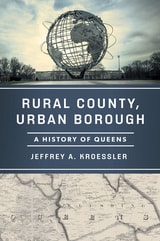
Rural County, Urban Borough
A History of QueensJeffrey A. Kroessler
Rutgers University Press, 2025
Rural County, Urban Borough is a history of place, charting the rapid transformation of the Queens landscape. It identifies what drove the borough’s development, from public infrastructure, architecture, and transportation to technological innovation and urban planning. New York historian Jeffrey A. Kroessler takes us inside the backrooms and boardrooms where local powerbrokers shaped the borough’s future, chronicling how its relationship with the city has evolved. He also shows the steps Queens residents from all backgrounds took to care for their neighborhoods and build their communities. Richly illustrated, this book underscores why Queens is integral to New York City and the wider world and reveals how, in its evolution, we see the whole arc of American urban history.
Rural Literacies
Kim Donehower, Charlotte Hogg, and Eileen Schell
Southern Illinois University Press, 2006
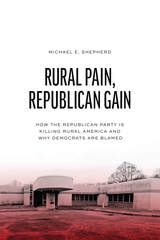
Rural Pain, Republican Gain
How the Republican Party Is Killing Rural America and Why Democrats Are BlamedMichael E. Shepherd
University of Chicago Press, 2026
An eye-opening look at how Republican policies have affected health outcomes in rural communities and why poor, rural white voters are turning to the Republican Party—not despite this harm, but because of it.
Over the last four decades, the health of rural Americans has been in free fall. Just as opioid and gun deaths have ripped apart rural communities, hospitals have closed at alarming rates, leaving millions desperately far from care. At the same time, voters in struggling rural communities have increasingly come to vote for the Republican Party.
In Rural Pain, Republican Gain, Michael E. Shepherd demonstrates that these two trends are closely connected. At both the federal and state levels, the Republican Party has increasingly enacted policies that worsen rural health. Rural voters are not indifferent to this development (quite the contrary), but they misassign blame, in part, because the Democratic Party is more commonly associated with health-related policy initiatives and has ownership of health as an issue area. Republican politicians can reap rewards from their own destructive policies by appealing to the shared grievances of rural people.
Shepherd draws on new, wide-ranging data, including in-depth studies of the opioid epidemic, hospital closures, and COVID-19. In so doing, he quantifies the harm of Republican policymaking and its disproportionate effect on rural communities, recasting how readers understand growing Republican support among less healthy, lower-income rural white Americans.
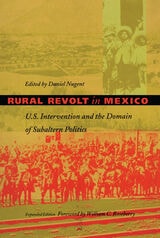
Rural Revolt in Mexico
U.S. Intervention and the Domain of Subaltern PoliticsDaniel Nugent, ed.
Duke University Press, 1998
Through their studies of social movements and popular mobilization in the Mexican countryside, the contributors argue for understanding rural revolts in terms of the specific historical contexts of particular regions and peoples, as well as the broader context of unequal cultural, political, and economic relations between Mexico and the United States. Exploring the connections between external and internal factors in social movements, these essays reveal the wide range of organized efforts through which peasants and Indians have struggled to shape their own destiny while confronted by the influence of U.S. capital and military might. Originally published as a limited edition in 1988 by the Center for U. S.–Mexican Studies, this volume presents a pioneering effort by Latin Americanist scholars to sympathetically embrace and enrich work begun in Subaltern Studies between 1982 and 1987 by projecting it onto a different region of historical experience. This revised and expanded edition includes a new introduction by Daniel Nugent and an extensive essay by Adolfo Gilly on the recent Chiapas uprising.
Rural and Small Town America
Glenn V. Fuguitt
Russell Sage Foundation, 1989
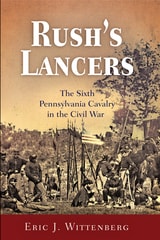
Rush's Lancers
The Sixth Pennsylvania Cavalry in the Civil WarEric J. Wittenberg
Westholme Publishing, 2007
The Sixth Pennsylvania Cavalry, also known as Rush’s Lancers, was a completely volunteer unit and one of the finest regiments to serve in the Civil War. Tracing their history from George Washington’s personal bodyguard during the Revolutionary War, many of the men of the Sixth Pennsylvania were the cream of Philadelphia society, including Richard H. Rush, grandson of Dr. Benjamin Rush, Maj. Robert Morris, Jr., great-grandson of the financier of the Revolutionary War, Capt. Charles Cadwalader, whose great-grandfather was a general under George Washington, Frank H. Furness, architect and Medal of Honor recipient, and George G. Meade, Jr. But it was their actions in battle, not their illustrious family histories, that distinguished Rush’s Lancers. The Sixth Pennsylvania Cavalry earned a reputation for being a highly trained and reliable unit, despite being armed initially with antiquated weapons, leaving their mark on key battlefields, including Antietam, Fredericksburg, Hanover Court House, Chancellorsville, Gettysburg, Brandy Station—where they conducted one of the most famous charges of the war—and Appomattox.
Drawing upon letters, diaries, memoirs, service and pension files, contemporary newspaper coverage, official records, and other primary sources, Rush’s Lancers: The Sixth Pennsylvania Cavalry in the Civil War by distinguished military historian Eric J. Wittenberg is an engrossing account of these young men from both Philadelphia’s social elite and the city’s working classes who, despite not being professional soldiers, answered the Nation’s call to war.
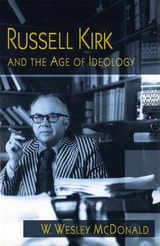
Russell Kirk and the Age of Ideology
W. Wesley McDonald
University of Missouri Press, 2004
Russia and the United States
Nikolai V. Sivachev and Nikolai N. Yakovlev
University of Chicago Press, 1979
Sivachev and Yakolev trace the course of the U.S.-Russian relations from the years preceding the American Revolution to the 1970s, when human rights issues began to cause friction. Those relations, the authors believe, were characterized by America's repeated failure to take advantage of opportunities to improve them. Recognizing the controversial nature of the book, Sivachev said in an interview with the New York Times: "We did not set out to please the American reader, nor did the University of Chicago Press ask us to. On the contrary, they recommended that we should feel free to present our own views."
"Scholars and students of American foreign policy . . . are likely to be alternatively interested, intrigued, angered, and sometimes illuminated by some of the interpretations found in this work."—Perspective
"An American reader should not prejudge this book as simply another dreary contribution to the rhetoric of Soviet propaganda. It is more than this. The book is an expression of a view of the world that is truly and strikingly different from an American one and it is important to understand that it is a theory of reality that is shared by most, if not all, Soviet intellectuals who study America and its foreign policy. It is not enough simply to establish the inaccuracies and misrepresentations contained in such a view. One must go further and understand that such a view of reality is sincerely deeply held and that it is a part of a larger belief system that gives the authors' scholarly work coherence and meaning."—Boston Sunday Globe
Russian Refuge
Religion, Migration, and Settlement on the North American Pacific RimSusan Wiley Hardwick
University of Chicago Press, 1993
Russian Refuge is a comprehensive account of the Russian immigrant experience in California, Oregon, Washington, Alaska, and British Columbia since the first settlements over two hundred years ago. Susan Hardwick focuses on six little-studied Christian groups—Baptists, Pentecostals, Molokans, Doukhobors, Old Believers, and Orthodox believers—to study the role of religion in their decisions to emigrate and in their adjustment to American culture.
Hardwick deftly combines ethnography and cultural geography, presenting narratives and other data collected in over 260 personal interviews with recent immigrants and their family members still in Russia. The result is an illuminating blend of geographic analysis with vivid portrayals of the individual experience of persecution, migration, and adjustment.
Russian Refuge will interest cultural geographers, historians, demographers, immigration specialists, and anyone concerned with this virtually untold chapter in the story of North American ethnic diversity.
Russian-American Dialogue on Cultural Relations, 1776-1914
Edited by Norman E. Saul & Richard D. McKinzie
University of Missouri Press, 1996
Russian-American Dialogue on Cultural Relations, 1776-1914, the third volume in the Russian-American Dialogues series, provides English translations of the best Russian scholarship on cultural relations. Each essay originally appeared as an article in the former Soviet Union. Five issues are discussed: the contributions that each country made to the cultural life of the other; the correspondence and interactions between scientists, writers, and others from the two nations; the development of public perceptions and how these changed over time; the "American focus" in Russian periodicals during the nineteenth century; and the significant roles of Russians and the Russian presence in American history. The Russian articles on each of these subjects are followed by comments from American historians.
The articles by the Russian scholars make extensive use of and liberally cite material from Russian archives and publications. As a result, they provide American readers with new scientific exchanges, personalities, and points of view. The result is a plethora of new material for Western historians of Russia as well as of the United States. The book provides an opportunity for scholars to examine more thoroughly the relevant issues of Russian-American cultural relations.
An important scholarly contribution, Russian-American Dialogue on Cultural Relations, 1776-1914 brings a new dimension to the relationship between the United States and Russia before 1914. It will be of interest not only to historians of this period but to all historians and students of international cultural relations.
Russian-American Dialogue on the History of U.S. Political Parties
Edited by Joel H. Silbey
University of Missouri Press, 2000
Russian-American Dialogue on the History of U.S. Political Parties is the fourth volume in the Russian-American Dialogues series—a series that brings together scholars in the former Soviet Union and the United States who share an interest in the study of America's heritage and its importance to contemporary Russia.
In this valuable work, Russian scholars such as N. V. Sivachev, Alexander S. Manykin, and Vladimir V. Sogrin examine the history of American political parties and the role they played across two centuries. The Russians draw their own conclusions about the durability of the two-party system, giving careful consideration to historical crises—the secessionist movement and the Civil War, the reform era of the Populists and Progressives at the turn of the twentieth century, the Great Depression and the New Deal—in which the two-party structure was tested. Russian perspectives are also applied in analyzing the evolution of particular parties, from the rise and fall of the nineteenth-century Whigs to the shifting balance between twentieth-century Democrats and Republicans. The dialogue is then developed through commentaries by American historians such as Allan G. Bogue and Theodore J. Lowi and through counter-responses, often strongly expressed, by the Russian authors.
This lively exchange of ideas helps advance an understanding of key aspects of American party history and offers thought-provoking discussions of comparative international studies and historiography. Because the book provides unique perspectives on the American partisan experience by non-American specialists, it will be welcomed by all historians, as well as by anyone with an interest in the American-Russian connection.

Russians in Alaska
1732-1867Lydia Black
University of Alaska Press, 2004
Black's work challenges the standard perspective on the Russian period in Alaska as a time of unbridled exploitation of Native inhabitants and natural resources. Without glossing over the harsher aspects of the period, Black acknowledges the complexity of relations between Russians and Native peoples.
She chronicles the lives of ordinary men and women, the merchants and naval officers, laborers and clergy, who established Russian outposts in Alaska. These early colonists carried with them the Orthodox faith and the Russian language; their legacy endures in architecture and place names from Baranof Island to the Pribilofs.
This deluxe volume features fold-out maps and color illustrations of rare paintings and sketches from Russian, American, Japanese, and European sources, many have never before been published. An invaluable source for historians and anthropologists, this accessible volume brings to life a dynamic period in Russian and Alaskan history. A tribute to Black's life as a scholar and educator, Russians in Alaska will become a classic in the field.
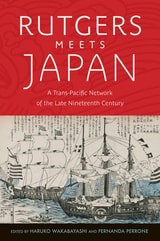
Rutgers Meets Japan
A Trans-Pacific Network of the Late Nineteenth CenturyHaruko Wakabayashi
Rutgers University Press, 2026
Griffis and Kusakabe were only a small piece of a vast transnational network of leading modernizers of Japan in the 1860s and 70s. The Japanese students in New Brunswick were young and innovative men of samurai and aristocratic lineage, who were sent by reform-minded leaders of Japan, which was undergoing a dramatic transformation. They came to New Brunswick seeking Western knowledge that was much needed for the modernization of a newly forming nation. New Brunswick became the hub of a network of Japanese nationals that extended to the major cities of New York, Philadelphia, and Boston, and from there to the smaller towns of New England. Once in New Brunswick, these Japanese students were embraced by Protestant ministers, educators, and missionaries—both men and women—whose network encompassed Rutgers College and the neighboring New Brunswick Theological Seminary, and which stretched to Dutch Reformed parishes throughout the Eastern seaboard, and westward as far as the Dutch enclave of Holland, Michigan. Meanwhile, the American teachers and missionaries who left for Japan became part of a network of reformist leaders and Japanese returnees that extended to schools, colleges, and missions in Japan, and formed the foundations of Japan’s modern educational system. Through contributions from scholars and archivists in the U.S., Canada, and Japan, Rutgers Meets Japan aims to reconstruct the early Rutgers-Japan connections and examine the role and impact of this transnational network on Japan and the U.S. in the late nineteenth century.
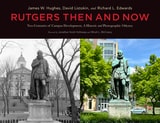
Rutgers Then and Now
Two Centuries of Campus Development: A Historic and Photographic OdysseyJames W. Hughes
Rutgers University Press, 2025
Rutgers, Then and Now tells this story, proceeding through ten sequential development phases of College Avenue and Piscataway campus expansions—each with its own buildings and physical layouts—that took place over the course of 250 years. It delivers stunning photographic and historic documentation of the growth of the university, showing “what it was and appeared originally” versus “what it is and looks like today.” Among other in-depth analyses, the book compares the diminutive geographic scale of today’s historical College Avenue Campus—once the entirety of Rutgers—to the much larger-sized (in acreage) Busch Campus. Replete with more than 500 images, the book also considers the Rutgers campuses that might have been, examining plans that were changed or abandoned. Shedding light on the sacrifices and gifts that transformed a small college into a vital hub for research and beloved home for students, it explores how Rutgers grew to become a world-class university.
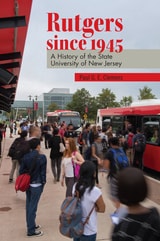
Rutgers since 1945
A History of the State University of New JerseyPaul G. E. Clemens with an essay by Carla Yanni
Rutgers University Press, 2015

Ruth Asawa
An Artist Takes ShapeSam Nakahira
J. Paul Getty Trust, The, 2024
Renowned for her innovative wire sculptures, Japanese American artist Ruth Asawa (1926–2013) was a teenager in Southern California when Japan bombed Pearl Harbor and the United States entered World War II. Japanese Americans on the West Coast were forcibly removed from their homes. Asawa’s family had to abandon their farm, her father was incarcerated, and she and the rest of her family were sent to a concentration camp. Asawa nurtured her dreams of becoming an artist while imprisoned and eventually made her way to the experimental Black Mountain College in North Carolina.
This graphic biography by Sam Nakahira, developed in consultation with Asawa’s youngest daughter, Addie Lanier, chronicles the genesis of Asawa as an artist—from the horror of Pearl Harbor to her transformative education at Black Mountain College to building a life in San Francisco, where she would further develop and refine her groundbreaking wire sculpture.
Asawa never sought fame, preferring to work on her own terms: for her, art and life were one. Featuring lively illustrations and photographs of Asawa’s work, this retelling of her young adult years demonstrates the power of making art.
Ages thirteen and up
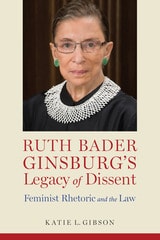
Ruth Bader Ginsburg’s Legacy of Dissent
Feminist Rhetoric and the LawKatie L. Gibson
University of Alabama Press, 2018
A rhetorical analysis of Justice Ruth Bader Ginsburg’s feminist jurisprudence.
Ruth Bader Ginsburg’s lifelong effort to reshape the language of American law has had profound consequences: she has shifted the rhetorical boundaries of jurisprudence on a wide range of fundamental issues from equal protection to reproductive rights. Beginning in the early 1970s, Ginsburg led a consequential attack on sexist law in the United States. By directly confronting the patriarchal voice of the law, she pointedly challenged an entrenched genre of legal language that silenced the voices and experiences of American women and undermined their status as equal citizens. On the United States Supreme Court, Justice Ginsburg continues to challenge the traditional scripts of legal discourse to insist on a progressive vision of the Constitution and to demand a more inclusive and democratic body of law.
This illuminating work examines Justice Ruth Bader Ginsburg’s contributions in reshaping the rhetoric of the law (specifically through the lens of watershed cases in women’s rights) and describes her rhetorical contributions—beginning with her work in the 1970s as a lawyer and an advocate for the ACLU’s Women’s Rights Project through her tenure as a Supreme Court justice. Katie L. Gibson examines Ginsburg’s rhetoric to argue that she has dramatically shifted the boundaries of legal language. Gibson draws from rhetorical theory, critical legal theory, and feminist theory to describe the law as a rhetorical genre, arguing that Ginsburg’s jurisprudence can appropriately be understood as a direct challenge to the traditional rhetoric of the law.
Ruth Bader Ginsburg stands as an incredibly important figure in late twentieth- and early twenty-first-century feminism. While a growing number of admirers celebrate Justice Ginsburg’s voice of dissent today, Ginsburg’s rhetorical legacy reveals that she has long articulated a sharp and strategic voice of judicial dissent. This study contributes to a more complete understanding of her feminist legacy by detailing the unique contributions of her legal rhetoric.
Ruth Ben-Ghiat
Intellectual Freedom in an Authoritarian AgeRuth Ben-Ghiat
Disobedience Press, 2026
In this lecture, Ruth Ben-Ghiat, an internationally renowned historian of fascism and authoritarian regimes past and present, stresses that universities have always been core targets of anti-democratic forces: “Strongmen disappear people, and they also disappear knowledge.” It’s an operation of noise and silence, she tells us. Aggressively take over institutions with the authoritarian worldview, hollow them out through “moral deregulation,” and bankrupt individuals by enticing them to distrust facts and betray their values. The goal, she argues, is to frighten civil society into silence in a coordinated attempt to stamp out dissent.
Ben-Ghiat speaks from experience: she had to deliver this talk, part of the University of Michigan’s yearly lecture devoted to academic freedom, on Zoom due to safety concerns.

Ruth Benedict
Stranger in This LandBy Margaret M. Caffrey
University of Texas Press, 1989
Poet, anthropologist, feminist—Ruth Fulton Benedict was all of these and much more. Born into the last years of the Victorian era, she came of age during the Progressive years and participated in inaugurating the modern era of American life. Ruth Benedict: Stranger in This Land provides an intellectual and cultural history of the first half of the twentieth century through the life of an important and remarkable woman.
As a Lyricist poet, Ruth Benedict helped define Modernism. As an anthropologist, she wrote the classic Patterns of Culture and at one point was considered the foremost anthropologist in the United States—the first woman ever to attain such status. She was an intellectual and an artist living in a time when women were not encouraged to be either. In this fascinating study, Margaret Caffrey attempts to place Benedict in the cultural matrix of her time and successfully shows the way in which Benedict was a product of and reacted to the era in which she lived.
Caffrey goes far beyond providing simple biographical material in this well-written interdisciplinary study. Based on exhaustive research, including access for the first time to the papers of Margaret Mead, Benedict's student and friend, Caffrey is able to put Benedict's life clearly in perspective. By identifying the family and educational influences that so sharply influenced Benedict's psychological makeup, the author also closely analyzes the currents of thought that were strong when Victorianism paralleled the Modernism that figured in Benedict's life work. The result is a richly detailed study of a gifted woman.
This important work will be of interest to students of Modernism, poetry, and women's studies, as well as to anthropologists.
Ruth Hall and Other Writings by Fanny Fern
Edited by Joyce W Warren
Rutgers University Press, 1986
Fanny Fern was one of the most popular American writers of the mid-nineteenth century, the first woman newspaper columnist in the United States, and the most highly paid newspaper writer of her day. This volume gathers together for the first time almost one hundred selections of her best work as a journalist. Writing on such taboo subjects as prostitution, venereal disease, divorce, and birth control, Fern stripped the façade of convention from some of society's most sacred institutions, targeting cant and hypocrisy, pretentiousness and pomp.
Fern portrays a mid-nineteenth century woman who becomes the incarnartion of the American individualist, something regarded as exclusively for men.
Ruthless Criticism
New Perspectives in U.S. Communication HistoryWilliam S. Solomon and Robert W. McChesney, Editors
University of Minnesota Press, 1993
Ruthless Criticism was first published in 1993. Minnesota Archive Editions uses digital technology to make long-unavailable books once again accessible, and are published unaltered from the original University of Minnesota Press editions.
Ruthless Criticism offers perspectives and subjects largely outside traditional historiography. It broadens the concept of media history to include lesser-studied media, and offers alternative interpretations of traditional media.
This anthology of original research includes an array of scholarly and theoretical perspectives. Each addresses specific topic within a specific era. reflecting the diversity of U.S. mass media.
Solomon and McChesney begin by using critical theory and deconstruction to examine the meanings of print in the colonial era. Subsequent chapters study the media ecology of the antebellum press; the intense focus on profits of the post-Civil War mainstream press; gender images in the labor press; the diversity of political views within the working-class press; and the development of a commercial press in the black community.
The essays concerning the twentieth century focus on the rise of a culture industry and include studies on the origins of the broadcast ratings system and the commercial broadcast system and the commercial broadcast system, early television's portrayals of childhood, the televisions networks' close ties with the federal government, the government's key role in creating and developing the field of mass communication research, and teenage girls' popular culture from 1960–1968 as a formative influence on the feminist movement.
Ruthless Hedonism
The American Reception of MatisseJohn O'Brian
University of Chicago Press, 1999
In this ambitious study, John O'Brian argues that Matisse's sober presentations of himself were calculated to fit with the social constraints and ideological demands of the times. Matisse's strategy included cooperating with museums, cultivating private collectors, playing off dealers one against another, and reassuring the media that, whatever his reputation as an avant-gardist, the conduct of his life was solidly bourgeois.
Moving from the late 1920s, when Matisse's output was shedding its outlaw reputation, to the early 1950s, when his work was canonized, O'Brian shows how the way Matisse's work was viewed changed as attention shifted away from the seductiveness of his subject matter to the seductiveness of his paint. The art's resolute rejection of political concerns, its deployment of decorative design for visual satisfaction, and its representations of pleasure encouraged American audiences, who in the 1930s deemed the art disreputable, to celebrate its gratifications by the early years of the Cold War.
This intriguing, wide-ranging investigation of Matisse's self-promotion, America's uneasy embrace of modernism, and America's consumer culture and politics provides a rich context to Clement Greenberg's words published in the Nation in 1947: "Matisse's cold hedonism and ruthless exclusion of everything but the concrete, immediate sensation will in the future, once we are away from the present Zeitgeist, be better understood as the most profound mood of the first half of the twentieth century."

Rx for Health Care Reform
Ken Terry
Vanderbilt University Press, 2007
raúlrsalinas and the Jail Machine
My Weapon Is My PenSelected writings by Raúl R. Salinas
University of Texas Press, 2006
Raúl R. Salinas is regarded as one of today's most important Chicano poets and human rights activists, but his passage to this place of distinction took him through four of the most brutal prisons in the country. His singular journey from individual alienation to rage to political resistance reflected the social movements occurring inside and outside of prison, making his story both personal and universal.
This groundbreaking collection of Salinas' journalism and personal correspondence from his years of incarceration and following his release provides a unique perspective into his spiritual, intellectual, and political metamorphosis. The book also offers an insider's view of the prison rebellion movement and its relation to the civil rights and anti-war movements of the 1960s and 1970s. The numerous letters between Salinas and his family, friends, and potential allies illustrate his burgeoning political awareness of the cause and conditions of his and his comrades' incarceration and their link to the larger political and historical web of social relations between dominant and subaltern groups. These collected pieces, as well as two interviews with Salinas—one conducted upon his release from prison in 1972, the second more than two decades later—reveal to readers the transformation of Salinas from a street hipster to a man seeking to be a part of something larger than himself. Louis Mendoza has painstakingly compiled a body of work that is autobiographical, politically insurgent, and representative.