Results by title
2018 books match the query 'Political aspects' and 103 start with r
Reichsrock
The International Web of White-Power and Neo-Nazi Hate MusicDyck, Kirsten
Rutgers University Press, 2016
Reimagining National Belonging
Post-Civil War El Salvador in a Global ContextRobin Maria DeLugan
University of Arizona Press, 2012
Examining events that unfolded between 1992 and 2011, DeLugan both illustrates the idiosyncrasies of state and society in El Salvador and opens a larger portal into conditions of constructing a state in the present day around the globe—particularly the process of democratization in an age of neoliberalism. She demonstrates how academics, culture experts, popular media, and the United Nations and other international agencies have all helped shape ideas about national belonging in El Salvador. She also reveals the efforts that have been made to include populations that might have been overlooked, including indigenous people and faraway citizens not living inside the country’s borders. And she describes how history and memory projects have begun to recall the nation’s violent past with the goal of creating a more just and equitable nation.
This illuminating case study fills a gap in the scholarship about culture and society in contemporary El Salvador, while offering an “ethnography of the state” that situates El Salvador in a global context.
Religion and the Politics of Time
Noah Shusterman
Catholic University of America Press, 2010
Remaindered Life
Neferti X. Tadiar
Duke University Press, 2022
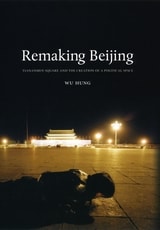
Remaking Beijing
Tiananmen Square and the Creation of a Political SpaceWu Hung
University of Chicago Press, 2005
Wu Hung grew up in Beijing and experienced much of the city's makeover firsthand. In this lavishly illustrated work, he offers a vivid, often personal account of the struggle over Beijing's reinvention, drawing particular attention to Tiananmen Square—the most sacred space in the People's Republic of China. Remaking Beijing considers the square's transformation from a restricted imperial domain into a public arena for political expression, from an epic symbol of socialism into a holy relic of the Maoist regime, and from an official and monumental complex into a site for unofficial and antigovernment demonstrations.
Wu Hung also explores how Tiananmen Square has become a touchstone for official art in modern China—as the site for Mao's monumental portrait, as the location of museums narrating revolutionary history, and as the grounds for extravagant National Day parades celebrating the revolutionary masses. He then shows how in recent years the square has inspired artists working without state sponsorship to create paintings, photographs, and even performances that reflect the spirit of the 1989 uprisings and pose a forceful challenge to official artworks and the sociopolitical system that supports them.
Remaking Beijing will reward anyone interested in modern Chinese history, society, and art, or, more generally, in how urban renewal becomes intertwined with cultural and national politics.
Remaking the Citizen for New Times
History, Pedagogy and the Amar Chitra KathaDeepa Sreenivas
Seagull Books, 2024
How does orthodoxy maintain its power over culture? In Remaking the Citizen for New Times, Deepa Sreenivas explores how the Amar Chitra Katha, a widely read comic series started in 1967 in India, influenced the historical and national consciousness of young readers in a conservative direction. Tacitly blaming Nehruvian welfarism of the time for the moral decline of the nation, the Amar Chitra Katha emerged as a literary articulation of the Indian right’s Hindu-nationalist ideology in a modern, bourgeois guise. To renew Hindutva hegemony, the comic series gave orthodox ideas a new sheen, both in its form and content, merging Western comic styles with Indian visual storytelling traditions on the one hand, and combining mythological characters with political figureheads into harmonious narratives on the other—making it difficult to sift history from myths and legends. Sreenivas deftly argues that these mythological-political tales emphasized the instructive rather than the informative potential of history, encouraging neoliberal values such as merit and hard work while ignoring caste or class as systemic issues.
Remembrance, History, and Justice
Coming to terms with traumatic pasts in democratic societiesBogdan C. Iacob
Central European University Press, 2015
Renegade Rhymes
Rap Music, Narrative, and Knowledge in TaiwanMeredith Schweig
University of Chicago Press, 2022
Like many states emerging from oppressive political rule, Taiwan saw a cultural explosion in the late 1980s, when nearly four decades of martial law under the Chinese Nationalist Party ended. As members of a multicultural, multilingual society with a complex history of migration and colonization, Taiwanese people entered this moment of political transformation eager to tell their stories and grapple with their identities. In Renegade Rhymes, ethnomusicologist Meredith Schweig shows how rap music has become a powerful tool in the post-authoritarian period for both exploring and producing new knowledge about the ethnic, cultural, and political history of Taiwan.
Schweig draws on extensive ethnographic fieldwork, taking readers to concert venues, music video sets, scenes of protest, and more to show how early MCs from marginalized ethnic groups infused rap with important aspects of their own local languages, music, and narrative traditions. Aiming their critiques at the educational system and a neoliberal economy, new generations of rappers have used the art form to nurture associational bonds and rehearse rituals of democratic citizenship, making a new kind of sense out of their complicated present.
Replace the State
How to Change the World When Elections and Protests FailSasha Davis
University of Minnesota Press, 2025
A practical call to action against oppression
Across the globe, millions of people have participated in protests and marches, donated to political groups, or lobbied their representatives with the aim of creating lasting social change, overturning repressive laws, or limiting environmental destruction. Yet very little seems to improve for those affected by rapacious governments. Replace the State brings new hope for social justice movements by looking to progressive campaigns that have found success by unconventional, and more direct, means.
Sasha Davis, an activist and scholar of radical environmental advocacy, focuses on the strategies of movements, many of them Indigenous, that have occupied contested sites and demonstrated their effectiveness at managing or governing them. Including case studies of resistance to development on Indigenous lands in Hawai‘i, nuclear testing in the Nevada desert, and the U.S. military occupation of Okinawa, he offers insight and direction for activists, students, academics, and others dedicated to protecting and improving the well-being of their communities and beyond.
It would be easy to succumb to pessimism and political apathy in the face of governing institutions that are increasingly unresponsive to calls for change and repressive in response to protest, even as they violate human rights, ignore existential climate catastrophes, and concentrate power into fewer and fewer hands. Instead, Davis finds inspiration for genuine political change through social movements that are successfully “replacing the state” and taking over the day-to-day governance of threatened places. From contesting environmental abuse to reasserting Indigenous sovereignty, these social movements demonstrate how people can collectively wrest control over their communities from oppressive governments and manage them with a more egalitarian ethics of care.
Retail e-book files for this title are screen-reader friendly with images accompanied by short alt text and/or extended descriptions.
Replaying Marc Anthony
Sonic, Political, and Cultural ResonancesFrances R. Aparicio
The Ohio State University Press, 2025
Reproduction, Globalization, and the State
New Theoretical and Ethnographic PerspectivesCarole H. Browner and Carolyn F. Sargent, eds.
Duke University Press, 2011
Contributors. Aditya Bharadwaj, Caroline H. Bledsoe, Carole H. Browner, Junjie Chen, Aimee R. Eden, Susan L. Erikson, Didier Fassin, Claudia Lee Williams Fonseca, Ellen Gruenbaum, Matthew Gutmann, Marcia C. Inhorn, Mark B. Padilla, Rayna Rapp, Lisa Ann Richey, Carolyn Sargent, Papa Sow, Cecilia Van Hollen, Linda Whiteford
Resistance on the National Stage
Theater and Politics in Late New Order IndonesiaMichael H. Bodden
Ohio University Press, 2010
Resistance on the National Stage analyzes the ways in which, between 1985 and 1998, modern theater pracxadtitioners in Indonesia contributed to a rising movement of social protest against the long-governing New Order regime of President Suharto. It examines the work of an array of theater groups and networks from Jakarta, Bandung, and Yogyakarta that pioneered new forms of theater-making and new themes that were often presented more directly and critically than previous groups had dared to do.
Michael H. Bodden looks at a wide range of case studies to show how theater contributed to and helped build the opposition. He also looks at how specific combinations of social groups created tensions and gave modern theater a special role in bridging social gaps and creating social networks that expanded the reach of the prodemocracy movement. Theater workers constructed new social networks by involving peasants, Muslim youth, industrial workers, and lower-middle-class slum dwellers in theater productions about their own lives. Such networking and resistance established theater as one significant arena in which the groundwork for the ouster of Suharto in May 1998, and the succeeding Reform era, was laid.
Resistance on the National Stage will have broad appeal, not only for scholars of contemporary Indonesian culture and theater, but also for those interested in Indonesian history and politics, as well as scholars of postcolonial theater and culture.
Resisting Extractivism
Peruvian Gold, Everyday Violence, and the Politics of AttentionMichael Wilson Becerril
Vanderbilt University Press, 2021
Peru is classified as one of the deadliest countries in the world for environmental defenders, where activists face many forms of violence. Through an ethnographic and systematic comparison of four gold-mining conflicts in Peru, Resisting Extractivism presents a vivid account of subtle and routine forms of violence, analyzing how meaning-making practices render certain types of damage and suffering noticeable while occluding others. The book thus builds a theory of violence from the ground up—how it is framed, how it impacts people’s lived experiences, and how it can be confronted. By excavating how the everyday interactions that underlie conflicts are discursively concealed and highlighted, this study assists in the prevention and transformation of violence over resource extraction in Latin America.
The book draws on a controlled, qualitative comparison of four case studies, extensive ethnographic research conducted over fourteen months of fieldwork, analysis of over nine hundred archives and documents, and unprecedented access to more than 250 semi-structured interviews with key actors across industry, the state, civil society, and the media. Michael Wilson Becerril identifies, traces, and compares these dynamics to explain how similar cases can lead to contrasting outcomes—insights that may be usefully applied in other contexts to save lives and build better futures.
Resisting Spirits
Drama Reform and Cultural Transformation in the People's Republic of ChinaMaggie Greene
University of Michigan Press, 2019
Resonant Violence
Affect, Memory, and Activism in Post-Genocide SocietiesKerry Whigham
Rutgers University Press, 2022
Resource Radicals
From Petro-Nationalism to Post-Extractivism in EcuadorThea Riofrancos
Duke University Press, 2020
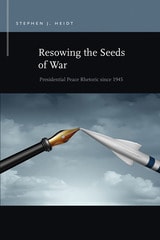
Resowing the Seeds of War
Presidential Peace Rhetoric since 1945Stephen J. Heidt
Michigan State University Press, 2021
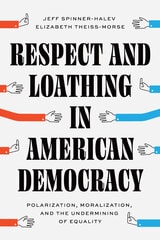
Respect and Loathing in American Democracy
Polarization, Moralization, and the Undermining of EqualityJeff Spinner-Halev and Elizabeth Theiss-Morse
University of Chicago Press, 2024
A deep examination of why respect is in short supply in politics today and why it matters.
Respect is in trouble in the United States. Many Americans believe respecting others is a necessary virtue, yet many struggle to respect opposing partisans. Surprisingly, it is liberal citizens, who hold respect as central to their view of democratic equality, who often have difficulty granting respect to others. Drawing on evidence from national surveys, focus groups, survey experiments, and the views of political theorists, Jeff Spinner-Halev and Elizabeth Theiss-Morse explain why this is and why respect is vital to—and yet so lacking in—contemporary US politics.
Respect and Loathing in American Democracy argues that liberals and conservatives are less divided than many believe, but alienate one another because they moralize different issues. Liberals moralize social justice, conservatives champion national solidarity, and this worldview divide keeps them at odds.
Respect is both far-reaching and vital, yet it is much harder to grant than many recognize, partly because of the unseen tension between respect, social justice, and national solidarity. Respect and Loathing in American Democracy proposes a path forward that, while challenging, is far from impossible for citizens to traverse.
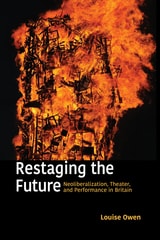
Restaging the Future
Neoliberalization, Theater, and Performance in BritainLouise Owen
Northwestern University Press, 2023
Post-Thatcher, British cultural politics were shaped by the government’s use of the arts in service of its own social and economic agenda. Restaging the Future: Neoliberalization, Theater, and Performance in Britain interrogates how arts practices and cultural institutions were enmeshed with the particular processes of neoliberalization mobilized at the end of the twentieth century and into the twenty-first.
Louise Owen traces the uneasy entanglement of performance with neoliberalism's marketization of social life. Focusing on this political moment, Owen guides readers through a wide range of performance works crossing multiple forms, genres, and spaces—from European dance tours, to Brazilian favelas, to the streets of Liverpool—attending to their distinct implications for the reenvisioned future in whose wake we now live.
Analyzing this array of participatory dance, film, music, public art, and theater projects, Owen uncovers unexpected affinities between community-based, experimental, and avant-garde movements. Restaging the Future provides key historical context for these performances, their negotiations of their political moment, and their themes of insecurity, identity, and inequality, created in a period of profound ideological and socioeconomic change.
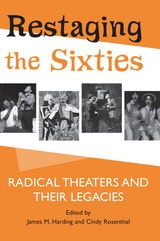
Restaging the Sixties
Radical Theaters and Their LegaciesEdited by James M. Harding and Cindy Rosenthal
University of Michigan Press, 2006
The volume explores how creations such as the Living Theatre's Paradise Now and the Performance Group’s Dionysus in 69 overlapped with political interests that, in the late 1960s, highlighted the notion of social collectives as a radical alternative to mainstream society. Situating theatrical practice within this socio-political context, the book considers how radical theaters sought to redefine the relationship between theater and political activism, and how, as a result, they challenged the foundations of theater itself.
James M. Harding is Associate Professor of English at Mary Washington University. His other books include Not the Other Avant-Garde: The Transnational Foundations of Avant-Garde Performance.
Cindy Rosenthal is Associate Professor of Theatre Studies, Hofstra University.
“A useful introduction to an eclectic period of experimental theater, providing portraits of the major political theaters and engaging with new vigor many of the era’s familiar aesthetic and ideological concerns. The writers offer a provocative history of theater’s attraction to (and occasional anxiety over) activism.”
--Marc Robinson, Yale University
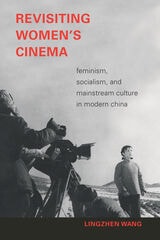
Revisiting Women's Cinema
Feminism, Socialism, and Mainstream Culture in Modern ChinaLingzhen Wang
Duke University Press, 2021
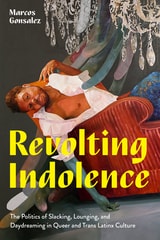
Revolting Indolence
The Politics of Slacking, Lounging, and Daydreaming in Queer and Trans Latinx CultureMarcos Gonsalez
University of Texas Press, 2024
2026 Bronze Medal for the Best LGBTQ+ Themed Book, Conference on Latin American History (CLAH)
2025 Honorable Mention, John Leo & Dana Heller Award for Best Single Work, Anthology, Multi-Authored, or Edited Book in LGBTQ Studies, Popular Culture Association (PCA)
2025 Honorable Mention, Alan Bray Memorial Book Prize, GL/Q Caucus of the Modern Language Association and the Q/T Caucus of the American Studies Association
How indolent practices in Latinx LGBTQ culture challenge capitalist imperatives to be productive.
Revolting Indolence makes a case for laziness as an aesthetic-political strategy for countering the oppressive logics of cisheteronormative racial capitalism. Focusing on ways in which queer and trans Latinx people demonstrate the unwillingness of their participation in “productivist” ethics and allied respectability politics, Marcos Gonsalez argues that slacking off, lounging, daydreaming, and partying are liberatory practices—revolts that in turn are treated as revolting.
Gonsalez explores how queer and trans Latinx artists refute discourses in which work is a moral good. In Paris Is Burning, RuPaul's Drag Race, documentary photography of queer and trans Latinx life in Los Angeles, and other sources, Gonsalez identifies two lazy styles: first, flagrant refusals of work that critique capitalist reason; and second, the invention of alternative aesthetic worlds beyond racial capitalism and violence targeting queer and trans people, whose rejection of the cisgender nuclear family paradigm is rightly seen as threatening the stability of a functioning capitalist system. Reclaiming laziness as a resource for radical imagining, Revolting Indolence asks us to do that which we want most and which capitalist exploitation can least tolerate: to slow down.
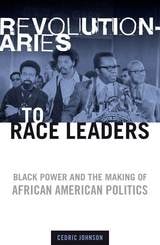
Revolutionaries to Race Leaders
Black Power and the Making of African American PoliticsCedric Johnson
University of Minnesota Press, 2007
The Black Power movement represented a key turning point in American politics. Disenchanted by the hollow progress of federal desegregation during the 1960s, many black citizens and leaders across the United States demanded meaningful self-determination. The popular movement they created was marked by a vigorous artistic renaissance, militant political action, and fierce ideological debate.
Exploring the major political and intellectual currents from the Black Power era to the present, Cedric Johnson reveals how black political life gradually conformed to liberal democratic capitalism and how the movement’s most radical aims—the rejection of white aesthetic standards, redefinition of black identity, solidarity with the Third World, and anticapitalist revolution—were gradually eclipsed by more moderate aspirations. Although Black Power activists transformed the face of American government, Johnson contends that the evolution of the movement as a form of ethnic politics restricted the struggle for social justice to the world of formal politics.
Johnson offers a compelling and theoretically sophisticated critique of the rhetoric and strategies that emerged in this period. Drawing on extensive archival research, he reinterprets the place of key intellectual figures, such as Harold Cruse and Amiri Baraka, and influential organizations, including the African Liberation Support Committee, the National Black Political Assembly, and the National Black Independent Political Party in postsegregation black politics, while at the same time identifying the contradictions of Black Power radicalism itself.
Documenting the historical retreat from radical, democratic struggle, Revolutionaries to Race Leaders ultimately calls for the renewal of popular struggle and class-conscious politics.
Cedric Johnson is assistant professor of political science at Hobart and William Smith Colleges.

Revolutionary Medicine
Health and the Body in Post-Soviet CubaP. Sean Brotherton
Duke University Press, 2012
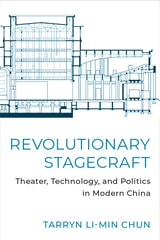
Revolutionary Stagecraft
Theater, Technology, and Politics in Modern ChinaTarryn Li-Min Chun
University of Michigan Press, 2024
2026 NYU Joe Callaway Prize Winner
- 2025 Association for Theatre in Higher Education Outstanding Book Award in Innovative Achievement Winner
- 2024 Theatre Library Association George Freedley Memorial Award Co-Winner
- American Society for Theatre Research Barnard Hewitt Award for Outstanding Research in Theatre History Finalist
Revolutionary Stagecraft draws on a rich corpus of literary, historical, and technical materials to reveal a deep entanglement among technological modernization, political agendas, and the performing arts in modern China. This unique approach to Chinese theater history combines a close look at plays themselves, performance practices, technical theater details, and behind-the-scenes debates over “how to” make theater amid the political upheavals of China’s 20th century. The book begins at a pivotal moment in the 1920s—when Chinese theater artists began to import, use, and write about modern stage equipment—and ends in the 1980s when China's scientific and technological boom began. By examining iconic plays and performances from the perspective of the stage technologies involved, Tarryn Li-Min Chun provides a fresh perspective on their composition and staging. The chapters include stories on the challenges of creating imitation neon, rigging up a makeshift revolving stage, and representing a nuclear bomb detonating onstage.
In thinking about theater through technicity, the author mines well-studied materials such as dramatic texts and performance reviews for hidden technical details and brings to light a number of previously untapped sources such as technical journals and manuals; set design renderings, lighting plots, and prop schematics; and stage technology how-to guides for amateur thespians. This approach focuses on material stage technologies, situating these objects equally in relation to their technical potential, their human use, and the social, political, economic, and cultural forces that influence them. In each of its case studies, Revolutionary Stagecraft reveals the complex and at times surprising ways in which Chinese theater artists and technicians of the 20th century envisioned and enacted their own revolutions through the materiality of the theater apparatus.
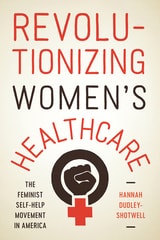
Revolutionizing Women's Healthcare
The Feminist Self-Help Movement in AmericaHannah Dudley-Shotwell
Rutgers University Press, 2020
Revolutionizing Women’s Healthcare is the story of a feminist experiment: the self-help movement. This movement arose out of women’s frustration, anger, and fear for their health. Tired of visiting doctors who saw them as silly little girls, suffering shame when they asked for birth control, seeking abortions in back alleys, and holding little control over their own reproductive lives, women took action. Feminists created “self-help groups” where they examined each other’s bodies and read medical literature. They founded and ran clinics, wrote books, made movies, undertook nationwide tours, and raided and picketed offending medical institutions. Some performed their own abortions. Others swore off pharmaceuticals during menopause. Lesbian women found “at home” ways to get pregnant. Black women used self-help to talk about how systemic racism affected their health. Hannah Dudley-Shotwell engagingly chronicles these stories and more to showcase the creative ways women came together to do for themselves what the mainstream healthcare system refused to do.
Revolutions of Capitalism
The Politics of the EventMaurizio Lazzarato. Translated by Brian Whitener and Geo Maher.
Duke University Press, 2026
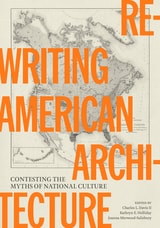
Rewriting American Architecture
Contesting the Myths of National CultureEdited by Charles L. Davis II, Kathryn E. Holliday, and Joanna Merwood-Salisbury
University of Texas Press, 2026
A critical reassessment of nineteenth‑century American architecture that uncovers how race, settler colonialism, and contested national identities shaped the built environment and its historiography.
Rewriting American Architecture offers a revisionist riposte to the canonical story of nineteenth-century American architecture. Drawing on new archival research and revisionist historiography, the essays in this volume reveal how American architecture was shaped not by inevitable progress toward a unified national culture but by the turbulent realities of race, labor, settler colonialism, and territorial expansion. Rather than treating architecture as an apolitical aesthetic expression, the contributors expose it as an active arena in which the meanings of nationhood were constructed, contested, and often violently enforced. From Indigenous spatial practices and Black institutional building to transnational exchanges and the racial politics embedded in professionalization, this collection reframes the built environment as central to the competing cultural, political, and geographic claims that defined the United States during this period.
Rhetoric and Demagoguery
Patricia Roberts-Miller
Southern Illinois University Press, 2019
In a culture of profit-driven media, demagoguery is a savvy short-term rhetorical strategy. Once it becomes the norm, individuals are more likely to employ it and, in that way, increase its power by making it seem the only way of disagreeing with or about others. When that happens, arguments about policy are replaced by arguments about identity—and criticism is met with accusations that the critic has the wrong identity (weak, treacherous, membership in an out-group) or the wrong feelings (uncaring, heartless).
Patricia Roberts-Miller proposes a definition of demagoguery based on her study of groups and cultures that have talked themselves into disastrously bad decisions. She argues for seeing demagoguery as a way for people to participate in public discourse, and not necessarily as populist or heavily emotional. Demagoguery, she contends, depoliticizes political argument by making all issues into questions of identity. She broaches complicated questions about its effectiveness at persuasion, proposes a new set of criteria, and shows how demagoguery plays out in regard to individuals not conventionally seen as demagogues.
Roberts-Miller looks at the discursive similarities among the Holocaust in early twentieth-century Germany, the justification of slavery in the antebellum South, the internment of Japanese Americans in the United States during World War II, and the U.S.-led invasion of Iraq in 2003, among others. She examines demagoguery among powerful politicians and jurists (Earl Warren, chief justice of the U.S. Supreme Court) as well as more conventional populists (Theodore Bilbo, two-time governor of Mississippi; E. S. Cox, cofounder of the Anglo-Saxon Clubs of America). She also looks at notorious demagogues (Athenian rhetor Cleon, Ann Coulter) and lesser-known public figures (William Hak-Shing Tam, Gene Simmons).
Rhetoric and Guns
Lydia Wilkes
Utah State University Press, 2021
Guns hold a complex place in American culture. Over 30,000 Americans die each year from gun violence, and guns are intimately connected to issues of public health, as is evident whenever a mass shooting occurs. But guns also play an important role in many Americans’ lives that is not reducible to violence and death—as tools, sporting equipment, and identity markers. They are also central to debates about constitutional rights, as seen in ongoing discussions about the Second Amendment, and they are a continuous source of legislative concern, as apparent in annual ratings of gun-supporting legislators.
Even as guns are wrapped up with other crucial areas of concern, they are also fundamentally a rhetorical concern. Guns and gun violence occupy a unique rhetorical space in the United States, one characterized by silent majorities, like most gun owners; vocal minorities, like the firearm industry and gun lobby; and a stalemate that fails to stem the flood of the dead. How Americans talk, deliberate, and fight about guns is vital to how guns are marketed, used, and regulated. A better understanding of the rhetorics of guns and gun violence can help Americans make better arguments about them in the world. However, where guns are concerned, rhetorical studies is not terribly different from American culture more generally. Guns are ever-present and exercise powerful effects, but they are commonly talked about in oblique, unsystematic ways.
Rhetoric and Guns advances more direct, systematic engagement in the field and beyond by analyzing rhetoric about guns, guns in rhetoric, and guns as rhetoric, particularly as they relate to specific instances of guns in culture. The authors attempt to understand rhetoric’s relationship to guns by analyzing rhetoric about guns and how they function in and as rhetoric related to specific instances—in media coverage, political speech, marketing, and advertising. Original chapters from scholars in rhetorical studies, communication, education, and related fields elucidate how rhetoric is used to maintain and challenge the deadly status quo of gun violence in the United States and extend rhetoricians’ sustained interest in the fields’ relationships to violence, brutality, and atrocity.
Contributors: Ira J. Allen, Brian Ballentine, Matthew Boedy, Peter Buck, Lisa Corrigan, Rosa Eberly, Kendall Gerdes, Ian E. J. Hill, Nathalie Kuriowa-Lewis, Patricia Roberts-Miller, Craig Rood, Bradley Serber, Catherine R. Squires, Scott Gage
Rhetoric and the Republic
Politics, Civic Discourse, and Education in Early AmericaMark Garrett Longaker
University of Alabama Press, 2007
Rhetoric, Independence, and Nationhood, 1760–1800, Volume II
Stephen E Lucas
Michigan State University Press, 2022
Rhetorical Education In America
Cheryl Jean Glenn
University of Alabama Press, 2009
A timely collection of essays by prominent scholars in the field—on the past, present, and future of rhetoric instruction.
From Isocrates and Aristotle to the present, rhetorical education has consistently been regarded as the linchpin of a participatory democracy, a tool to foster civic action and social responsibility. Yet, questions of who should receive rhetorical education, in what form, and for what purpose, continue to vex teachers and scholars.
The essays in this volume converge to explore the purposes, problems, and possibilities of rhetorical education in America on both the undergraduate and graduate levels and inside and outside the academy. William Denman examines the ancient model of the "citizen-orator" and its value to democratic life. Thomas Miller argues that English departments have embraced a literary-research paradigm and sacrificed the teaching of rhetorical skills for public participation. Susan Kates explores how rhetoric is taught at nontraditional institutions, such as Berea College in Kentucky, where Appalachian dialect is espoused. Nan Johnson looks outside the academy at the parlor movement among women in antebellum America. Michael Halloran examines the rhetorical education provided by historical landmarks, where visitors are encouraged to share a common public discourse. Laura Gurak presents the challenges posed to traditional notions of literacy by the computer, the promises and dangers of internet technology, and the necessity of a critical cyber-literacy for future rhetorical curricula.
Collectively, the essays coalesce around timely political and cross-disciplinary issues. Rhetorical Education in America serves to orient scholars and teachers in rhetoric, regardless of their disciplinary home, and help to set an agenda for future classroom practice and curriculum design.
Rhetorics of Whiteness
Postracial Hauntings in Popular Culture, Social Media, and EducationEdited by Tammie M. Kennedy, Joyce Irene Middleton, Krista Ratcliffe, with a foreword by Lilia D. Monzó and Peter McLaren
Southern Illinois University Press, 2017
With the election of our first black president, many Americans began to argue that we had finally ended racism, claiming that we now live in a postracial era. Yet near-daily news reports regularly invoke white as a demographic category and recount instances of racialized violence as well as an increased sensitivity to expressions of racial unrest. Clearly, American society isn’t as color-blind as people would like to believe. In Rhetorics of Whiteness: Postracial Hauntings in Popular Culture, Social Media, and Education, contributors reveal how identifications with racialized whiteness continue to manifest themselves in American culture.
The sixteen essays that comprise this collection not only render visible how racialized whiteness infiltrates new twenty-first-century discourses and material spaces but also offer critical tactics for disrupting this normative whiteness. Specifically, contributors examine popular culture (novels, films, TV), social media (YouTube, eHarmony, Facebook), education (state law, the textbook industry, dual credit programs), pedagogy (tactics for teaching via narratives, emotional literacy, and mindfulness) as well as cultural theories (concepts of racialized space, anti-dialogicism, and color blindness). Offering new approaches to understanding racialized whiteness, this volume emphasizes the importance of a rhetorical lens for employing whiteness studies’ theories and methods to identify, analyze, interpret, and interrupt representations of whiteness.
Although whiteness studies has been waning as an active research field for the past decade, the contributors to Rhetorics of Whiteness assert that it hasn’t lost its relevancy because racialized whiteness and issues of systemic racism persist in American society and culture today. Few whiteness studies texts have been published in rhetoric and composition in the past decade, so this collection should quickly become mandatory reading. By focusing on common, yet often overlooked, contemporary examples of how racialized whiteness haunts U.S. society, Rhetorics of Whiteness serves as a valuable text for scholars in the field as well as anyone else interested in the topic.
Righting the American Dream
How the Media Mainstreamed Reagan's Evangelical VisionDiane Winston
University of Chicago Press, 2023
After two years in the White House, an aging and increasingly unpopular Ronald Reagan looked like a one-term president, but in 1983 something changed. Reagan spoke of his embattled agenda as a spiritual rather than a political project and cast his vision for limited government and market economics as the natural outworking of religious conviction. The news media broadcast this message with enthusiasm, and white evangelicals rallied to the president’s cause. With their support, Reagan won reelection and continued to dismantle the welfare state, unraveling a political consensus that stood for half a century.
In Righting the American Dream, Diane Winston reveals how support for Reagan emerged from a new religious vision of American identity circulating in the popular press. Through four key events—the “evil empire” speech, AIDS outbreak, invasion of Grenada, and rise in American poverty rates—Winston shows that many journalists uncritically adopted Reagan’s religious rhetoric and ultimately mainstreamed otherwise unpopular evangelical ideas about individual responsibility. The result is a provocative new account of how Reagan together with the press turned America to the right and initiated a social revolution that continues today.
Rings of Dissent
Boxing and Performances of RebellionEdited by Rudy Mondragón, Gaye Theresa Johnson, and David J. Leonard
University of Illinois Press, 2025
Rio as Method
Collective Resistance for a New GenerationPaul Amar, editor
Duke University Press, 2024
Contributors. Rosiane Rodrigues de Almeida, José Claudio Souza Alves, Tamires Maria Alves, Paul Amar, Marcelo Caetano Andreoli, Beatriz Bissio, Thaddeus Gregory Blanchette, Fernando Brancoli, Thayane Brêtas, Victoria Broadus, Fatima Cecchetto, Leonard Cortana, Marcos Coutinho, Monica Cunha, Luiz Henrique Eloy Amado, Marielle Franco, Cristiane Gomes Julião, Benjamin Lessing, Roberto Kant de Lima, Amanda De Lisio, Bryan McCann, Flávia Medeiros, Ana Paula Mendes de Miranda, Sean T. Mitchell, Rodrigo Monteiro, Vitória Moreira, Jacqueline de Oliveira Muniz, Laura Rebecca Murray, Cesar Pinheiro Teixeira, Osmundo Pinho, Paulo Pinto, María Victoria Pita, João Gabriel Rabello Sodré, Luciane Rocha, Marcos Alexandre dos Santos Albuquerque, Ana Paula da Silva, Denise Ferreira da Silva, Soraya Simões, Indianare Siqueira, Antonio Carlos de Souza Lima, Leonardo Vieira Silva

Riot Report and the News
How the Kerner Commission Changed Media Coverage of Black AmericaHrach Thomas J
University of Massachusetts Press, 0
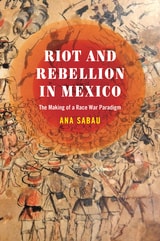
Riot and Rebellion in Mexico
The Making of a Race War ParadigmAna Sabau
University of Texas Press, 2022
2023 Best Book in the Humanities, Latin American Studies Association Mexico Section
Challenging conventional narratives of Mexican history, this book establishes race-making as a central instrument for the repression of social upheaval in nineteenth-century Mexico rather than a relic of the colonial-era caste system.
Many scholars assert that Mexico’s complex racial hierarchy, inherited from Spanish colonialism, became obsolete by the turn of the nineteenth century as class-based distinctions became more prominent and a largely mestizo population emerged. But the residues of the colonial caste system did not simply dissolve after Mexico gained independence. Rather, Ana Sabau argues, ever-present fears of racial uprising among elites and authorities led to persistent governmental techniques and ideologies designed to separate and control people based on their perceived racial status, as well as to the implementation of projects for development in fringe areas of the country.
Riot and Rebellion in Mexico traces this race-based narrative through three historical flashpoints: the Bajío riots, the Haitian Revolution, and the Yucatán’s caste war. Sabau shows how rebellions were treated as racially motivated events rather than political acts and how the racialization of popular and indigenous sectors coincided with the construction of “whiteness” in Mexico. Drawing on diverse primary sources, Sabau demonstrates how the race war paradigm was mobilized in foreign and domestic affairs and reveals the foundations of a racial state and racially stratified society that persist today.
Rivalry and Reform
Presidents, Social Movements, and the Transformation of American PoliticsSidney M. Milkis and Daniel J. Tichenor
University of Chicago Press, 2019
Rivalry and Reform explores the relationship between presidents and social movements throughout history and into the present day, revealing the patterns that emerge from the epic battles and uneasy partnerships that have profoundly shaped reform. Through a series of case studies, including Abraham Lincoln and abolitionism, Lyndon Johnson and the civil rights movement, and Ronald Reagan and the religious right, Sidney M. Milkis and Daniel J. Tichenor argue persuasively that major political change usually reflects neither a top-down nor bottom-up strategy but a crucial interplay between the two. Savvy leaders, the authors show, use social movements to support their policy goals. At the same time, the most successful social movements target the president as either a source of powerful support or the center of opposition. The book concludes with a consideration of Barack Obama’s approach to contemporary social movements such as Black Lives Matter, United We Dream, and Marriage Equality.
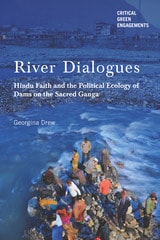
River Dialogues
Hindu Faith and the Political Ecology of Dams on the Sacred GangaGeorgina Drew
University of Arizona Press, 2017
India’s sacred Ganga River is arguably one of the most iconic sites for worship, with a continuity of rituals for the living and the dead that span over two millennia. Along the river, from high in the Himalaya to the vast plains below, people gather daily to worship the Ganga through prayer and song. But large government-sponsored dams threaten to upend these practices.
In River Dialogues, Georgina Drew offers a detailed ethnographic engagement with the social movements contesting hydroelectric development on the Ganga. The book examines the complexity of the cultural politics that, on the one hand, succeeded in influencing an unprecedented reversal of government plans for three contested hydroelectric projects, and how, on the other hand, this decision sparked ripples of discontent after being paired with the declaration of a conservation zone where the projects were situated.
The book follows the work of women who were initially involved in efforts to stop the disputed projects. After looking to their discourses and actions, Drew argues for the use of a political ecology analysis that incorporates the everyday practice and everyday religious connections that animated the cultural politics of development. Drew offers a nuanced understanding of the struggles that communities enact to assert their ways of knowing and caring for resources that serves as an example for others critically engaging with the growing global advocacy of the “green economy” model for environmental stewardship.

River of Hope
Forging Identity and Nation in the Rio Grande BorderlandsOmar S. Valerio-Jiménez
Duke University Press, 2012
Diverse influences transformed the borderlands as Spain, Mexico, and the United States competed for control of the region. Indian slaves joined Spanish society; Mexicans allied with Indians to defend river communities; Anglo Americans and Mexicans intermarried and collaborated; and women sued to confront spousal abuse and to secure divorces. Drawn into multiple conflicts along the border, Mexican nationals and Mexican Texans (tejanos) took advantage of their transnational social relations and ambiguous citizenship to escape criminal prosecution, secure political refuge, and obtain economic opportunities. To confront the racialization of their cultural practices and their increasing criminalization, tejanos claimed citizenship rights within the United States and, in the process, created a new identity.
Published in cooperation with the William P. Clements Center for Southwest Studies, Southern Methodist University.

River of Tears
Country Music, Memory, and Modernity in BrazilAlexander Sebastian Dent
Duke University Press, 2009
Since 1998, Alexander Sebastian Dent has analyzed rural music in the state of São Paulo, interviewing and spending time with listeners, musicians, songwriters, journalists, record-company owners, and radio hosts. Dent not only describes the production and reception of this music, he also explains why the genre experienced such tremendous growth as Brazil transitioned from an era of dictatorship to a period of intense neoliberal reform. Dent argues that rural genres reflect a widespread anxiety that change has been too radical and has come too fast. In defining their music as rural, Brazil’s country musicians—whose work circulates largely in cities—are criticizing an increasingly inescapable urban life characterized by suppressed emotions and an inattentiveness to the past. Their performances evoke a river of tears flowing through a landscape of loss—of love, of life in the countryside, and of man’s connections to the natural world.

Rock | Water | Life
Ecology and Humanities for a Decolonial South AfricaLesley Green
Duke University Press, 2020
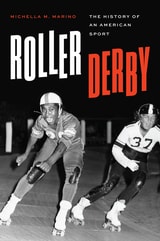
Roller Derby
The History of an American SportBy Michella M. Marino
University of Texas Press, 2021
Since 1935, roller derby has thrilled fans and skaters with its constant action, hard hits, and edgy attitude. However, though its participants’ athleticism is undeniable, roller derby has never been accepted as a “real” sport. Michella M. Marino, herself a former skater, tackles the history of a sport that has long been a cultural mainstay for one reason both utterly simple and infinitely complex: roller derby has always been coed.
Richly illustrated and drawing on oral histories, archival materials, media coverage, and personal experiences, Roller Derby is the first comprehensive history of this cultural phenomenon, one enjoyed by millions yet spurned by mainstream gatekeepers. Amid the social constraints of the mid-twentieth century, roller derby’s emphasis on gender equality attracted male and female athletes alike, producing gender relations and gender politics unlike those of traditional sex-segregated sports. In an enlightening feminist critique, Marino considers how the promotion of pregnancy and motherhood by roller derby management has simultaneously challenged and conformed to social norms. Finally, Marino assesses the sport’s present and future after its resurgence in the 2000s.
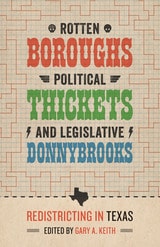
Rotten Boroughs, Political Thickets, and Legislative Donnybrooks
Redistricting in TexasEdited by Gary A. Keith
University of Texas Press, 2013
Every ten years, the Texas legislature redistricts itself and the state’s congressional districts in an attempt to ensure equality in representation. With a richly textured cultural fabric, Texas often experiences redistricting battles that are heated enough to gain national attention. Collecting a variety of voices, including legislators themselves, in addition to lawyers, community organizers, political historians, and political scientists, Rotten Boroughs, Political Thickets, and Legislative Donnybrooks delivers a multidimensional picture of how redistricting works in Texas today, and how the process evolved.
In addition to editor Gary Keith’s historical narrative, which emphasizes the aftermath of the Warren Court’s redistricting decisions, longtime litigators David Richards and J. D. Pauerstein describe the contentious lines drawn from the 1970s into the 2000s. Former state legislator and congressman Craig Washington provides an insider’s view, while redistricting attorney and grassroots organizer Jose Garza describes the repercussions for Mexican Americans in Texas. Balancing these essays with a quantitative perspective, political scientists Seth McKee and Mark McKenzie analyze the voting data for the 2000 decade to describe the outcomes of redistricting. The result is a timely tour that provides up-to-date context, particularly on the role of the Voting Rights Act in the twenty-first century. From local community engagement to the halls of the Capitol, this is the definitive portrait of redistricting and its repercussions for all Texans.
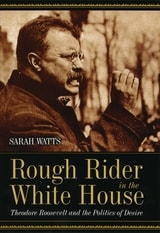
Rough Rider in the White House
Theodore Roosevelt and the Politics of DesireSarah Watts
University of Chicago Press, 2003
In this book, Sarah Watts probes this dark side of the Rough Rider, presenting a fascinating psychological portrait of a man whose personal obsession with masculinity profoundly influenced the fate of a nation. Drawing on his own writings and on media representations of him, Watts attributes the wide appeal of Roosevelt's style of manhood to the way it addressed the hopes and anxieties of men of his time. Like many of his contemporaries, Roosevelt struggled with what it meant to be a man in the modern era. He saw two foes within himself: a fragile weakling and a primitive beast. The weakling he punished and toughened with rigorous, manly pursuits such as hunting, horseback riding, and war. The beast he unleashed through brutal criticism of homosexuals, immigrants, pacifists, and sissies—anyone who might tarnish the nation's veneer of strength and vigor. With his unabashed paeans to violence and aggressive politics, Roosevelt ultimately offered American men a chance to project their longings and fears onto the nation and its policies. In this way he harnessed the primitive energy of men's desires to propel the march of American civilization—over the bodies of anyone who might stand in its way.
Written with passion and precision, this powerful revisioning of an American icon will forever alter the way we see Theodore Roosevelt and his political legacy.
"A superb scholarly study of how Roosevelt built his political base on the aspiration and fears of men in a rapidly changing nation and world."—Charles K. Piehl, Library Journal
"A thought-provoking and innovative study of the dark side of Roosevelt's personality. . . . [Watt's] arguments are clear, passionate, and thoroughly supported."—Elizabeth A. Bennion, Journal of Interdisciplinary History
Royal Apologetic in the Ancient Near East
Andrew Knapp
SBL Press, 2015
A fresh exploration of apologetic material that pushes beyond form criticism
Andrew Knapp applies modern genre theory to seven ancient Near Eastern royal apologies that served to defend the legitimacy of kings who came to power under irregular circumstances. Knapp examines texts and inscriptions related to Telipinu, Hattusili III, David, Solomon, Hazael, Esarhaddon, and Nabonidus to identify transhistorical common issues that unite each discourse.
Features:
- Compares Hittite, Israelite, Aramean, Assyrian, and Babylonian apologies
- Examination of apologetic as a mode instead of a genre
- Charts and illustrations
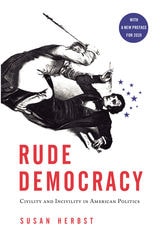
Rude Democracy
Civility and Incivility in American PoliticsAuthored by Susan Herbst
Temple University Press, 2020
Democracy is, by its very nature, often rude. But there are limits to how uncivil we should be. In her timely and important book, Rude Democracy, Susan Herbst explores the ways we discuss public policy, how we treat each other as we do, and how we can create a more civil national culture.
Herbst uses the examples of Sarah Palin and Barack Obama to illustrate her case. She scrutinizes Palin as both victim and perpetrator of incivility, including close analysis of her speeches on the 2008 campaign trail, the tone at her rallies, and her interactions with her audience. Turning to Barack Obama, Herbst argues that a key 2009 speech reveals much about his own perspective on American civility as it pertains to contentious issues such as abortion, and notes, too, what the controversy surrounding the speech reveals about the nature of public opinion in the United States. She also dissects Palin’s and Obama’s roles in the 2009 health care debate. Finally, in a fascinating chapter, Herbst examines how young people come to form their own attitudes about civility and political argument.
In Rude Democracy, Susan Herbst insists that Americans need to recognize the bad tendencies and habits we have developed, use new media for more effective debate, and develop a tougher and more strategic political skin. She urges us to boost both the intelligence and productivity of our debates, noting that the effort demands a commitment to the nature of argument itself. Rude Democracy outlines a plan for moving forward and creating a more civil climate for American politics.
Rule Breaking and Political Imagination
Kenneth A. Shepsle
University of Chicago Press, 2017
So writes Kenneth A. Shepsle in his introduction to Rule Breaking and Political Imagination. Institutions are thought to channel the choices of individual actors. But what about when they do not? Throughout history, leaders and politicians have used imagination and transgression to break with constraints upon their agency. Shepsle ranges from ancient Rome to the United States Senate, and from Lyndon B. Johnson to the British House of Commons. He also explores rule breaking in less formal contexts, such as vigilantism in the Old West and the CIA’s actions in the wake of 9/11. Entertaining and thought-provoking, Rule Breaking and Political Imagination will prompt a reassessment of the nature of institutions and remind us of the critical role of political mavericks.