Results by title
2916 books match the query 'Politics and government' and 160 start with r
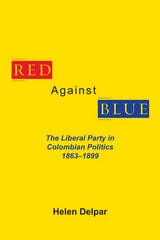
Red Against Blue
The Liberal Party in Colombian Politics, 1863 - 1899Helen Delpar
University of Alabama Press, 1981
A landmark study of Liberalism, political conflict, and nation-building in Colombia.
Red Against Blue: The Liberal Party in Colombian Politics, 1863–1899 is a seminal study of the political forces that shaped modern Colombia during the nineteenth century. In this carefully researched work, historian Helen Delpar traces the rise, dominance, decline, and transformation of the Colombian Liberal Party, offering readers a deeper understanding of one of Latin America's most influential political movements. Through extensive use of political writings, personal papers, electoral records, and contemporary sources, Delpar reconstructs the complex world of Colombian politics during an era marked by ideological conflict, regional division, constitutional experimentation, and recurring civil unrest.
The book examines the period from the adoption of the federal Constitution of 1863 through the end of the nineteenth century, when Liberal leaders sought to shape Colombia's political future while confronting growing opposition from Conservative rivals. Delpar explores the origins of Colombian Liberalism, the development of party ideology, the regional bases of political support, and the personalities who guided the party through both triumph and defeat. Her analysis reveals a political movement that was far more diverse and dynamic than conventional interpretations have suggested.
As Liberal influence declined in the 1880s and Conservatives consolidated power under the Regeneration movement, political tensions intensified. Delpar shows how these struggles helped lay the groundwork for the devastating War of the Thousand Days at the century's close, one of the most significant conflicts in Colombian history.
Combining narrative history with insightful political analysis, Red Against Blue remains an indispensable resource for students and scholars of Latin American history, political development, democracy, and nation-building. It offers a compelling portrait of a society grappling with questions of power, ideology, regional identity, and the meaning of political participation in a rapidly changing world.
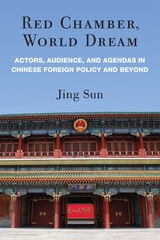
Red Chamber, World Dream
Actors, Audience, and Agendas in Chinese Foreign Policy and BeyondJing Sun
University of Michigan Press, 2021
Chinese president Xi Jinping is most famously associated with his “Chinese Dream” campaign, envisioning a great rejuvenation of the nation. Many observers, though, view China’s pursuit of this dream as alarming. They see a global power ready to abandon its low-profile diplomacy and eager to throw its weight around.
Red Chamber, World Dream represents an interdisciplinary effort of deciphering the Chinese Dream and its global impact. Jing Sun employs methods from political science and journalism and concepts from literature, sociology, psychology and drama studies, to offer a multilevel analysis of various actors’ roles in Chinese foreign policy making: the leaders, the bureaucrats, and its increasingly diversified public. This book rejects a simple dichotomy of an omnipotent, authoritarian state versus a suppressed society. Instead, it examines how Chinese foreign policy is constantly being forged and contested by interactions among its leaders, bureaucrats, and people. The competition for shaping China’s foreign policy also happens on multiple arenas: intraparty fighting, inter-ministerial feuding, social media, TV dramas and movies, among others. This book presents vast amounts of historical detail, many unearthed the first time in the English language. Meanwhile, it also examines China’s diplomatic responses to ongoing issues like the Covid-19 crisis. The result is a study multidisciplinary in nature, rich in historical nuance, and timely in contemporary significance.
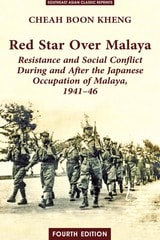
Red Star Over Malaya
Resistance and Social Conflict During and After the Japanese Occupation, 1941-1946Cheah Boon Kheng
National University of Singapore Press, 2012
As Japanese forces withdrew from the countryside, the Chinese guerrillas of the communist-led resistance movement, the Malayan People's Anti-Japanese Army (MPAJA), emerged from the jungle and took control of some 70 per cent of the country's smaller towns and villages, seriously alarming the Malay population. When the British Military Administration sought to regain control of these liberated areas, the ensuing conflict set the tone for future political conflicts and marked a crucial stage in the history of Malaya. Based on extensive archival research, Red Star Over Malaya provides a riveting account of the way the Japanese occupation reshaped colonial Malaya, and of the tension-filled months that followed Japan's surrender. This book is fundamental to an understanding of social and political developments in Malaysia during the second half of the 20th century.

Red Star Over the Third World
Vijay Prashad
Pluto Press, 2019
From Cuba to Vietnam, China to South Africa, the October Revolution of 1917 inspired millions of people beyond the territory of Russia. It proved that the masses could not only overthrow autocratic governments, but that they could also form an opposing government in their own image.
The new idea that the working class and the peasantry could be allied, combined with the clear strength and necessity of a vanguard party, guided multiple revolutions across the globe. Here is much-needed antidote to all the glum histories written on the demise of the Soviet Union. Vijay Prashad throws a spotlight on the way the Russian Revolution was seen and received in the countries colonized by European empires. With Russia as an inspiration and providing support, suddenly workers and peasants, those left out of capitalist prosperity, organized and attempted to create for themselves real socialist revolution. Prashad’s chapters include:
*Eastern Graves
*Red October
*Follow the Path of the Russians
*The Lungs of Russia
*Soviet Asia
*Enemy of Imperialism
*Eastern Marxism
*Colonial Fascism
*Polycentric Communism
*Memories of Communism
The author writes in this Preface, “It has been a quarter-century since the demise of the USSR. And yet, the marks of the October Revolution remain—not just in the territories of the USSR but more so in what used to be known as the Third World. From Cuba to Vietnam, from China to South Africa, the October Revolution remains as an inspiration. After all, that Revolution proved that the working class and the peasantry could not only overthrow an autocratic government but it could form its own government.”
This book explains the power of the October Revolution in the Global South. From Ho Chí Minh to Fidel Castro, reflections on polycentric communism, and collective memories of communism, it shows how, for a brief moment, another world was possible.
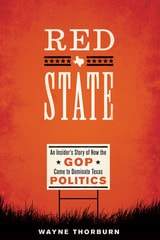
Red State
An Insider's Story of How the GOP Came to Dominate Texas PoliticsBy Wayne Thorburn
University of Texas Press, 2014
In November 1960, the Democratic party dominated Texas. The newly elected vice president, Lyndon Johnson, was a Texan. Democrats held all thirty statewide elective positions. The state legislature had 181 Democrats and no Republicans or anyone else. Then fast forward fifty years to November 2010. Texas has not voted for a Democratic president since 1976. Every statewide elective office is held by Republicans. Representing Texas in Washington is a congressional delegation of twenty-five Republicans and nine Democrats. Republicans control the Texas Senate by a margin of nineteen to twelve and the Texas House of Representatives by 101 to 49.
Red State explores why this transformation of Texas politics took place and what these changes imply for the future. As both a political scientist and a Republican party insider, Wayne Thorburn is especially qualified to explain how a solidly one-party Democratic state has become a Republican stronghold. He analyzes a wealth of data to show how changes in the state’s demographics—including an influx of new residents, the shift from rural to urban, and the growth of the Mexican American population—have moved Texas through three stages of party competition, from two-tiered politics, to two-party competition between Democrats and Republicans, and then to the return to one-party dominance, this time by Republicans. His findings reveal that the shift from Democratic to Republican governance has been driven not by any change in Texans’ ideological perspective or public policy orientation—even when Texans were voting Democrat, conservatives outnumbered liberals or moderates—but by the Republican party’s increasing identification with conservatism since 1960.

Red War on the Family
Sex, Gender, and Americanism in the First Red ScareErica J Ryan
Temple University Press, 2016
In her probing and engaging book, Red War on the Family, Erica Ryan traces the roots of sexual modernism and the history of antiradicalism and antifeminism. She illuminates how Americans responded to foreign and domestic threats and expressed nationalism by strengthening traditional gender and family roles-especially by imposing them on immigrant groups, workers, women, and young people.
Ryan argues that the environment of political conformity in the 1920s was maintained in part through the quest for cultural and social conformity, exemplified by white, middle-class family life. Red War on the Family charts the ways Americanism both reinforced and was reinforced by these sexual and gender norms in the decades after World War I.

Reel Power
Hollywood Cinema and American SupremacyMatthew Alford
Pluto Press, 2010
Hollywood is often characterised as a stronghold of left-liberal ideals. In Reel Power, Matthew Alford shows that it is in fact deeply complicit in serving the interests of the most regressive US corporate and political forces.
Films like Transformers, Terminator: Salvation and Black Hawk Down are constructed with Defence Department assistance as explicit cheerleaders for the US military, but Matthew Alford also emphasises how so-called 'radical' films like Three Kings, Hotel Rwanda and Avatar present watered-down alternative visions of American politics that serve a similar function.
Reel Power is the first book to examine the internal workings of contemporary Hollywood as a politicised industry as well as scores of films across all genres. No matter what the progressive impulses of some celebrities and artists, Alford shows how they are part of a system that is hard-wired to encourage American global supremacy and frequently the use of state violence.
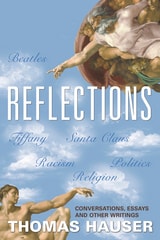
Reflections
Conversations, Essays, and Other WritingsThomas Hauser
University of Arkansas Press, 2014
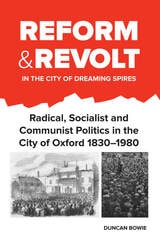
Reform and Revolt in the City of Dreaming Spires
Radical, Socialist and Communist Politics in the City of Oxford 1830–1980Duncan Bowie
University of Westminster Press, 2018
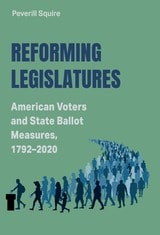
Reforming Legislatures
American Voters and State Ballot Measures, 1792-2020Peverill Squire
University of Missouri Press, 2024
Legislatures are ubiquitous in the American political experience. First created in Virginia in 1619, they have existed continuously ever since. Indeed, they were established in even the most unlikely of places, notably in sparsely populated frontier settlements, and functioned as the focal point of every governing system devised.
Despite the ubiquity of state legislatures, we know remarkably little about how Americans have viewed them as organizations, in terms of their structures, rules, and procedures. But with the rise of modern public opinion surveys in the twentieth century, we now have extensive data on how Americans have gauged legislative performance throughout the many years. That said, the responses to the questions pollsters typically pose reflect partisanship, policy, and personality. Generally, respondents respond favorably to legislatures controlled by their own political party and those in power during good economic times. Incumbent lawmakers get ratings boosts from having personalities, “home styles” that mesh with those of their constituents. These relationships are important indicators of people’s thoughts regarding the current performance of their legislatures and legislators, but they tell us nothing about attitudes toward the institution and its organizational characteristics.
This study offers a unique perspective on what American voters have historically thought about legislatures as organizations and legislators as representatives. Rather than focusing on responses to surveys that ask respondents how they rate the current performance of lawmakers and legislatures, this study leverages the most significant difference between national and state politics: the existence of ballot propositions in the latter. At the national level Americans have never had any say over Congress’s structure, rules, or procedures. In contrast, at the state level they have had ample opportunities over the course of more than two centuries to shape their state legislatures. The data examined here look at how people have voted on more than 1,500 state ballot propositions targeting a wide array of legislative organizational and parliamentary features. By linking the votes on these measures with the public debates preceding them, this study documents not only how American viewed various aspects of their legislatures, but also whether their opinions held constant or shifted over time. The findings reported paint a more nuanced picture of Americans’ attitudes toward legislatures than the prevailing one derived from survey research. When presented with legislative reform measures on which concrete choices were offered and decisions on them had to be made, the analyses presented here reveal that, counter to the conventional wisdom that people loved their representatives but hated the legislature, voters usually took charitable positions toward the institution while harboring skeptical attitudes about lawmakers’ motives and behaviors.
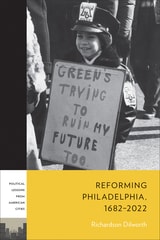
Reforming Philadelphia, 1682–2022
Richardson Dilworth
Temple University Press, 2023
Reforming Philadelphia examines the cyclical efforts of insurgents to change the city’s government over nearly 350 years. Political scientist Richardson Dilworth tracks reformers as they create a new purpose for the city or reshape the government to reflect emerging ideas. Some wish to thwart the “corrupt machine,” while others seek to gain control of the government via elections. These actors formed coalitions and organizations that disrupted the status quo in the hope of transforming the city (and perhaps also enriching themselves).
Dilworth addresses Philadelphia’s early development through the present day, including momentous changes from its new city charter in 1885 and the Republican machine that emerged around the same time to its transformation to a Democratic stronghold in the 1950s, when the city also experienced a racial transition. Focusing primarily on the twentieth and twenty-first centuries, Dilworth evaluates the terms of Mayors Frank Rizzo, Wilson Goode, and Ed Rendell, as well as John Street, Michael Nutter, and Jim Kenney to illustrate how power and resistance function, and how Philadelphia’s political history and reform cycles offer a conceptual model that can easily be applied to other cities.
Reforming Philadelphia provides a new framework for understanding the evolving relationship between national politics and local, city politics.
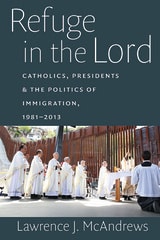
Refuge in the Lord
Lawrence J. McAndrews
Catholic University of America Press, 2015
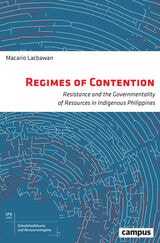
Regimes of Contention
Resistance and the Governmentality of Resources in Indigenous PhilippinesMacario Lacbawan
Campus Verlag, 2021
The notion of indigeneity in the Philippines is politically fraught. Most who live on the archipelago are descendants of aboriginal peoples, whether they claim tribal affiliation or not, and those who do enact traditional identities share little else in common. As a result, the term “indigenous” remains unstable and malleable seventy-five years after independence. Connecting insights from Tillian and Foucauldian social theory, Regimes illuminates how the ever-changing Philippine state, from the 1970s through today, constructs artificial subjectivities that Indigenous peoples must embody to access ancestral resources held by the federal government. What emerges is a lucid illustration of how governmentality is entangled with indigeneity in the Philippines.
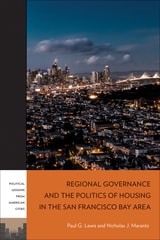
Regional Governance and the Politics of Housing in the San Francisco Bay Area
Paul G. Lewis and Nicholas J. Marantz
Temple University Press, 2023
The authors evaluate six potential reforms, arguing that targeted changes to local and regional institutions could generate durable improvements to the region’s housing opportunities. The main lesson from the case of the San Francisco Bay Area is the need to focus on governance when addressing the housing challenge. As the authors effectively illustrate, leaving a solution up to individual cities is unlikely to lead to increased housing supply.
Regulation in the White House
The Johnson PresidencyBy David M. Welborn
University of Texas Press, 1993
Regulation in the White House is an examination of regulatory policy and its development in the Johnson administration and the first comprehensive study of any presidency and regulation. Based upon a thorough analysis of presidential papers in the Lyndon B. Johnson Library, the book investigates the working relationships linking the presidency, regulatory commissions, and executive agencies with regulatory responsibilities in both the economic and social spheres.
David Welborn finds that the president's business included regulation as a major component. Johnson's concerns in regulation were varied and complex. He and his aides worked assiduously and successfully to establish effective, cooperative relationships with regulators and to avoid the exercise of undue influence on particular regulatory determinations. In Welborn's view, Johnson traversed the treacherous ground of regulatory politics with adeptness and achieved his major purposes in regulation.
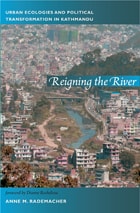
Reigning the River
Urban Ecologies and Political Transformation in KathmanduAnne M. Rademacher
Duke University Press, 2011
Rademacher conducted research during a volatile period in Nepal’s political history. As clashes between Maoist revolutionaries and the government intensified, the riverscape became a site of competing claims to a capital city that increasingly functioned as a last refuge from war-related violence. In this time of intense flux, efforts to ensure, create, or imagine ecological stability intersected with aspirations for political stability. Throughout her analysis, Rademacher emphasizes ecology as an important site of dislocation, entitlement, and cultural meaning.
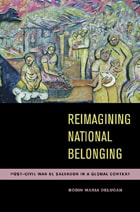
Reimagining National Belonging
Post-Civil War El Salvador in a Global ContextRobin Maria DeLugan
University of Arizona Press, 2012
Examining events that unfolded between 1992 and 2011, DeLugan both illustrates the idiosyncrasies of state and society in El Salvador and opens a larger portal into conditions of constructing a state in the present day around the globe—particularly the process of democratization in an age of neoliberalism. She demonstrates how academics, culture experts, popular media, and the United Nations and other international agencies have all helped shape ideas about national belonging in El Salvador. She also reveals the efforts that have been made to include populations that might have been overlooked, including indigenous people and faraway citizens not living inside the country’s borders. And she describes how history and memory projects have begun to recall the nation’s violent past with the goal of creating a more just and equitable nation.
This illuminating case study fills a gap in the scholarship about culture and society in contemporary El Salvador, while offering an “ethnography of the state” that situates El Salvador in a global context.
Reimagining the Nation-State
The Contested Terrains of Nation-BuildingJim MacLaughlin
Pluto Press, 2001
Mac Laughlin offers a theoretical and empirical analysis of nation building, taking as a case study the historical connections between Ireland and Great Britain in the clash between 'big nation' historic British nationalism on the one hand, and minority Irish nationalism on the other. Locating the origins of the historic nation in the seventeenth and eighteenth centuries, Mac Laughlin emphasises the difficulties, and specifities, of minority nationalisms in the nineteenth century. In so doing he calls for a place-centred approach which recognises the symbolic and socio-economic significance of territory to the different scales of nation-building. Exploring the evolution of Irish Nationalism, Reimaging the Nation State also shows how minority nations can challenge the hegemony of dominant states and threaten the territorial integrity of historic nations.
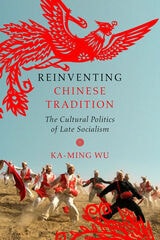
Reinventing Chinese Tradition
The Cultural Politics of Late SocialismKa-ming Wu
University of Illinois Press, 2015
Ka-ming Wu's ethnographic account of contemporary Yan'an documents how people have reworked the revival of three rural practices--paper-cutting, folk storytelling, and spirit cults--within (and beyond) the socialist legacy. Moving beyond dominant views of Yan'an folk culture as a tool of revolution or object of market reform, Wu reveals how cultural traditions become battlegrounds where conflicts among the state, market forces, and intellectuals in search of an authentic China play out. At the same time, she shows these emerging new dynamics in the light of the ways rural residents make sense of rapid social change.
Alive with details, Reinventing Chinese Tradition is an in-depth, eye-opening study of an evolving culture and society within contemporary China.
Reinventing Citizenship
Black Los Angeles, Korean Kawasaki, and Community ParticipationKazuyo Tsuchiya
University of Minnesota Press, 2014
In the 1960s and 1970s, the United States and Japan went through massive welfare expansions that sparked debates about citizenship. At the heart of these disputes stood African Americans and Koreans. Reinventing Citizenship offers a comparative study of African American welfare activism in Los Angeles and Koreans’ campaigns for welfare rights in Kawasaki. In working-class and poor neighborhoods in both locations, African Americans and Koreans sought not only to be recognized as citizens but also to become legitimate constituting members of communities.
Local activists in Los Angeles and Kawasaki ardently challenged the welfare institutions. By creating opposition movements and voicing alternative visions of citizenship, African American leaders, Tsuchiya argues, turned Lyndon B. Johnson’s War on Poverty into a battle for equality. Koreans countered the city’s and the nation’s exclusionary policies and asserted their welfare rights. Tsuchiya’s work exemplifies transnational antiracist networking, showing how black religious leaders traveled to Japan to meet Christian Korean activists and to provide counsel for their own struggles.
Reinventing Citizenship reveals how race and citizenship transform as they cross countries and continents. By documenting the interconnected histories of African Americans and Koreans in Japan, Tsuchiya enables us to rethink present ideas of community and belonging.
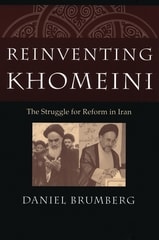
Reinventing Khomeini
The Struggle for Reform in IranDaniel Brumberg
University of Chicago Press, 2001
A complex figure, Khomeini was a fervent champion of Islam, but while he sought a Shi'ite vision of clerical rule under one Supreme Leader, he also strove to mesh that vision with an implicitly Western view of mass participatory politics. The intense magnetism and charisma of the ayatollah obscured this paradox. But reformers in Iran today, while rejecting his autocratic vision, are reviving the constitutional notions of government that he considered, and even casting themselves as the bearers of his legacy. In Reinventing Khomeini, Brumberg proves that the ayatollah is as much the author of modern Iran as he is the symbol of its fundamentalist past.
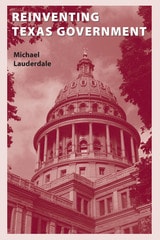
Reinventing Texas Government
By Michael Lauderdale
University of Texas Press, 1999
The Survey of Organizational Excellence is revolutionizing the operation of Texas state agencies and other governmental and private organizations. Developed and refined over the last twenty years by a team of researchers led by Michael Lauderdale, the survey is a proven tool for improving the effectiveness of state government services through surveys of employee attitudes toward their organizations.
In this book, Lauderdale gives a history of the survey and its use under four governors, including George W. Bush. He explains what the survey is, how to use it, and how to apply its results to organizational change and improvement. Step-by-step instructions for planning, implementing, and evaluating the survey are enhanced with real-life case studies from the 140,000 surveys that have been distributed and used by more than 75 different organizations. Lauderdale also sets the survey in a broader perspective by identifying some of the forces currently impelling change in organizations throughout our society and exploring where this push for change is taking us.
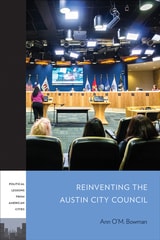
Reinventing the Austin City Council
Ann O'M. Bowman
Temple University Press, 2020
Reinventing the Austin City Council explores the puzzle that was Austin’s reluctance to alter its at-large system and establish a geographically-based, single-member district system. Ann Bowman chronicles the repeated attempts to change the system, the eventual decision to do so, and the consequences of that change. In the process, she explores the many twists and turns that occurred in Austin as it struggled to design a fair system of representation. Reinventing the Austin City Council assesses the impact of the new district system since its inception in 2014.
Austin’s experience ultimately offers a political lesson for creating institutional change.
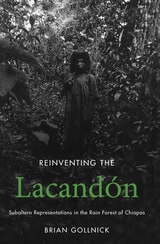
Reinventing the Lacandón
Subaltern Representations in the Rain Forest of ChiapasBrian Gollnick
University of Arizona Press, 2008
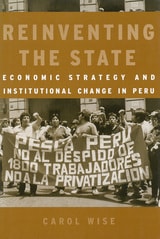
Reinventing the State
Economic Strategy and Institutional Change in PeruCarol Wise
University of Michigan Press, 2003

Rekindling the Sacred Fire
Métis Ancestry and Anishinaabe SpiritualityChantal Fiola
University of Manitoba Press, 2015

Religion and Nationalism in Soviet and East European Politics
Pedro Ramet, ed.
Duke University Press, 1988

Religion and Politics in East Africa
The Period since IndependenceHölger Bernt Hansen
Ohio University Press, 1994
Religious activities have been of continuing importance in the rise of protest against postcolonial governments in Eastern Africa. Governments have attempted to “manage“ religious affairs in both Muslim and Christian areas. Religious denominations have acted as advocates of human rights and in opposition to one-party-state regimes. Islamic fundamentalism changed with the ending of the Cold War.
The book is divided into four parts: The Challenge of Islam; Christianity, Sectarianism, and Politics in Uganda; Christians and Muslim in Kenyan Politics; and Cross-cultural Complications. An introductory essay by Michael Twaddle provides and overview of the changing character of politico-religious conflict in Eastern Africa. Holger Bernt Hansen summarizes the presentation with a discussion of dilemmas and challenges in the study of religion and politics.
Religion and Radical Politics
An Alternative Christian Tradition in the United StatesRobert Craig
Temple University Press, 1995
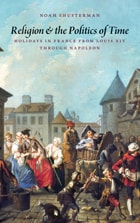
Religion and the Politics of Time
Noah Shusterman
Catholic University of America Press, 2010
Religious Pluralism and the Nigerian State
Mis Af#66Simeon O. Ilesanmi
Ohio University Press, 1996
Reluctant Landscapes
Historical Anthropologies of Political Experience in Siin, SenegalFrancois G. Richard
University of Chicago Press, 2018
Reluctant Landscapes is an exploration of the making and remaking of political experience and physical landscapes among rural communities in the Siin province of Senegal between the late 1500s and the onset of World War II. By recovering the histories of farmers and commoners who made up African states’ demographic core in this period, Richard shows their crucial—but often overlooked—role in the making of Siin history. The book also delves into the fraught relation between the Seereer, a minority ethnic and religious group, and the Senegalese nation-state, with Siin’s perceived “primitive” conservatism standing at odds with the country’s Islamic modernity. Through a deep engagement with oral, documentary, archaeological, and ethnographic archives, Richard’s groundbreaking study revisits the four-hundred-year history of a rural community shunted to the margins of Senegal’s national imagination.

Remaining Chickasaw in Indian Territory, 1830s-1907
Wendy St. Jean
University of Alabama Press, 2011
In the early 1800s, the U.S. government attempted to rid the Southeast of Indians in order to make way for trading networks, American immigration, optimal land use, economic development opportunities, and, ultimately, territorial expansion westward to the Pacific. The difficult removal of the Chickasaw Nation to Indian Territory—later to become part of the state of Oklahoma— was exacerbated by the U.S. government’s unenlightened decision to place the Chickasaws on lands it had previously provided solely for the Choctaw Nation.
This volume deals with the challenges the Chickasaw people had from attacking Texans and Plains Indians, the tribe’s ex-slaves, the influence on the tribe of intermarried white men, and the presence of illegal aliens (U.S. citizens) in their territory. By focusing on the tribal and U.S. government policy conflicts, as well as longstanding attempts of the Chickasaw people to remain culturally unique, St. Jean reveals the successes and failures of the Chickasaw in attaining and maintaining sovereignty as a separate and distinct Chickasaw Nation.
Remaking New Orleans
Beyond Exceptionalism and AuthenticityThomas J. Adams and Matt Sakakeeny, editors
Duke University Press, 2019
Contributors. Thomas Jessen Adams, Vincanne Adams, Vern Baxter, Maria Celeste Casati Allegretti, Shannon Lee Dawdy, Rien Fertel, Megan French-Marcelin, Cedric G. Johnson, Alecia P. Long, Vicki Mayer, Toby Miller, Sue Mobley, Marguerite Nguyen, Aaron Nyerges, Adolph Reed Jr., Helen A. Regis, Matt Sakakeeny, Heidi Schmalbach, Felipe Smith, Bryan Wagner
Remaking New York
Primitive Globalization And The Politics Of Urban CommunityWilliam Sites
University of Minnesota Press, 2003
Uses New York City to discuss the ways that policy has mismanaged the effects of globalization
Inequality increases, instability grows, communities fragment: this is the fate of a city in the wake of globalization—but is globalization really the cause? Proposing a new perspective on politics, globalization, and the city, this provocative book argues that such urban problems result in part from U.S. policies that can be changed.
William Sites develops the concept of primitive globalization, identifying a pattern of reactive politics—ad hoc measures to subsidize business, displace the urban poor, and dismantle the welfare state—that uproots social actors (corporations, citizens, urban residents) and facilitates a damaging, short-term-oriented type of international integration. In light of this theory, Sites examines the transformation of New York City since the 1970s, focusing on the logic of political action at national, local, and neighborhood levels. In the process, the story of late twentieth-century New York and its Lower East Side community emerges as something different: not a tale of globalist transformation or of local resurgence but a distinctly American case, one in which urban politics and the state, in their own right, exacerbate inequality and community fragmentation within the city.
Remaking Rwanda
State Building and Human Rights after Mass ViolenceScott Straus
University of Wisconsin Press, 2011
Remaking the Citizen for New Times
History, Pedagogy and the Amar Chitra KathaDeepa Sreenivas
Seagull Books, 2024
How does orthodoxy maintain its power over culture? In Remaking the Citizen for New Times, Deepa Sreenivas explores how the Amar Chitra Katha, a widely read comic series started in 1967 in India, influenced the historical and national consciousness of young readers in a conservative direction. Tacitly blaming Nehruvian welfarism of the time for the moral decline of the nation, the Amar Chitra Katha emerged as a literary articulation of the Indian right’s Hindu-nationalist ideology in a modern, bourgeois guise. To renew Hindutva hegemony, the comic series gave orthodox ideas a new sheen, both in its form and content, merging Western comic styles with Indian visual storytelling traditions on the one hand, and combining mythological characters with political figureheads into harmonious narratives on the other—making it difficult to sift history from myths and legends. Sreenivas deftly argues that these mythological-political tales emphasized the instructive rather than the informative potential of history, encouraging neoliberal values such as merit and hard work while ignoring caste or class as systemic issues.
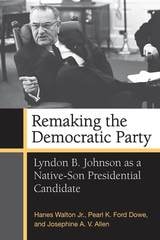
Remaking the Democratic Party
Lyndon B. Johnson as a Native-Son Presidential CandidateHanes Walton Jr., Pearl K. Ford Dowe, and Josephine A. V. Allen
University of Michigan Press, 2016
Although ridiculed by contemporaries for his apparent lack of control over formal party politics and the national committee, Johnson excelled at leading the Democratic Party’s policy agenda. While a senator and as president, Johnson advocated for—and secured—liberal social welfare and civil rights legislation, forcing the party to break with its Southern tradition of elitism, conservatism, and white supremacy. In a way, Johnson set the terms for the continuing partisan battle because, by countering the Democrats’ new ideology, the Republican Party also underwent a transformation.
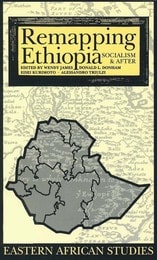
Remapping Ethiopia
Socialism & AfterWendy James
Ohio University Press, 2002
Governance everywhere is concerned with spatial relationships. Modern states “map” local communities, making them legible for the purposes of control. Ethiopia has gone through several stages of “mapping” in its imperial, revolutionary, and postrevolutionary phases.
In 1986 The Southern Marches of Imperial Ethiopia, a cross-disciplinary collection edited by Don Donham and Wendy James, opened up the study of center/periphery relations in the Ethiopian empire until the fall of the monarchy in 1974. This new volume examines similar themes, taking the story forward through the major changes effected by the socialist regime from the revolution of 1974 to its overthrow in 1991, and then into the current period that has been marked by moves toward local democracy and political devolution.
Topics include the changing fortunes of new and historic towns and cities, the impact of the Mengistu regime’s policies of villagization and resettlement, local aspects of the struggle against Mengistu and its aftermath, and the fate of border regions. Special attention is given to developments since 1991: to new local institutions and forms of autonomy, the links between the international diasporas of Ethiopia and the fortunes of their home areas. The collection draws on the work of established scholars as well as a new generation of Ethiopian and international researchers in the disciplines of anthropology, political science, history, and geography.
Remembering 1989
Future Archives of Public ProtestAnke Pinkert
University of Chicago Press, 2024
For many, 1989 is an iconic date, one we associate with the fall of the Berlin Wall and the end of the Cold War. The year prompts some to rue the defeat of socialism in the East, while others celebrate a victory for democracy and capitalism in the reunified Germany. Remembering 1989 focuses on a largely forgotten interregnum: the months between the outbreak of protests in the German Democratic Republic in 1989 and its absorption by the West in 1990. Anke Pinkert, who herself participated in those protests, recalls these months as a volatile but joyous “laboratory of radical democracy,” and tells the story of how and why this “time out of joint” has been erased from Germany’s national memory.
Remembering 1989 argues that in order to truly understand Germany’s historic transformation, we must revisit protesters’ actions across a wide range of minor, vernacular, and often transient sources. Drawing on rich archives including videotapes of untelevised protests, illegally printed petitions by Church leaders, audio recordings of dissident meetings, and interview footage with military troops, Pinkert opens the discarded history of East European social uprisings to new interpretations and imagines alternatives to Germany’s neoliberal status quo. The result is a vivid, unexpected contribution to memory studies and European history.
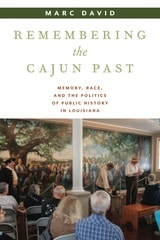
Remembering the Cajun Past
Memory, Race, and the Politics of Public History in LouisianaMarc David
University of Massachusetts Press, 2025
Exploring how public history creates collective memory of this white ethnic group through memorials
Cajuns arrived in southern Louisiana in the 18th century after the British exiled them from eastern Canada. Also known as Acadians, they retain a unique dialect of French, and their distinctive music, food, and other cultural traits characterized them as an ethnic group. Until the 1960s, authorities viewed them as a serious problem, allegedly blocking the state’s progress as they clung to their antiquated ways. Few Cajun residents in the region remembered the remote past of their ancestors, but by the 1970s, organizations ranging from local non-profits to the National Park Service created sites that commemorated their history, such as the Acadian Memorial in St. Martinville, allowing Cajuns to connect their lives to their past and claim it as their own.
In Remembering the Cajun Past, anthropologist Marc David studies the cultural and political dynamics that reconfigured Cajun memory and identity. Focusing on St. Martinville and the Acadian Memorial, he explores how authorities changed their minds about Cajuns and demonstrates how Cajuns’ historical memories took shape. Part ethnography and part history, David examines the racial aspects of the Memorial’s creation in the wake of the Civil Rights movement and the growth of a new Cajun history, one through which individual Cajuns rejected the label’s connotation of “white trash” and embraced belonging within a storied white ethnic group. Based on decades of fieldwork and deep engagement with public history practices, David explores how historical memory and the historic sites that foster it are intertwined with the politics of civic life.
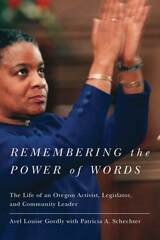
Remembering the Power of Words
The Life of an Oregon Activist, Legislator, and Community LeaderAvel Louise Gordly
Oregon State University Press, 2011
Remembering the Power of Words recounts the personal and professional journey of Avel Gordly, the first African-American woman elected to the Oregon State Senate.
The book is a brave and honest telling of Gordly’s life. She shares the challenges and struggles she faced growing up black in Portland in the 1950s and 1960s, as well as her determination to attend college, the dedication to activism that took her from Portland to Africa, and her eventual decision to run for a seat in the state legislature.
That words have power is a constant undercurrent in Gordly’s account and a truth she learned early in life. “Growing up, finding my own voice,” she writes, “was tied up with denying my voice or having it forcefully rejected and in all of that the memory of my father is very strong. To this day—and I am today a very experienced public speaker—preparation to speak takes a great deal of energy.” That this memoir has its origins as an oral history is fitting since Gordly has used her voice, out loud, to teach and inspire others for so many years.
Important as a biographical account of one significant Oregonian’s story, the book also contributes “broader narratives touching on Black history (and Oregon’s place within it), and most particularly the politics associated with being an African American woman,” according to series editor Melody Rose.
Remembrance, History, and Justice
Coming to terms with traumatic pasts in democratic societiesBogdan C. Iacob
Central European University Press, 2015

Reminiscences of a Soldier's Wife
An AutobiographyMrs. John A. Logan. Foreword by John Y. Simon
Southern Illinois University Press, 1997
"To tell my own story is to tell that of my famous husband, General John A. Logan," explains Mary S. Logan in the preface to her autobiography.
Married to John A. Logan for thirty-one years, Mary Logan shared in her distinguished husband’s career as a prosecutor in southern Illinois, as a Civil War general, and as a senator from Illinois. She observed firsthand the extraordinary events before, during, and after the Civil War, and she knew personally those world leaders who held the power to shape history. After the death of her husband, she maintained her influence in Washington, D.C. "Under the brightest and darkest skies," she explains, "I have passed than a half-century at the national capital."
Born in 1838, Logan writes of her early days growing up in southern Illinois through 1913, when this book was first published. A skillful observer, she recounts events that are personal, regional, and national in scope. In charming detail, she shares her courtship and subsequent marriage to a young prosecutor from Jackson County and the births of their children. She writes proudly of the Lincoln-Douglas debates in 1858 and her husband’s election to the Thirty-seventh Congress that same year. Logan tells of the coming of the Civil War and of her husband—formerly a Democrat and an enemy of Lincoln—casting his fate with the Union and raising a regiment in southern Illinois. She poignantly describes her brother’s defection to the Confederate Army, her life in war-torn Cairo, Illinois, and her horror at her husband’s severe war wounds. She recounts the battles, the political campaigns, and Lincoln’s reelection and subsequent assassination from her point of view—and, as the wife of a politician and general, hers is a decidedly privileged perspective.
In a position to observe and to participate in events ranging from momentous to minute throughout the latter half of the nineteenth and early twentieth centuries, she reports the essential episodes of history with the flair of journalism, a career she in fact embraced after the death of her husband. She writes movingly of a wounded captain on the road to recovery who suddenly died when the minié shifted next to his lung, amusingly of the excuses soldiers invented to wrangle a pass to town, and elegantly of her trips to Europe and of the pomp and circumstance of the parties attended by the great men and women of the time. Drawing on events grand and small, she re-creates history as only a skillful writer who was in the right place at the right time could.
Remotely Global
Village Modernity in West AfricaCharles Piot
University of Chicago Press, 1999
Confounding both anthropological theorizations and the State Department's stereotyped images of African village life, Remotely Global aims to rethink Euroamerican theories that fail to come to terms with the fluidity of everyday relations in a society where persons and things are forever in motion.
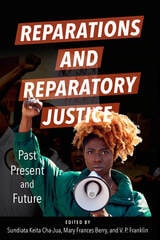
Reparations and Reparatory Justice
Past, Present, and FutureEdited by Sundiata Keita Cha-Jua, Mary Frances Berry, and V. P. Franklin
University of Illinois Press, 2024
Sharing a focus on reparations as an issue of justice, the contributors provide a historical primer of the movement; introduce the philosophical, political, economic, legal and ethical issues surrounding reparations; explain why government, corporations, universities, and other institutions must take steps to rehabilitate, compensate, and commemorate African Americans; call for the restoration of Black people’s human and civil rights and material and psychological well-being; lay out specific ideas about how reparations can and should be paid; and advance cutting-edge interpretations of the complex long-lasting effects that enslavement, police and vigilante actions, economic discrimination, and other behaviors have had on people of African descent.
Groundbreaking and innovative, Reparations and Reparatory Justice offers a multifaceted resource to anyone wishing to explore a defining moral issue of our time.
Contributors: Dedrick Asante-Muhammad, Hilary McDonald Beckles, Mary Frances Berry, Sundiata Keita Cha-Jua, Chuck Collins, Ron Daniels, V. P. Franklin, Danny Glover, Adom Gretachew, Charles Henry, Kamm Howard, Earl Ofari Hutchinson, Jesse Jackson, Sr., Brian Jones, Sheila Jackson Lee, James B. Stewart, the Movement 4 Black Lives, the National African American Reparations Commission, the National Coalition of Blacks for Reparations in America, the New Afrikan Peoples Organization/Malcolm X Grassroots Movement
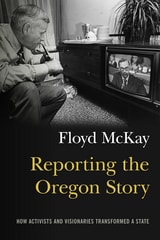
Reporting the Oregon Story
How Activists and Visionaries Transformed a StateFloyd J. McKay
Oregon State University Press, 2016
As a political reporter for The Oregon Statesman in Salem, and then as news analyst for KGW-TV in Portland, McKay was known for asking tough questions and pulling no punches. His reporting and commentaries ranged from analysis of the “Tom and Bob” rivalry, to the Vietnam War’s impact on Senators Wayne Morse and Mark Hatfield and the emergence of a new generation of Portland activists in the 1970s.
McKay and his colleagues were on the beaches as Oregon crafted its landmark Beach Bill, ensuring the protection of beaches for public use. They watched as activists turned back efforts to build a highway on the sand at Pacific City. Pitched battles over Oregon’s Bottle Bill, and the panic-inducing excitement of “Vortex”—the nation’s only state-sponsored rock festival—characterized the period. Covering the period from 1964-1986, McKay remembers the action, the players and the consequences, in this compelling and personal account.
As major actors fade from the scene and new leaders emerge, McKay casts a backwards glance at enduring Oregon legends. Half a century later, amid today’s cynicism and disillusionment with media, politics, and politicians, Reporting the Oregon Story serves as a timely reminder that charged politics and bitter rivalries can also come hand-in-hand with lasting social progress.
Reporting the Oregon Story will be relished by those who lived the history, and it will serve as a worthy introduction to Oregonians young and old who want a first-hand account of Oregon’s mid- twentieth-century political history and legislative legacy.
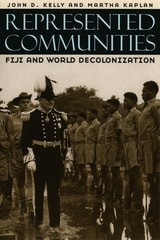
Represented Communities
Fiji and World DecolonizationJohn D. Kelly and Martha Kaplan
University of Chicago Press, 2001
Now, in Represented Communities, John D. Kelly and Martha Kaplan offer an extensive and devastating critique of Anderson's depictions of colonial history, his comparative method, and his political anthropology. The authors build a forceful argument around events in Fiji from World War II to the 2000 coups, showing how focus on "imagined communities" underestimates colonial history and obscures the struggle over legal rights and political representation in postcolonial nation-states. They show that the "self-determining" nation-state actually emerged with the postwar construction of the United Nations, fundamentally changing the politics of representation.
Sophisticated and impassioned, this book will further anthropology's contribution to the understanding of contemporary nationalisms.
Repression, Exile, and Democracy
Uruguayan CultureSaul Sosnowski and Louise B. Popkin, eds.
Duke University Press, 1992
The first section provides a context for the volume, with its analyses of the historical, political, and social aspects of the Uruguayan experience. The following chapters explore various aspects of cultural production, including personal experiences of exile and imprisonment, popular music, censorship, literary criticism, return from exile, and the role that culture plays in redemocratization.
This book's appeal extends well beyond the study of Uruguay to scholars and students of the history and culture of other Latin American nations, as well as to fields of comparative literature and politics in general.
Contributors. Hugo Achugar, Alvarro Barros-Lémez, Lisa Block de Behar, Amanda Berenguer, Hiber Conteris, José Pedro Díaz, Eduardo Galeano, Edy Kaufman, Leo Masliah, Carina Perelli, Teresa Porzecanski, Juan Rial, Mauricio Rosencof, Jorge Ruffinelli, Saúl Sosonowski, Martin Weinstein, Ruben Yáñez
Republican Portugal
A Political History, 1910–1926Douglas L. Wheeler
University of Wisconsin Press, 1998