Results by title
828 books match the query 'Study and teaching' and 56 start with r
Rhetorical Listening
Identification, Gender, WhitenessKrista Ratcliffe
Southern Illinois University Press, 2005
Extending the feminist rhetorical project to define and model rhetorical listening
Long-ignored within rhetoric and composition studies, listening has returned to the disciplinary radar. Rhetorical Listening: Identification, Gender, Whiteness argues that rhetorical listening facilitates conscious identifications needed for cross-cultural communication.
Krista Ratcliffe establishes eavesdropping, listening metonymically, and listening pedagogically as approaches to rhetorical listening. She defines and models rhetorical listening, addressing identifications with gender and whiteness within public debates, scholarship, and pedagogy. Offering an approach grounded in classical rhetorical theory, Heideggerian theory, feminist theory, and critical race theory, Ratcliffe presents rhetorical listening as an invention tactic that engages spoken and written texts and supplements reading, writing, speaking, and silence as a rhetorical art.
Theorizing intersections of gender and whiteness, Rhetorical Listening examines how whiteness functions as an "invisible" racial category and provides disciplinary and cultural reasons for the displacement of listening and for the use of rhetorical listening as a code of cross-cultural conduct. Ratcliffe presents rhetorical listening in terms of cultural logics, stances, and dominant interpretive tropes. She highlights the modern identification theory of Kenneth Burke and the postmodern identification and disidentification theory of Diana Fuss and presents nonidentification as a more productive site for rhetorical listening.
Rhetorical Speculations
The Future of Rhetoric, Writing, and TechnologyScott Sundvall
Utah State University Press, 2019
Rhetoric and writing studies often engages technological shifts reactively, after the production and reception of rhetoric and writing has changed. This collection allows rhetoric and writing scholars to explore modes of critical speculation into the transformative effect of emerging technologies, particularly as a means to speculate on future shifts in the intellectual, pedagogical, and institutional frameworks of the field. In doing so, the project repositions rhetoric and writing scholars as proprietors of our technological future to come rather than as secondary receivers, critics, and adjusters of the technological present.
Major and emerging voices in the field offer a range of styles that include pragmatic, technical, and philosophical approaches to the issue of speculative rhetoric, exploring what new media/writing studies could be—theoretically, pedagogically, and institutionally—as future technologies begin to impinge on the work of writing. Rhetorical Speculations is at the cutting edge of the subject of futures thinking and will have broad appeal to scholars of rhetoric, literacy, futures studies, and material and popular culture.
Contributors:
Bahareh Brittany Alaei, Sarah J. Arroyo, Kristine L. Blair, Geoffrey V. Carter, Sid Dobrin, Kristie S. Fleckenstein, Steve Holmes, Kyle Jensen, Halcyon Lawrence, Alexander Monea, Sean Morey, Alex Reid, Jeff Rice, Gregory L. Ulmer, Anna Worm
Rhetorical Strategies and Genre Conventions in Literary Studies
Teaching and Writing in the DisciplinesLaura Wilder
Southern Illinois University Press, 2012
Laura Wilder fills a gap in the scholarship on writing in the disciplines and writing across the curriculum with this thorough study of the intersections between scholarly literary criticism and undergraduate writing in introductory literature courses. Rhetorical Strategies and Genre Conventions in Literary Studies is the first examination of rhetorical practice in the research and teaching of literary study and a detailed assessment of the ethics and efficacy of explicit instruction in the rhetorical strategies and genre conventions of the discipline.
Using rhetorical analysis, ethnographic observation, and individual interviews, Wilder demonstrates how rhetorical conventions play a central, although largely tacit, role in the teaching of literature and the evaluation of student writing. Wilder follows a group of literature majors and details their experiences. Some students received experimental, explicit instruction in the special topoi, while others received more traditional, implicit instruction.
Arguing explicit instruction in disciplinary conventions has the potential to help underprepared students, Wilder explores how this kind of instruction may be incorporated into literature courses without being overly reductive. Taking into consideration student perspectives, Wilder makes a bold case for expanding the focus of research in writing in the disciplines and writing across the curriculum in order to grasp the full complexity of disciplinary discourse.
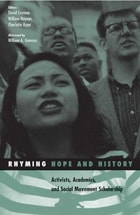
Rhyming Hope and History
Activists, Academics, and Social Movement ScholarshipDavid Croteau
University of Minnesota Press, 2005
Contributors: Kevin M. Carragee, Suffolk U; Catherine Corrigall-Brown, U of California, Irvine; Myra Marx Ferree, U of Wisconsin, Madison; Richard Flacks, U of California, Santa Barbara; Adria D. Goodson; Richard Healy and Sandra Hinson, Grassroots Policy Project; David Meyer, U of California, Irvine; Cynthia Peters, Worker Education Program of the Service Employees International Union, Local 2020; Barbara Risman, North Carolina State U; Robert J. S. Ross, Clark U; Leila J. Rupp, U of California, Santa Barbara; Cassie Schwerner, Schott Foundation; Valerie Sperling, Clark U; David A. Snow, U of California, Irvine; Verta Taylor, U of California, Santa Barbara.
David Croteau is formerly associate professor of sociology and anthropology at Virginia Commonwealth University. William Hoynes is professor of sociology and director of media studies at Vassar College. Charlotte Ryan is codirector of the Media Research and Action Project at Boston College. William A. Gamson is professor of sociology at Boston College.
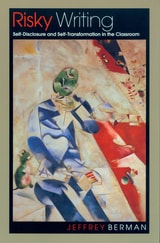
Risky Writing
Self-Disclosure and Self-Transformation in the ClassroomJeffrey Berman
University of Massachusetts Press, 2001
This is the final volume in a trilogy of works that examine the impact of writing and reading about traumatic subjects. Diaries to an English Professor (1994) explores the ways in which undergraduate students use psychoanalytic diaries to probe conflicted issues in their lives. Surviving Literary Suicide (1999) investigates how graduate students respond to suicidal literature—novels and poems that portray and sometimes glorify self-inflicted death.
In Risky Writing, Jeffrey Berman builds on those earlier studies, describing ways teachers can encourage college students to write safely on a wide range of subjects often deemed too personal or too dangerous for the classroom: grieving the loss of a beloved relative or friend, falling into depression, coping with the breakup of one's family, confronting sexual abuse, depicting a drug or alcohol problem, encountering racial prejudice. Berman points out that nearly everyone has difficulty talking or writing about such issues because they arouse shame and tend to be enshrouded in secrecy and silence. This is especially true for college students, who are just emerging from adolescence and find themselves at institutions that rarely promote self-disclosure.
Recognizing the controversial nature of his subject, Berman confronts academic opposition to personal writing head on. He also discusses the similarities between the “writing cure” and the “talking cure,” the role of the teacher and audience in the self-disclosing classroom, and the pedagogical strategies necessary to minimize risk, including the importance of empathy and other befriending skills.
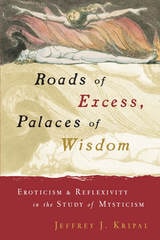
Roads of Excess, Palaces of Wisdom
Eroticism and Reflexivity in the Study of MysticismJeffrey J. Kripal
University of Chicago Press, 2001
In his new book, Kripal addresses the twentieth-century study of mysticism as a kind of mystical tradition in its own right, with its own unique histories, discourses, sociological dynamics, and rhetorics of secrecy. Fluidly combining autobiography and biography with scholarly exploration, Kripal takes us on a tour of comparative mystical thought by examining the lives and works of five major historians of mysticism—Evelyn Underhill, Louis Massignon, R. C. Zaehner, Agehananda Bharati, and Elliot Wolfson—as well as relating his own mystical experiences. The result, Kripal finds, is seven "palaces of wisdom": the religious power of excess, the necessity of distance in the study of mysticism, the relationship between the mystical and art, the dilemmas of male subjectivity and modern heterosexuality, a call for ethical criticism, the paradox of the insider-outsider problem in the study of religion, and the magical power of texts and their interpretation.
An original and penetrating analysis of modern scholarship and scholars of mysticism, Roads of Excess, Palaces of Wisdom is also a persuasive demonstration of the way this scholarly activity is itself a mystical phenomenon.