Results by title
28164 books match the query 'History' and 1206 start with r

Ruth Asawa
An Artist Takes ShapeSam Nakahira
J. Paul Getty Trust, The, 2024
Renowned for her innovative wire sculptures, Japanese American artist Ruth Asawa (1926–2013) was a teenager in Southern California when Japan bombed Pearl Harbor and the United States entered World War II. Japanese Americans on the West Coast were forcibly removed from their homes. Asawa’s family had to abandon their farm, her father was incarcerated, and she and the rest of her family were sent to a concentration camp. Asawa nurtured her dreams of becoming an artist while imprisoned and eventually made her way to the experimental Black Mountain College in North Carolina.
This graphic biography by Sam Nakahira, developed in consultation with Asawa’s youngest daughter, Addie Lanier, chronicles the genesis of Asawa as an artist—from the horror of Pearl Harbor to her transformative education at Black Mountain College to building a life in San Francisco, where she would further develop and refine her groundbreaking wire sculpture.
Asawa never sought fame, preferring to work on her own terms: for her, art and life were one. Featuring lively illustrations and photographs of Asawa’s work, this retelling of her young adult years demonstrates the power of making art.
Ages thirteen and up

Ruth Bader Ginsburg’s Legacy of Dissent
Feminist Rhetoric and the LawKatie L. Gibson
University of Alabama Press, 2018
A rhetorical analysis of Justice Ruth Bader Ginsburg’s feminist jurisprudence.
Ruth Bader Ginsburg’s lifelong effort to reshape the language of American law has had profound consequences: she has shifted the rhetorical boundaries of jurisprudence on a wide range of fundamental issues from equal protection to reproductive rights. Beginning in the early 1970s, Ginsburg led a consequential attack on sexist law in the United States. By directly confronting the patriarchal voice of the law, she pointedly challenged an entrenched genre of legal language that silenced the voices and experiences of American women and undermined their status as equal citizens. On the United States Supreme Court, Justice Ginsburg continues to challenge the traditional scripts of legal discourse to insist on a progressive vision of the Constitution and to demand a more inclusive and democratic body of law.
This illuminating work examines Justice Ruth Bader Ginsburg’s contributions in reshaping the rhetoric of the law (specifically through the lens of watershed cases in women’s rights) and describes her rhetorical contributions—beginning with her work in the 1970s as a lawyer and an advocate for the ACLU’s Women’s Rights Project through her tenure as a Supreme Court justice. Katie L. Gibson examines Ginsburg’s rhetoric to argue that she has dramatically shifted the boundaries of legal language. Gibson draws from rhetorical theory, critical legal theory, and feminist theory to describe the law as a rhetorical genre, arguing that Ginsburg’s jurisprudence can appropriately be understood as a direct challenge to the traditional rhetoric of the law.
Ruth Bader Ginsburg stands as an incredibly important figure in late twentieth- and early twenty-first-century feminism. While a growing number of admirers celebrate Justice Ginsburg’s voice of dissent today, Ginsburg’s rhetorical legacy reveals that she has long articulated a sharp and strategic voice of judicial dissent. This study contributes to a more complete understanding of her feminist legacy by detailing the unique contributions of her legal rhetoric.
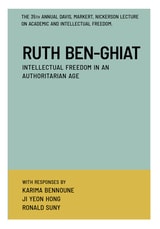
Ruth Ben-Ghiat
Intellectual Freedom in an Authoritarian AgeRuth Ben-Ghiat
Disobedience Press, 2026
In this lecture, Ruth Ben-Ghiat, an internationally renowned historian of fascism and authoritarian regimes past and present, stresses that universities have always been core targets of anti-democratic forces: “Strongmen disappear people, and they also disappear knowledge.” It’s an operation of noise and silence, she tells us. Aggressively take over institutions with the authoritarian worldview, hollow them out through “moral deregulation,” and bankrupt individuals by enticing them to distrust facts and betray their values. The goal, she argues, is to frighten civil society into silence in a coordinated attempt to stamp out dissent.
Ben-Ghiat speaks from experience: she had to deliver this talk, part of the University of Michigan’s yearly lecture devoted to academic freedom, on Zoom due to safety concerns.

Ruthless Criticism
New Perspectives in U.S. Communication HistoryWilliam S. Solomon and Robert W. McChesney, Editors
University of Minnesota Press, 1993
Ruthless Criticism was first published in 1993. Minnesota Archive Editions uses digital technology to make long-unavailable books once again accessible, and are published unaltered from the original University of Minnesota Press editions.
Ruthless Criticism offers perspectives and subjects largely outside traditional historiography. It broadens the concept of media history to include lesser-studied media, and offers alternative interpretations of traditional media.
This anthology of original research includes an array of scholarly and theoretical perspectives. Each addresses specific topic within a specific era. reflecting the diversity of U.S. mass media.
Solomon and McChesney begin by using critical theory and deconstruction to examine the meanings of print in the colonial era. Subsequent chapters study the media ecology of the antebellum press; the intense focus on profits of the post-Civil War mainstream press; gender images in the labor press; the diversity of political views within the working-class press; and the development of a commercial press in the black community.
The essays concerning the twentieth century focus on the rise of a culture industry and include studies on the origins of the broadcast ratings system and the commercial broadcast system and the commercial broadcast system, early television's portrayals of childhood, the televisions networks' close ties with the federal government, the government's key role in creating and developing the field of mass communication research, and teenage girls' popular culture from 1960–1968 as a formative influence on the feminist movement.
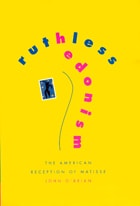
Ruthless Hedonism
The American Reception of MatisseJohn O'Brian
University of Chicago Press, 1999
In this ambitious study, John O'Brian argues that Matisse's sober presentations of himself were calculated to fit with the social constraints and ideological demands of the times. Matisse's strategy included cooperating with museums, cultivating private collectors, playing off dealers one against another, and reassuring the media that, whatever his reputation as an avant-gardist, the conduct of his life was solidly bourgeois.
Moving from the late 1920s, when Matisse's output was shedding its outlaw reputation, to the early 1950s, when his work was canonized, O'Brian shows how the way Matisse's work was viewed changed as attention shifted away from the seductiveness of his subject matter to the seductiveness of his paint. The art's resolute rejection of political concerns, its deployment of decorative design for visual satisfaction, and its representations of pleasure encouraged American audiences, who in the 1930s deemed the art disreputable, to celebrate its gratifications by the early years of the Cold War.
This intriguing, wide-ranging investigation of Matisse's self-promotion, America's uneasy embrace of modernism, and America's consumer culture and politics provides a rich context to Clement Greenberg's words published in the Nation in 1947: "Matisse's cold hedonism and ruthless exclusion of everything but the concrete, immediate sensation will in the future, once we are away from the present Zeitgeist, be better understood as the most profound mood of the first half of the twentieth century."

Rwandan Women Rising
Swanee Hunt
Duke University Press, 2017