Results by title
3258 books match the query 'Art' and 128 start with r
Robin and the Making of American Adolescence
Lauren R. O'Connor
Rutgers University Press, 2021
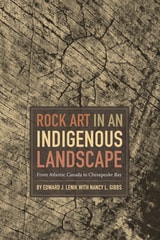
Rock Art in an Indigenous Landscape
From Atlantic Canada to Chesapeake BayEdward J. Lenik with Nancy L. Gibbs
University of Alabama Press, 2021
A landmark study of Native American rock art from Atlantic Canada to Chesapeake Bay.
Rock art, petroglyphs, and pictographs have been made by indigenous peoples for thousands of years. Images have been found on bedrock, cliff faces, ridge tops, and boulders and in rock shelters. Some rock surfaces are covered with abstract and geometric designs such as concentric circles, zigzag lines, grids, and cross-hatched and ladder-like patterns. Others depict humans, footprints and handprints, mammals, serpents, and mythic creatures. All were meticulously pecked, incised or painted. This ancient art form connects us to Native Americans’ past, traditions, world views, and sacred places.
Rock Art in an Indigenous Landscape: From Atlantic Canada to Chesapeake Bay is the culmination of the research of preeminent rock art scholar Edward J. Lenik. Here, he profiles more than 64 examples of rock art in varied locations from Nova Scotia to Maryland. Chapters are organized geographically and lead the reader through coastal sites, rivers and streams, lakes and ponds, and upland sites.
Lenik discusses the rock art examples in the context of the indigenous landscape, noting the significance of the place of discovery. Coverage includes a meticulous description of the design or motif and suggestions of time frame, artist-makers, and interpretations. Where possible, indigenous views on the artifacts enrich the narrative. Other invaluable elements are a discussion of how to identify indigenous rock art; a glossary of rock art terms and features and archaeological culture periods; an up-to-date bibliography; and an appendix of a number of reported but unconfirmed petroglyph sites in the regions.
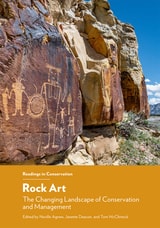
Rock Art
The Changing Landscape of Conservation and ManagementNeville Agnew
J. Paul Getty Trust, The, 2026
Painted and engraved marks and images on rock surfaces represent the oldest and most widespread form of human expression. Found globally in its original landscapes, with some images dating back fifty thousand years or more, the world’s rock art constitutes the most important body of latent knowledge about our deep past. Today, however, mass tourism, vandalism, theft, land development, and climate change are posing increasingly dire threats to this irreplaceable heritage.
This richly illustrated volume is the first interdisciplinary anthology to focus on the conservation and management of rock art sites. Its 133 readings survey the arc of published writings on the subject, ranging from early academic theories and oral narratives of Traditional peoples to an abundant selection of recent scholarship covering current best practices and advances in portable instrumentation that can be used in the field. Initial sections probe the origins and significance of these often-enigmatic forms, then survey scientific and technological methods of dating, monitoring, and documenting them. Subsequent readings discuss rock art’s physical characteristics and weathering, its importance to Indigenous communities, the decolonization of site management, the role of governments, the value of public outreach, and climate change. The volume closes with a selection of case studies drawn from major sites worldwide.
Rock of Ages, Sands of Time
Paintings by Barbara Page, Text by Warren AllmonBarbara Page and Warren D. Allmon
University of Chicago Press, 2001
These are just a few scenes from the magnificent drama that unfolds in glorious full color and three-dimensional texture in Rock of Ages, Sands of Time. Each of Barbara Page's 544 contiguous painted panels represents a million years of the history of life on earth, with fossil plants and animals depicted at the same scale and in association with each other just as they might be found by a paleontologist in the field. A muted rainbow of background colors evoke the rocks in which the fossils were found—the Texas Red Beds, for instance, or the yellow Solnhofen limestone—and keystone events are shown metaphorically, with fat rolls of paint marking major extinctions or continental drift.
To fully experience the awesome impact of an eon's worth of time spread across 500 feet of bas-relief panels, you'd have to visit the Museum of the Earth in Ithaca, New York, where Page's specially commissioned work will be installed when the museum opens in 2002. But this book is the next best thing. Not only does it contain crisp color reproductions of each painting, but it also includes an accessible essay from paleontologist Warren Allmon giving the scientific context behind the art.
For fossil lovers of all ages, and anyone interested in the merging of art and science, Rock of Ages, Sands of Time will be the find of a lifetime.
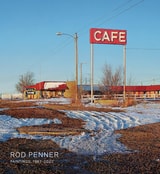
Rod Penner
Paintings, 1987–2022Rod Penner
The Artist Book Foundation, 2022
Rod Penner infuses his photorealistic paintings of the American southwest with a cinematic quality in the first major monograph on this contemporary realist artist.
The abandoned and forgotten landscapes of rural southwestern towns are the favored subjects of Rod Penner's paintings. His deft use of contrasts in his images—despondency and hope, isolation and nostalgia—evokes memories of The Last Picture Show and elicits complex responses from viewers. "I'm interested in the look of things and the quality of being there," he says. "A moment that is completely frozen with all the variety of textures; rust on poles, crumbling asphalt, light hitting the grass."
Penner's works are based on his photographs, digital video stills, and his experience of the rural landscapes of Texas and New Mexico. He depicts desolate, often deserted locations, the character of old houses and abandoned buildings, weather, and unique geography. His chosen scenes are infused with a cinematic quality that is the result of the exquisite light that he captures with his meticulous process. "The finished paintings should evoke contrasting responses of melancholy and warmth, desolation and serenity," he says.
Penner's hyperrealistic technique meticulously records both the iconic imagery and the beauty in the ashes of these once-prosperous streets and nighborhoods that still endure. The incredible poignant scenes evoke a universalism, a collective experience seen through the lens of Americana. "You won't find any hidden or overt socio-political meaning in my work and at the same time I hope that by utilizing what I find in the American landscape I'm able to connect to viewers on a deeper psychological level."
Roman Artists, Patrons, and Public Consumption
Familiar Works ReconsideredBrenda Longfellow and Ellen E. Perry, editors
University of Michigan Press, 2018
The work gathered in Roman Artists, Patrons, and Public Consumption displays the breadth and depth of scholarship in the field made possible by these fundamental changes. The first five essays approach individual objects and artistic tropes, as well as their cultural contexts and functions, from fresh and dynamic angles. The latter essays focus on case studies in Pompeii, demonstrating how close visual analysis firmly rooted in local and temporal contexts not only strengthens understanding of ancient interactions with monuments but also sparks a reconsideration of long-held assumptions reinforced by earlier scholarship.
These rigorous essays reflect and honor the groundbreaking scholarship of Elaine K. Gazda. In addition to volume editors Brenda Longfellow and Ellen E. Perry, contributors include Bettina Bergmann, Elise Friedland, Barbara Kellum, Diana Y. Ng, Jessica Powers, Melanie Grunow Sobocinski, Lea M. Stirling, Molly Swetnam-Burland, Elizabeth Wolfram Thill, and Jennifer Trimble.
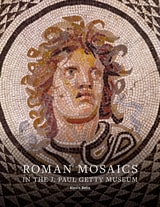
Roman Mosaics in the J. Paul Getty Museum
Alexis Belis
J. Paul Getty Trust, The, 2016
The mosaics in the collection of the J. Paul Getty Museum span the second through the sixth centuries AD and reveal the diversity of compositions found throughout the Roman Empire during this period. Elaborate floors of stone and glass tesserae transformed private dwellings and public buildings alike into spectacular settings of vibrant color, figural imagery, and geometric design. Scenes from mythology, nature, daily life, and spectacles in the arena enlivened interior spaces and reflected the cultural ambitions of wealthy patrons. This online catalogue documents all of the mosaics in the Getty Museum’s collection, presenting their artistry in new color photography as well as the contexts of their discovery and excavation across Rome's expanding empire—from its center in Italy to provinces in southern Gaul, North Africa, and ancient Syria.
Reflecting the Getty's commitment to open content, Roman Mosaics in the J. Paul Getty Museum is available online at www.getty.edu/publications/romanmosaics and may be downloaded free of charge in multiple formats. For readers who wish to have a bound reference copy, a paperback edition has been made available for sale.
The publication of this online catalogue is issued on the occasion of the exhibition, Roman Mosaics across the Empire, on view at the Getty Villa from March 30 through September 12, 2016.
Romanesque Architectural Sculpture
The Charles Eliot Norton LecturesMeyer Schapiro
University of Chicago Press, 2006
Meyer Schapiro (1904-96), renowned for his critical essays on nineteenth- and twentieth-century painting, also played a decisive role as a young scholar in defining the style of art and architecture known as Romanesque. And, appropriately, when he was invited to deliver the prestigious Charles Eliot Norton Lectures at Harvard, he chose Romanesque architectural sculpture as his topic. These lectures, acclaimed for the verve and freshness with which Schapiro delivered them, languished unpublished for decades. But Linda Seidel, who knew Schapiro well and attended the 1967 lectures, has now expertly transcribed and edited them, presenting them for the first time to an audience beyond the halls of Harvard.
In editing the lectures, Seidel closely followed the recordings of the originals. Sentences are rendered as Schapiro spoke them, affording readers a unique opportunity to experience the legendary teacher as he rarely appears in print: forming his thoughts spontaneously, interrupting himself to develop related ideas, and responding to the audience’s interests by introducing humorous asides. Nonetheless, these lectures are carefully constructed, demonstrating Schapiro’s commitment to the originality and value of artistic production and affirming his lifelong belief in artists’ engagement with their cultures. Amply illustrated with many key works and augmented with Seidel’s indispensable introduction, this long-awaited volume will delight students and scholars of art history, as well as anyone interested in seeing a new side of a profoundly influential mind.
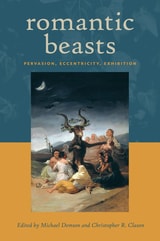
Romantic Beasts
Pervasion, Eccentricity, ExhibitionMichael Demson
Bucknell University Press, 2025
Published by Bucknell University Press. Distributed worldwide by Rutgers University Press.
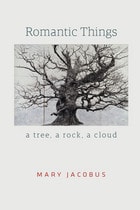
Romantic Things
A Tree, a Rock, a CloudMary Jacobus
University of Chicago Press, 2012
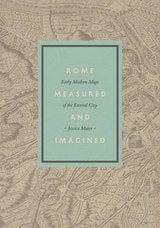
Rome Measured and Imagined
Early Modern Maps of the Eternal CityJessica Maier
University of Chicago Press, 2015
In Rome Measured and Imagined, Jessica Maier explores the history of this genre—which merged the accuracy of scientific endeavor with the imaginative aspects of art—during the rise of Renaissance print culture. Through an exploration of works dating from the fifteenth to the eighteenth centuries, her book interweaves the story of the city portrait with that of Rome itself.
Highly interdisciplinary and beautifully illustrated with nearly one hundred city portraits, Rome Measured and Imagined advances the scholarship on Renaissance Rome and print culture in fascinating ways.
Rome as a Guide to the Good Life
A Philosophical Grand TourScott Samuelson
University of Chicago Press, 2023
This is a guidebook to Rome for those interested in both la dolce vita and what the ancient Romans called the vita beata—the good life. Philosopher Scott Samuelson offers a thinker’s tour of the Eternal City, rooting ideas from this philosophical tradition within the geography of the city itself. As he introduces the city’s great works of art and its most famous sites—the Colosseum, the Forum, the Campo de’ Fiori—Samuelson also gets to the heart of the knotty ethical and emotional questions they pose. Practicing philosophy in place, Rome as a Guide to the Good Life tackles the profound questions that most tours of Rome only bracket. What does all this history tell us about who we are?
In addition to being a thoughtful philosophical companion, Samuelson is also a memorable tour guide, taking us on plenty of detours and pausing to linger over an afternoon Negroni, sample four classic Roman pastas, or explore the city’s best hidden gems. With Samuelson’s help, we understand why Rome has inspired philosophers such as Lucretius and Seneca, poets and artists such as Horace and Caravaggio, filmmakers like Fellini, and adventurers like Rosa Bathurst. This eclectic guidebook to Roman philosophy is for intrepid wanderers and armchair travelers alike—anyone who wants not just a change of scenery, but a change of soul.
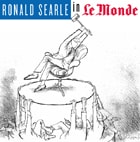
Ronald Searle in Le Monde
Ronald Searle
University of Chicago Press, 2002
Since 1995, Searle has plied his sardonic trade on the coveted op-ed pages of the French daily newspaper Le Monde. This book presents more than a hundred of the best of these cartoons, ranging across politics, the new Europe, the nature of the contemporary economy, social games, and various "angels," both benign and mischievous. Whether skewering the greed of the rich with images of men in suits padding each other's pockets with cash or conducting business under the table, or making a poignant comment about how much harder peace has to work than war to stay in the same place, Searle displays the same pungent, incisive, yet infinitely humane wit. The deceptive simplicity of his lines and shadings combine with meticulously observed details of dress, background, and facial expression to produce arresting images that convey his messages powerfully and beautifully.
By turns delightful, amusing, and disturbing, but always deeply thought provoking, Searle's work reaches well beyond the specific occasion that inspired a given cartoon to illuminate key aspects of public life in the West at the end of the millennium. This book contains twenty-five illustrations not found in the French edition, together with a new preface for English-speaking readers written by Searle himself.
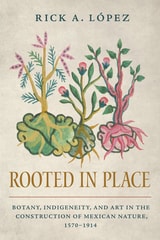
Rooted in Place
Botany, Indigeneity, and Art in the Construction of Mexican Nature, 1570–1914Rick A. López
University of Arizona Press, 2025
Prize for Best Book in Environmental Studies, Latin American Studies Association
Honorable mention for Best Book Prize in Visual Culture, Latin American Studies Association
Honorable mention for Best Book on Mexico, Latin American Studies Association
Since the first moment of conquest, colonizers and the colonized alike in Mexico confronted questions about what it meant to be from this place, what natural resources it offered, and who had the right to control those resources and on what basis.
Focusing on the ways people, environment, and policies have been affected by political boundaries, historian Rick A. López explores the historical connections between political identities and the natural world. López analyzes how scientific intellectuals laid claim to nature within Mexico, first on behalf of the Spanish Empire and then in the name of the republic, during three transformative moments: the Hernández expedition of the late sixteenth century; the Royal Botanical Expedition of the late eighteenth century; and the heyday of scientific societies such as the Sociedad Mexicana de Historia Natural of the late nineteenth century.
This work traces how scientific intellectuals studied and debated what it meant to know and claim the flora that sprang from Mexican soil—ranging from individual plants to forests and vegetated landscapes—and the importance they placed on indigeneity. It also points to the short- and long-term consequences of these efforts. López draws on archival and published sources produced from the sixteenth century through the start of the twentieth century and gives special attention to the use of visual images such as scientific illustrations and landscape art. López employs the term “visualization” in recognition of the degree to which officials, botanists, and draftsmen produced imagery and also how they and others viewed nature.
Rooted in Place reveals how scientific endeavors were not just about cataloging flora but were deeply intertwined with the construction of identity and the political landscape at three pivotal moments in Mexican history.
Roots of the Black Chicago Renaissance
New Negro Writers, Artists, and Intellectuals, 1893-1930Edited by Richard A. Courage and Christopher Robert Reed
University of Illinois Press, 2020
Richard A. Courage and Christopher Robert Reed have brought together essays that explore the intersections in the backgrounds, education, professional affiliations, and public lives and achievements of black writers, journalists, visual artists, dance instructors, and other creators working in the late nineteenth and early twentieth centuries. Organized chronologically, the chapters unearth transformative forces that supported the emergence of individuals and social networks dedicated to work in arts and letters. The result is an illuminating scholarly collaboration that remaps African American intellectual and cultural geography and reframes the concept of urban black renaissance.
Contributors: Richard A. Courage, Mary Jo Deegan, Brenda Ellis Fredericks, James C. Hall, Bonnie Claudia Harrison, Darlene Clark Hine, John McCluskey Jr., Amy M. Mooney, Christopher Robert Reed, Clovis E. Semmes, Margaret Rose Vendryes, and Richard Yarborough
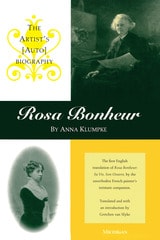
Rosa Bonheur
The Artist's (Auto)biographyAnna Klumpke
University of Michigan Press, 2001
Rosa Bonheur: The Artist's (Auto)Biography brings this extraordinary woman to life in a unique blend of biography and autobiography. Coupling her own memories with Bonheur's first-person account, Anna Klumpke, a young American artist who was Bonheur's lover and chosen portraitist, recounts how she came to meet and fall in love with Bonheur. Bonheur's account of her own life story, set nicely within Klumpke's narrative, sheds light on such topics as gender formation, institutional changes in the art world, governmental intervention in the arts, the social and legal regulation of dress codes, and the perceived transgressive nature of female sexual companionship in a repressive society, all with the distinctive flavor of Bonheur's artistic personality.
Gretchen van Slyke's translation provides a rare glimpse into the unconventional life of this famous French painter, and renders accessible for the first time in English this public statement of Bonheur's artistic credo. More importantly, whether judged by her century's standards (or perhaps even our own), it details a story of lesbian love that is bold, unconventional, and courageous.
"The remarkable life of Rosa Bonheur, one of the most highly decorated artists and certainly the best known female artist of her time in nineteenth-century France, is long overdue for further scrutiny." --Therese Dolan, Temple University
Gretchen van Slyke is Associate Professor of French, University of Vermont.

Rosebud Sleds and Horses' Heads
50 of Film's Most Evocative Objects - An Illustrated JourneyScott Jordan Harris
Intellect Books, 2013
Rosebud Sleds and Horses’ Heads presents incisive discussion of fifty of the most significant objects in cinema history and explores their importance within their films and within the popular imagination. With original full color illustrations, this book surveys objects from a range of genres, from the birth of cinema to the present day.
Curated and written by a prominent film critic who routinely writes for some of the leading publications in the English language, as well as broadcasts for the BBC, Rosebud Sleds and Horses’ Heads is the only book of its kind. With a fascinating, original, and instantly understandable concept, it will find grateful audiences in film buffs around the world.
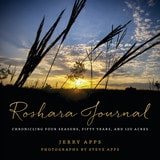
Roshara Journal
Chronicling Four Seasons, Fifty Years, and 120 AcresJerry Apps
Wisconsin Historical Society Press, 2016
A photographic diary of a small Midwestern farm and the family who’ve made it their home
In Roshara Journal, father-and-son team Jerry and Steve Apps share the monthly happenings at their family’s farm in central Wisconsin. Featuring Steve’s stunning photos and fifty years of Jerry’s journal entries, Roshara Journal captures the changes—both from month to month and over the decades—on the landscape and farmstead.
The Apps family has owned Roshara since 1966. There they nurture a prairie restoration and pine plantation, maintain a large garden that feeds three generations, observe wildlife species by the dozens, and support a population of endangered butterflies. In documenting life on this piece of land, Jerry and Steve remind us how, despite the pace and challenges of modern life, the seasons continue to influence our lives in ways large and small. Jerry explains that his journal entries become much more than mere observations: "It seems that when I write about something—a bur oak tree, for example—that old tree becomes a part of me. . . . Writing takes me to a place that goes beyond observation and understanding, a place filled with feeling and meaning."
In the tradition of Bernd Heinrich in Maine, Barry Lopez in the Canadian Arctic, and Aldo Leopold just an hour down the road in Baraboo, Jerry and Steve Apps combine observation, experience, and reflection to tell a profound story about one place in the world.
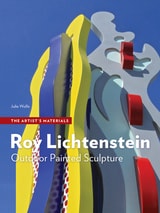
Roy Lichtenstein
Outdoor Painted SculptureJulie Wolfe
J. Paul Getty Trust, The, 0
Vibrant color was essential to the paintings of the American pop artist Roy Lichtenstein (1923–1997), and when he began exploring the creation of outdoor sculpture in the late 1970s, vivid hues remained an important part of his artistic vocabulary. Today, preserving these remarkable works after they have endured decades in outdoor environments around the world is an issue of pressing concern.
This abundantly illustrated volume is based on extensive archival research of Lichtenstein’s studio materials, interviews with his assistants, and a thorough technical analysis of the sculpture Three Brushstrokes. The book concludes with a chapter showing various options for the care, conservation, and restoration of his sculptural works, making this an essential resource for conservators, curators, and others interested both in the iconic artist and modern sculpture in general.
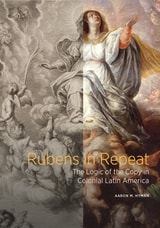
Rubens in Repeat
The Logic of the Copy in Colonial Latin AmericaAaron M. Hyman
J. Paul Getty Trust, The, 2021
Winner of the Latin American Studies Association's 2022 Best Book in Colonial Latin American Studies.
This book examines the reception in Latin America of prints designed by the Flemish artist Peter Paul Rubens, showing how colonial artists used such designs to create all manner of artworks and, in the process, forged new frameworks for artistic creativity.
Peter Paul Rubens (1577–1640) never crossed the Atlantic himself, but his impact in colonial Latin America was profound. Prints made after the Flemish artist’s designs were routinely sent from Europe to the Spanish Americas, where artists used them to make all manner of objects.
Rubens in Repeat is the first comprehensive study of this transatlantic phenomenon, despite broad recognition that it was one of the most important forces to shape the artistic landscapes of the region. Copying, particularly in colonial contexts, has traditionally held negative implications that have discouraged its serious exploration. Yet analyzing the interpretation of printed sources and recontextualizing the resulting works within period discourse and their original spaces of display allow a new critical reassessment of this broad category of art produced in colonial Latin America—art that has all too easily been dismissed as derivative and thus unworthy of sustained interest and investigation. This book takes a new approach to the paradigms of artistic authorship that emerged alongside these complex creative responses, focusing on the viceroyalties of New Spain and Peru in the seventeenth and eighteenth centuries. It argues that the use of European prints was an essential component of the very framework in which colonial artists forged ideas about what it meant to be a creator.
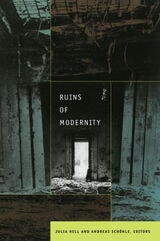
Ruins of Modernity
Julia Hell and Andreas Schönle, eds.
Duke University Press, 2009
Several contributors discuss ideas about ruins developed by philosophers such as Immanuel Kant, Georg Simmel, and Walter Benjamin. One contributor examines how W. G. Sebald’s novel The Rings of Saturn betrays the ruins erased or forgotten in the Hegelian philosophy of history. Another analyzes the repressed specter of being bombed out of existence that underpins post-Second World War modernist architecture, especially Le Corbusier’s plans for Paris. Still another compares the ways that formerly dominant white populations relate to urban-industrial ruins in Detroit and to colonial ruins in Namibia. Other topics include atomic ruins at a Nevada test site, the connection between the cinema and ruins, the various narratives that have accrued around the Inca ruin of Vilcashuamán, Tolstoy’s response in War and Peace to the destruction of Moscow in the fire of 1812, the Nazis’ obsession with imperial ruins, and the emergence in Mumbai of a new “kinetic city” on what some might consider the ruins of a modernist city. By focusing on the concept of ruin, this collection sheds new light on modernity and its vast ramifications and complexities.
Contributors. Kerstin Barndt, Jon Beasley-Murray, Russell A. Berman, Jonathan Bolton, Svetlana Boym, Amir Eshel, Julia Hell, Daniel Herwitz, Andreas Huyssen, Rahul Mehrotra, Johannes von Moltke, Vladimir Paperny, Helen Petrovsky, Todd Presner, Helmut Puff, Alexander Regier, Eric Rentschler, Lucia Saks, Andreas Schönle, Tatiana Smoliarova, George Steinmetz, Jonathan Veitch, Gustavo Verdesio, Anthony Vidler
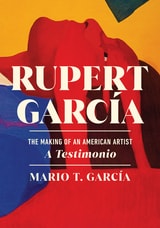
Rupert García
The Making of an American Artist, a TestimonioMario T. García
Rutgers University Press, 2026
This is the first biography of the renowned American Chicano visual artist and activist Rupert García, drawing on fifty hours of interviews conducted over thirty years and accompanied by eighty images. This in-depth oral history gives an unparalleled look at García’s life and work, tracing his evolution as an artist and the political upheavals that shaped his life and worldview.
Mario T. García’s testimonio places Rupert García’s art in historical perspective, from his beginnings as a working-class Mexican American from California’s Central Valley, his coming of age in the U.S. Air Force during the Vietnam War, his involvement in the antiwar movement during the San Francisco State student strike in 1968-69, and his participation in the Chicano Movement and beyond. Influenced by history and politics, García’s vital works of art represent a changing world through the eyes of an artist, speaking to issues of poverty, racism, capitalism, war, and the role of the artist in society.
His art—from revolutionary silkscreen posters to monumental pastels to portraits of political icons like Frida Kahlo, Che Guevara, and Dolores Huerta—serves to critique history and reassess it. It is work that will endure for generations to come.
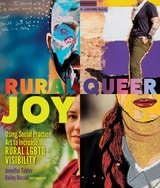
Rural Queer Joy
Using Social Practice Art to Increase Rural LGBTQ+ VisibilityJennifer Tabler
University of Wyoming Press, 2026
Blending social science, fine arts, and the humanities, Rural Queer Joy explores how the telling of rural LGBTQ+ stories affects young rural queer people today. The stories of well-known Wyoming LGBTQ+ people like Matthew Shepard, Sissy Goodwin, and Artemis Langford often center experiences of trauma and hardship, leaving little space for experiences of triumph or joy.
Author Jennifer Tabler and photographer Bailey Russel provided rural LGBTQ+ community members with an opportunity to represent their own experiences through participation in a social practice art project, asking what about being LGBTQ+ brings them joy. They then took the participants’ portraits and invited them to annotate these portraits with paint, markers, paper, or other media. This kind of social practice art provides an opportunity to engage in epistemic activism through the self-empowerment of marginalized voices and perspectives, while also centering visuals of rural queer people that counter existing stereotypes and add nuance to our understanding of rural LGBTQ+ people.
The dynamic artwork and quotes from young rural LGBTQ+ people displayed in this book highlight how their identities are sources of joy and opportunity rather than constraint and hardship. Rural and/or LGBTQ+ people, researchers, and teachers in the fields of community-engaged arts, gender studies, sociology of sexualities, and public humanities will find inspiration in Rural Queer Joy—inspiration to rethink what it means to be rural and LGBTQ+ as well as to use social practice art to increase the visibility of other underserved communities.
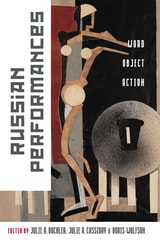
Russian Performances
Word, Object, ActionEdited by Julie A. Buckler, Julie A. Cassiday, and Boris Wolfson
University of Wisconsin Press, 2018
Challenging the primacy of the written word in this field, the volume fosters a larger intellectual community informed by theories and practices of performance from anthropology, art history, dance studies, film studies, cultural and social history, literary studies, musicology, political science, theater studies, and sociology.
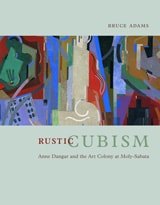
Rustic Cubism
Anne Dangar and the Art Colony at Moly-SabataBruce Adams
University of Chicago Press, 2004
In part a gripping biography of this Australian expatriate, Rustic Cubism chronicles Dangar's personal battles and the tumult of the World War II era during her tempestuous tenure at Moly-Sabata. Dangar dedicated herself to the colony's aims by working in the region's village potteries, combining their vernacular elements with Gleizes' design methods to arrive at a type of rustic Cubism. Her work there would ultimately be rewarded; her pieces can today be found in the Musée des Arts Décoratifs in Paris, the Musée d'Art Moderne de la Ville de Paris, the Museo Internazionale delle Ceramiche in Faenza, the National Gallery of Australia, Canberra, and many other museums.
Rustic Cubism places Dangar at the heart of Moly-Sabata's alternative art movement—one that, in its nostalgic present, attempted to construct a culture based on the distant past. Generously illustrated with photographs of the art and social milieu of the period, this captivating and original narrative makes a considerable contribution to our understanding of French modernism and early twentieth-century cultural politics as well as of the life of a most talented and intriguing female artist.
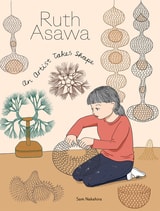
Ruth Asawa
An Artist Takes ShapeSam Nakahira
J. Paul Getty Trust, The, 2024
Renowned for her innovative wire sculptures, Japanese American artist Ruth Asawa (1926–2013) was a teenager in Southern California when Japan bombed Pearl Harbor and the United States entered World War II. Japanese Americans on the West Coast were forcibly removed from their homes. Asawa’s family had to abandon their farm, her father was incarcerated, and she and the rest of her family were sent to a concentration camp. Asawa nurtured her dreams of becoming an artist while imprisoned and eventually made her way to the experimental Black Mountain College in North Carolina.
This graphic biography by Sam Nakahira, developed in consultation with Asawa’s youngest daughter, Addie Lanier, chronicles the genesis of Asawa as an artist—from the horror of Pearl Harbor to her transformative education at Black Mountain College to building a life in San Francisco, where she would further develop and refine her groundbreaking wire sculpture.
Asawa never sought fame, preferring to work on her own terms: for her, art and life were one. Featuring lively illustrations and photographs of Asawa’s work, this retelling of her young adult years demonstrates the power of making art.
Ages thirteen and up
Ruthless Hedonism
The American Reception of MatisseJohn O'Brian
University of Chicago Press, 1999
In this ambitious study, John O'Brian argues that Matisse's sober presentations of himself were calculated to fit with the social constraints and ideological demands of the times. Matisse's strategy included cooperating with museums, cultivating private collectors, playing off dealers one against another, and reassuring the media that, whatever his reputation as an avant-gardist, the conduct of his life was solidly bourgeois.
Moving from the late 1920s, when Matisse's output was shedding its outlaw reputation, to the early 1950s, when his work was canonized, O'Brian shows how the way Matisse's work was viewed changed as attention shifted away from the seductiveness of his subject matter to the seductiveness of his paint. The art's resolute rejection of political concerns, its deployment of decorative design for visual satisfaction, and its representations of pleasure encouraged American audiences, who in the 1930s deemed the art disreputable, to celebrate its gratifications by the early years of the Cold War.
This intriguing, wide-ranging investigation of Matisse's self-promotion, America's uneasy embrace of modernism, and America's consumer culture and politics provides a rich context to Clement Greenberg's words published in the Nation in 1947: "Matisse's cold hedonism and ruthless exclusion of everything but the concrete, immediate sensation will in the future, once we are away from the present Zeitgeist, be better understood as the most profound mood of the first half of the twentieth century."
Rwanda's Genocide Heritage
Between Justice and SovereigntyDelia Duong Ba Wendel
Duke University Press, 2025