Results by title
4531 books match the query 'Cultural & Ethnic Studies' and 272 start with r
Reading Together, Reading Apart
Identity, Belonging, and South Asian American CommunityTamara Bhalla
University of Illinois Press, 2016
Tamara Bhalla blends a case study with literary and textual analysis to illuminate this phenomenon. Her fascinating investigation considers institutions from literary reviews to the marketplace to social media and other technologies, as well as traditional forms of literary discussion like book clubs and academic criticism. Throughout, Bhalla questions how her subjects' circumstances, desires, and shared race and class, limit the values they ascribe to reading. She also examines how ideology circulating around a body of literature or a self-selected, imagined community of readers shapes reading itself and influences South Asians' powerful, if contradictory, relationship with ideals of cultural authenticity.
Reading the Literatures of Asian America
Shirley Geok-lin Lim
Temple University Press, 1992
Ready Player Juan
Latinx Masculinities and Stereotypes in Video GamesCarlos Gabriel Kelly González
University of Arizona Press, 2023
The book employs an intersectional approach through performance theory, border studies, and lived experience to analyze the designed identity “Player Juan.” Player Juan manifests in video game representations through a discourse of criminality that sets expectations of who and what Latinxs can be and do. Developing an original approach to video game experiences, the author theorizes video games as border crossings, and defines a new concept—digital mestizaje—that pushes players, readers, and scholars to deploy a Latinx way of seeing and that calls on researchers to consider a digital object’s constructive as well as destructive qualities.
Real Black
Adventures in Racial SincerityJohn L. Jackson Jr.
University of Chicago Press, 2005
Jackson argues that authenticity caricatures identity as something imposed on people, imprisoning them within stereotypes: an African American high school student who excels in the classroom, for instance, might be dismissed as "acting white." On the other hand, sincerity, as Jackson defines it, imagines authenticity as an incomplete measuring stick, an analytical model that attempts to deny people agency in their search for identity.
Drawing on more than ten years of ethnographic research in and around New York City, Jackson offers a kaleidoscope of subjects and stories that directly and indirectly address how race is negotiated in today's world—including tales of book-vending numerologists, urban conspiracy theorists, corrupt police officers, mixed-race neo-Nazis, and gospel choirs forbidden to catch the Holy Ghost. Jackson records and retells their interconnected sagas, all the while attempting to reconcile these stories with his own crisis of identity and authority as an anthropologist terrified by fieldwork. Finding ethnographic significance where mere mortals see only bricks and mortar, his invented alter ego Anthroman takes to the streets, showing how race is defined and debated, imposed and confounded every single day.
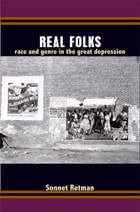
Real Folks
Race and Genre in the Great DepressionSonnet H. Retman
Duke University Press, 2011
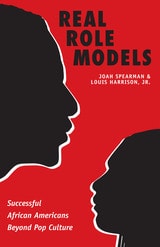
Real Role Models
Successful African Americans Beyond Pop CultureBy Joah Spearman and Louis Harrison, Jr.
University of Texas Press, 2010
All young people need good role models, and black youth especially need positive and real examples beyond the famous and wealthy people they see on SportsCenter highlights and MTV Cribs. While success as a celebrity athlete or entertainer may seem like an achievable dream, the reality is that young African Americans have a much greater chance of succeeding in the professions through education and hard work—and a mentor to show them the path. Real Role Models introduces high school and college-age African Americans to twenty-three black professionals who have achieved a high level of success in their chosen fields and who tell their stories to inspire young people to pursue a professional career and do the work necessary to achieve their dreams.
Some of the individuals profiled by Joah Spearman and Louis Harrison, Jr., include Leonard Pitts, Pulitzer Prize–winning columnist for the Miami Herald; Melody Barnes, Director of the White House Domestic Policy Council; Danyel Smith, editor-in-chief of Vibe; and Dr. Tim George, Chief of Pediatric Neuroscience at Dell Children's Medical Center of Central Texas. They and other interviewees describe their backgrounds, career paths, and desire to give back by helping others reach their goals. Representing a wide range of occupations, these real role models prove to African American youths that a whole world of successful, rewarding careers awaits them.
The Real Role Models
- Rufus Cormier, JD, Partner at the Baker Botts Law Firm, Houston, Texas
- Melody Barnes, Director of the White House Domestic Policy Council, Washington, D.C.
- Eric Motley, PhD, Managing Director of the Aspen Institute's Henry Crown Fellowship Program, Aspen, Colorado
- James McIntyre, Spokesman for the Federal Emergency Management Agency, Washington, D.C.
- Tracie Hall, Assistant Dean and Librarian at Dominican University, River Forest, Illinois
- Kimberlydawn Wisdom, MD, Surgeon General of the State of Michigan, Lansing, Michigan
- Timothy George, MD, Chief of Pediatric Neuroscience at Dell Children's Medical Center, Austin, Texas
- Victoria Holloway Barbosa, MD, Ethnic Dermatologist and Former Executive for L'Oreal, Chicago, Illinois
- Bill Douglas, White House Correspondent for McClatchy Newspapers, Washington, D.C.
- Leonard Pitts, Jr., Columnist for the Miami Herald, Miami, Florida
- Danyel Smith, Editor of Vibe Magazine, New York, New York
- Ed Stewart, Managing Director of External Communications for Delta Airlines, Atlanta, Georgia
- Lynn Tyson, Vice President of Investor Relations for Dell, Austin, Texas
- Willie Miles, Jr., Founder and CEO of Miles Wealth Management, Houston, Texas
- Horace Allen, Founder and CEO of TeamPact, Atlanta, Georgia
- Deavra Daughtry, President and CEO of Excellent Care Management, Houston, Texas
- Je'Caryous Johnson, Founder and CEO of I'm Ready Productions, Houston, Texas
- Steve Jones, Cofounder of a graphic design company, Oakland, California
- Isiah Warner, PhD, Chemistry Professor at Louisiana State University, Baton Rouge, Louisiana
- Gloria Ladson-Billings, PhD, Professor of Education at the University of Wisconsin, Madison, Wisconsin
- Bernard Muir, Athletic Director at Georgetown University, Washington, D.C.
- Craig Littlepage, Athletic Director at the University of Virginia, Charlottesville, Virginia
- Beverly Kearney, Women's Track Coach at the University of Texas at Austin, Austin, Texas
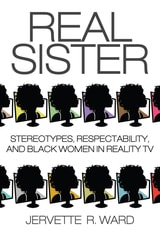
Real Sister
Stereotypes, Respectability, and Black Women in Reality TVWard, Jervette R
Rutgers University Press, 2015
The first book of scholarship devoted to the issue of how black women are depicted on reality television, Real Sister offers an even-handed consideration of the genre. The book’s ten contributors—black female scholars from a variety of disciplines—provide a wide range of perspectives, while considering everything from Basketball Wives to Say Yes to the Dress. As regular viewers of reality television, these scholars are able to note ways in which the genre presents positive images of black womanhood, even as they catalog a litany of stereotypes about race, class, and gender that it tends to reinforce.
Rather than simply dismissing reality television as “trash,” this collection takes the genre seriously, as an important touchstone in ongoing cultural debates about what constitutes “trashiness” and “respectability.” Written in an accessible style that will appeal to reality TV fans both inside and outside of academia, Real Sister thus seeks to inspire a more nuanced, thoughtful conversation about the genre’s representations and their effects on the black community.

Rebellion or Revolution?
Harold Cruse
University of Minnesota Press, 2009
A classic work of African American cultural, social, and political thought by a forerunner of the Black Power movement
One of the leading writers of African American intellectual life in the second half of the twentieth century, Harold Cruse first came to international attention in 1967 with the publication of his influential and inflammatory book, The Crisis of the Negro Intellectual. This fiercely opinionated and deeply informed critique of both integrationism and black nationalism established Cruse as a bold new voice on race and resistance in America.
First published in the wake of The Crisis of the Negro Intellectual’s success, Rebellion or Revolution? collects reviews and essays Cruse wrote between 1950 and 1966, examining the relevance of such figures as James Baldwin, Booker T. Washington, Albert Camus, and Josephine Baker, as well as such subjects as Marxism and the African American community, the economics of black nationalism, and the emerging Black Power movement. Rebellion or Revolution? contains a number of significant writings not available elsewhere.Now, with a new foreword by Cedric Johnson, this work finally emerges as both an essential document from a crucial moment in African American history and a road map to the origins and evolution of Cruse’s critical thought, asserting its importance in today’s debates on race in America.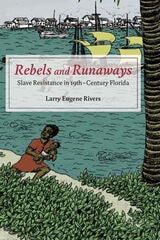
Rebels and Runaways
Slave Resistance in Nineteenth-Century FloridaLarry Eugene Rivers
University of Illinois Press, 2013
Against a smoldering backdrop of violence, this study analyzes the various degrees of slave resistance--from the perspectives of both slave and master--and how they differed in various regions of antebellum Florida. In particular, Rivers demonstrates how the Atlantic world view of some enslaved blacks successfully aided their escape to freedom, a path that did not always lead North but sometimes farther South to the Bahama Islands and Caribbean. Identifying more commonly known slave rebellions such as the Stono, Louisiana, Denmark (Telemaque) Vesey, Gabriel, and the Nat Turner insurrections, Rivers argues persuasively that the size, scope, and intensity of black resistance in the Second Seminole War makes it the largest sustained slave insurrection ever to occur in American history.
Meticulously researched, Rebels and Runaways offers a detailed account of resistance, protest, and violence as enslaved blacks fought for freedom.
Recharting the Caribbean
Land, Law, and Citizenship in the British Virgin IslandsBill Maurer
University of Michigan Press, 2000
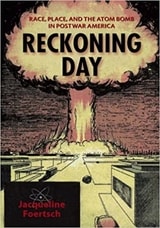
Reckoning Day
Race, Place, and the Atom Bomb in Postwar AmericaJacqueline Foertsch
Vanderbilt University Press, 2013
Foertsch also examines the location of African American characters in novels, science fiction, and survivalist nonfiction such as government-sponsored forecasts regarding post-nuclear survival. In these, black characters are often displaced or absented entirely: in doomsday narratives they are excluded from executive decision-making and the stories' often triumphant conclusions; in the nonfiction, they are rarely envisioned amongst the "typical American" survivors charged with rebuilding US society. Throughout Reckoning Day, issues of placement and positioning provide the conceptual framework: abandoned at "ground zero" (America's inner cities) during the height of the atomic threat, African Americans were figured in white-authored survival fiction as compliant servants aiding white victory over atomic adversity, while as historical figures they were often perceived as "elsewhere" (indifferent) to the atomic threat. In fact, African Americans' "position" on the bomb was rarely one of silence or indifference. Ranging from appreciation to disdain to vigorous opposition, atomic-era African Americans developed diverse and meaningful positions on the bomb and made essential contributions to a remarkably American dialogue.

Reckoning with Harm
The Toxic Relations of Oil in AmazoniaAmelia Fiske
University of Texas Press, 2023
2025 Margaret Mead Award, Society for Applied Anthropology (SfAA) and the American Anthropological Association (AAA)
An ethnography of the Ecuadorian Amazon that demonstrates the need for a relational, place-based, contingent understanding of harm and toxicity.
Reckoning with Harm is a striking ethnographic analysis of the harm resulting from oil extraction. Covering fifty years of settler colonization and industrial transformation of the Ecuadorian Amazon, Amelia Fiske interrogates the relations of harm. She moves between forest-courtrooms and oily waste pits, farms and toxic tours, to explore both the ways in which harm from oil is entangled with daily life and the tensions surrounding efforts to verify and redress it in practice. Attempts to address harm from the oil industry in Ecuador have been consistently confounded by narrow, technocratic understandings of evidence, toxicity, and responsibility. Building on collaborators’ work to contest state and oil company insistence that harm is controlled and principally chemical in nature, Fiske shows that it is necessary to refigure harm as relational in order to reckon with unremediated contamination of the past while pushing for broad forms of accountability in the present. She theorizes that harm is both a relationship and an animating feature of relationships in this place, a contingent understanding that is needed to contemplate what comes next when living in a toxic world.
Reckoning with Slavery
Gender, Kinship, and Capitalism in the Early Black AtlanticJennifer L. Morgan
Duke University Press, 2021
Reckoning with the World
South Korean Television and the Latin American ImaginaryBenjamin M. Han
Temple University Press, 2026
Historical dramas like The Land of Humans, about Korean migrants in Mexico, consider diasporic identity and nationalism, while the fantasy series Secret Garden explores issues of modernity. In addition, the TV drama Encounter and the entertainment show Traveler contrast the cultures of global Korea with Cuba. As these programs create appealing storytelling, characters, and aesthetics, they inspire and resonate with audiences and fans across the globe. However, Korean television’s imaginary of Latin America is not about its investment in fostering greater interculturality with Latin American nations and their cultures but instead projects a façade of progressive racial and cultural politics shaping Korea’s reckoning with the world.
Reclaiming Basque
Language, Nation, and Cultural ActivismJacqueline Urla
University of Nevada Press, 2015

Reclaiming Black Brazil
Literature, Culture, and the Politics of DiasporaEdited by Cristina Ferreira Pinto-Bailey and Paulo Dutra
Amherst College Press, 2027
Covering nearly two centuries of cultural production, this compelling collection brings together critical readings from the genesis of Afro-Brazilian literary studies alongside some of Brazil’s most vital contemporary voices. From nineteenth-century pioneer Maria Firmina dos Reis to the boundary-breaking trans performer Linn da Quebrada, the contributions to this book trace a powerful lineage of Black intellectual, artistic, and political expression.
The authors engage urgently with questions of identity and the enduring realities of racism in Brazilian society, while confronting why race remains both central and controversial in Brazil’s cultural imagination. The contributors illuminate how Afro-Brazilian writers, artists, and thinkers have continually forged spaces to create, theorize, and assert their own subjectivities—challenging erasure and reclaiming Black agency. By mapping this expansive tradition across literature, music, and cultural thought, this book reveals not only the richness of Afro-Brazilian creativity, but also why Brazil still struggles to fully embrace its Blackness. Both historically grounded and sharply contemporary, it is an essential exploration of race, culture, and resistance in Brazil that will speak to scholars not just of Brazil but also of Latin America and the African diaspora.

Reclaiming Diasporic Identity
Transnational Continuity and National Fragmentation in the Hmong DiasporaSangmi Lee
University of Illinois Press, 2024
In-depth and interdisciplinary, Reclaiming Diasporic Identity blends ethnography and history to provide a fresh consideration of Hmong life today.
Reclaiming Haiti's Futures
Returned Intellectuals, Placemaking, and Radical ImaginationDarlène Elizabeth Dubuisson
Rutgers University Press, 2025
Winner of the 2024 Annual Book Award from the Society for Latin American and Caribbean Anthropology (SLACA)
Co-winner of the Isis Duarte Book Prize from the Latin American Studies Association
Haiti was once a beacon of Black liberatory futures, but now it is often depicted as a place with no future where emigration is the only way out for most of its population. But Reclaiming Haiti's Futures tells a different story. It is a story about two generations of Haitian scholars who returned home after particular crises to partake in social change. The first generation, called jenerasyon 86, were intellectuals who fled Haiti during the Duvalier dictatorship (1957–1986). They returned after the regime fell to participate in the democratic transition through their political leadership and activism. The younger generation, dubbed the jenn doktè, returned after the 2010 earthquake to partake in national reconstruction through public higher education reform. An ethnography of the future, the book explores how these returned scholars resisted coloniality's fractures and displacements by working toward and creating inhabitability or future-oriented places of belonging through improvisation, rasanblaj (assembly), and radical imagination. By centering on Haiti and the Caribbean, the book offers insights not just into the Haitian experience but also into how fractures have come to typify more aspects of life globally and what we might do about it.
Recollecting Early Asian America
Essays In Cultural HistoryJosephine Lee
Temple University Press, 2002
Reconceptualizations of the African Diaspora, Volume 2009
Erica Ball, Melina Pappademos, and Michelle Ann Stephens, eds.
Duke University Press, 0
The contributors draw on perspectives from political science, history, cultural studies, art history, anthropology, feminist theory, sexuality and queer studies, and Caribbean and African American studies. The collection addresses transnational discourses of race, gender, and sexuality in African diaspora politics, African diaspora experiences on the African continent, the politics of African-descended peoples in Europe, and creative uses of the discourses of memory and diaspora to support political organizing and local struggles. Essays on Venezuelans, Bolivians, and Mexicans address the status of race in the study of African-descended populations and cultures in Latin America. The issue also includes two essays that showcase African diasporic art and curatorial practices in the United States, the Caribbean, and the United Kingdom.
Contributors: Erica Ball, Anthony Bogues, Lisa Brock, Sara Busdiecker, Prudence Cumberbatch,Jacqueline Francis, Anita González, Amoaba Gooden, Dayo Gore, Laura A. Harris, Christopher J. Lee, Kevin Mumford, Melina Pappademos, Cristóbal Valencia Ramírez, Rochelle Rowe, Theresa Runstedtler, Michelle Ann Stephens, Tyler Stovall, Deborah Thomas, Leon Wainwright, Cadence Wynter, Paul Tiyambe Zeleza
Reconfiguring Racial Capitalism
South Africa in the Chinese CenturyMingwei Huang
Duke University Press, 2024
Reconstituting the American Renaissance
Emerson, Whitman, and the Politics of RepresentationJay Grossman
Duke University Press, 2003
Reconstituting the American Renaissance describes how Emerson and Whitman came into the period of their greatest productivity with different conceptions of the functions and political efficacy of the word in the world. It challenges Emerson’s position as Whitman’s necessary precursor and offers a cultural history that emphasizes the two writers’ differences in social class, cultural experience, and political perspective. In their writings between 1830 and 1855, the book finds contrasting conceptions of the relations between the “representative man” and the constituencies to whom, and for whom, he speaks. Reconstituting the American Renaissance opens up the canonical relationship between Emerson and Whitman and multiplies the historical and discursive contexts for understanding their published and unpublished works.
Reconstructing a Chicano/a Literary Heritage
Hispanic Colonial Literature of the SouthwestEdited by María Herrera-Sobek
University of Arizona Press, 1993
Contributors:
Juan Bruce-Novoa
Ramón Gutiérrez
María Herrera-Sobek
Enrique Lamadrid
Luis Leal
Francisco A. Lomelí
Genaro Padilla
Tey Diana Rebolledo
Tino Villanueva
Reconstruction after the Civil War
Second EditionJohn Hope Franklin
University of Chicago Press, 1994
Now Franklin has updated his work to acknowledge the enormous body of research and scholarship that followed in the wake of the first edition. New are Franklin’s references to important, later texts that enrich the original narrative. In addition, the extensive bibliography has been thoroughly revised.
What has not changed, however, is the foundation Franklin has laid. Still compelling are his arguments concerning the brevity of the North’s military occupation of the South, the limited amount of power wielded by former slaves, the influence of moderate southerners, the flaws of the constitutions drawn up by the Radical state governments, and the reasons for the downfall of Reconstruction.
Recovered Legacies
Authority And Identity In Early Asian Amer Litedited by Keith Lawrence and Floyd Cheung
Temple University Press, 2005
Recovering History, Constructing Race
The Indian, Black, and White Roots of Mexican AmericansBy Martha Menchaca
University of Texas Press, 2002
A CHOICE Outstanding Academic Book, 2002
The history of Mexican Americans is a history of the intermingling of races—Indian, White, and Black. This racial history underlies a legacy of racial discrimination against Mexican Americans and their Mexican ancestors that stretches from the Spanish conquest to current battles over ending affirmative action and other assistance programs for ethnic minorities. Asserting the centrality of race in Mexican American history, Martha Menchaca here offers the first interpretive racial history of Mexican Americans, focusing on racial foundations and race relations from prehispanic times to the present.
Menchaca uses the concept of racialization to describe the process through which Spanish, Mexican, and U.S. authorities constructed racial status hierarchies that marginalized Mexicans of color and restricted their rights of land ownership. She traces this process from the Spanish colonial period and the introduction of slavery through racial laws affecting Mexican Americans into the late twentieth-century. This re-viewing of familiar history through the lens of race recovers Blacks as important historical actors, links Indians and the mission system in the Southwest to the Mexican American present, and reveals the legal and illegal means by which Mexican Americans lost their land grants.
Recovering Subversion
Feminist Politics beyond the LawNivedita Menon
University of Illinois Press, 2004
Is the language of rights enough to foster real social and political change? Nivedita Menon explores the relationship between law and feminist politics by examining the contemporary Indian women's movement with comparisons to France and the United States. She argues that the intersection of feminist politics, law, and the state often paradoxically and severely distorts important ethical and emancipatory impulses of feminism.
Menon reviews historical challenges to the liberal notion of rights from Marxist, feminist, postcolonial, and critical legal scholars, and analyzes current Indian debates on topics including abortion, sexual violence, and Parliamentary quotas for women. Far from being a call to withdraw from the arena of law, Recovering Subversion instead urges feminists everywhere to recognize the limits of "rights discourse" and pleads for a politics that goes beyond its boundaries.
Recovering the Black Female Body
Self-Representation by African American WomenEdited by Michael Bennett and Vanessa D Dickerson
Rutgers University Press, 2000
Despite the recent flood of scholarly work investigating the interrelated issues of race, gender, and representation, little has been written about black women’s depictions of their own bodies. Both past and present-day American cultural discourse has attempted either to hypereroticize the black female body or make it a site of impropriety and crime.
The essays in this volume focus on how African American women, from the nineteenth century to the present, have represented their physical selves in opposition to the distorted vision of others. Contributors attempt to “recover” the black female body in two ways: they explore how dominant historical images have mediated black female identity, and they analyze how black women have resisted often demeaning popular cultural perceptions in favor of more diverse, subtle presentations of self.
The pieces in this book—all of them published here for the first time—address a wide range of topics, from antebellum American poetry to nineteenth-century African American actors, and twentieth-century pulp fiction.
Recovering the Black Female Body recognizes the pressing need to highlight through scholarship the vibrant energy of African American women’s attempts to wrest control of the physical and symbolic construction of their bodies away from the distortions of others.
Contributors are Margaret Bass, Dorri Rabung Beam, Michael Bennett, Jacqueline E. Brady, Daphne A. Brooks, Vanessa D. Dickerson, Meredith Goldsmith, Yvette Louis, Ajuan Maria Mance, Noliwe Rooks, Mark Winokur, and Doris Witt. This book also contains a foreword by Carla L. Peterson and an afterword by Deborah E. McDowell.
Red and Yellow, Black and Brown
Decentering Whiteness in Mixed Race StudiesRondilla, Joanne L
Rutgers University Press, 2017

Red, White & Black
Cinema and the Structure of U.S. AntagonismsFrank B. Wilderson III
Duke University Press, 2010
Wilderson provides detailed readings of two films by Black directors, Antwone Fisher (Denzel Washington) and Bush Mama (Haile Gerima); one by an Indian director, Skins (Chris Eyre); and one by a White director, Monster’s Ball (Marc Foster). These films present Red and Black people beleaguered by problems such as homelessness and the repercussions of incarceration. They portray social turmoil in terms of conflict, as problems that can be solved (at least theoretically, if not in the given narratives). Wilderson maintains that at the narrative level, they fail to recognize that the turmoil is based not in conflict, but in fundamentally irreconcilable racial antagonisms. Yet, as he explains, those antagonisms are unintentionally disclosed in the films’ non-narrative strategies, in decisions regarding matters such as lighting, camera angles, and sound.
Red, White, Black, and Blue
A Dual Memoir of Race and Class in AppalachiaWilliam M. Drennen Jr., Kojo (William T.) Jones Jr.
Ohio University Press, 2004
Redefining History
Ghosts, Spirits, and Human Society in P'u Sung-ling's World, 1640-1715Chun-shu Chang and Shelley Hsueh-lun Chang
University of Michigan Press, 1998
While P'u did not attain his goal of becoming a statesman, having failed exam after exam for fifty years, he was not impeded in his intellectual and literary pursuits. When he died in 1715, he left a body of work including over 500 essays, 1,295 poems, 119 lyrics, 18 encyclopedias and handbooks, 20 operas, 100 folk songs, and 500 short stories. He went on to become one of the most well-known scholar-writers and the best known short-story author in Chinese history. The 500 stories in Liao-chai chih-i, which P'u composed in his self-styled capacity as historian, had the most lasting influence of any single work on the shaping of popular consciousness in China.
Following the life and literature of one man, this study sets out to detail the history of the Ming-Ch'ing dynastic transition in the East Shantung region. It is based on an exhaustive exploration of contemporary Chinese historical and literary sources, including local histories, clan and family records, autobiographical and biographical materials, folklore, essays, poems, and plays: in short, the entire range of literary sources. Using a comprehensive historical approach, the authors cover a broad array of issues relevant to the topic at hand.
Redefining History is an important source for the study of Chinese history and literature and comparative historical studies. It will also appeal to people interested in the relation between history and literature, issues of gender and class, race relations, biographical studies, and popular culture movements.
Chun-shu Chang is Professor of History, University of Michigan, and Honorary Professor of Chinese History, China. Shelley Hsueh-lun Chang is Visiting Associate Professor of History and Research Associate, Center for Chinese Studies, University of Michigan.

Redefining Japaneseness
Japanese Americans in the Ancestral HomelandYamashiro, Jane H
Rutgers University Press, 2017
Redefining Multicultural Families in South Korea
Reflections and Future DirectionsMinjeong Kim
Rutgers University Press, 2022
Redefining Race
Asian American Panethnicity and Shifting Ethnic BoundariesDina G. Okamoto is associate professor of sociology and director of the Center for Research on Race and Ethnicity in Society at Indiana University.
Russell Sage Foundation, 2014
Redefining the Political
Black Feminism and the Politics of Everyday LifeAlex J. Moffett-Bateau
Temple University Press, 2024
Moffett-Bateau uses radical Black feminist political theory and develops a framework called the political possible-self, which argues that belonging to a community and developing political imagination foment change. These women employ grassroots efforts to subvert oppressive power structures by protesting institutions within their communities, addressing the benign neglect of their housing development, organizing community art shows and meals, volunteering at local public schools, and holding meetings to increase the political confidence of public-housing tenants by educating them on navigating government bureaucracies.
Ultimately, Redefining the Political shows how political engagement at both the individual and community levels can be fruitful for nontraditional political contributions.
Redress for Historical Injustices in the United States
On Reparations for Slavery, Jim Crow, and Their LegaciesMichael T. Martin and Marilyn Yaquinto, eds.
Duke University Press, 2007
Written by activists and scholars of law, political science, African American studies, philosophy, economics, and history, the twenty-six essays include both previously published articles and pieces written specifically for this volume. Essays theorize the historical and legal bases of claims for redress; examine the history, strengths, and limitations of the reparations movement; and explore its relation to human rights and social justice movements in the United States and abroad. Other essays evaluate the movement’s primary strategies: legislation, litigation, and mobilization. While all of the contributors support the campaign for redress in one way or another, some of them engage with arguments against reparations.
Among the fifty-three primary documents included in the volume are federal, state, and municipal acts and resolutions; declarations and statements from organizations including the Black Panther Party and the NAACP; legal briefs and opinions; and findings and directives related to the provision of redress, from the Oklahoma Commission to Study the Tulsa Race Riot of 1921 to the mandate for the Greensboro Truth and Reconciliation Commission. Redress for Historical Injustices in the United States is a thorough assessment of the past, present, and future of the modern reparations movement.
Contributors. Richard F. America, Sam Anderson, Martha Biondi, Boris L. Bittker, James Bolner, Roy L. Brooks, Michael K. Brown, Robert S. Browne, Martin Carnoy, Chiquita Collins, J. Angelo Corlett, Elliott Currie, William A. Darity, Jr., Adrienne Davis, Michael C. Dawson, Troy Duster, Dania Frank, Robert Fullinwider, Charles P. Henry, Gerald C. Horne, Robert Johnson, Jr., Robin D. G. Kelley, Jeffrey R. Kerr-Ritchie, Theodore Kornweibel, Jr., David Lyons, Michael T. Martin, Douglas S. Massey , Muntu Matsimela , C. J. Munford, Yusuf Nuruddin, Charles J. Ogletree Jr., Melvin L. Oliver, David B. Oppenheimer, Rovana Popoff, Thomas M. Shapiro, Marjorie M. Shultz, Alan Singer, David Wellman, David R. Williams, Eric K. Yamamoto, Marilyn Yaquinto
Reel Freedom
Black Film Culture in Early Twentieth-Century New York CityAlyssa Lopez
Temple University Press, 2025
Lopez investigates how ordinary people, labor activists, journalists, filmmakers, theater managers, and owners all shaped Black film culture. Black girls and women used moviegoing as a means of independence and control over their lives. Race filmmaker Oscar Micheaux fought with New York State’s censorship board to get his films screened with limited edits in local theaters. And Harlem’s Black projectionists battled for unionization and fair pay, while journalists linked cinema to Black New Yorkers’ lived experiences.
In Reel Freedom, Lopez chronicles the wide-ranging and remarkable pervasiveness of Black film culture in New York City, redefining a period and place most associated with the Harlem Renaissance. In doing so, she illustrates how Black New Yorkers leveraged cinema to make the city their own and to enjoy urban living to its fullest.
In the series Urban Life, Landscape, and Policy
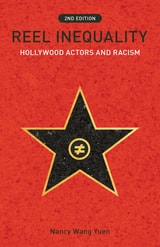
Reel Inequality, Second Edition
Hollywood Actors and RacismNancy Wang Yuen
Rutgers University Press, 2027
Reel Inequality was the first book to systematically document how Hollywood's institutional racism shapes the lives and careers of actors of color. In this updated edition, Nancy Wang Yuen again translates academic research on structural racism into an engaging, accessible narrative for general readers. Connecting personal stories from actors of color, industry data and practices, and historical patterns, she reveals how racism operates both behind the scenes and on the screen. She also examines Hollywood’s retreat from diversity efforts amid the broader backlash against DEI.
Yuen draws on newly released industry data and recently published interviews with actors of color, showing how racism continues to shape who gets cast, who gets hired, and who gets to tell their own story. She looks closely at the pressures actors of color face, including typecasting, financial precarity, and racial burdens, even as many push back and forge their own paths. She also uses the lens of Hollywood to explore broader issues of race, inequality, and representation.
Reel Inequality
Hollywood Actors and RacismNancy Wang Yuen
Rutgers University Press, 2016
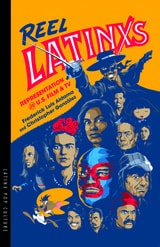
Reel Latinxs
Representation in U.S. Film and TVFrederick Luis Aldama and Christopher González
University of Arizona Press, 2019
As pop culture experts Frederick Luis Aldama and Christopher González show, the way Latinx peoples have appeared and are still represented in mainstream TV and film narratives is as frustrating as it is illuminating. Stereotypes such as drug lords, petty criminals, buffoons, and sexed-up lovers have filled both small and silver screens—and the minds of the public. Aldama and González blaze new paths through Latinx cultural phenomena that disrupt stereotypes, breathing complexity into real Latinx subjectivities and experiences. In this grand sleuthing sweep of Latinx representation in mainstream TV and film that continues to shape the imagination of U.S. society, these two Latinx pop culture authorities call us all to scholarly action.
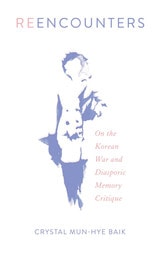
Reencounters
On the Korean War and Diasporic Memory CritiqueCrystal Mun-hye Baik
Temple University Press, 2020
In Reencounters,Crystal Mun-hye Baik examines what it means to live with and remember an ongoing war when its manifestations—hypervisible and deeply sensed—become everyday formations delinked from militarization. Contemplating beyond notions of inherited trauma and post memory, Baik offers the concept of reencounters to better track the Korean War’s illegible entanglements through an interdisciplinary archive of diasporic memory works that includes oral history projects, performances, and video installations rarely examined by Asian American studies scholars.
Baik shows how Korean refugee migrations are repackaged into celebrated immigration narratives, how transnational adoptees are reclaimed by the South Korean state as welcomed “returnees,” and how militarized colonial outposts such as Jeju Island are recalibrated into desirable tourist destinations. Baik argues that as the works by Korean and Korean/American artists depict this Cold War historiography, they also offer opportunities to remember otherwise the continuing war.
Ultimately, Reencounters wrestles with questions of the nature of war, racial and sexual violence, and neoliberal surveillance in the twenty-first century.
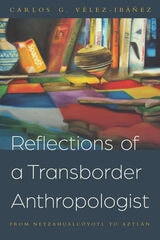
Reflections of a Transborder Anthropologist
From Netzahualcóyotl to AztlánCarlos G. Vélez-Ibáñez
University of Arizona Press, 2020
In each chapter, Vélez-Ibáñez revisits a critical piece of his written work, providing a new introduction and discussion of ideas, sources, and influences for the piece. These are followed by the work, chosen because it accentuates key aspects of his development and formation as an anthropologist. By returning to these previously published works, Vélez-Ibáñez offers insight not only into the evolution of his own thinking and conceptualization but also into changes in the fields in which he has been so influential. Throughout his career, Vélez-Ibáñez has addressed why he does the work that he does, and in this volume he continues to address the personal and intellectual drives that have brought him from Netzahualcóyotl to Aztlán.
Reflections of a Transborder Anthropologist shows how both Vélez-Ibáñez and anthropology have changed and formed over a fifty-year period. Throughout, he has worked to understand how people survive and thrive against all odds. Vélez-Ibáñez has been guided by the burning desire to understand inequality, exploitation, and legitimacy, and, most importantly, to provide platforms for the voiceless to narrate their own histories.
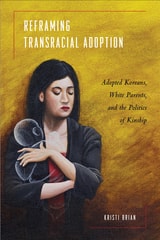
Reframing Transracial Adoption
Adopted Koreans, White Parents, and the Politics of KinshipKristi Brian
Temple University Press, 2012
Until the late twentieth century, the majority of foreign-born children adopted in the United States came from Korea. In the absorbing book Reframing Transracial Adoption, Kristi Brian investigates the power dynamics at work between the white families, the Korean adoptees, and the unknown birth mothers. Brian conducts interviews with adult adopted Koreans, adoptive parents, and adoption agency facilitators in the United States to explore the conflicting interpretations of race, culture, multiculturalism, and family.
Brian argues for broad changes as she critiques the so-called "colorblind" adoption policy in the United States. Analyzing the process of kinship formation, the racial aspects of these adoptions, and the experience of adoptees, she reveals the stifling impact of dominant nuclear-family ideologies and the crowded intersections of competing racial discourses.
Brian finds a resolution in the efforts of adult adoptees to form coherent identities and launch powerful adoption reform movements.

Refugee Lifeworlds
The Afterlife of the Cold War in CambodiaY-Dang Troeung
Temple University Press, 2022
Cambodian history is Cold War history, asserts Y-Dang Troeung in Refugee Lifeworlds. Constructing a genealogy of the afterlife of the Cold War in Cambodia, Troeung mines historical archives and family anecdotes to illuminate the refugee experience, and the enduring impact of war, genocide, and displacement in the lives of Cambodian people.
Troeung, a child of refugees herself, employs a method of autotheory that melds critical theory, autobiography, and textual analysis to examine the work of contemporary artists, filmmakers, and authors. She references a proverb about the Cambodian kapok tree that speaks to the silences, persecutions, and modes of resistance enacted during the Cambodian Genocide, and highlights various literary texts, artworks, and films that seek to document and preserve Cambodian histories nearly extinguished by the Khmer Rouge regime.
Addressing the various artistic responses to prisons and camps, issues of trauma, disability, and aphasia, as well as racism and decolonialism, Refugee Lifeworlds repositions Cambodia within the broader transpacific formation of the Cold War. In doing so, Troeung reframes questions of international complicity and responsibility in ways that implicate us all.
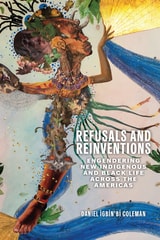
Refusals and Reinventions
Engendering New Indigenous and Black Life across the AmericasDaniel Ìgbín’bí Coleman
The Ohio State University Press, 2024
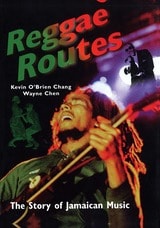
Reggae Routes
The Story of Jamaican MusicKevin Chang
Temple University Press, 1997
Jamaican music can be roughly divided into four eras, each with a distinctive beat - ska, rocksteady, reggae, and dancehall. Ska dates from about 1960 to mid-1966 and rocksteady from 1966 to 1968, while from 1969 to 1983 reggae was the popular beat. The reggae era had two phases, "early reggae" up to 1974 and "roots reggae" up to 1983. Since 1983 dancehall has been the prevalent the prevalent sound.
The authors describe each stage in the development of the music, identifying the most popular songs and artists, highlighting the significant social, political, and economic issues as they affected the music scene. While they write from a Jamaican perspective, the intended audience is "any person, local or foreign, interested in an intelligent discussion of reggae music and Jamaica." Featuring some four hundred illustrations that range from album covers to rare photos, Reggae Routes profiles the innumerable artists, producers, and recordings that secured an international audience for Jamaican music.
Artists discussed: Toots and the Maytals, the Wailers, Gaylads, Desmond Dekker, Delroy Wilson, Alton Ellis, Burning Spear, Itals, Wailing Souls, Skatalites, Heptones, and hundreds more.
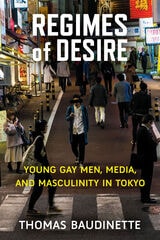
Regimes of Desire
Young Gay Men, Media, and Masculinity in TokyoThomas Baudinette
University of Michigan Press, 2021
Shinjuku Ni-chōme is a nightlife district in central Tokyo filled with bars and clubs targeting the city’s gay male community. Typically understood as a “safe space” where same-sex attracted men and women from across Japan’s largest city can gather to find support from a relentlessly heteronormative society, Regimes of Desire reveals that the neighborhood may not be as welcoming as previously depicted in prior literature. Through fieldwork observation and interviews with young men who regularly frequent the neighborhood’s many bars, the book reveals that the district is instead a space where only certain performances of gay identity are considered desirable. In fact, the district is highly stratified, with Shinjuku Ni-chōme’s bar culture privileging “hard” masculine identities as the only legitimate expression of gay desire and thus excluding all those men who supposedly “fail” to live up to these hegemonic gendered ideals.
Through careful analysis of media such as pornographic videos, manga comics, lifestyle magazines and online dating services, this book argues that the commercial imperatives of the Japanese gay media landscape and the bar culture of Shinjuku Ni-chōme act together to limit the agency of young gay men so as to better exploit them economically. Exploring the direct impacts of media consumption on the lives of four key informants who frequent the district’s gay bars in search of community, fun and romance, Regimes of Desire reveals the complexity of Tokyo’s most popular “gay town” and intervenes in debates over the changing nature of masculinity in contemporary Japan.

Regina Anderson Andrews, Harlem Renaissance Librarian
Ethelene Whitmire
University of Illinois Press, 2015
Andrews also played a key role in the Harlem Renaissance, supporting writers and intellectuals with dedicated workspace at her 135th Street Branch Library. After hours she cohosted a legendary salon that drew the likes of Langston Hughes and Zora Neale Hurston. Her work as an actress and playwright helped establish the Harlem Experimental Theater, where she wrote plays about lynching, passing, and the Underground Railroad.
Ethelene Whitmire's new biography offers the first full-length study of Andrews's activism and pioneering work with the NYPL. Whitmire's portrait of her sustained efforts to break down barriers reveals Andrews's legacy and places her within the NYPL's larger history.
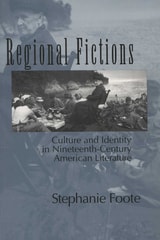
Regional Fictions
Culture and Identity in Nineteenth-Century American LiteratureStephanie Foote
University of Wisconsin Press, 2001
Out of many, one—e pluribus unum—is the motto of the American nation, and it sums up neatly the paradox that Stephanie Foote so deftly identifies in Regional Fictions. Regionalism, the genre that ostensibly challenges or offers an alternative to nationalism, in fact characterizes and perhaps even defines the American sense of nationhood.
In particular, Foote argues that the colorful local characters, dialects, and accents that marked regionalist novels and short stories of the late nineteenth century were key to the genre’s conversion of seemingly dangerous political differences—such as those posed by disaffected Midwestern farmers or recalcitrant foreign nationals—into appealing cultural differences. She asserts that many of the most treasured beliefs about the value of local identities still held in the United States today are traceable to the discourses of this regional fiction, and she illustrates her contentions with insightful examinations of the work of Sarah Orne Jewett, Hamlin Garland, Gertrude Atherton, George Washington Cable, Jacob Riis, and others. Broadening the definitions of regional writing and its imaginative territory, Regional Fictions moves beyond literary criticism to comment on the ideology of national, local, ethnic, and racial identity.