Results by title
2646 books match the query 'History & Criticism' and 111 start with r
Rock and Roll Always Forgets
A Quarter Century of Music CriticismChuck Eddy
Duke University Press, 2011
Rocking My Life Away
Writing about Music and Other MattersAnthony DeCurtis
Duke University Press, 1998
Rocking the Closet
How Little Richard, Johnnie Ray, Liberace, and Johnny Mathis Queered Pop MusicVincent Stephens
University of Illinois Press, 2019
Roll Over, Tchaikovsky!
Russian Popular Music and Post-Soviet HomosexualityStephen Amico
University of Illinois Press, 2017
Centered on the musical experiences of homosexual men in St. Petersburg and Moscow, this ground-breaking study examines how post-Soviet popular music both informs and plays off of a corporeal understanding of Russian male homosexuality.
Drawing upon ethnography, musical analysis, and phenomenological theory, Stephen Amico offers an expert technical analysis of Russian rock, pop, and estrada music, dovetailing into an illuminating discussion of homosexual men's physical and bodily perceptions of music. He also outlines how popular music performers use song lyrics, drag, physical movements, images of women, sexualized male bodies, and other tools and tropes to implicitly or explicitly express sexual orientation through performance. Finally, Amico uncovers how such performances help homosexual Russian men to create their own social spaces and selves, in meaningful relation to others with whom they share a "nontraditional orientation."
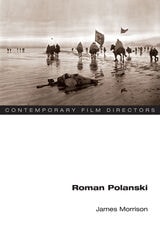
Roman Polanski
James Morrison
University of Illinois Press, 2006
James Morrison's critical study offers a comprehensive and critically engaged treatment on Roman Polanski's immense body of work. Tracing the filmmaker's remarkably diverse career from its beginnings to 2007, the book provides commentary on all of Polanski's major films in their historical, cultural, social, and artistic contexts. Morrison locates Polanski's work within the genres of comedy and melodrama, arguing that he is not merely obsessed with the theme of repression, but that his true interest is in the concrete—what is out in the open—and why we so rarely see it.
The range of Polanski's filmmaking challenges traditional divisions between high and low culture. For example, The Ninth Gate is a brash pastiche of the horror genre, while The Pianist is an Academy Award-winner about the Holocaust. Dubbing Polanski a relentless critic of modernity, Morrison concludes that his career is representative of the fissures, victories, and rehabilitations of the last fifty years of international cinema.
A volume in the series Contemporary Film Directors, edited by James Naremore
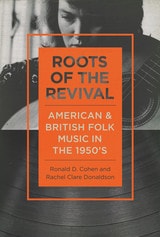
Roots of the Revival
American and British Folk Music in the 1950sRonald D. Cohen and Rachel Clare Donaldson
University of Illinois Press, 2014
After setting the stage with the work of music collectors in the nineteenth century, the authors explore the so-called recovery of folk music practices and performers by Alan Lomax and others, including journeys to and within the British Isles that allowed artists and folk music advocates to absorb native forms and facilitate the music's transatlantic exchange. Cohen and Donaldson place the musical and cultural connections of the twin revivals within the decade's social and musical milieu and grapple with the performers' leftist political agendas and artistic challenges, including the fierce debates over "authenticity" in practice and repertoire that erupted when artists like Harry Belafonte and the Kingston Trio carried folk into the popular music mainstream.
From work songs to skiffle, from the Weavers in Greenwich Village to Burl Ives on the BBC, Roots of the Revival offers a frank and wide-ranging consideration of a time, a movement, and a transformative period in American and British pop culture.
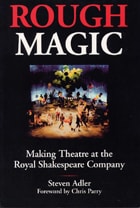
Rough Magic
Making Theatre at the Royal Shakespeare CompanySteven Adler. Foreword by Chris Parry
Southern Illinois University Press, 2001
Steven Adler examines the dynamic life and workings of the theatre company responsible for some of the world’s most compelling performances and influential productions of the last forty years, including Marat/Sade, A Midsummer Night’s Dream, Les Misérables, Les Liaisons Dangereuses, and Nicholas Nickleby.
Rough Magic provides a thorough analysis of the many strands of theatrical activity on both sides of the footlights that coalesce in the artistic vigor of the Royal Shakespeare Company. Adler traces the company’s evolution from its origins in 1879 as a week-long festival presented by Stratford-upon-Avon as a birthday homage to its native son, to its current incarnation as one of the world’s most distinguished institutional theatres. He probes the aspirations and achievements of the RSC’s four successive artistic directors: Peter Hall, Trevor Nunn, Terry Hands, and Adrian Noble. He offers a comprehensive view of the design and aesthetics of the RSC’s five theatres in Stratford and London, and explores the intricate process of crafting a repertoire at home and on tour that responds to the needs of the artists as well as the demands of the box office.
Vivid illustrations, personal observation, research, and dozens of interviews with current and former members of the Royal Shakespeare Company unite to produce Rough Magic.
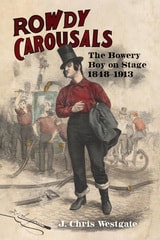
Rowdy Carousals
The Bowery Boy on Stage, 1848-1913J. Chris Westgate
University of Iowa Press, 2024
The book’s examination of working-class whiteness on stage, in the theatre, and in print culture invites theatre historians and critics to check the impulse to downplay or ignore questions about race and ethnicity in discussion of the Bowery Boy. J. Chris Westgate further explores links between the Bowery Boy’s rowdyism in the nineteenth century and the resurgence of white supremacy in the early twenty-first century.
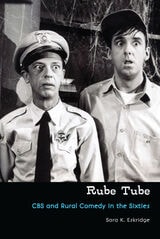
Rube Tube
CBS and Rural Comedy in the SixtiesSara K. Eskridge
University of Missouri Press, 2022
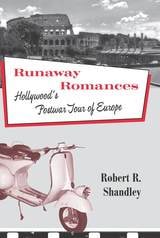
Runaway Romances
Hollywood's Postwar Tour of EuropeRobert R. Shandley
Temple University Press, 2009
In the 1950s and early 1960s, America imagined itself young and in love in Europe. And Hollywood films of the era reflected this romantic allure. From a young and naïve Audrey Hepburn falling in love with Gregory Peck inRoman Holiday to David Lean’s Summertime, featuring Katherine Hepburn’s sexual adventure in Venice, these glossy travelogue romances were shot on location, and established an exciting new genre for Hollywood.
As Robert Shandley shows in Runaway Romances, these films were not only indicative of the ideology of the American-dominated postwar world order, but they also represented a shift in Hollywood production values. Eager to capture new audiences during a period of economic crisis, Hollywood’s European output utilized the widescreen process to enhance cinematic experience. The films—To Catch a Thief, Three Coins in the Fountain, and Funny Face among them—enticed viewers to visit faraway places for romantic escapades. In the process, these runaway romances captured American fantasies for a brief, but intense, period that ended as audiences grew tired of old World splendors, and entered into a new era of sexual awakening.

Russian Theater
The Twenty-first Century, Volume 36Tom Sellar and Yana Ross, eds.
Duke University Press, 0
In the first English-language collection to examine twenty-first-century Russian theater, this special issue of Theater also includes the complete texts of two new Russian plays, published for the first time in English. Ivan Vyrypaev’s Oxygen is a poetic panorama of new Russian identity set to techno music, and Danila Privalov’s 5-25 explores traditional Dostoyevskian existential themes in the language of a new generation. One contributor chronicles the sweeping cultural and institutional changes in the Russian theater since 2000, while another provides an overview of the regional theater system in the world’s most geographically vast country. Another essay explores the development of the new playwriting movement, identifying its key writers and producers. This special issue also includes interviews with the movement’s directors and producers. Additionally, it contains letters, previously unpublished in English, from the Moscow Art Theater’s Olga Bokshanskaya to the Russian theatrical titan Vladimir Nemirovich-Danchenko, reporting on the Moscow Art Theater’s legendary U.S. tour in 1920–22, which was recorded in theater history as a turning point for American acting.
Contributors. AKHE, Dmitri Chernikov, Nina Chusova, Marina Dmitrievskaya, Sasha Dugdale, John Freedman, Elena Gremina, Nina Karpova, Mindaugus Korbauskis, Ryan McKittrick, Arkady Ostrovsky, Danila Privalov, Victor Rizhakov, Yana Ross, Tom Sellar, Kirill Serebrennikov, Anatoly Smeliansky, Julia Smeliansky, Ivan Vyrypaev