2817 books match the query 'Nature' and 107 start with r
cover of Rubber Boots Methods for the Anthropocene: Doing Fieldwork in Multispecies Worlds

Rubber Boots Methods for the Anthropocene

Doing Fieldwork in Multispecies Worlds

Astrid Oberborbeck Andersen

University of Minnesota Press, 2023

A methodological follow-up to Arts of Living on a Damaged Planet
 

The environmental and climatic crises of our time are fundamentally multispecies crises. And the Anthropocene, a time of “human-made” disruptions on a planetary scale, is a disruption of the fabric of life as a whole. The contributors to Rubber Boots Methods for the Anthropocene argue that understanding the multispecies nature of these disruptions requires multispecies methods.

Answering methodological challenges posed by the Anthropocene, Rubber Boots Methods for the Anthropocene retools the empirical study of the socioecological chaos of the contemporary moment across the arts, human science, and natural science. Based on critical landscape history, multispecies curiosity, and collaboration across disciplines and knowledge systems, the volume presents thirteen transdisciplinary accounts of practical methodological experimentation, highlighting diverse settings ranging from the High Arctic to the deserts of southern Africa and from the pampas of Argentina to the coral reefs of the Western Pacific, always insisting on the importance of firsthand, “rubber boots” immersion in the field.

The methodological companion to Arts of Living on a Damaged Planet: Ghosts and Monsters of the Anthropocene (Minnesota, 2017), this collection puts forth empirical studies of the multispecies messiness of contemporary life that investigate some of the critical questions of our time.

Contributors: Filippo Bertoni, Museum für Naturkunde, Berlin; Harshavardhan Bhat, U of Westminster; Nathalia Brichet, U of Copenhagen; Janne Flora, Aarhus U, Denmark; Natalie Forssman, U of British Columbia; Peter Funch, Aarhus U; Kirsten Hastrup, U of Copenhagen; Colin Hoag, Smith College; Joseph Klein, U of California, Santa Cruz; Andrew S. Mathews, U of California, Santa Cruz; Daniel Münster, U of Oslo; Ursula Münster, U of Oslo; Jon Rasmus Nyquist, U of Oslo; Katy Overstreet, U of Copenhagen; Pierre du Plessis, U of Oslo; Meredith Root-Bernstein; Heather Anne Swanson, Aarhus U; Anna Lowenhaupt Tsing, U of California,

Santa Cruz; Stine Vestbo.
[more]
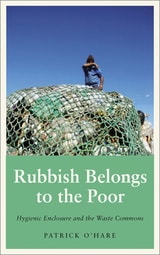
cover of Rubbish Belongs to the Poor: Hygienic Enclosure and the Waste Commons

Rubbish Belongs to the Poor

Hygienic Enclosure and the Waste Commons

Patrick O’Hare

Pluto Press, 2021

Rubbish. Waste. Trash. Whatever term you choose to describe the things we throw away, the connotations are the same; of something dirty, useless and incontrovertibly 'bad'. But does such a dismissive rendering mask a more nuanced reality? In Rubbish Belongs to the Poor, Patrick O'Hare journeys to the heart of Uruguay's waste disposal system in order to reconceptualize rubbish as a 21st century commons, at risk of enclosure. On a giant landfill site outside the capital Montevideo we meet the book's central protagonists, the 'classifiers': waste-pickers who recover and recycle materials in and around its fenced but porous perimeter. Here the struggle of classifiers against the enclosure of the landfill, justified on the grounds of hygiene, is brought into dialogue with other historical and contemporary enclosures - from urban privatizations to rural evictions - to shed light on the nature of contemporary forms of capitalist dispossession. Supplementing this rich ethnography with the author's own insights from dumpster diving in the UK, the book analyzes capitalism's relations with its material surpluses and what these tell us about its expansionary logics, limits and liminal spaces. Rubbish Belongs to the Poor ultimately proposes a fundamental rethinking of the waste-capitalism nexus.
[more]
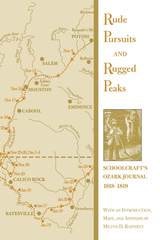
cover of Rude Pursuits and Rugged Peaks: Schoolcraft's Ozark Journal, 1818-1819

Rude Pursuits and Rugged Peaks

Schoolcraft's Ozark Journal, 1818-1819

H. Schoolcraft

University of Arkansas Press, 1996

In the winter of 1818, Henry Rowe Schoolcraft set out from Potosi, Missouri, to document lead mines in the interior of the Ozarks. Intending only to make his fortune by publishing an account of the area's mineral resources, he became the first skilled observer to witness and record frontier life in the Ozarks.

The journal kept by Schoolcraft as he traveled ninety days in the rugged terrain of southern Missouri and northern Arkansas was originally published in 1821 and has become an essential record of Ozark territorial society and natural history documenting some of the earliest American settlers in the region, the power and beauty of many lost portions of the White River, the majesty of the open prairies, and the wealth of wildlife once found in the Ozarks.
[more]
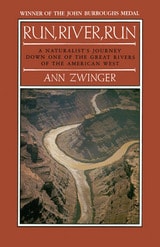
cover of Run, River, Run: A Naturalist's Journey Down One of the Great Rivers of the West

Run, River, Run

A Naturalist's Journey Down One of the Great Rivers of the West

Ann Zwinger

University of Arizona Press, 1984
The Green River runs wild, free and vigourous from southern Wyoming to northeastern Utah. Edward Abbey wrote in these pages in 1975 that Anne Zwinger's account of the Green River and its subtle forms of life and nonlife may be taken as authoritative. 'Run, River, Run,' should serve as a standard reference work on this part of the American West for many years to come." —New York Times Book Review
[more]
cover of Running After Paradise: Hope, Survival, and Activism in Brazil's Atlantic Forest

Running After Paradise

Hope, Survival, and Activism in Brazil's Atlantic Forest

Colleen M. Scanlan Lyons

University of Arizona Press, 2022

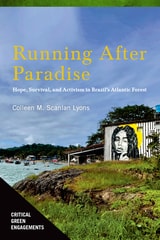
Brazil’s Atlantic Forest is a paradise to many. In Southern Bahia, surfers, billionaires, travelers, and hippies mingle with environmentalists, family farmers, quilombolas (descendants of formerly enslaved people), and nativos, or “locals.” Each of these groups has connections to the unique environment, culture, and character of this region as their home, their source of a livelihood, or perhaps their vacation escape. And while sometimes these connections converge—other times they clash.

The pressures on this tropical forest are palpable. So are people’s responses to these pressures. What was once the state’s economic mainstay, cacao production, is only now beginning to make a comeback after a disease decimated the crops of large and small farmers alike. Tourism, another economic hope, is susceptible to economic crises and pandemics. And the threat of a massive state-led infrastructure project involving mining, a railroad, and an international port has loomed over the region for well over a decade.

Southern Bahia is at a crossroads: develop a sustainable, forest-based economy or run the risk of losing the identity and soul of this place forevermore. Through the lives of environmentalists, farmers, quilombolas, and nativos—people who are in and of this place—this book brings alive the people who are grappling with this dilemma.

Anthropologist Colleen M. Scanlan Lyons brings the eye of a storyteller to present this complex struggle, weaving in her own challenges of balancing family and fieldwork alongside the stories of the people who live in this dynamic region. Intertwined tales, friendships, and hope emerge as people both struggle to sustain their lives in a biodiversity hotspot and strive to create their paradise.
 
[more]
cover of Running Dry: Essays on Energy, Water, and Environmental Crisis

Running Dry

Essays on Energy, Water, and Environmental Crisis

Jones, Toby Craig

Rutgers University Press, 2015

The world’s water is under siege. A combination of corporate greed, the elite pursuit of political power, and our unrelenting reliance on carbon-based energy is accerlating a broad range of environmental and political crises. Potentially catastrophic climate change, driven primarily by the consumption of oil and gas, threatens the environment in a variety of ways, including producing unprecedented patterns of heavy weather and superstorms in some places and droughts in others. Alongside intensifying environmental dangers posed by our reliance on carbon energy, the conditions of modern life, from happiness to the possibility of democratic politics, are also being undermined. 
 
In Running Dry, historian Toby Craig Jones explores how modern society’s unquenchable thirst for carbon-based energy is endangering the environment broadly, as well as the historical roots of this threat. This accessible book examines the history of the "energy-water nexus," the ways in which oil and gas extraction poison and dry up water resources, the role of corporate "science" in deflecting attention away from the emerging crises, and the ways in which the rush to capture more energy is also challenging America's democratic order. 
[more]