Results by title
3027 books match the query 'Sociology' and 157 start with r
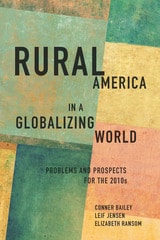
Rural America in a Globalizing World
Problems and Prospects for the 2010'sConner Bailey
West Virginia University Press, 2014
This fourth Rural Sociological Society decennial volume provides advanced policy scholarship on rural North America during the 2010’s, closely reflecting upon the increasingly global nature of social, cultural, and economic forces and the impact of neoliberal ideology upon policy, politics, and power in rural areas.
The chapters in this volume represent the expertise of an influential group of scholars in rural sociology and related social sciences. Its five sections address the changing structure of North American agriculture, natural resources and the environment, demographics, diversity, and quality of life in rural communities.
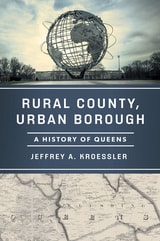
Rural County, Urban Borough
A History of QueensJeffrey A. Kroessler
Rutgers University Press, 2025
Rural County, Urban Borough is a history of place, charting the rapid transformation of the Queens landscape. It identifies what drove the borough’s development, from public infrastructure, architecture, and transportation to technological innovation and urban planning. New York historian Jeffrey A. Kroessler takes us inside the backrooms and boardrooms where local powerbrokers shaped the borough’s future, chronicling how its relationship with the city has evolved. He also shows the steps Queens residents from all backgrounds took to care for their neighborhoods and build their communities. Richly illustrated, this book underscores why Queens is integral to New York City and the wider world and reveals how, in its evolution, we see the whole arc of American urban history.
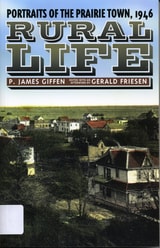
Rural Life
Portraits of the Prairie Town, 1946James P. Giffen
University of Manitoba Press, 2004
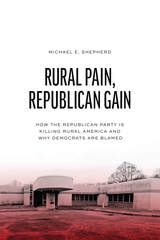
Rural Pain, Republican Gain
How the Republican Party Is Killing Rural America and Why Democrats Are BlamedMichael E. Shepherd
University of Chicago Press, 2026
An eye-opening look at how Republican policies have affected health outcomes in rural communities and why poor, rural white voters are turning to the Republican Party—not despite this harm, but because of it.
Over the last four decades, the health of rural Americans has been in free fall. Just as opioid and gun deaths have ripped apart rural communities, hospitals have closed at alarming rates, leaving millions desperately far from care. At the same time, voters in struggling rural communities have increasingly come to vote for the Republican Party.
In Rural Pain, Republican Gain, Michael E. Shepherd demonstrates that these two trends are closely connected. At both the federal and state levels, the Republican Party has increasingly enacted policies that worsen rural health. Rural voters are not indifferent to this development (quite the contrary), but they misassign blame, in part, because the Democratic Party is more commonly associated with health-related policy initiatives and has ownership of health as an issue area. Republican politicians can reap rewards from their own destructive policies by appealing to the shared grievances of rural people.
Shepherd draws on new, wide-ranging data, including in-depth studies of the opioid epidemic, hospital closures, and COVID-19. In so doing, he quantifies the harm of Republican policymaking and its disproportionate effect on rural communities, recasting how readers understand growing Republican support among less healthy, lower-income rural white Americans.
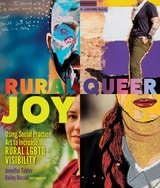
Rural Queer Joy
Using Social Practice Art to Increase Rural LGBTQ+ VisibilityJennifer Tabler
University of Wyoming Press, 2026
Blending social science, fine arts, and the humanities, Rural Queer Joy explores how the telling of rural LGBTQ+ stories affects young rural queer people today. The stories of well-known Wyoming LGBTQ+ people like Matthew Shepard, Sissy Goodwin, and Artemis Langford often center experiences of trauma and hardship, leaving little space for experiences of triumph or joy.
Author Jennifer Tabler and photographer Bailey Russel provided rural LGBTQ+ community members with an opportunity to represent their own experiences through participation in a social practice art project, asking what about being LGBTQ+ brings them joy. They then took the participants’ portraits and invited them to annotate these portraits with paint, markers, paper, or other media. This kind of social practice art provides an opportunity to engage in epistemic activism through the self-empowerment of marginalized voices and perspectives, while also centering visuals of rural queer people that counter existing stereotypes and add nuance to our understanding of rural LGBTQ+ people.
The dynamic artwork and quotes from young rural LGBTQ+ people displayed in this book highlight how their identities are sources of joy and opportunity rather than constraint and hardship. Rural and/or LGBTQ+ people, researchers, and teachers in the fields of community-engaged arts, gender studies, sociology of sexualities, and public humanities will find inspiration in Rural Queer Joy—inspiration to rethink what it means to be rural and LGBTQ+ as well as to use social practice art to increase the visibility of other underserved communities.
Rural and Small Town America
Glenn V. Fuguitt
Russell Sage Foundation, 1989
Russia's Imperial Endeavor and Its Geopolitical Consequences
The Russia-Ukraine War, Volume TwoBálint Madlovics
Central European University Press, 2024
Aside from the near-complete devastation of a sovereign state and reversal of the global balance of power, the Russian invasion of Ukraine in 2022 is leading to a radical transformation in the Eastern European and Eurasian regions – including Russia itself.
The 13 chapters in this volume examine the main geopolitical consequences of the resurgent imperialist aspirations of the Russian Federation. They examine the ideological tools of history falsification as an integral part of hybrid warfare. Turning to the economy, the book discusses how the war and economic sanctions imposed on Russia are redrawing the geopolitical map and how economic relations would change following a regime transformation. The book discusses the reactions of members of the international community to the invasion, whether threatened or neutral parties or allies. The collection therefore offers a comprehensive picture of the main consequences of the resurgent imperialist aspirations of the Russian Federation. Equipped with the conceptual tools of the analysis with a focus on the patronal features of the political-economic system, the book considers the aftermath of the war. This collection complements the book entitled Ukraine. Patronal Democracy and the Russian Invasion.