Results by title
8642 books match the query '20th century' and 391 start with r
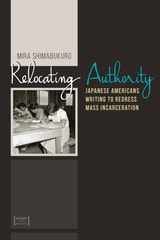
Relocating Authority
Japanese Americans Writing to Redress Mass IncarcerationMira Shimabukuro
University Press of Colorado, 2015
Relocating Authority examines the ways Japanese Americans have continually used writing to respond to the circumstances of their community’s mass imprisonment during World War II. Using both Nikkei cultural frameworks and community-specific history for methodological inspiration and guidance, Mira Shimabukuro shows how writing was used privately and publicly to individually survive and collectively resist the conditions of incarceration.
Examining a wide range of diverse texts and literacy practices such as diary entries, note-taking, manifestos, and multiple drafts of single documents, Relocating Authority draws upon community archives, visual histories, and Asian American history and theory to reveal the ways writing has served as a critical tool for incarcerees and their descendants. Incarcerees not only used writing to redress the “internment” in the moment but also created pieces of text that enabled and inspired further redress long after the camps had closed.
Relocating Authority highlights literacy’s enduring potential to participate in social change and assist an imprisoned people in relocating authority away from their captors and back to their community and themselves. It will be of great interest to students and scholars of ethnic and Asian American rhetorics, American studies, and anyone interested in the relationship between literacy and social justice.
Reluctant Interveners
America's Failed Responses to Genocide from Bosnia to DarfurEyal Mayroz
Rutgers University Press, 2020
Featured in the 2020 Association of University Presses Book, Jacket, and Journal Show
Why do we allow our governments to get away with “bystanding” to genocide? How can we, when alerted to the mass slaughter of innocents, still not take a stand? Reluctant Interveners provides the most comprehensive answers yet to these confronting questions, focusing on the complex relationships between the citizenry, the media, the political elites, and institutions in the most powerful nation in the world, the United States of America.
Eyal Mayroz offers a sobering account of the interactions between the governing and the governed, and the dynamics which transformed moral concerns for the lives of faraway “others” into cold political calculations. Exposed are the processes that turned the promise of “never again” to a recurring reality of ever again, the role of the office of the presidency in their advancement, and the resultant image of America as seen by the rest of the world. In a time of ubiquitous social media and populist revival, a greater role for the U.S. citizenry in decision-making on responses to genocide may be in the cards. The question is, in which directions will these trends take American foreign policy?
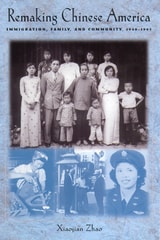
Remaking Chinese America
Immigration, Family, and Community, 1940-1965Zhao, Xiaojian
Rutgers University Press, 2001
In Remaking Chinese America, Xiaojian Zhao explores the myriad forces that changed and unified Chinese Americans during a key period in American history. Prior to 1940, this immigrant community was predominantly male, but between 1940 and 1965 it was transformed into a family-centered American ethnic community. Zhao pays special attention to forces both inside and outside of the country in order to explain these changing demographics. She scrutinizes the repealed exclusion laws and the immigration laws enacted after 1940. Careful attention is also paid to evolving gender roles, since women constituted the majority of newcomers, significantly changing the sex ratio of the Chinese American population.
As members of a minority sharing a common cultural heritage as well as pressures from the larger society, Chinese Americans networked and struggled to gain equal rights during the cold war period. In defining the political circumstances that brought the Chinese together as a cohesive political body, Zhao also delves into the complexities they faced when questioning their personal national allegiances. Remaking Chinese America uses a wealth of primary sources, including oral histories, newspapers, genealogical documents, and immigration files to illuminate what it was like to be Chinese living in the United States during a period that—until now—has been little studied.
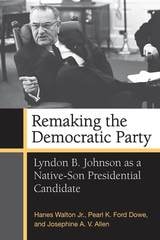
Remaking the Democratic Party
Lyndon B. Johnson as a Native-Son Presidential CandidateHanes Walton Jr., Pearl K. Ford Dowe, and Josephine A. V. Allen
University of Michigan Press, 2016
Although ridiculed by contemporaries for his apparent lack of control over formal party politics and the national committee, Johnson excelled at leading the Democratic Party’s policy agenda. While a senator and as president, Johnson advocated for—and secured—liberal social welfare and civil rights legislation, forcing the party to break with its Southern tradition of elitism, conservatism, and white supremacy. In a way, Johnson set the terms for the continuing partisan battle because, by countering the Democrats’ new ideology, the Republican Party also underwent a transformation.
Remaking the Godly Marriage
Gender Negotiation in Evangelical FamiliesBartkowski, John
Rutgers University Press, 2001
While religious leaders often have enormous influence over their members’ beliefs and how they translate their beliefs into action in everyday life, the individual family remains the place where religious values are practiced through and ultimately transferred to the next generation. As such, the family is an extremely important, though frequently overlooked, topic of study for sociologists of religion.
In Remaking the Godly Marriage, John Bartkowski studies evangelical Protestants and their views on marriage and gender relations and how they are lived within individual families. The author compares elite evangelical prescriptions for godly family living with the day-to-day practices in conservative Protestant households. He asks: How serious are the debates over gender and the family that are manifested within contemporary evangelicalism? What are the values that underlie this debate? Have these internecine disputes been altered by the emergence of new evangelical movements such as biblical feminism and the Promise Keepers? And given the fact that leading evangelicals advance competing visions of godly family life, how do conservative religious spouses make sense of their own family relationships and gender identities?
Through in-depth interviews with evangelical married couples and an exhaustive study of evangelical family advice manuals, Bartkowski explores the disputes and ambivalence concerning traditional gender roles and patriarchal models of family life, which derive from the tension between evangelical Protestantism as a religious subculture and the broader American secular culture in which it is embedded. Bartkowski reveals how evangelical men and women jointly negotiate gender roles within their families and selectively appropriate values of the larger culture even as they attempt to cope with the conflicting messages of their own faith.
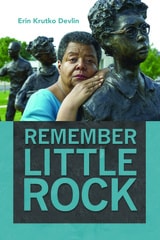
Remember Little Rock
Erin Krutko Devlin
University of Massachusetts Press, 2017
In Remember Little Rock Erin Krutko Devlin explores public memories surrounding the iconic Arkansas school desegregation crisis of 1957 and shows how these memories were vigorously contested and sometimes deployed against the cause. Delving into a wide variety of sources, from memoirs to televised docudramas, commemoration ceremonies, and the creation of Little Rock High museums, Devlin reveals how many white moderates proclaimed Little Rock a victory for civil rights and educational equality even as segregation persisted. At the same time, African American activists, students, and their families asserted their own stories in the ongoing fight for racial justice.
Devlin also demonstrates that public memory directly bears on law and policy. She argues that the triumphal narrative of civil rights has been used to stall school desegregation, support tokenism, and to roll back federal court oversight of school desegregation, voter registration, and efforts to promote diversity in public institutions. Remember Little Rock examines the chasm between the rhetoric of the “post–civil rights” era and the reality of enduring racial inequality.
Remembering 1989
Future Archives of Public ProtestAnke Pinkert
University of Chicago Press, 2024
For many, 1989 is an iconic date, one we associate with the fall of the Berlin Wall and the end of the Cold War. The year prompts some to rue the defeat of socialism in the East, while others celebrate a victory for democracy and capitalism in the reunified Germany. Remembering 1989 focuses on a largely forgotten interregnum: the months between the outbreak of protests in the German Democratic Republic in 1989 and its absorption by the West in 1990. Anke Pinkert, who herself participated in those protests, recalls these months as a volatile but joyous “laboratory of radical democracy,” and tells the story of how and why this “time out of joint” has been erased from Germany’s national memory.
Remembering 1989 argues that in order to truly understand Germany’s historic transformation, we must revisit protesters’ actions across a wide range of minor, vernacular, and often transient sources. Drawing on rich archives including videotapes of untelevised protests, illegally printed petitions by Church leaders, audio recordings of dissident meetings, and interview footage with military troops, Pinkert opens the discarded history of East European social uprisings to new interpretations and imagines alternatives to Germany’s neoliberal status quo. The result is a vivid, unexpected contribution to memory studies and European history.
Remembering Brown at Fifty
The University of Illinois Commemorates Brown v. Board of EducationEdited by Orville Vernon Burton and David O'Brien
University of Illinois Press, 2009
Inspired by the University of Illinois's celebration of the Brown v. Board of Education decision's fiftieth anniversary, this collection addresses the significance of Brown in the contributors' lives or work in education and civil rights. Several authors describe their personal roles in the Brown case or similar cases, while others examine and illustrate events, performances, and exhibitions that were part of the anniversary commemoration. The book not only explores the repercussions of the Brown decision, but also stands as a historic document in its own right, preserving the reactions of many prominent intellectuals, artists, and activists fifty years after the decision.
Contributors are Kal Alston, Margaret L. Andersen, Kathryn H. Anthony, Nathaniel C. Banks, Bernice McNair Barnett, Christopher Benson, Ed Blankenheim, Julian Bond, Orville Vernon Burton, Jason Chambers, Constance Curry, Joseph A. De Laine Jr., Mary L. Dudziak, Joe R. Feagin, John Hope Franklin, Ophelia De Laine Gona, Lani Guinier, Darlene Clark Hine, Freeman A. Hrabowski III, John Jennings, Ralph Lemon, George Lipsitz, Jim Loewen, Laughlin McDonald, David O'Brien, James C. Onderdonk, Sekou Sundiata, Christopher Teal, Nicholas Watkins, Carrie Mae Weems, Juan Williams, and Joy Ann Williamson.
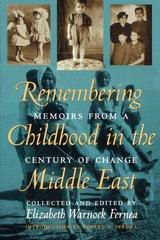
Remembering Childhood in the Middle East
Memoirs from a Century of ChangeCollected and edited by Elizabeth Warnock Fernea
University of Texas Press, 2002
Growing up is a universal experience, but the particularities of homeland, culture, ethnicity, religion, family, and so on make every childhood unique. To give Western readers insight into what growing up in the Middle East was like in the twentieth century, this book gathers thirty-six original memoirs written by Middle Eastern men and women about their own childhoods.
Elizabeth Warnock Fernea, a well-known writer of books and documentary films about women and the family in the Middle East, has collected stories of childhoods spent in Egypt, Iran, Iraq, Israel, Jordan, Kuwait, Lebanon, Morocco, Palestine, Saudi Arabia, Sudan, Syria, Tunisia, and Turkey. The accounts span the entire twentieth century, a full range of ethnicities and religions, and the social spectrum from aristocracy to peasantry. They are grouped by eras, for which Fernea provides a concise historical sketch, and include a brief biography of each contributor. The introduction by anthropologist Robert A. Fernea sets the memoirs in the larger context of Middle Eastern life and culture.
As a collection, the memoirs offer an unprecedented opportunity to look at the same period in history in the same region of the world from a variety of very different remembered experiences. At times dramatic, humorous, or tragic, and always deeply felt, the memoirs document the diversity and richness of people's lives in the modern Middle East.
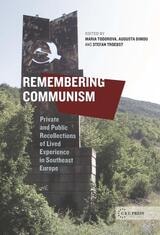
Remembering Communism
Private and Public Recollections of Lived Experience in Southeast EuropeContributors: Simina Bădica, Iskra Baeva, Tanya Boneva, Corina Cimpoieru, Liliana Deyanova, Albena Hranova, Nataliya Hristova, Petya Kabakchieva, Evgenia Kalinova, Anny Kirilova, Thomas Lindenberger, Tamás Lőnhárt, Izabella Main, Tsvetana Manova, Iliiana Marcheva, Vasil Markov, Andi Mihalache, Cătălina Mihalache, Milla Mineva, Cristina Petrescu, Dragoş Petrescu, Vania Stoyanova, Virgiliu Ţârău, Nikolai Vukov, Smaranda Vultur
Central European University Press, 2014
Remembering Communism examines the formation and transformation of the memory of communism in the post-communist period. The majority of the articles focus on memory practices in the post-Stalinist era in Bulgaria and Romania, with occasional references to the cases of Poland and the GDR. Based on an interdisciplinary approach, including history, anthropology, cultural studies and sociology, the volume examines the mechanisms and processes that influence, determine and mint the private and public memory of communism in the post-1989 era. The common denominator to all essays is the emphasis on the process of remembering in the present, and the modalities by means of which the present perspective shapes processes of remembering, including practices of commemoration and representation of the past.
The volume deals with eight major thematic blocks revisiting specific practices in communism such as popular culture and everyday life, childhood, labor, the secret police, and the perception of “the system”.
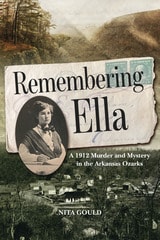
Remembering Ella
A 1912 Murder and Mystery in the Arkansas OzarksNita Gould
Butler Center for Arkansas Studies, 2018
This examination of the murder of Ella Barham and the trial of her alleged killer opens a window into the meaning of community and due process during a time when politicians and judges sought to professionalize justice, moving from local hangings to state-run executions. Davidson’s appeal has been cited as a precedent in numerous court cases and his brief was reviewed by the lawyers in Georgia who prepared Leo Frank’s appeal to the U.S. Supreme Court in 1915.
Author Nita Gould is a descendant of the Barhams of Boone County and Ella Barham’s cousin. Her tenacious pursuit to create an authoritative account of the community, the crime, and the subsequent legal battle spanned nearly fifteen years. Gould weaves local history and short biographies into her narrative and also draws on the official case files, hundreds of newspaper accounts, and personal Barham family documents. Remembering Ella reveals the truth behind an event that has been a staple of local folklore for more than a century and still intrigues people from around the country.
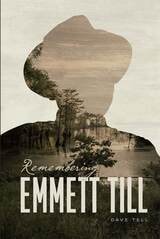
Remembering Emmett Till
Dave Tell
University of Chicago Press, 2019
In Remembering Emmett Till, Dave Tell gives us five accounts of the commemoration of this infamous crime. In a development no one could have foreseen, Till’s murder—one of the darkest moments in the region’s history—has become an economic driver for the Delta. Historical tourism has transformed seemingly innocuous places like bridges, boat landings, gas stations, and riverbeds into sites of racial politics, reminders of the still-unsettled question of how best to remember the victim of this heinous crime. Tell builds an insightful and persuasive case for how these memorials have altered the Delta’s physical and cultural landscape, drawing potent connections between the dawn of the civil rights era and our own moment of renewed fire for racial justice.

Remembering Paris in Text and Film
Echoes of Baudelaire in Text and on ScreenEdited by Alistair Rolls and Marguerite Johnson
Intellect Books, 2021
Experiencing urban space conjures visions of the past alongside contemplation of the present. This edited volume investigates this feeling of seeing double by investigating Paris—a city that has come to embody the tension of this sensation—through a dual lens of nostalgia and modernity.
Contributors survey Paris in film, poetry, and prose in the nineteenth and twentieth centuries, presenting the city as both a concrete reality and as a collection of the myths associated with it. Interdisciplinary and deeply researched, the essays distill complex concepts of the urban, the textual, and the modern for a wide readership.
Remembering the Holocaust
Michael E. Stevens
Wisconsin Historical Society Press, 1997
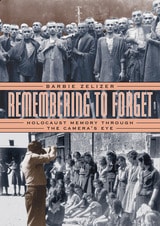
Remembering to Forget
Holocaust Memory through the Camera's EyeBarbie Zelizer
University of Chicago Press, 1998
"[A] fascinating study. . . . Here we have a completely fresh look at the emergence of photography as a major component of journalistic reporting in the course of the liberation of the camps by the Western Allies. . . . Well written and argued, superbly produced with more photographs of atrocity than most people would want to see in a lifetime, this is clearly an important book."—Omer Bartov, Times Literary Supplement
Remembrance of Things Present
The Invention of the Time CapsuleNick Yablon
University of Chicago Press, 2019
By offering a direct line to posterity, time capsules stimulated various hopes for the future. Remembrance of Things Present delves into these treasure chests to unearth those forgotten futures.
Remembrance, History, and Justice
Coming to terms with traumatic pasts in democratic societiesBogdan C. Iacob
Central European University Press, 2015
Remembrances in Black
Personal Perspectives of the African American Experience at the University of Arkansas, 1940s–2000sCharles F. Robinson II
University of Arkansas Press, 2015

Reminiscences of Conrad S. Babcock
The Old U.S. Army and the New, 1898-1918Edited by Robert H. Ferrell
University of Missouri Press, 2012
Babcock’s original manuscript has been shortened by Robert H. Ferrell into eight chapters which illustrate the tremendous shift in warfare in the years surrounding the turn of the century. The first part of the book describes small actions against Filipinos and such assignments as taking a cavalry troop into the fire-destroyed city of San Francisco in 1906 or duty in the vicinity of Yuma in Arizona when border troubles were heating up with brigands and regular troops. The remaining chapters, beginning in 1918, set out the battles of Soissons (July 18–22) and Saint-Mihiel (September 12–16) and especially the immense battle of the Meuse-Argonne (September 26–November 11), the largest (1.2 million troops involved) and deadliest (26,000 men killed) battle in all of American history.
By the end of his career, Babcock was an adroit battle commander and an astute observer of military operations. Unlike most other officers around him, he showed an ability and willingness to adapt infantry tactics in the face of recently developed technology and weaponry such as the machine gun. When he retired in 1937 and began to write his memoirs, another world war had begun, giving additional context to his observations about the army and combat over the preceding forty years.
Until now, Babcock’s account has only been available in the archives of the Hoover Institution, but with the help of Ferrell's crisp, expert editing, this record of army culture in the first decades of the twentieth century can now reach a new generation of scholars.
Remnants
A Memoir of Spirit, Activism, and MotheringRosemarie Freeney Harding with Rachel Elizabeth Harding
Duke University Press, 2015
Remote
Reflections on Life in the Shadow of CelebrityDavid Shields
University of Wisconsin Press, 2003
In this truly one-of-a-kind book, the author/narrator—a representative, in extremis, of contemporary American obsession with beauty, celebrity, transmitted image—finds himself suspended, fascinated, in the remoteness of our wall-to-wall mediascape. It is a remoteness that both perplexes and enthralls him.
Through dazzling sleight of hand in which the public becomes private and the private becomes public, the entire book—clicking from confession to family-album photograph to family chronicle to sexual fantasy to pseudo-scholarly footnote to reportage to personal essay to stand-up comedy to cultural criticism to literary criticism to film criticism to prose-poem to litany to outtake —becomes both an anatomy of American culture and a searing self-portrait.
David Shields reads his own life—reads our life—as if it were an allegory about remoteness and finds persuasive, hilarious, heartbreaking evidence wherever he goes.
Winner of the PEN / Revson Award?
Rendering unto Caesar
The Catholic Church and the State in Latin AmericaAnthony Gill
University of Chicago Press, 1997
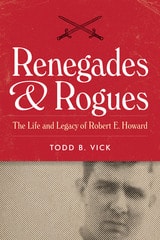
Renegades and Rogues
The Life and Legacy of Robert E. HowardBy Todd B. Vick
University of Texas Press, 2021
2022 Atlantean Award, Robert E. Howard Foundation
You may not know the name Robert E. Howard, but you probably know his work. His most famous creation, Conan the Barbarian, is an icon of popular culture. In hundreds of tales detailing the exploits of Conan, King Kull, and others, Howard helped to invent the sword and sorcery genre.
Todd B. Vick delves into newly available archives and probes Howard’s relationships, particularly with schoolteacher Novalyne Price, to bring a fresh, objective perspective to Howard's life. Like his many characters, Howard was an enigma and an outsider. He spent his formative years visiting the four corners of Texas, experiences that left a mark on his stories. He was intensely devoted to his mother, whom he nursed in her final days, and whose impending death contributed to his suicide in 1936 when he was just thirty years old.
Renegades and Rogues is an unequivocal journalistic account that situates Howard within the broader context of pulp literature. More than a realistic fantasist, he wrote westerns and horror stories as well, and engaged in avid correspondence with H. P. Lovecraft and other pulp writers of his day. Vick investigates Howard’s twelve-year writing career, analyzes the influences that underlay his celebrated characters, and assesses the afterlife of Conan, the figure in whom Howard's fervent imagination achieved its most durable expression.
Renewal
Liberal Protestants and the American City after World War IIMark Wild
University of Chicago Press, 2019
Renewal explores the rise and fall of this movement, which began as an effort to restore the church’s standing but wound up as nothing less than an openhearted crusade to remake our nation’s cities. These campaigns reached beyond church walls to build or lend a hand to scores of organizations fighting for welfare, social justice, and community empowerment among the increasingly nonwhite urban working class. Church leaders extended their efforts far beyond traditional evangelicalism, often dovetailing with many of the contemporaneous social currents coursing through the nation, including black freedom movements and the War on Poverty.
Renewal illuminates the overlooked story of how religious institutions both shaped and were shaped by postwar urban America.
Renewal
Liberal Protestants and the American City after World War IIMark Wild
University of Chicago Press, 2019
In the decades following World War II, a movement of clergy and laity sought to restore liberal Protestantism to the center of American urban life. Chastened by their failure to avert war and the Holocaust, and troubled by missionaries’ complicity with colonial regimes, they redirected their energies back home.
Renewal explores the rise and fall of this movement, which began as an effort to restore the church’s standing but wound up as nothing less than an openhearted crusade to remake our nation’s cities. These campaigns reached beyond church walls to build or lend a hand to scores of organizations fighting for welfare, social justice, and community empowerment among the increasingly nonwhite urban working class. Church leaders extended their efforts far beyond traditional evangelicalism, often dovetailing with many of the contemporaneous social currents coursing through the nation, including black freedom movements and the War on Poverty.
Renewal illuminates the overlooked story of how religious institutions both shaped and were shaped by postwar urban America.
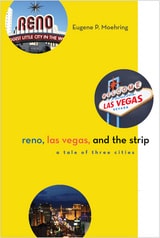
Reno, Las Vegas, and the Strip
A Tale of Three CitiesEugene P. Moehring
University of Nevada Press, 2024
Moehring brings the story of the three cities to the present day, examining lessons learned from the Great Recession and the efforts under way in all three metropolises to diversify their economies. Moehring makes an important contribution with the only current study of Nevada’s cities, focusing on urban development issues rather than social history or the gaming industry. As the service economy continues to grow, not only in Nevada but throughout the United States, Moehring’s work has many implications for urban studies and particularly the study of urban development in other metropolitan areas.

Replacing Home
From Primordial Hut to Digital Network in Contemporary ArtJennifer Johung
University of Minnesota Press, 2011
From property deeds to shipping containers to wearable shelters to virtual spaces: what does it mean to draw a spatial boundary? To be at home? In a world in which notions of place are constantly changing, Jennifer Johung looks at new constructions of staying in place—in contemporary site-specific art, digital media, portable architecture, and various other imaginable shelters and sites.
Replacing Home suggests that while “place” may no longer be a sustainable category, being in place and belonging at home are nonetheless possible. By emphasizing reusability rather than fixed constructions, art and architecture together propose various systems of replacing home in which sites can be revisited, material structures can be renewed, and dwellers can come back into contact over time. Bringing together a range of objects and events, Johung considers the structural replacements of home as evident in artistic analogies of the prehistoric hut, modular homes, transformable garments, and digitally networked sites.
In charting these intersections between contemporary art and architecture, Replacing Home introduces a new framework for reconceptualizing spatial situation; at the same time, it presents a new way to experience being and belonging within our globally expanded environments.

Replays, Rivalries, and Rumbles
The Most Iconic Moments in American SportsSteven Gietschier
University of Illinois Press, 2017
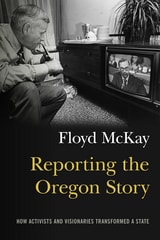
Reporting the Oregon Story
How Activists and Visionaries Transformed a StateFloyd J. McKay
Oregon State University Press, 2016
As a political reporter for The Oregon Statesman in Salem, and then as news analyst for KGW-TV in Portland, McKay was known for asking tough questions and pulling no punches. His reporting and commentaries ranged from analysis of the “Tom and Bob” rivalry, to the Vietnam War’s impact on Senators Wayne Morse and Mark Hatfield and the emergence of a new generation of Portland activists in the 1970s.
McKay and his colleagues were on the beaches as Oregon crafted its landmark Beach Bill, ensuring the protection of beaches for public use. They watched as activists turned back efforts to build a highway on the sand at Pacific City. Pitched battles over Oregon’s Bottle Bill, and the panic-inducing excitement of “Vortex”—the nation’s only state-sponsored rock festival—characterized the period. Covering the period from 1964-1986, McKay remembers the action, the players and the consequences, in this compelling and personal account.
As major actors fade from the scene and new leaders emerge, McKay casts a backwards glance at enduring Oregon legends. Half a century later, amid today’s cynicism and disillusionment with media, politics, and politicians, Reporting the Oregon Story serves as a timely reminder that charged politics and bitter rivalries can also come hand-in-hand with lasting social progress.
Reporting the Oregon Story will be relished by those who lived the history, and it will serve as a worthy introduction to Oregonians young and old who want a first-hand account of Oregon’s mid- twentieth-century political history and legislative legacy.
Represent and Destroy
Rationalizing Violence in the New Racial CapitalismJodi Melamed
University of Minnesota Press, 2011
In the global convulsions in the aftermath of World War II, one dominant world racial order broke apart and a new one emerged. This is the story Jodi Melamed tells in Represent and Destroy, portraying the postwar racial break as a transition from white supremacist modernity to a formally antiracist liberal capitalist modernity in which racial violence works normatively by policing representations of difference.
Following the institutionalization of literature as a privileged domain for Americans to get to know difference—to describe, teach, and situate themselves with respect to race—Melamed focuses on literary studies as a cultural technology for transmitting liberal racial orders. She examines official antiracism in the United States and finds that these were key to ratifying the country’s global ascendancy. She shows how racial liberalism, liberal multiculturalism, and neoliberal multiculturalism made racism appear to be disappearing, even as they incorporated the assumptions of global capitalism into accepted notions of racial equality.
Yet Represent and Destroy also recovers an anticapitalist “race radical” tradition that provides a materialist opposition to official antiracisms in the postwar United States—a literature that sounds out the violence of liberal racial orders, relinks racial inequality to material conditions, and compels desire for something better than U.S. multiculturalism.
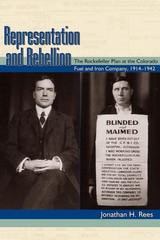
Representation and Rebellion
The Rockefeller Plan at the Colorado Fuel and Iron Company, 1914-1942Jonathan H. Rees
University Press of Colorado, 2010
Representing Modernist Texts
Editing as InterpretationGeorge Bornstein, Editor
University of Michigan Press, 1991
In Representing Modernist Texts, thirteen internationally known scholars provide major explorations of the topic in the work of particular writers. The issues they raise include the construction of a writer’s canon and the effect of newly available “uncanonical” manuscript materials on existing works and orderings; the replacement of the older idea of a fixed, stable text by a more contemporary notion of the text as process; and the interrogation by advanced textual theory of many of the same notions of “author,” “intention,” and “stability of the text” questioned by advanced literary theory.
Representing Talent
Hollywood Agents and the Making of MoviesViolaine Roussel
University of Chicago Press, 2017
The book takes readers behind the scenes to observe the day-to-day activities of agents, revealing their influence on artistic careers and the prospects of Hollywood’s forthcoming projects. Agents are crucial to understanding how creative and economic power are intertwined in Hollywood today. They play a key role in the process by which artistic worth and economic value are evaluated and attributed to people and projects. Roussel’s fieldwork examines what “having relationships” really means for agents, and how they perform the relationship work that’s at the heart of their professional existence and success. Representing Talent helps us to understand the players behind the definition of entertainment itself, as well as behind its current transformations.
Representing the Troubles in Irish Short Fiction
Michael L. Storey
Catholic University of America Press, 2004
Repression, Exile, and Democracy
Uruguayan CultureSaul Sosnowski and Louise B. Popkin, eds.
Duke University Press, 1992
The first section provides a context for the volume, with its analyses of the historical, political, and social aspects of the Uruguayan experience. The following chapters explore various aspects of cultural production, including personal experiences of exile and imprisonment, popular music, censorship, literary criticism, return from exile, and the role that culture plays in redemocratization.
This book's appeal extends well beyond the study of Uruguay to scholars and students of the history and culture of other Latin American nations, as well as to fields of comparative literature and politics in general.
Contributors. Hugo Achugar, Alvarro Barros-Lémez, Lisa Block de Behar, Amanda Berenguer, Hiber Conteris, José Pedro Díaz, Eduardo Galeano, Edy Kaufman, Leo Masliah, Carina Perelli, Teresa Porzecanski, Juan Rial, Mauricio Rosencof, Jorge Ruffinelli, Saúl Sosonowski, Martin Weinstein, Ruben Yáñez
Reproducing the French Race
Immigration, Intimacy, and Embodiment in the Early Twentieth CenturyElisa Camiscioli
Duke University Press, 2009
By focusing on telling aspects of the immigration debate, Camiscioli reveals how racial hierarchies were constructed, how gender figured in their creation, and how only white Europeans were cast as assimilable. Delving into pronatalist politics, she describes how potential immigrants were ranked according to their imagined capacity to adapt to the workplace and family life in France. She traces the links between racialized categories and concerns about industrial skills and output, and she examines medico-hygienic texts on interracial sex, connecting those to the crusade against prostitution and the related campaign to abolish “white slavery,” the alleged entrapment of (white) women for sale into prostitution abroad. Camiscioli also explores the debate surrounding the 1927 law that first made it possible for French women who married foreigners to keep their French nationality. She concludes by linking the Third Republic’s impulse to create racial hierarchies to the emergence of the Vichy regime.
Reproduction by Design
Sex, Robots, Trees, and Test-Tube Babies in Interwar BritainAngus McLaren
University of Chicago Press, 2012
Reproductions of Banality
Fascism, Literature, and French Intellectual LifeAlice Yaeger KaplanForeword by Russell Berman
University of Minnesota Press, 1986
Reproductions of Banality was first published in 1986. Minnesota Archive Editions uses digital technology to make long-unavailable books once again accessible, and are published unaltered from the original University of Minnesota Press editions.
An established fascist state has never existed in France, and after World War II there was a tendency to blame the Nazi Occupation for the presence of fascists within the country. Yet the memory of fascism within their ranks still haunts French intellectuals, and questions about a French version of fascist ideology have returned to the political forefront again and again in the years since the war. In Reproductions of Banality, Alice Yaegar Kaplan investigates the development of fascist ideology as it was manifested in the culture of prewar and Occupied France. Precisely because it existed only in a "gathering" or formative stage, and never achieved the power that brings with it a bureaucratic state apparatus, French fascism never lost its utopian, communal elements, or its consequent aesthetic appeal. Kaplan weighs this fascist aesthetic and its puzzling power of attraction by looking closely at its material remains: the narratives, slogans, newspapers, and film criticism produced by a group of writers who worked in Paris in the 1930s and early 1940s — their "most real moment."
These writers include Pierre Drieu la Rochelle, Louis-Ferdinand Celine, Lucien Rebatat, Robert Brasillach, and Maurice Bardeche, as well as two precursors of French fascism, Georges Sorel and the Italian futurist F.T. Marinetti, who made of the airplane an industrial carrier of sexual fantasies and a prime mover in the transit from futurism to fascism. Kaplan's work is grounded in the major Marxist and psychoanalytic theories of fascism and in concepts of banality and mechanical reproduction that draw upon Walter Benjamin. Emphasizing the role played by the new technologies of sight and sound, she is able to suggest the nature of the long-repressed cultural and political climate that produced French fascism, and to show—by implication — that the mass marketing of ideology in democratic states bears a family resemblance to the fascist mode of an earlier time.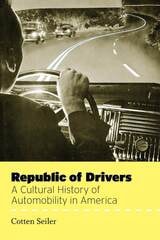
Republic of Drivers
A Cultural History of Automobility in AmericaCotten Seiler
University of Chicago Press, 2008
Cotten Seiler combs through a vast number of historical, social scientific, philosophical, and literary sources to illustrate the importance of driving to modern American conceptions of the self and the social and political order. He finds that as the figure of the driver blurred into the figure of the citizen, automobility became a powerful resource for women, African Americans, and others seeking entry into the public sphere. And yet, he argues, the individualistic but anonymous act of driving has also monopolized our thinking about freedom and democracy, discouraging the crafting of a more sustainable way of life. As our fantasies of the open road turn into fears of a looming energy crisis, Seiler shows us just how we ended up a republic of drivers—and where we might be headed.
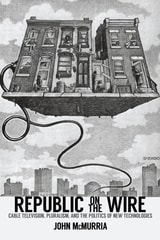
Republic on the Wire
Cable Television, Pluralism, and the Politics of New Technologies, 1948-1984McMurria, John
Rutgers University Press, 2017

Rereading the Revolution
The Turn-of-the-Century American Revolutionary War NovelAnita Lawson
University of Wisconsin Press, 2000
Approximately fifty historical novels dealing with the American Revolution were published in the United States from 1896 to 1906. Benjamin S. Lawson critically examines the narrative strategies employed in these works and the ways in which fiction is made to serve the purpose of vivifying national history.
Writing within the conventions of the historical romance, these authors created plots that reflect the enveloping concerns of the War for Independence, such as the young American woman who often must choose between suitors on opposite sides in the wider conflict.
Lawson concludes that these works reassured readers of the worth of an Anglo-American heritage. They were escapist fantasies to the degree that they failed to confront contemporary realities of crisis and change: the New Immigration, urbanization and industrialization, labor strife, the plight of the poor, and agitation on behalf of women and ethnic minorities.
Rereading the Spanish American Essay
Translations of 19th and 20th Century Women’s EssaysEdited by Doris Meyer
University of Texas Press, 1995
Latin American intellectual history is largely founded on essayistic writing. Women's essays have always formed a part of this rich tradition, yet they have seldom received the respect they merit and are often omitted entirely from anthologies.
This volume and its earlier companion, Reinterpreting the Spanish American Essay: Women Writers of the 19th and 20th Centuries, seek to remedy that neglect. This book collects thirty-six notable essays by twenty-two women writers, including Flora Tristan, Gertrudis Gómez de Avellaneda, Clorinda Matto de Turner, Victoria Ocampo, Alfonsina Storni, Rosario Ferré, Christina Peri Rossi, and Elena Poniatowska. All of the essays are here translated into English for the first time, many by the same scholars who wrote critical studies of the authors in the first volume. Each author's work is also prefaced by a brief biographical sketch.
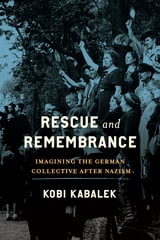
Rescue and Remembrance
Imagining the German Collective after NazismKobi Kabalek
University of Wisconsin Press, 2025
Kabalek argues that such simplistic depictions of the majority versus minority obscure the complex motivations and situations that led people in Nazi Germany to help persecuted Jews. Against the view that the rescuers were “forgotten” after the war, he shows that portrayals and interpretations of helping Jews appeared in various media and social discourses in East, West, and unified Germany and were used to actively debate questions of collective morality. Rescue and Remembrance analyzes the varied and changing depictions of rescue in the distinct German politics from the Nazi period, examining how the very notions of “majority” and “collective” were articulated and reformulated.
Rescue and Romance
Popular Novels Before World War IDiana Reep
University of Wisconsin Press, 1982
This study of the rescue motif in popular American novels before World War I focuses on the rescue convention as part of the romantic plot of the novels. The rescue as a structured convention that controls the movement of the romantic plot appears in all types of domestic novels, gothics, dime novels, historical romances, and westerns.
Rescuing History from the Nation
Questioning Narratives of Modern ChinaPrasenjit Duara
University of Chicago Press, 1995
The backlash against such histories has resulted in a tendency to view the past as largely constructed, imagined, or invented. In this book, Duara offers a way out of the impasse between constructionism and the evolving nation; he redefines history as a series of multiple, often conflicting narratives produced simultaneously at national, local, and transnational levels. In a series of closely linked case studies, he considers such examples as the very different histories produced by Chinese nationalist reformers and partisans of popular religions, the conflicting narratives of statist nationalists and of advocates of federalism in early twentieth-century China. He demonstrates the necessity of incorporating contestation, appropriation, repression, and the return of the repressed subject into any account of the past that will be meaningful to the present. Duara demonstrates how to write histories that resist being pressed into the service of the national subject in its progress—or stalled progress—toward modernity.
Rescuing the Children
A Holocaust MemoirVivette Samuel; Translated and with an introduction by Charles B. Paul; With a foreword by Elie Wiesel
University of Wisconsin Press, 2002
Resistance of the Heart
Intermarriage and the Rosenstrasse Protest in Nazi GermanyNathan Stoltzfus
Rutgers University Press, 2001
In February 1943 the Gestapo arrested approximately 10,000 Jews remaining in Berlin. Most died at Auschwitz. Two thousand of those Jews, however, had non-Jewish partners and were locked into a collection center on a street called Rosenstrasse. As news of the surprise arrest pulsed through the city, hundreds of Gentile spouses, mostly women, hurried to the Rosenstrasse in protest. A chant broke out: "Give us our husbands back."
Over the course of a week protesters vied with the Gestapo for control of the street. Now and again armed SS guards sent the women scrambling for cover with threats that they would shoot. After a week the Gestapo released these Jews, almost all of whom survived the war.
The Rosenstrasse Protest was the triumphant climax of ten years of resistance by intermarried couples to Nazi efforts to destroy their families. In fact, ninety-eight percent of German Jews who did not go into hiding and who survived Nazism lived in mixed marriages. Why did Hitler give in to the protesters? Using interviews with survivors and thousands of Nazi records never before examined in detail, Nathan Stoltzfus identifies the power of a special type of resistance--the determination to risk one's own life for the life of loved ones. A "resistance of the heart..."
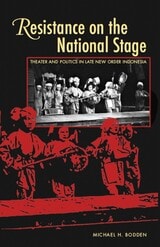
Resistance on the National Stage
Theater and Politics in Late New Order IndonesiaMichael H. Bodden
Ohio University Press, 2010
Resistance on the National Stage analyzes the ways in which, between 1985 and 1998, modern theater pracxadtitioners in Indonesia contributed to a rising movement of social protest against the long-governing New Order regime of President Suharto. It examines the work of an array of theater groups and networks from Jakarta, Bandung, and Yogyakarta that pioneered new forms of theater-making and new themes that were often presented more directly and critically than previous groups had dared to do.
Michael H. Bodden looks at a wide range of case studies to show how theater contributed to and helped build the opposition. He also looks at how specific combinations of social groups created tensions and gave modern theater a special role in bridging social gaps and creating social networks that expanded the reach of the prodemocracy movement. Theater workers constructed new social networks by involving peasants, Muslim youth, industrial workers, and lower-middle-class slum dwellers in theater productions about their own lives. Such networking and resistance established theater as one significant arena in which the groundwork for the ouster of Suharto in May 1998, and the succeeding Reform era, was laid.
Resistance on the National Stage will have broad appeal, not only for scholars of contemporary Indonesian culture and theater, but also for those interested in Indonesian history and politics, as well as scholars of postcolonial theater and culture.
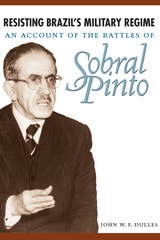
Resisting Brazil's Military Regime
An Account of the Battles of Sobral PintoBy John W. F. Dulles
University of Texas Press, 2007
Praised by his many admirers as a "courageous and fearless" defender of human rights, Heráclito Fontoura Sobral Pinto (1893-1991) was the most consistently forceful opponent of the regime of Brazilian dictator Getúlio Vargas. John W. F. Dulles chronicled Sobral's battles with the Vargas government in Sobral Pinto, "The Conscience of Brazil": Leading the Attack against Vargas (1930-1945), which History: Reviews of New Books called "a must-read for anyone wanting to understand twentieth-century Brazil."
In this second and final volume of his biography of Sobral Pinto, Professor Dulles completes the story of the fiery crusader's fight for democracy, morality, and justice, particularly for the downtrodden. Drawing on Sobral's vast correspondence, Dulles offers an extensive account of Sobral's opposition to the military regime that ruled Brazil from 1964 to 1985. He describes how Sobral Pinto defended those who had been politically influential before April, 1964, as well as other victims of the regime, including Communists, once-powerful labor leaders, priests, militant journalists, and students. Because Sobral Pinto participated in so many of the struggles against the military regime, his experiences provide vivid new insights into this important period in recent Brazilian history. They also shed light on developments in the Catholic Church (Sobral, a devout Catholic, vigorously opposed liberation theology), as well as on Sobral's key role in preserving Brazil's commission for defending human rights.

Resisting Regionalism
Gender And Naturalism In American Fiction, 1885-1915Donna Campbell
Ohio University Press, 1997
When James Lane Allen defined the “Feminine Principle” and the “Masculine Principle” in American fiction for the Atlantic Monthly in 1897, he in effect described local color fiction and naturalism, two branches of realism often regarded as bearing little relationship to each other. In this award-winning study of both movements, Resisting Regionalism explores the effect the cultural dominance of women’s local color fiction in the 1890’s had on young male naturalist writers, who rebelled against the local colorists and their “teacup tragedies.”
An immensely popular genre, local color fiction reached its peak in the 1880s in such literary journals as Harper’s Monthly, Scribner’s, the Atlantic Monthly, and the Century. These short stories exhibited local “characters,” depicted marginal groups and vanishing folkways, and addressed issues of absence, loss, limitation, and the past. Despite such prickly themes, according to Donna Campbell, local color fiction “fulfilled some specific needs of the public – for nostalgia, for a retreat into mildly exotic locales, for a semblance of order preserved in ritual.”
By the turn of the century, however, local color fiction was fading from the scene, supplanted by writers of adventure fiction and historical romances, with whom local colorists increasingly merged, and opposed by the naturalists. In examining this historic shift, Resisting Regionalism shows that far from being distanced from local color fiction, nationalism emerged in part as a dissenting response to its popularity and to the era’s concerns about the dominance of feminine influence in American literature. The new generation of authors, including Crane, Norris, London, Frederic, Wharton, resisted the cultural myths and narrative strategies common to local colorists Sarah Orne Jewett, Rose Terry Cooke, Mary E. Wilkins Freeman, and Constance Fenimore Woolson. Yet, as Campbell underscores in her analysis of Stephan Crane’s The Monster, the naturalists could, and did, integrate local color conventions with the grotesque and horrifying to powerful effect.
In clear, accessible prose, Resisting Regionalism provides fresh readings of naturalistic works in the context of the dispute between local color and naturalism. In the process, this book shows the debt naturalism owes to local color fiction and illuminates a neglected but significant literary era.