Results by title
5159 books match the query 'Biography' and 217 start with r

Rough-Water Man
Elwyn Blake'S Colorado River ExpeditionsRichard E. Westwood
University of Nevada Press, 2013

Rounded Up in Glory
Frank Reaugh, Texas Renaissance ManMichael Grauer
University of North Texas Press, 2016
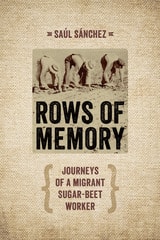
Rows of Memory
Journeys of a Migrant Sugar-Beet WorkerSaul Sanchez
University of Iowa Press, 2014
Rows of Memory tells his story and the story of his family and other migrant farm laborers like them, people who endured dangerous, dirty conditions and low pay, surviving because they took care of each other. Facing racism both on the road and at home, they lived a largely segregated life only occasionally breached by friendly employers.
Despite starting school late and leaving early every year and having to learn English on the fly, young Saúl succeeded academically. At the same time that Mexican Americans in South Texas upended the Anglo-dominated social order by voting their own leaders into local government, he upended his family’s order by deciding to go to college. Like many migrant children, he knew that his decision to pursue an education meant he would no longer be able to help feed and clothe the rest of his family. Nevertheless, with his parents’ support, he went to college, graduating in 1967 and, after a final display of his skill with a short hoe for his new friends, abandoned migrant labor for teaching.
In looking back at his youth, Sánchez invites us to appreciate the largely unrecognized and poorly rewarded strength and skill of the laborers who harvest the fruits and vegetables we eat. A first-person portrait of life on the bottom rung of the food system, this coming-of-age tale illuminates both the history of Latinos in the United States and the human consequences of industrial agriculture.
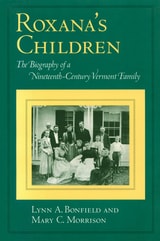
Roxana's Children
The Biography of a Nineteenth-Century Vermont FamilyLynn A. Bonfield
University of Massachusetts Press, 1995
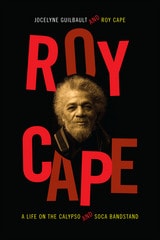
Roy Cape
A Life on the Calypso and Soca BandstandJocelyne Guilbault and Roy Cape
Duke University Press, 2014
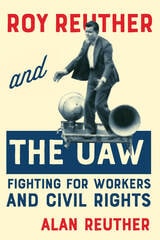
Roy Reuther and the UAW
Fighting for Workers and Civil RightsAlan Reuther
Michigan State University Press, 2025
Many of the injustices that Reuther fought continue to plague America today. This book provides important context for the current efforts of workers to organize, for the Black Lives Matter movement, and for efforts to reform the filibuster rule and stop voter suppression. It shows how dedicated individuals can overcome enormous odds to win great victories for social justice and emphasizes the potential connections between the labor and civil rights movements, offering hope for a more just future.
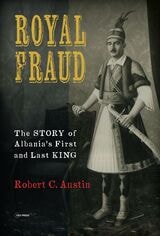
Royal Fraud
The Story of Albania’s First and Last KingRobert Austin
Central European University Press, 2024
Beginning its narrative in 1961, when Albanian King Zog I died in a Paris hospital after 22 years in exile, this book tells the colourful story of this Balkan country's first and only monarch. The road to becoming Europe's youngest president in 1925 and then king of Albania in 1928 was paved with feuds and assassinations, a political career-path common in the region. He craved the throne for several reasons; the Balkans were mostly run by kings, and Zog wanted to impress his mother and also give his six sisters an easy social rise.
Once king, his accomplishments were decidedly meagre. He spent most of his time keeping up appearances as a monarch despite the obvious fraud he had imposed on an illiterate and uninterested population. His one great success was that he had almost all his opponents assassinated, usually in broad daylight abroad.
Zog retained his power until his "friend" Mussolini ousted him in 1939. On the surface a Westernizer, this self-proclaimed ruler left Albania almost as he found it, with almost no roads or trains, thoroughly uneducated and utterly impoverished.
In his book, Robert Austin combines Zog’s adventurous life story with a studious analysis of Albania's political history from the fall of the Ottoman Empire to the threshold of Euro-Atlantic integration.
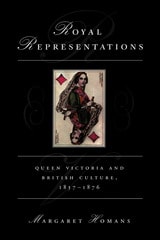
Royal Representations
Queen Victoria and British Culture, 1837-1876Margaret Homans
University of Chicago Press, 1998
Arguing that being, seeming, and appearing were crucial to Victoria's "rule," Homans explores the variability of Victoria's agency and of its representations using a wide array of literary, historical, and visual sources. Along the way she shows how Victoria provided a deeply equivocal model for women's powers in and out of marriage, how Victoria's dramatic public withdrawal after Albert's death helped to ease the monarchy's transition to an entirely symbolic role, and how Victoria's literary self-representations influenced debates over political self-representation.
Homans considers versions of Victoria in the work of Elizabeth Barrett Browning, George Eliot, John Ruskin, Margaret Oliphant, Lewis Carroll, Alfred Lord Tennyson, and Julia Margaret Cameron.
Ruling Peacefully
Cardinal Ercole Gonzaga and Patrician Reform in Sixteenth-Century ItalyPaul V. Murphy
Catholic University of America Press, 2007
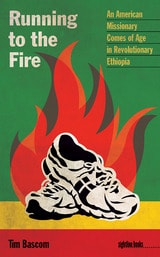
Running to the Fire
An American Missionary Comes of Age in Revolutionary EthiopiaTim Bascom
University of Iowa Press, 2015
Running to the Fire focuses on the turbulent year the Bascom family experienced upon traveling into revolutionary Ethiopia. The teenage Bascom finds a paradoxical exhilaration in living so close to constant danger. At boarding school in Addis Ababa, where dorm parents demand morning devotions and forbid dancing, Bascom bonds with other youth due to a shared sense of threat. He falls in love for the first time, but the young couple is soon separated by the politics that affect all their lives. Across the country, missionaries are being held under house arrest while communist cadres seize their hospitals and schools. A friend’s father is imprisoned as a suspected CIA agent; another is killed by raiding Somalis.
Throughout, the teenaged Bascom struggles with his faith and his role within the conflict as a white American Christian missionary’s child. Reflecting back as an adult, he explores the historical, cultural, and religious contexts that led to this conflict, even though in doing so he is forced to ask himself questions that are easier left alone. Why, he wonders, did he find such strange fulfillment in being young and idealistic in the middle of what was essentially a kind of holy war?
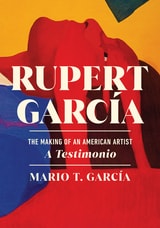
Rupert García
The Making of an American Artist, a TestimonioMario T. García
Rutgers University Press, 2026
This is the first biography of the renowned American Chicano visual artist and activist Rupert García, drawing on fifty hours of interviews conducted over thirty years and accompanied by eighty images. This in-depth oral history gives an unparalleled look at García’s life and work, tracing his evolution as an artist and the political upheavals that shaped his life and worldview.
Mario T. García’s testimonio places Rupert García’s art in historical perspective, from his beginnings as a working-class Mexican American from California’s Central Valley, his coming of age in the U.S. Air Force during the Vietnam War, his involvement in the antiwar movement during the San Francisco State student strike in 1968-69, and his participation in the Chicano Movement and beyond. Influenced by history and politics, García’s vital works of art represent a changing world through the eyes of an artist, speaking to issues of poverty, racism, capitalism, war, and the role of the artist in society.
His art—from revolutionary silkscreen posters to monumental pastels to portraits of political icons like Frida Kahlo, Che Guevara, and Dolores Huerta—serves to critique history and reassess it. It is work that will endure for generations to come.
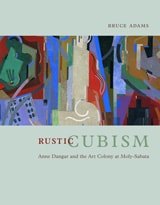
Rustic Cubism
Anne Dangar and the Art Colony at Moly-SabataBruce Adams
University of Chicago Press, 2004
In part a gripping biography of this Australian expatriate, Rustic Cubism chronicles Dangar's personal battles and the tumult of the World War II era during her tempestuous tenure at Moly-Sabata. Dangar dedicated herself to the colony's aims by working in the region's village potteries, combining their vernacular elements with Gleizes' design methods to arrive at a type of rustic Cubism. Her work there would ultimately be rewarded; her pieces can today be found in the Musée des Arts Décoratifs in Paris, the Musée d'Art Moderne de la Ville de Paris, the Museo Internazionale delle Ceramiche in Faenza, the National Gallery of Australia, Canberra, and many other museums.
Rustic Cubism places Dangar at the heart of Moly-Sabata's alternative art movement—one that, in its nostalgic present, attempted to construct a culture based on the distant past. Generously illustrated with photographs of the art and social milieu of the period, this captivating and original narrative makes a considerable contribution to our understanding of French modernism and early twentieth-century cultural politics as well as of the life of a most talented and intriguing female artist.
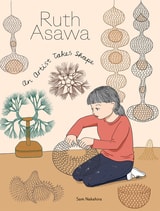
Ruth Asawa
An Artist Takes ShapeSam Nakahira
J. Paul Getty Trust, The, 2024
Renowned for her innovative wire sculptures, Japanese American artist Ruth Asawa (1926–2013) was a teenager in Southern California when Japan bombed Pearl Harbor and the United States entered World War II. Japanese Americans on the West Coast were forcibly removed from their homes. Asawa’s family had to abandon their farm, her father was incarcerated, and she and the rest of her family were sent to a concentration camp. Asawa nurtured her dreams of becoming an artist while imprisoned and eventually made her way to the experimental Black Mountain College in North Carolina.
This graphic biography by Sam Nakahira, developed in consultation with Asawa’s youngest daughter, Addie Lanier, chronicles the genesis of Asawa as an artist—from the horror of Pearl Harbor to her transformative education at Black Mountain College to building a life in San Francisco, where she would further develop and refine her groundbreaking wire sculpture.
Asawa never sought fame, preferring to work on her own terms: for her, art and life were one. Featuring lively illustrations and photographs of Asawa’s work, this retelling of her young adult years demonstrates the power of making art.
Ages thirteen and up
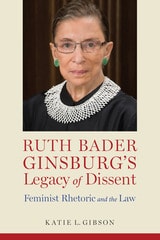
Ruth Bader Ginsburg’s Legacy of Dissent
Feminist Rhetoric and the LawKatie L. Gibson
University of Alabama Press, 2018
A rhetorical analysis of Justice Ruth Bader Ginsburg’s feminist jurisprudence.
Ruth Bader Ginsburg’s lifelong effort to reshape the language of American law has had profound consequences: she has shifted the rhetorical boundaries of jurisprudence on a wide range of fundamental issues from equal protection to reproductive rights. Beginning in the early 1970s, Ginsburg led a consequential attack on sexist law in the United States. By directly confronting the patriarchal voice of the law, she pointedly challenged an entrenched genre of legal language that silenced the voices and experiences of American women and undermined their status as equal citizens. On the United States Supreme Court, Justice Ginsburg continues to challenge the traditional scripts of legal discourse to insist on a progressive vision of the Constitution and to demand a more inclusive and democratic body of law.
This illuminating work examines Justice Ruth Bader Ginsburg’s contributions in reshaping the rhetoric of the law (specifically through the lens of watershed cases in women’s rights) and describes her rhetorical contributions—beginning with her work in the 1970s as a lawyer and an advocate for the ACLU’s Women’s Rights Project through her tenure as a Supreme Court justice. Katie L. Gibson examines Ginsburg’s rhetoric to argue that she has dramatically shifted the boundaries of legal language. Gibson draws from rhetorical theory, critical legal theory, and feminist theory to describe the law as a rhetorical genre, arguing that Ginsburg’s jurisprudence can appropriately be understood as a direct challenge to the traditional rhetoric of the law.
Ruth Bader Ginsburg stands as an incredibly important figure in late twentieth- and early twenty-first-century feminism. While a growing number of admirers celebrate Justice Ginsburg’s voice of dissent today, Ginsburg’s rhetorical legacy reveals that she has long articulated a sharp and strategic voice of judicial dissent. This study contributes to a more complete understanding of her feminist legacy by detailing the unique contributions of her legal rhetoric.
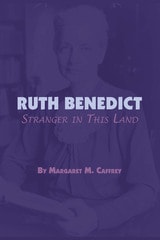
Ruth Benedict
Stranger in This LandBy Margaret M. Caffrey
University of Texas Press, 1989
Poet, anthropologist, feminist—Ruth Fulton Benedict was all of these and much more. Born into the last years of the Victorian era, she came of age during the Progressive years and participated in inaugurating the modern era of American life. Ruth Benedict: Stranger in This Land provides an intellectual and cultural history of the first half of the twentieth century through the life of an important and remarkable woman.
As a Lyricist poet, Ruth Benedict helped define Modernism. As an anthropologist, she wrote the classic Patterns of Culture and at one point was considered the foremost anthropologist in the United States—the first woman ever to attain such status. She was an intellectual and an artist living in a time when women were not encouraged to be either. In this fascinating study, Margaret Caffrey attempts to place Benedict in the cultural matrix of her time and successfully shows the way in which Benedict was a product of and reacted to the era in which she lived.
Caffrey goes far beyond providing simple biographical material in this well-written interdisciplinary study. Based on exhaustive research, including access for the first time to the papers of Margaret Mead, Benedict's student and friend, Caffrey is able to put Benedict's life clearly in perspective. By identifying the family and educational influences that so sharply influenced Benedict's psychological makeup, the author also closely analyzes the currents of thought that were strong when Victorianism paralleled the Modernism that figured in Benedict's life work. The result is a richly detailed study of a gifted woman.
This important work will be of interest to students of Modernism, poetry, and women's studies, as well as to anthropologists.

Ryan Adams
Losering, a Story of WhiskeytownBy David Menconi
University of Texas Press, 2012
Before he achieved his dream of being an internationally known rock personality, Ryan Adams had a band in Raleigh, North Carolina. Whiskeytown led the wave of insurgent-country bands that came of age with No Depression magazine in the mid-1990s, and for many people it defined the era. Adams was an irrepressible character, one of the signature personalities of his generation, and as a singer-songwriter he blew people away with a mature talent that belied his youth. David Menconi witnessed most of Whiskeytown’s rocket ride to fame as the music critic for the Raleigh News & Observer, and in Ryan Adams, he tells the inside story of the singer’s remarkable rise from hardscrabble origins to success with Whiskeytown, as well as Adams’s post-Whiskeytown self-reinvention as a solo act.
Menconi draws on early interviews with Adams, conversations with people close to him, and Adams’s extensive online postings to capture the creative ferment that produced some of Adams’s best music, including the albums Strangers Almanac and Heartbreaker. He reveals that, from the start, Ryan Adams had an absolutely determined sense of purpose and unshakable confidence in his own worth. At the same time, his inability to hold anything back, whether emotions or torrents of songs, often made Adams his own worst enemy, and Menconi recalls the excesses that almost, but never quite, derailed his career. Ryan Adams is a fascinating, multifaceted portrait of the artist as a young man, almost famous and still inventing himself, writing songs in a blaze of passion.
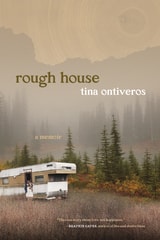
rough house
a memoirTina Ontiveros
Oregon State University Press, 2020
Tina Ontiveros was born into timber on both sides of the family. Her mother spent summers driving logging trucks for her family’s operation, and her father was the son of an itinerant logger, raised in a variety of lumber towns, as Tina herself would be.
A story of growing up in turmoil, rough house recounts a childhood divided between a charming, mercurial, abusive father in the forests of the Pacific Northwest and a mother struggling with small-town poverty. It is also a story of generational trauma, especially for the women—a story of violent men and societal restrictions, of children not always chosen and frequently raised alone.
Ontiveros’s father, Loyd, looms large. Reflecting on his death and long absence from her life, she writes, “I had this ridiculous hope that I would get to enjoy a functional relationship with my father, on my own terms, now that I was an adult.” In searingly honest, straightforward prose, rough house is her attempt to carve out this relationship, to understand her father and her family from an adult perspective.
While some elements of Ontiveros’s story are universal, others are indelibly grounded in the logging camps of the Pacific Northwest at the end of the twentieth century, as the lumber industry shifted and contracted. Tracing her childhood through the working-class towns and forests of Washington and Oregon, Ontiveros explores themes of love and loss, parents and children, and her own journey to a different kind of adulthood.