Results by title
5448 books match the query 'History and criticism' and 301 start with r
Resisting Spirits
Drama Reform and Cultural Transformation in the People's Republic of ChinaMaggie Greene
University of Michigan Press, 2019
Resonant Dissonance
The Russian Joke in Cultural ContextSeth Graham
Northwestern University Press, 2009
Respectability and Deviance
Nineteenth-Century German Women Writers and the Ambiguity of RepresentationRuth-Ellen Boetcher Joeres
University of Chicago Press, 1998
Studying a period of German literary history that has been largely ignored by modern readers, Ruth-Ellen Boetcher Joeres demonstrates that these writings offer intriguing opportunities to examine such critical topics as canon formation; the relationship between gender, class, and popular culture; and women, professionalism, and technology. The writers she explores range from Annette von Droste-Hülshoff, who managed to work her way into the German canon, to the popular serial novelist E. Marlitt, from liberal writers such as Louise Otto and Fanny Lewald, to the virtually unknown novelist and journalist Claire von Glümer. Through this investigation, Boetcher Joeres finds ambiguities, compromises, and subversions in these texts that offer an extensive and informative look at the exciting and transformative epoch that so much shaped our own.
Responding to Crisis in Contemporary Mexico
The Political Writings of Paz, Fuentes, Monsiváis, and PoniatowskaClaire Brewster
University of Arizona Press, 2005
Claire Brewster has mined direct quotations from a host of publications to illustrate the techniques that they used in combating government and editorial restraints. Brewster first addresses the Student Movement of 1968—the violent suppression of which was a watershed in the relationship between the Mexican government and people—and illustrates the ways in which the student crisis affected the writers’ relationships with presidents Luis Echeverría Alvarez and José López Portillo. She next considers the profound social and political repercussions of the 1985 earthquake as described by Poniatowska and Monsiváis and the consequent emergence of Mexican civil society. She then outlines Paz’s and Monsiváis’s vociferous responses to the 1988 presidential election campaigns and their highly contentious result, and lastly she examines the Chiapas rebellion from January to July 1994.
The eloquent Zapatista spokesman, Subcomandante Marcos, challenged Mexican writers to a duel of words, and Brewster analyzes the ways in which the four writers took up the gauntlet—and in so doing reveals the development of their political thoughts and their relationships with the Mexican people and the federal government. The work of these four authors charts an important historical era, and a close examination of their essays reveals their maturation as writers and provides an understanding of the development of Mexican society. By bringing their opinions and attitudes to light, Brewster unearths a rich lode of insight into the inner workings of Mexican intellectuals and invites observers of contemporary Mexico to reconsider their role in reflecting social change.

Responses to Oliver Stone’s Alexander
Film, History, and Cultural StudiesEdited by Paul Cartledge and Fiona Rose Greenland; Afterword by Oliver Stone
University of Wisconsin Press, 2009
This volume brings together an intriguing mix of leading scholars in Macedonian and Greek history, Persian culture, film studies, classical literature, and archaeology—including some who were advisors for the film—and includes an afterword by Oliver Stone discussing the challenges he faced in putting Alexander’s life on the big screen. The contributors scrutinize Stone’s project from its inception and design to its production and reception, considering such questions as: Can a film about Alexander (and similar figures from history) be both entertaining and historically sound? How do the goals of screenwriters and directors differ from those of historians? How do Alexander’s personal relationships—with his mother Olympias, his wife Roxane, his lover Hephaistion, and others—affect modern perceptions of Alexander? Several of the contributors also explore reasons behind the film’s tepid response at the box office and subsequent controversies.
Restoring Relations Through Stories
From Dinétah to DenendehRenae Watchman; Foreword by Luci Tapahonso
University of Arizona Press, 2024
While the Diné (those from the four sacred mountains in Dinétah in the southwestern United States) are not now politically and economically cohesive with the Dene (who are in Denendeh in Canada), they are ancestral and linguistic relatives. In this book, Watchman turns to literary and visual texts to explore how relations are restored through stories, showing how literary linkages from land-based stories affirm Diné and Dene kinship. She explores the power of story to forge ancestral and kinship ties between the Diné and Dene across time and space through re-storying of relations.
*A complex Diné worldview and philosophy that cannot be defined with one word in the English language. Hózhǫ́ means to continually strive for harmony, beauty, balance, peace, and happiness, but most importantly the Diné have a right to it.
Resurrecting the First Great American Play
Imperial Politics and Colonial Ambitions in Frontier DetroitSämi Ludwig
University of Wisconsin Press, 2020
Sämi Ludwig contends that Ponteach's literary and artistic merits are worthy of further exploration. He investigates questions of authorship and analyzes the play's content, embracing its many contradictions as enriching windows into the era. In this way, he suggests using Ponteach as a tool to better understand British imperialism in North America and the emerging theatrical forms of the Young Republic.
Retelling the Siege of Jerusalem in Early Modern England
Vanita Neelakanta
University of Delaware Press, 2019
Published by University of Delaware Press. Distributed worldwide by Rutgers University Press.
Rethinking American Music
Edited by Tara Browner and Thomas L. Riis
University of Illinois Press, 2019

Rethinking Reality
Lucretius and the Textualization of NatureDuncan F. Kennedy
University of Michigan Press, 2002
The book engages in a sustained argument about realist assumptions in scientific and other discourses through detailed analysis and discussion of some of the most important recent contributions to this debate. Engaging sympathetically but not uncritically with constructivist accounts of scientific knowledge, the book takes up a sustained critique of recent contributions to that debate, including those of Ian Hacking, Evelyn Fox Keller, Bruno Latour, and Hans-Jörg Rheinberger. What are the implications of regarding such knowledge as "discovered" or "invented"? How is the rhetoric of such claims to be identified and the pretentions of those claims assessed?In what ways can realist and constructivist approaches be reconciled? How do these considerations affect the way we read scientific texts from the past and regard them historically?
What emerges is a fresh and challenging assessment of the role of time and temporal perspective in assessing claims to knowledge in scientific thought and of the importance of textuality to the history of knowledge. A wide variety of readers, from classicists and intellectual historians to epistemologists of science, will enjoy and learn from Rethinking Reality.
Duncan Kennedy is Reader in Latin Literature and the Theory of Criticism, University of Bristol. He is also the author of The Arts of Love: Five Studies in the Discourse of Roman Love Elegy.

Retracing the Platonic Text
John Russon and John Sallis
Northwestern University Press, 1999
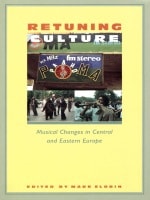
Retuning Culture
Musical Changes in Central and Eastern EuropeMark Slobin
Duke University Press, 1996
During the period of state socialism, both the reinterpretation of the folk music heritage and the domestication of Western forms of music offered ways to resist and redefine imposed identities. With the removal of state control and support, music was free to channel and to shape emerging forms of cultural identity. Stressing both continuity and disjuncture in a period of enormous social and cultural change, this volume focuses on the importance and evolution of traditional and popular musics in peasant communities and urban environments in Hungary, Poland, Romania, Russia, the Czech Republic, Ukraine, the former Yugoslavia, Macedonia, and Bulgaria. Written by longtime specialists in the region and considering both religious and secular trends, these essays examine music as a means of expressing diverse aesthetics and ideologies, participating in the formation of national identities, and strengthening ethnic affiliation.
Retuning Culture provides a rich understanding of music’s role at a particular cultural and historical moment. Its broad range of perspectives will attract readers with interests in cultural studies, music, and Central and Eastern Europe.
Contributors. Michael Beckerman, Donna Buchanan, Anna Czekanowska, Judit Frigyesi, Barbara Rose Lange, Mirjana Lausevic, Theodore Levin, Margarita Mazo, Steluta Popa, Ljerka Vidic Rasmussen, Timothy Rice, Carol Silverman, Catherine Wanner
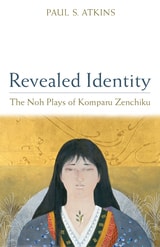
Revealed Identity
The Noh Plays of Komparu ZenchikuPaul S. Atkins
University of Michigan Press, 2006
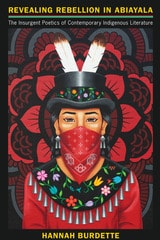
Revealing Rebellion in Abiayala
The Insurgent Poetics of Contemporary Indigenous LiteratureHannah Burdette
University of Arizona Press, 2019
Revealing Rebellion in Abiayala explores the intersections between Indigenous literature and social movements over the past thirty years through the lens of insurgent poetics. Author Hannah Burdette is interested in how Indigenous literature and social movements are intertwined and why these phenomena arise almost simultaneously in disparate contexts across the Americas.
Literature constitutes a key weapon in political struggles as it provides a means to render subjugated knowledge visible and to envision alternatives to modernity and coloniality. The surge in Indigenous literature and social movements is arguably one of the most significant occurrences of the twenty-first century, and yet it remains understudied. Revealing Rebellion in Abiayala bridges that gap by using the concept of Abiayala as a powerful starting point for rethinking inter-American studies through the lens of Indigenous sovereignty.
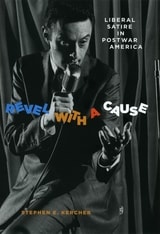
Revel with a Cause
Liberal Satire in Postwar AmericaStephen E. Kercher
University of Chicago Press, 2006
Revel with a Cause is their story. Stephen Kercher here provides the first comprehensive look at the satiric humor that flourished in the United States during the 1950s and early 1960s. Focusing on an impressive range of comedy—not just standup comedians of the day but also satirical publications like MAD magazine, improvisational theater groups such asSecond City, the motion picture Dr. Strangelove, and TV shows like That Was the Week That Was—Kercher reminds us that the postwar era saw varieties of comic expression that were more challenging and nonconformist than we commonly remember. His history of these comedic luminaries shows that for a sizeable audience of educated, middle-class Americans who shared such liberal views, the period’s satire was a crucial mode of cultural dissent. For such individuals, satire was a vehicle through which concerns over the suppression of civil liberties, Cold War foreign policies, blind social conformity, and our heated racial crisis could be productively addressed.
A vibrant and probing look at some of the most influential comedy of mid-twentieth-century America, Revel with a Cause belongs on the short list of essential books for anyone interested in the relationship between American politics and popular culture.
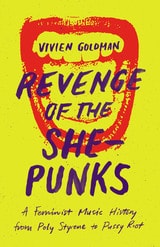
Revenge of the She-Punks
A Feminist Music History from Poly Styrene to Pussy RiotBy Vivien Goldman
University of Texas Press, 2019
As an industry insider and pioneering post-punk musician, Vivien Goldman’s perspective on music journalism is unusually well-rounded. In Revenge of the She-Punks, she probes four themes—identity, money, love, and protest—to explore what makes punk such a liberating art form for women.
With her visceral style, Goldman blends interviews, history, and her personal experience as one of Britain’s first female music writers in a book that reads like a vivid documentary of a genre defined by dismantling boundaries. A discussion of the Patti Smith song “Free Money,” for example, opens with Goldman on a shopping spree with Smith. Tamar-Kali, whose name pays homage to a Hindu goddess, describes the influence of her Gullah ancestors on her music, while the late Poly Styrene's daughter reflects on why her Somali-Scots-Irish mother wrote the 1978 punk anthem “Identity,” with the refrain “Identity is the crisis you can't see.” Other strands feature artists from farther afield (including in Colombia and Indonesia) and genre-busting revolutionaries such as Grace Jones, who wasn't exclusively punk but clearly influenced the movement while absorbing its liberating audacity. From punk's Euro origins to its international reach, this is an exhilarating world tour.
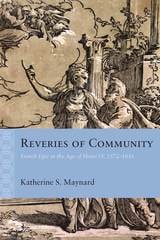
Reveries of Community
French Epic in the Age of Henri IV, 1572–1616Katherine S. Maynard
Northwestern University Press, 2018
Traditionally united by une foi, une loi, un roi (one faith, one law, one king), France under Henri IV was cleaved into warring factions of Catholics and Huguenots. The country suffered episodes of bloodshed such as the St. Bartholomew’s Day Massacre, even as attempts were made to attenuate the violence through frequent edicts, including those of St. Germain (1570) and Nantes (1598). Maynard examines the rich and often dismissed body work written during these bloody decades: Pierre de Ronsard’s Franciade, Guillaume Salluste Du Bartas’s La Judit and La Sepmaine, Sébastian Garnier’s La Henriade, Agrippa d’Aubigné’s Les Tragiques, and others. She traces how French poets, taking classics such as Virgil’s Aeneid and Homer’s Iliad as their models, reimagined possibilities for French reconciliation and unity.

Reverse Colonization
Science Fiction, Imperial Fantasy, and Alt-victimhoodDavid M. Higgins
University of Iowa Press, 2021
Higgins shows that this reverse colonization stance depends upon a science fictional logic that achieved dominance within imperial fantasy during the 1960s and has continued to gain momentum ever since. By identifying with fantastic forms of victimhood, subjects who already enjoy social hegemony are able to justify economic inequality, expansions of police and military power, climatological devastation, new articulations of racism, and countless other forms of violence—all purportedly in the name of security, self-defense, and self-protection.
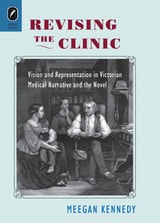
Revising the Clinic
Vision and Representation in Victorian Medical Narrative and the NovelMeegan Kennedy
The Ohio State University Press, 2010
Critics have examined how novelists borrow from other genres—newspapers, legal cases, autobiographies. Medical writing likewise enriches the novel’s uniquely flexible and wide-ranging presentation of Victorian culture. In turn, the novel shapes medical narrative even as clinical science idealizes methodological rigor. Revising the Clinic shows how the wealth of scientific material in mainstream Victorian periodicals creates a productive literary “commons” where novelists and physicians can encounter each others’ strategies for seeing and stating. Novelists adapt physicians’ techniques to nonmedical scenes, and physicians echo the sentimental or sensational novel to gain sympathy or rhetorical force when medical knowledge falters.
Kennedy traces the development of the Victorian novel and the case history from eighteenth-century curious observation and curious sights through nineteenth-century clinical observation, mechanical observation, and speculation, to Freud’s labyrinthine mapping and speculative insight. These make new sense, read within the literary tradition of the case history. The lens of Kennedy’s argument clarifies and illuminates the preoccupation with genre and visuality that is common to Victorian medicine and the novel.
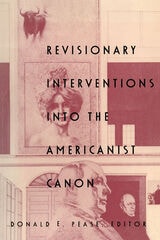
Revisionary Interventions into the Americanist Canon
Donald E. Pease
Duke University Press, 1994
Originally published as a special issue of boundary 2, the essays gathered here discuss writers as diverse as Kate Chopin, Frederick Douglass, Emerson, Melville, W. D. Howells, Henry James, W. E. B. DuBois, and Mark Twain, plus the historical figure John Brown. Two major sections devoted to the theory of romance and to cultural-historical analyses emphasize the political perspective of "New Americanist" literary and cultural study.
Contributors. William E. Cain, Wai-chee Dimock, Howard Horwitz, Gregory S. Jay, Steven Mailloux, John McWilliams, Susan Mizruchi, Donald E. Pease, Ivy Schweitzer, Priscilla Wald, Michael Warner, Robert Weimann

Revisiting Racialized Voice
African American Ethos in Language and LiteratureDavid G. Holmes
Southern Illinois University Press, 2004
Revisiting Racialized Voice:African American Ethos in Language and Literature argues that past misconceptions about black identity and voice, codified from the 1870s through the 1920s, inform contemporary assumptions about African American authorship and ethos. Tracing elements of racial consciousness in the works of Frederick Douglass, Charles Chesnutt, W. E. B. DuBois, Zora Neale Hurston, and others, David G. Holmes urges a revisiting of narratives from this period to strengthen and advance notions about racialized writing and to shape contemporary composition pedagogies.
Pointing to the intersection of African American identity, literature, and rhetoric, Revisiting Racialized Voice begins to construct rhetorically workable yet ideologically flexible definitions of black voice. Holmes maintains that political pressure to embrace“color blindness” endangers scholars’ ability to uncover links between racialized discourses of the past and those of the present, and he calls instead for a reassessment of the material realities and theoretical assumptions race represents and with which it has been associated.
Revisiting Richardson
Rebecca Anne Barr
Bucknell University Press, 2025
Published by Bucknell University Press. Distributed by Rutgers University Press.
Revisiting Women's Cinema
Feminism, Socialism, and Mainstream Culture in Modern ChinaLingzhen Wang
Duke University Press, 2021
Revivalist Fantasy
Alliterative Verse and Nationalist Literary HistoryRandy P. Schiff
The Ohio State University Press, 2011
Schiff revises readings of alliterative poetry as Francophobic, exploring the transnational imperialist elitism in the translation William of Palerne. He contributes to the discussion of gender in Sir Gawain and the Green Knight by linking the poem’s powerful female players with anxieties about women’s control of wealth and property in militarized regions of England. The book also explores the emphatically pre-national, borderlands sensibilities informing the Awntyrs off Arthure and Golagros and Gawane, and it examines the exploitation of collaborative composition in the material legacy of the Piers Plowman tradition.
Revivalist Fantasy concludes that Revivalist nationalism obscures crucial continuities between late-medieval and post-national worlds and that critics’ interests should be channeled into the forging of connections between past and present rather than suspended in the scholarly pursuit of origins. The book will be of interest to scholars of editorial history and translation studies and to those interested in manuscript studies.
Revolution and Its Narratives
China's Socialist Literary and Cultural Imaginaries, 1949-1966Cai Xiang
Duke University Press, 2016
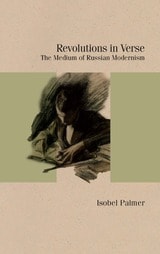
Revolutions in Verse
The Medium of Russian ModernismIsobel Palmer
Northwestern University Press, 2025
How modernist interartistic experimentation and the proliferation of new media technologies inspired fresh insights into poetry
Isobel Palmer spotlights Russian modernist poets’ and formalist theorists’ conscious engagement with formal convention, showing how their efforts were tied up with broader attempts in the early Soviet era to understand and articulate the nature of poetry and its most characteristic devices. Returning to critical debates around poetic encounters with three key aesthetic categories—rhythm, image, and voice—Palmer unpacks the period’s deeper interest in the material bases of poetic speech itself. Through fresh, incisive readings of canonical poets and theorists, from Andrei Bely and Vladimir Mayakovsky to Yury Tynianov and Viktor Shklovsky, Revolutions in Verse: The Medium of Russian Modernism explores the proliferation of interartistic experiments and the emergence of new media technologies that made poetry visible as a medium in its own right.
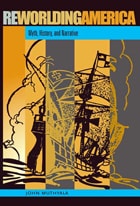
Reworlding America
Myth, History, and NarrativeJohn Muthyala
Ohio University Press, 2006
John Muthyala's Reworlding America moves beyond the U.S.-centered approach of traditional American literary criticism. In this groundbreaking book, Muthyala argues for a transgeographical perspective from which to study the literary and cultural histories of the Americas.
By emphasizing transnational migration, border crossing, and colonial modernity, Reworlding America exposes how national, ethnic, linguistic, religious, and cultural boundaries have been continually created and transgressed—with profound consequences for the peoples of the Americas.
Drawing from cultural studies, anthropology, literature, and history, Muthyala examines the literatures of the Americas in terms of their intimate relationship to questions of cultural survival, identity formation, and social power. He goes beyond nationalist, ethnocentric, and religious frameworks used to conceptualize American literary history and examines the connection between modernity and colonialism.
Reworlding America's significance extends into the realm of education, history, ethnography, and literary and cultural studies and contributes to the larger project of refashioning the role of English and American studies in a transborder, postnational global culture.
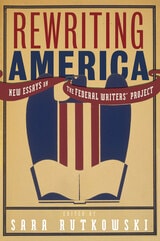
Rewriting America
New Essays on the Federal Writers' ProjectEdited by Sara Rutkowski
University of Massachusetts Press, 2022
Established in 1935, the Federal Writers’ Project (FWP) sent over 6,500 unemployed historians, teachers, writers, and librarians out to document America’s past and present in the midst of the Great Depression. The English poet W. H. Auden referred to this New Deal program as “one of the noblest and most absurd undertakings ever attempted by any state.”
Featuring original work by scholars from a range of disciplinary perspectives, this edited collection provides fresh insights into how this extraordinary program helped transform American culture. In addition to examining some of the major twentieth-century writers whose careers the FWP helped to launch—including Ralph Ellison, Richard Wright, and Margaret Walker—Rewriting America presents new perspectives on the role of African Americans, Mexican Americans, Asian Americans, and women on the project. Essays also address how the project’s goals continue to resonate with contemporary realities in the midst of major economic and cultural upheaval.
Along with the volume editor, contributors include Adam Arenson, Sue Rubenstein DeMasi, Racheal Harris, Jerrold Hirsch, Kathi King, Maiko Mine, Deborah Mutnick, Diane Noreen Rivera, Greg Robinson, Robert Singer, James Sun, and David A. Taylor.
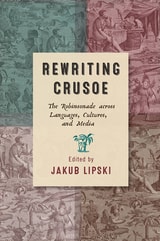
Rewriting Crusoe
The Robinsonade across Languages, Cultures, and MediaJakub Lipski
Bucknell University Press, 2020
Published by Bucknell University Press. Distributed worldwide by Rutgers University Press.
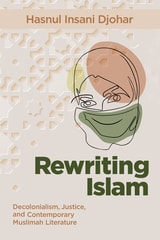
Rewriting Islam
Decolonialism, Justice, and Contemporary Muslimah LiteratureHasnul Insani Djohar
The Ohio State University Press, 2024
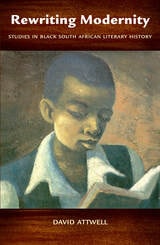
Rewriting Modernity
Studies in Black South African Literary HistoryDavid Attwell
Ohio University Press, 2006
Rewriting Modernity: Studies in Black South African Literary History connects the black literary archive in South Africa—from the nineteenth-century writing of Tiyo Soga to Zakes Mda in the twenty-first century—to international postcolonial studies via the theory of transculturation, a position adapted from the Cuban anthropologist Fernando Ortiz.
David Attwell provides a welcome complication of the linear black literary history—literature as a reflection of the process of political emancipation—that is so often presented. He focuses on cultural transactions in a series of key moments and argues that black writers in South Africa have used print culture to map themselves onto modernity as contemporary subjects, to negotiate, counteract, reinvent, and recast their positioning within colonialism, apartheid, and the context of democracy.
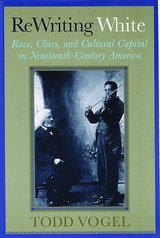
Rewriting White
Race, Class, and Cultural Capital in Nineteenth-Century AmericaTodd Vogel
Rutgers University Press, 2004
What did it mean for people of color in nineteenth-century America to speak or write "white"? More specifically, how many and what kinds of meaning could such "white" writing carry? In ReWriting White, Todd Vogel looks at how America has racialized language and aesthetic achievement. To make his point, he showcases the surprisingly complex interactions between four nineteenth-century writers of color and the "standard white English" they adapted for their own moral, political, and social ends. The African American, Native American, and Chinese American writers Vogel discusses delivered their messages in a manner that simultaneously demonstrated their command of the dominant discourse of their times-using styles and addressing forums considered above their station-and fashioned a subversive meaning in the very act of that demonstration.
The close readings and meticulous archival research in ReWriting White upend our conventional expectations, enrich our understanding of the dynamics of hegemony and cultural struggle, and contribute to the efforts of other cutting-edge contemporary scholars to chip away at the walls of racial segregation that have for too long defined and defaced the landscape of American literary and cultural studies.
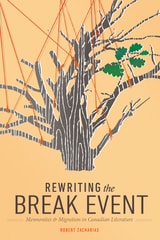
Rewriting the Break Event
Mennonites and Migration in Canadian LiteratureRobert Zacharias
University of Manitoba Press, 2013
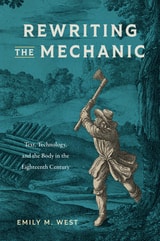
Rewriting the Mechanic
Text, Technology, and the Body in the Eighteenth CenturyEmily M. West
Bucknell University Press, 2027
In the eighteenth century, “technology” didn’t name a particular device or a process. It referred instead to written accounts of the mechanical arts, a now-obsolete category encompassing the wide range of work done by hand, from baking bread to building ships. Rewriting the Mechanic examines how these written descriptions, circulating across genres in eighteenth-century Britain, transformed certain mechanical arts by imagining them as newly innovative, authoritative, and able to make speculative possibilities real—as what we now call technological. Reversing the familiar story in which literature simply reflects technological change, West draws on the work of Robert Hooke, Aphra Behn, Daniel Defoe, Maria Edgeworth, and Jane Austen to demonstrate the influence of literary techniques on ideas about masculinity, power, and the body, and how these texts helped to bring the very idea of technological modernity into being.
Published by Bucknell University Press. Distributed worldwide by Rutgers University Press.
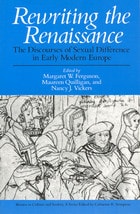
Rewriting the Renaissance
The Discourses of Sexual Difference in Early Modern EuropeEdited by Margaret W. Ferguson, Maureen Quilligan, and Nancy Vickers
University of Chicago Press, 1986
Throughout, the essays focus on the structures of Renaissance patriarchy that organized power relations both in the state and in the family. They explore the major conequences of patriarchy for women—their marginalization and lack of identity and power—and the ways in which individual women or groups of women broke, or in some cases deliberately circumvented, the rules that defined them as a secondary sex. Topics covered include representations of women in literature and art, the actual work done by women both inside and outside of the home, and the writings of women themselves. In analyzing the rhetorical strategies that "marginalized" historical and fictional women, these essays counter scholarly and critical traditions that continue to exhibit patriarchal biases.
Rhetoric and Resistance
The Literary Arts of Dissent in Nineteenth-Century BritainMaeve Adams
Ohio University Press, 2025
A fresh perspective on the enduring relationship between literature, democracy, and dissent
Rhetoric and Resistance explores the transformative role of nineteenth-century literature in shaping modern concepts and practices of democratic dissent. By examining the works of Romantic and Victorian novelists, poets, and journalists, Maeve Adams identifies origins of modern theories and practices of resistance in nineteenth-century literary forms. Offering a literary history of dissent, the book recovers the intertwined development of democracy and aesthetics, revealing how narrative form became a potent tool for challenging authority.
Tracing the lineage of dissent from the radical fiction and journalism of the 1800s to contemporary movements like #MeToo, Adams offers a genealogy that highlights how literary texts experimented with political power, granting new and consequential voices to working-class individuals, women, colonized peoples, and other marginalized groups.
Adams takes an interdisciplinary approach, weaving together close readings of works by Thomas De Quincey, Walter Scott, Elizabeth Gaskell, and H. G. Wells, as well as lesser-known journalists, with insights from modern moral and political philosophy. Drawing on theories of democratic ethics and justice from scholars such as Miranda Fricker, Sharon Krause, Martha Nussbaum, and Philip Pettit, the book bridges literary history and contemporary debates about political agency and expression.

Rhetoric in Antiquity
Laurent Pernot
Catholic University of America Press, 2005

Rhetoric, Science, and Magic in Seventeenth-century England
Ryan J. Stark
Catholic University of America Press, 2009
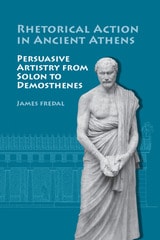
Rhetorical Action in Ancient Athens
Persuasive Artistry from Solon DemosthenesJames Fredal
Southern Illinois University Press, 2006
James Fredal’s wide-ranging survey examines the spatial and performative features of rhetorical artistry in ancient Athens from Solon to Demosthenes, demonstrating how persuasive skill depended not on written treatises, but on the reproduction of spaces and modes for masculine self-formation and displays of contests of character.
Studies of the history of rhetoric generally begin with Homer and Greek orality, then move on to fifth-century Sicily and the innovations of Corax, Tisias, and the older Sophists. While thorough and useful, these narratives privilege texts as the sole locus of proper rhetorical knowledge. Rhetorical Action in Ancient Greece:Persuasive Artistry from Solon to Demosthenes describes rhetoric as largely unwritten and rhetorical skill as closely associated with the ideologies and practices of gender formation and expression. In expanding the notion of rhetorical innovation to include mass movements, large social genres, and cultural practices—rather than the formulations of of individual thinkers and writers—Fredal offers a view of classical rhetoric as local and contingent, bound to the physical spaces, local histories, and cultural traditions of place.
Fredal argues that Greek rhetorical skill remained a function of local spaces like the Pnyx, social practices such as symposia or local meetings, cultural ideologies like those surrounding masculine friendship, and genres of performance such as how to act like a man, herald, sage, tyrant, or democrat. Citizen participation, he explains, was motivated by the desire to display masculine excellence in contests of character by overcoming fear and exerting symbolic and bodily control over self, situation, and audience. He shows how ancient Greek rhetoric employed patterns of “action” such as public oratory and performance to establish, reinforce, or challenge hierarchies and claims to political power.
Instead of examining speeches, handbooks, and theory, Rhetorical Action in Ancient Greece examines the origins of rhetoric in terms of performance. The result is a presentation of rhetorical knowledge as embodied in places and practices with spatial and practical logics that are rarely articulated in written discourse. The volume calls on archaeological, literary, and anthropological evidence about the rhetorical actions of Athens’s leading political agents—including Solon, Peisistratus, Cleisthenes, Demosthenes, and the anonymous “herm-choppers” of the Peloponnesian war—to demonstrate how each generation of political leaders adopted and transformed existing performance genres and spaces to address their own political exigency.
Rhetorics of Literacy
The Cultivation of American Dialect PoetryNadia Nurhussein
The Ohio State University Press, 2013
Rhymes in the Flow
How Rappers Flip the BeatMacklin Smith and Aurko Joshi
University of Michigan Press, 2020
Despite its global popularity, rap has received little scholarly attention in terms of its poetic features. Rhymes in the Flow systematically analyzes the poetics (rap beats, rhythms, rhymes, verse and song structures) of many notable rap songs to provide new insights on rap artistry and performance. Defining and describing the features of what rappers commonly call flow, the authors establish a theory of the rap line as they trace rap’s deepest roots and stylistic evolution—from Anglo-Saxon poetry to Lil Wayne—and contextualize its complex poetics. Rhymes in the Flow helps explain rap’s wide appeal by focusing primarily on its rhythmic and thematic power, while also claiming its historical, cultural, musical, and poetic importance.
Rhymin' and Stealin'
Musical Borrowing in Hip-HopJustin A. Williams
University of Michigan Press, 2014
Rhymin’ and Stealin’begins with a crucial premise: the fundamental element of hip-hop culture and aesthetics is the overt use of preexisting material to new ends. Whether it is taking an old dance move for a breakdancing battle, using spray paint to create street art, quoting from a famous speech, or sampling a rapper or 1970s funk song, hip-hop aesthetics involve borrowing from the past. By appropriating and reappropriating these elements, they become transformed into something new, something different, something hip-hop. Rhymin’ and Stealin’ is the first book-length study of musical borrowing in hip-hop music, which not only includes digital sampling but also demonstrates a wider web of references and quotations within the hip-hop world. Examples from Nas, Jay-Z, A Tribe Called Quest, Eminem, and many others show that the transformation of preexisting material is the fundamental element of hip-hop aesthetics. Although all music genres use and adapt preexisting material in different ways, hip-hop music celebrates and flaunts its “open source” culture through highly varied means. It is this interest in the web of references, borrowed material, and digitally sampled sounds that forms the basis of this book—sampling and other types of borrowing becomes a framework with which to analyze hip-hop music and wider cultural trends.
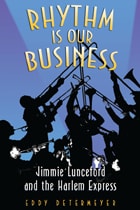
Rhythm Is Our Business
Jimmie Lunceford and the Harlem ExpressEddy Determeyer
University of Michigan Press, 2010
"The first detailed study of one of the swing era's most important bands and the first biography of its leader, Jimmie Lunceford. This is a most welcome and significant contribution to the literature of jazz, to our understanding of a vital period in jazz history, and to the music of an outstanding and unique ensemble that was emblematic of the swing era."
---Dan Morgenstern, Director, Institute of Jazz Studies, Rutgers University, and author of Living with Jazz
"We were more popular than Benny Goodman! We were the first black band that played the Paramount Theater, downtown New York. Not Duke Ellington, not Count Basie. Six weeks in a row, four or five shows daily, and it was packed every day, people lining up around the corner constantly! We could outdraw any band in the country."
---Gerald Wilson
"Jimmie Lunceford was a key swing-era figure, and no book covers his biography and music like this one does. Grounded in years of research and inspired by the writer's love of his subject, the book fills a critical gap in the jazz literature and will be essential reading for all swing aficionados."
---Jeffrey Magee, Associate Professor of Musicology, University of Illinois, Urbana-Champaign, and author of The Uncrowned King of Swing: Fletcher Henderson and Big Band Jazz
"It was Jimmie Lunceford and his orchestra that inspired me to become a musician. I was eleven years old at the time. When I heard that band play I said to myself, 'That's for me. I want to become a musician.' I still get inspired when I listen to some of their recordings. The Jimmie Lunceford Orchestra is one of the great jazz orchestras of all time."
---Horace Silver
"Jimmie Lunceford has the best of all bands. Duke is great, Basie is remarkable, but Lunceford tops them both."
---Glenn Miller
In the 1930s, swing music reigned, and the Jimmie Lunceford Orchestra was the hottest and hippest attraction on the black dance circuits. Known for its impeccable appearance and infectious rhythms, Lunceford's group was able to out-swing and outdraw any band. For ten consecutive years, they were the best-loved attraction at Harlem's famed Apollo Theater. The group's hit recordings sold in the hundreds of thousands, and Jimmie Lunceford's band rivaled Ellington's for popularity in the African American community.
Jimmie Lunceford was also an innovator, elevating big-band showmanship to an art and introducing such novel instruments as the electric guitar and bass. The band's arrangements, written by Sy Oliver, Edwin Wilcox, Gerald Wilson, Billy Moore, Jr., and Tadd Dameron, were daring and forward looking, influencing generations of big-band writers.
Rhythm Is Our Business traces the development of the Jimmie Lunceford Orchestra from its infant days as a high school band in Memphis to its record-breaking tours across the United States, Canada, and Europe. The book also unveils Lunceford's romantic yet ill-fated involvement with Yolande Du Bois, daughter of famous writer and opinion leader W.E.B. Du Bois. And by reconstructing Lunceford's last day, the book offers a glimpse into the mysteries surrounding the leader's untimely death. This is essential reading for anyone interested in the history and legacy of swing.
Eddy Determeyer has been a freelance music journalist for more than three decades. In 1984 Determeyer wrote a seven-part series on Jimmie Lunceford for the Dutch magazine Jazz Nu. Determeyer has written thousands of articles on music for a variety of Dutch publications and is the author of several books. He currently produces the Holiday for Hipsters radio show for Dutch station Concertzender.
Cover image: Lunceford brass section, ca. late 1936. Left to right: Paul Webster, Eddie Durham, Sy Oliver, Elmer Crumbley, Eddie Tompkins, Russell Bowles. (Bertil Lyttkens Collection)

Rhythmic Gesture in Mozart
Le Nozze di Figaro and Don GiovanniWye Jamison Allanbrook
University of Chicago Press, 1984
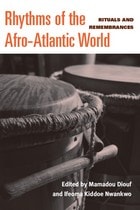
Rhythms of the Afro-Atlantic World
Rituals and RemembrancesEdited by Mamadou Diouf and Ifeoma Kiddoe Nwankwo
University of Michigan Press, 2010
"Collecting essays by fourteen expert contributors into a trans-oceanic celebration and critique, Mamadou Diouf and Ifeoma Kiddoe Nwankwo show how music, dance, and popular culture turn ways of remembering Africa into African ways of remembering. With a mix of Nuyorican, Cuban, Haitian, Kenyan, Senegalese, Trinidagonian, and Brazilian beats, Rhythms of the Afro-Atlantic World proves that the pleasures of poly-rhythm belong to the realm of the discursive as well as the sonic and the kinesthetic."
---Joseph Roach, Sterling Professor of Theater, Yale University
"As necessary as it is brilliant, Rhythms of the Afro-Atlantic World dances across, beyond, and within the Black Atlantic Diaspora with the aplomb and skill befitting its editors and contributors."
---Mark Anthony Neal, author of Soul Babies: Black Popular Culture and the Post-Soul Aesthetic
Along with linked modes of religiosity, music and dance have long occupied a central position in the ways in which Atlantic peoples have enacted, made sense of, and responded to their encounters with each other. This unique collection of essays connects nations from across the Atlantic---Senegal, Kenya, Trinidad, Cuba, Brazil, and the United States, among others---highlighting contemporary popular, folkloric, and religious music and dance. By tracking the continuous reframing, revision, and erasure of aural, oral, and corporeal traces, the contributors to Rhythms of the Afro-Atlantic World collectively argue that music and dance are the living evidence of a constant (re)composition and (re)mixing of local sounds and gestures.
Rhythms of the Afro-Atlantic World distinguishes itself as a collection focusing on the circulation of cultural forms across the Atlantic world, tracing the paths trod by a range of music and dance forms within, across, or beyond the variety of locales that constitute the Atlantic world. The editors and contributors do so, however, without assuming that these paths have been either always in line with national, regional, or continental boundaries or always transnational, transgressive, and perfectly hybrid/syncretic. This collection seeks to reorient the discourse on cultural forms moving in the Atlantic world by being attentive to the specifics of the forms---their specific geneses, the specific uses to which they are put by their creators and consumers, and the specific ways in which they travel or churn in place.
Mamadou Diouf is Leitner Family Professor of African Studies, Director of the Institute of African Studies, and Professor of History at Columbia University.
Ifeoma Kiddoe Nwankwo is Associate Professor of English at Vanderbilt University.
Jacket photograph by Elias Irizarry

Right to the Juke Joint
A Personal History of American MusicPatrick B Mullen
University of Illinois Press, 2018
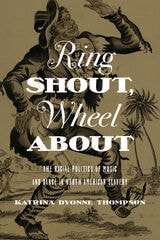
Ring Shout, Wheel About
The Racial Politics of Music and Dance in North American SlaveryKatrina D. Thompson
University of Illinois Press, 2014
In this ambitious project, historian Katrina Thompson examines the conceptualization and staging of race through the performance, sometimes coerced, of black dance from the slave ship to the minstrel stage. Drawing on a rich variety of sources, Thompson explicates how black musical performance was used by white Europeans and Americans to justify enslavement, perpetuate the existing racial hierarchy, and mask the brutality of the domestic slave trade. Whether on slave ships, at the auction block, or on plantations, whites often used coerced performances to oppress and demean the enslaved.
As Thompson shows, however, blacks' "backstage" use of musical performance often served quite a different purpose. Through creolization and other means, enslaved people preserved some native musical and dance traditions and invented or adopted new traditions that built community and even aided rebellion.
Thompson shows how these traditions evolved into nineteenth-century minstrelsy and, ultimately, raises the question of whether today's mass media performances and depictions of African Americans are so very far removed from their troublesome roots.
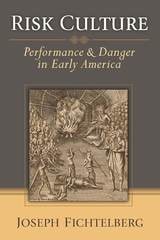
Risk Culture
Performance and Danger in Early AmericaJoseph Fichtelberg
University of Michigan Press, 2010
---David Shields, University of South Carolina

Ritual Humor in Highland Chiapas
By Victoria Reifler Bricker
University of Texas Press, 1973
Zinacantan, Chamula, and Chenalhó are neighboring Mayan communities situated in highland Chiapas, Mexico, near the city of San Cristóbal Las Casas. The inhabitants of the three communities speak dialects of the Tzotzil language. Five religious fiestas, celebrated by these communities in honor of their saints, provide the data for Victoria Bricker's comparative study of ritual humor.
In Chenalhó and Chamula performances of ritual humor are concentrated in the five-day period of a single fiesta, while in Zanacantan similar performances are distributed over threee fiestas. In these fiesta settings, performers in distinctive costumes make obscene and sacreligious remarks in the context of religious ritual. These performances are defined as ritual humor because they occur only in ritual settings.
Bricker's study constitutes a controlled cross-cultural comparison of ceremonial or ritual humor in its social and cultural setting. Much new information is provided in verbatim texts, recorded during actual fiesta performances. The study reveals that, although the three communities share a common pool of ritual symbols, they elaborate them differently in ritual humor. The study analyzes the symbolic expression of values, social organization, and interethnic relations.

River of Tears
Country Music, Memory, and Modernity in BrazilAlexander Sebastian Dent
Duke University Press, 2009
Since 1998, Alexander Sebastian Dent has analyzed rural music in the state of São Paulo, interviewing and spending time with listeners, musicians, songwriters, journalists, record-company owners, and radio hosts. Dent not only describes the production and reception of this music, he also explains why the genre experienced such tremendous growth as Brazil transitioned from an era of dictatorship to a period of intense neoliberal reform. Dent argues that rural genres reflect a widespread anxiety that change has been too radical and has come too fast. In defining their music as rural, Brazil’s country musicians—whose work circulates largely in cities—are criticizing an increasingly inescapable urban life characterized by suppressed emotions and an inattentiveness to the past. Their performances evoke a river of tears flowing through a landscape of loss—of love, of life in the countryside, and of man’s connections to the natural world.