Results by title
8642 books match the query '20th century' and 391 start with r
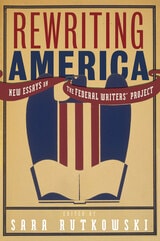
Rewriting America
New Essays on the Federal Writers' ProjectEdited by Sara Rutkowski
University of Massachusetts Press, 2022
Established in 1935, the Federal Writers’ Project (FWP) sent over 6,500 unemployed historians, teachers, writers, and librarians out to document America’s past and present in the midst of the Great Depression. The English poet W. H. Auden referred to this New Deal program as “one of the noblest and most absurd undertakings ever attempted by any state.”
Featuring original work by scholars from a range of disciplinary perspectives, this edited collection provides fresh insights into how this extraordinary program helped transform American culture. In addition to examining some of the major twentieth-century writers whose careers the FWP helped to launch—including Ralph Ellison, Richard Wright, and Margaret Walker—Rewriting America presents new perspectives on the role of African Americans, Mexican Americans, Asian Americans, and women on the project. Essays also address how the project’s goals continue to resonate with contemporary realities in the midst of major economic and cultural upheaval.
Along with the volume editor, contributors include Adam Arenson, Sue Rubenstein DeMasi, Racheal Harris, Jerrold Hirsch, Kathi King, Maiko Mine, Deborah Mutnick, Diane Noreen Rivera, Greg Robinson, Robert Singer, James Sun, and David A. Taylor.
Rewriting Crusoe
The Robinsonade across Languages, Cultures, and MediaJakub Lipski
Bucknell University Press, 2020
Published by Bucknell University Press. Distributed worldwide by Rutgers University Press.
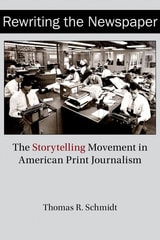
Rewriting the Newspaper
The Storytelling Movement in American Print JournalismThomas R. Schmidt
University of Missouri Press, 2020
Thomas Schmidt analyzes the expansion of narrative journalism and the corresponding institutional changes in the American newspaper industry in the last quarter of the twentieth century. In doing so, he offers the first institutionally situated history of narrative journalism’s evolution from the New Journalism of the 1960s to long-form literary journalism in the 1990s. Based on the analysis of primary sources, industry publications, and oral history interviews, this study traces how narrative techniques developed and spread through newsrooms, advanced by institutional initiatives and a growing network of practitioners, proponents, and writing coaches who mainstreamed the use of storytelling. Challenging the popular belief that it was only a few talented New York reporters (Tome Wolfe, Jimmy Breslin, Gay Talese, Joan Didion, and others) who revolutionized journalism by deciding to employ storytelling techniques in their writing, Schmidt shows that the evolution of narrative in late twentieth century American Journalism was more nuanced, more purposeful, and more institutionally based than the New Journalism myth suggests.
Rhetoric and Reality
Writing Instruction in American Colleges, 1900 - 1985James A. Berlin
Southern Illinois University Press, 1987
Berlin here continues his unique history of American college composition begun in his Writing Instruction in Nineteenth-Century Colleges (1984), turning now to the twentieth century.
In discussing the variety of rhetorics that have been used in writing classrooms Berlin introduces a taxonomy made up of three categories: objective rhetorics, subjective rhetorics, and transactional rhetorics, which are distinguished by the epistemology on which each is based. He makes clear that these categories are not tied to a chronology but instead are to be found in the English department in one form or another during each decade of the century.
His historical treatment includes an examination of the formation of the English department, the founding of the NCTE and its role in writing instruction, the training of teachers of writing, the effects of progressive education on writing instruction, the General Education Movement, the appearance of the CCCC, the impact of Sputnik, and today’s “literacy crisis.”
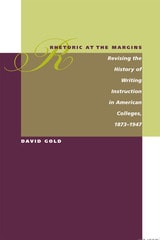
Rhetoric at the Margins
Revising the History of Writing Instruction in American Colleges, 1873-1947David Gold
Southern Illinois University Press, 2008
Rhetoric at the Margins: Revising the History of Writing Instruction in American Colleges, 1873-1947 examines the rhetorical education of African American, female, and working-class college students in the late nineteenth and early twentieth centuries. The rich case studies in this work encourage a reconceptualization of both the history of rhetoric and composition and the ways we make use of it.
Author David Gold uses archival materials to study three types of institutions historically underrepresented in disciplinary histories: a black liberal arts college in rural East Texas (Wiley College); a public women's college (Texas Woman's University); and an independent teacher training school (East Texas Normal College). The case studies complement and challenge previous disciplinary histories and suggest that the epistemological schema that have long applied to pedagogical practices may actually limit our understanding of those practices.
Gold argues that each of these schools championed intellectual and pedagogical traditions that differed from the Eastern liberal arts model—a model that often serves as the standard bearer for rhetorical education. He demonstrates that by emphasizing community uplift and civic participation and attending to local needs, these schools created contexts in which otherwise moribund curricular features of the era—such as strict classroom discipline and an emphasis on prescription—took on new possibilities.
Rhetoric at the Margins describes the recent revisionist turn in rhetoric and composition historiography, argues for the importance of diverse institutional microhistories, and argues that the nineteenth and early twentieth centuries offer rich lessons for contemporary classroom practice. The study brings alive the voices of black, female, rural, Southern, and first-generation college students and their instructors, effectively linking these histories to the history of rhetoric and writing. Appendices include excerpts of important and rarely seen primary source material, allowing readers to experience in fuller detail the voices captured in this work.
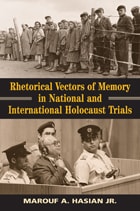
Rhetorical Vectors of Memory in National and International Holocaust Trials
Marouf A. Hasian Jr.
Michigan State University Press, 2006
During the past several decades, the twentieth century Holocaust has become a defining event in many histories. This newfound respect for the Judeocide has been cathartic for both individuals and communities, in that it provides evidence that audiences around the world are rethinking the significance of the World War II narratives of bystanders, perpetrators, and victims. Given the complexities of these issues, scholars who are interested in studying Holocaust memory make choices about the questions on which they focus, the artifacts they select for analysis, and the perspectives they want to present.
Hasian reviews how national and international courts have used Holocaust trials as forums for debates about individuated justice, historical record keeping, and pedagogical memory work. He concludes that the trials involving Auschwitz, Demjanjuk, Eichmann, Finta, Nuremberg, Irving, Kastner, Keegstra, Sawoniuk, and Zündel are highly problematic. The author provides a rhetorical analysis of holocaust trials as a way of looking into the question of what role court proceedings play in the creation of Holocaust collective memories.
Rhetorics of Exile
Emergent Cartographies of LiberationKate Siegfried
The Ohio State University Press, 2027
Rhetorics of Exile forwards the concept of rhetorical cartographies of liberation to offer an alternative history of the Cold War period. Exile, Kate Siegfried argues, is used as a powerful rhetorical practice that reveals alternative maps of power, resistance, and liberation. Drawing on archival research, she reveals how political insurgents from Paul Robeson to Gerry Adams leveraged experiences of exile and containment to advocate for the eradication of colonialism, imperialism, racialization, and global capitalism and to advance a vision of transnational solidarity that defied the hegemonic political and geographic binaries of the time. Examining movements and political figures across the globe, from Cuba to the American Black Belt, through southern Africa’s colonial borders, to China, Ireland, and elsewhere, Rhetorics of Exile reveals how seemingly disparate political ruptures during the second half of the twentieth century shaped an emergent world system. Siegfried not only broadens our view of Cold War–era social movements but also adapts rhetorical cartography to better account for racialized power dynamics—showing its applicability to understanding activism today.
Rhetorics of Literacy
The Cultivation of American Dialect PoetryNadia Nurhussein
The Ohio State University Press, 2013
Rhetorics of Motherhood
Lindal Buchanan
Southern Illinois University Press, 2013
Becoming a mother profoundly alters one’s perception of the world, as Lindal Buchanan learned firsthand when she gave birth. Suddenly attentive to representations of mothers and mothering in advertisements, fiction, film, art, education, and politics, she became intrigued by the persuasive force of the concept of motherhood, an interest that unleashed a host of questions: How is the construct defined? How are maternal appeals crafted, presented, and performed? What do they communicate about gender and power? How do they affect women? Her quest for answers has produced Rhetorics of Motherhood, the first book-length consideration of the topic through a feminist rhetorical lens.
Although both male and female rhetors employ motherhood to promote themselves and their agendas, Buchanan argues it is particularly slippery terrain for women—on the one hand, affording them authority and credibility but, on the other, positioning them disadvantageously within the gendered status quo. Rhetorics of Motherhood investigates that paradox by detailing the cultural construction and performance of the Mother in American public discourse, tracing its use and impact in three case studies, and by theorizing how, when, and why maternal discourses work to women’s benefit or detriment. In the process, the reader encounters a fascinating array of issues—including birth control, civil rights, and abortion—and rhetors, ranging from Diane Nash and Margaret Sanger to Sarah Palin and Michelle Obama.
As Buchanan makes clear, motherhood is a rich site for investigating the interrelationships among gender, power, and public discourse. Her latest book contributes to the discipline of rhetoric by attending to and making a convincing case for the significance of this understudied subject. With its examination of timely controversies, contemporary and historical figures, and powerful women, Rhetorics of Motherhood will appeal to a wide array of readers in rhetoric, communications, American studies, women’s studies, and beyond.
Richmond's Priests and Prophets
Race, Religion, and Social Change in the Civil Rights EraDouglas E. Thompson
University of Alabama Press, 2017
Douglas E. Thompson’s Richmond’s Priests and Prophets: Race, Religion, and Social Change in the Civil Rights Era presents a compelling study of religious leaders’ impact on the political progression of Richmond, Virginia, during the time of desegregation. Scrutinizing this city as an entry point into white Christians’ struggles with segregation during the 1950s, Thompson analyzes the internal tensions between ministers, the members of their churches, and an evolving world.
In the mid-twentieth-century American South, white Christians were challenged repeatedly by new ideas and social criteria. Neighborhood demographics were shifting, public schools were beginning to integrate, and ministers’ influence was expanding. Although many pastors supported the transition into desegregated society, the social pressure to keep life divided along racial lines placed Richmond’s ministers on a collision course with forces inside their own congregations. Thompson reveals that, to navigate the ideals of Christianity within a complex historical setting, white religious leaders adopted priestly and prophetic roles.
Moreover, the author argues that, until now, the historiography has not viewed white Christian churches with the nuance necessary to understand their diverse reactions to desegregation. His approach reveals the ways in which desegregationists attempted to change their communities’ minds, while also demonstrating why change came so slowly—highlighting the deeply emotional and intellectual dilemma of many southerners whose worldview was fundamentally structured by race and class hierarchies.
Riddle, Mystery, and Enigma
Two Hundred Years of British–Russian RelationsDavid Owen
Haus Publishing, 2022
With Riddle, Mystery, and Enigma, statesman and author David Owen tells the story of Britain’s relationship with Russia, which has been surprisingly underexplored. Through his characteristic insight and expertise, he depicts a relationship governed by principle as often as by suspicion, expediency, and necessity.
When the two nations formed a pragmatic alliance and fought together at the Battle of Navarino in Greece in 1827, it was overwhelmingly the work of the British prime minister, George Canning. His death brought about a drastic shift that would see the countries fighting on opposite sides in the Crimean War and jostling for power during the Great Game. It was not until the Russian Revolution of 1917 that another statesman had a defining impact on relations between Britain and Russia: Winston Churchill, who opposed Bolshevism yet never stopped advocating for diplomatic and military engagement with Russia. In the Second World War, he recognized early on the necessity of allying with the Soviets against the menace of Nazi Germany. Bringing us into the twenty-first century, Owen chronicles how both countries have responded to their geopolitical decline. Drawing on both imperial and Soviet history, he explains the unique nature of Putin’s autocracy and addresses Britain’s return to “blue water” diplomacy. Newly revised, this paperback edition features extended chapters on Putin’s Russia and the future of British–Russian relations after the Russo-Ukrainian War.
Riding Lucifer's Line
Ranger Deaths along the Texas-Mexico BorderBob Alexander
University of North Texas Press, 2013
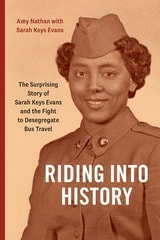
Riding into History
The Surprising Story of Sarah Keys Evans and the Fight to Desegregate Bus TravelAmy Nathan with Sarah Keys Evans
Duke University Press, 2026
Riding on Comets
A MemoirCat Pleska
West Virginia University Press, 2015
Riding on Comets is the true story of an only child growing up in a working-class family during the 1950s and ‘60s.
As the family storyteller, Cat Pleska whispers and shouts about her life growing up around savvy, strong women and hard-working, hard-drinking men. Unlike many family stories set within Appalachia, this story provides an uncommon glimpse into this region: not coal, but an aluminum plant; not hollers, but small-town America; not hillbillies, but a hard-working family with traditional values.
From the dinner table, to the back porch, to the sprawling countryside, Cat Pleska reveals the sometimes tender, sometimes frightening education of a child who listens at the knees of these giants. She mimics and learns every nuance, every rhythm—how they laugh, smoke, cuss, fight, love, and tell stories—as she unwittingly prepares to carry their tales forward, their words and actions forever etched in her mind. And finally, she discovers a life story of her own.
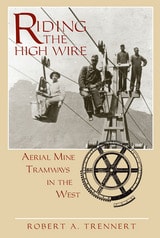
Riding the High Wire
Aerial Mine Tramways in the WestRobert A. Trennert
University Press of Colorado, 2001
Aerial mine tramways proved to have a special fascination; people often rode them for a thrill, sometimes with disastrous results. They were also very temperamental, needed constant attention, and were prone to accidents. The years between 1900 and 1920 saw the operation of some of the west's most spectacular tramways, but the decline in high-country mining beginning in the 1920s--coupled with the development of more efficient means of transportation--made this technology all but obsolete by the end of the Second World War.
Historians and the general reader will be equally enthralled by Trennert's fascinating story of the rise and fall of aerial mine tramways.
"Professor Trennert has explored a new area of mining history, and is to be commended for his pioneering work." --Liston Leyendecker, author of The Griffith Family and the Founding of Georgetown.
Right in Michigan's Grassroots
From the KKK to the Michigan MilitiaJoEllen McNergney Vinyard
University of Michigan Press, 2011
"A real contribution to Michigan history that gets to the root of the movements in twentieth-century American history that upon reflection can bring a certain discomfort and unease."
---Francis X. Blouin, Director of the Bentley Historical Library, University of Michigan
Throughout the twentieth century, Michigan became home to nearly every political movement in America that emerged from the grassroots. Citizens organized on behalf of concerns on the "left," on the "right," and in the "middle of the road." Right in Michigan's Grassroots: From the KKK to the Michigan Militia is about the people who supported movements that others, then and later, would denounce as disgraceful---members of the Ku Klux Klan during the 1920s, the followers of Father Charles Coughlin in the 1930s, anti-Communists and the John Birch Society in the post–World War II era, and the members of the Michigan Militia who first appeared in the 1990s.
The book explores the complex historical circumstances in Michigan that prompted the emergence of these organizations and led everyday men and women to head off, despite ridicule or condemnation, with plans unsanctioned and tactics unorthodox, variously brandishing weapons of intimidation, discrimination, fearmongering, and terror. Drawing heavily on primary sources, including the organizations' files and interviews with some of their leaders and surviving members, JoEllen Vinyard provides a far more complete portrait of these well-known extremist groups than has ever been available.
Righteous Revolutionaries
Morality, Mobilization, and Violence in the Making of the Chinese StateJeffrey A. Javed
University of Michigan Press, 2022
Righteous Revolutionaries argues that the Chinese Party-state simultaneously removed perceived threats to its authority at the grassroots and bolstered its legitimacy through a process called moral mobilization. This mobilization process created a moral boundary that designated a virtuous ingroup of “the masses” and a demonized outgroup of “class enemies,” mobilized the masses to participate in violence against this broadly defined outgroup, and strengthened this symbolic boundary by making the masses complicit in state violence. Righteous Revolutionaries shows how we can find traces of moral mobilization in China today under Xi Jinping’s rule. In an era where states and politicians regularly weaponize moral emotions to foment intergroup conflict and violence, understanding the dynamics of violent mobilization and state authority are more relevant than ever before.
Righting the American Dream
How the Media Mainstreamed Reagan's Evangelical VisionDiane Winston
University of Chicago Press, 2023
After two years in the White House, an aging and increasingly unpopular Ronald Reagan looked like a one-term president, but in 1983 something changed. Reagan spoke of his embattled agenda as a spiritual rather than a political project and cast his vision for limited government and market economics as the natural outworking of religious conviction. The news media broadcast this message with enthusiasm, and white evangelicals rallied to the president’s cause. With their support, Reagan won reelection and continued to dismantle the welfare state, unraveling a political consensus that stood for half a century.
In Righting the American Dream, Diane Winston reveals how support for Reagan emerged from a new religious vision of American identity circulating in the popular press. Through four key events—the “evil empire” speech, AIDS outbreak, invasion of Grenada, and rise in American poverty rates—Winston shows that many journalists uncritically adopted Reagan’s religious rhetoric and ultimately mainstreamed otherwise unpopular evangelical ideas about individual responsibility. The result is a provocative new account of how Reagan together with the press turned America to the right and initiated a social revolution that continues today.

Riot
Mary Casanova
University of Minnesota Press, 2014
Based on actual events from 1989 in International Falls, Minnesota, Riot tells the story of sixth-grader Bryan, whose family becomes stressed when nonunion labor “rats” are hired by the local paper mill, leaving his father, a union worker, angry and out of a job. Tension erupts into daily fights at school and nightly acts of vandalism with no solution in sight. Already torn between his parents’ opposing viewpoints on how to handle the escalating situation, Bryan’s growing feelings for the daughter of a nonunion worker only complicate matters.
Bryan tries to understand the turmoil affecting his home and his town, but it is becomes harder and harder to separate his friends from his enemies. And when he witnesses a violent act that implicates his father, he must wrestle with family loyalty and telling the truth.

Riot Report and the News
How the Kerner Commission Changed Media Coverage of Black AmericaHrach Thomas J
University of Massachusetts Press, 0
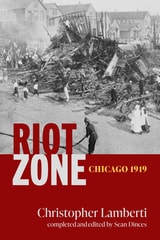
Riot Zone
Chicago 1919Christopher Lamberti, completed and edited by Sean Dinces
Temple University Press, 2027
Riot Zone presents a compelling forensic microhistory of the racial violence that exploded in Chicago starting on July 27, 1919, when a Black teenager named Eugene Williams drowned in Lake Michigan after white beachgoers attacked him as he swam with friends. In the days that followed, white gang members terrorized African Americans on the city’s South Side and Black Chicagoans armed and defended themselves in response. By the end of the first week of August, when the rioting finally ended, thirty-eight Chicagoans lay dead and hundreds nursed injuries as a result of what became known as America’s “Red Summer.”
The late Christopher Lamberti, with the help of editor Sean Dinces, recounts this sobering history using GIS software to map what occurred. The authors revisit and debunk ideas about the role race and ethnicity played in the riot and its aftermath, showing how the politics of housing and racial conflicts over residential space set the stage for the riots that ensued.
With insights that echo in today’s conflicts, Riot Zone proves that there is still plenty to learn about the history of America’s ongoing struggle with urban and racial violence.
Riot and Great Anger
Stage Censorship in Twentieth-Century IrelandJoan Fitzpatrick Dean
University of Wisconsin Press, 2010
Joan FitzPatrick Dean’s Riot and Great Anger suggests that while there was no state censorship in early-twentieth-century Ireland, the theater often evoked heated responses from theatergoers, sometimes resulting in riots and the public denunciation of playwrights and artists. Dean examines the plays that provoked these controversies, the degree to which they were "censored" by the audience or actors, and the range of responses from both the press and the courts. She addresses familiar pieces such as those of William Butler Yeats, John Millington Synge, and Sean O’Casey, as well as the works of less known playwrights such as George Birmingham. Dean’s original research meticulously analyzes Ireland’s great theatrical tradition, both on the stage and off, concluding that the public responses to these controversial productions reveal a country that, at century’s end as at its beginning, was pluralistic, heterogeneous, and complex.
Rise and Fall of the Cosmic Race
The Cult of Mestizaje in Latin AmericaBy Marilyn Grace Miller
University of Texas Press, 2004
Latin America is characterized by a uniquely rich history of cultural and racial mixtures known collectively as mestizaje. These mixtures reflect the influences of indigenous peoples from Latin America, Europeans, and Africans, and spawn a fascinating and often volatile blend of cultural practices and products. Yet no scholarly study to date has provided an articulate context for fully appreciating and exploring the profound effects of distinct local invocations of syncretism and hybridity. Rise and Fall of the Cosmic Race fills this void by charting the history of Latin America's experience of mestizaje through the prisms of literature, the visual and performing arts, social commentary, and music.
In accessible, jargon-free prose, Marilyn Grace Miller brings to life the varied perspectives of a vast region in a tour that stretches from Mexico and the Caribbean to Brazil, Ecuador and Argentina. She explores the repercussions of mestizo identity in the United States and reveals the key moments in the story of Latin America's cult of synthesis. Rise and Fall of the Cosmic Race examines the inextricable links between aesthetics and politics, and unravels the threads of colonialism woven throughout national narratives in which mestizos serve as primary protagonists.
Illuminating the ways in which regional engagements with mestizaje represent contentious sites of nation building and racial politics, Miller uncovers a rich and multivalent self-portrait of Latin America's diverse populations.
Risking Everything
A Freedom Summer ReaderMichael Edmonds
Wisconsin Historical Society Press, 2014
Risking Everything: A Freedom Summer Reader documents the 1964 Mississippi Freedom Summer Project, when SNCC and CORE workers and volunteers arrived in the Deep South to register voters and teach non-violence, and more than 60,000 black Mississippians risked everything to overturn a system that had brutally exploited them.
In the 44 original documents in this anthology, you’ll read their letters, eavesdrop on their meetings, shudder at their suffering, and admire their courage. You’ll witness the final hours of three workers murdered on the project’s first day, hear testimony by black residents who bravely stood up to police torture and Klan firebombs, and watch the liberal establishment betray them.
These vivid primary sources, collected by the Wisconsin Historical Society, provide both first-hand accounts of this astounding grassroots struggle as well as a broader understanding of the Civil Rights movement.
The selected documents are among the 25,000 pages about the Mississippi Freedom Summer Project in the archives of the Wisconsin Historical Society. The manuscripts were collected in the mid-1960s, at a time when few other institutions were interested in saving the stories of common people in McComb or Ruleville, Mississippi. Most have never been published before.
Risky Medicine
Our Quest to Cure Fear and UncertaintyRobert Aronowitz
University of Chicago Press, 2015
Exploring the transformation of health care over the last several decades that has led doctors to become more attentive to treating risk than treating symptoms or curing disease, Aronowitz shows how many aspects of the health system and clinical practice are now aimed at risk reduction and risk control. He argues that this transformation has been driven in part by the pharmaceutical industry, which benefits by promoting its products to the larger percentage of the population at risk for a particular illness, rather than the smaller percentage who are actually affected by it. Meanwhile, for those suffering from chronic illness, the experience of risk and disease has been conflated by medical practitioners who focus on anticipatory treatment as much if not more than on relieving suffering caused by disease. Drawing on such controversial examples as HPV vaccines, cancer screening programs, and the cancer survivorship movement, Aronowitz argues that patients and their doctors have come to believe, perilously, that far too many medical interventions are worthwhile because they promise to control our fears and reduce uncertainty.
Risky Medicine is a timely call for a skeptical response to medicine’s obsession with risk, as well as for higher standards of evidence for risk-reducing interventions and a rebalancing of health care to restore an emphasis on the actual curing of and caring for people suffering from disease.
Rite, Flesh, and Stone
The Matter of Death in Contemporary Spanish CultureAntonio Córdoba
Vanderbilt University Press, 2021
Materials analyzed here—ranging from cinematic and literary fictions, to historical archives and anthropological and ethnographic sources—make explicit a dynamic scenario where actors embody a variety of positions toward death and dying, the political production of mortality, and the commemoration of the dead. Ultimately, the goal of this volume is to chart the complex network in which the disenchantment of death and its reenchantment coexist, and biopolitical control over secularized bodies overlaps with new avatars of the religious and non-theistic desires for memorialization and transcendence.
Ritual Healing in Surburban America
McGuire, Meredith
Rutgers University Press, 1988

Ritual Medical Lore of Sephardic Women
Sweetening the Spirits, Healing the SickIsaac Jack Lévy and Rosemary Lévy Zumwalt
University of Illinois Press, 2002
Winner of the Ellii Kongas-Maranda Prize from the Women's Section of the American Folklore Society, 2003.
Ritual Medical Lore of Sephardic Women preserves the precious remnants of a rich culture on the verge of extinction while affirming women's pivotal role in the health of their communities. Centered around extensive interviews with elders of the Sephardic communities of the former Ottoman Empire, this volume illuminates a fascinating complex of preventive and curative rituals conducted by women at home--rituals that ensured the physical and spiritual well-being of the community and functioned as a vital counterpart to the public rites conducted by men in the synagogues.
Isaac Jack Lévy and Rosemary Lévy Zumwalt take us into the homes and families of Sephardim in Turkey, Israel, Greece, the former Yugoslavia, and the United States to unravel the ancient practices of domestic healing: the network of blessings and curses tailored to every occasion of daily life; the beliefs and customs surrounding mal ojo (evil eye), espanto (fright), and echizo (witchcraft); and cures involving everything from herbs, oil, and sugar to the powerful mumia (mummy) made from dried bones of corpses.
For the Sephardim, curing an illness required discovering its spiritual cause, which might be unintentional thought or speech, accident, or magical incantation. The healing rituals of domesticated medicine provided a way of making sense of illness and a way of shaping behavior to fit the narrow constraints of a tightly structured community. Tapping a rich and irreplaceable vein of oral testimony, Ritual Medical Lore of Sephardic Women offers fascinating insight into a culture where profound spirituality permeated every aspect of daily life.
Ritual, Myth, and Mysticism in the Work of Mary Butts
Between Feminism and ModernismFOY ROSLYN
University of Arkansas Press, 2000
Rituals and Ceremonies in Popular Culture
Edited by Ray B. Browne
University of Wisconsin Press, 1980
Rivers in Russian Literature
Margaret Ziolkowski
University of Delaware Press, 2011
Published by University of Delaware Press. Distributed worldwide by Rutgers University Press.
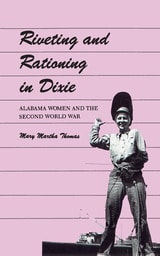
Riveting and Rationing in Dixie
Alabama Women and the Second World WarMary Martha Thomas
University of Alabama Press, 1987
Covers the experience of both black and white Alabama women as defense workers, volunteers, and homemakers. The most important change for women during the war years was their employment in jobs normally held by men, which posed an implicit challenge to traditional notions about femininity and female limitations.
Thomas describes the women employed in the defense industries—how they were recruited and trained, where they worked and under what conditions, and what changes employers made in the workplace to accommodate women, She also discusses the experience of the women who served as volunteers in the Ground Observer Corps, the Citizens’ Service Corps, the Red Cross, and other volunteer agencies. In addition, the author considers how homemakers coped during a time of rationing, housing shortages, lack of schools, and inadequate medical facilities.
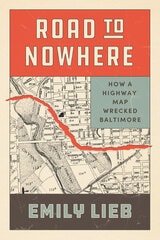
Road to Nowhere
How a Highway Map Wrecked BaltimoreEmily Lieb
University of Chicago Press, 2025
In the mid-1950s Baltimore’s Rosemont neighborhood was alive and vibrant with smart rowhouses, a sprawling park, corner grocery stores, and doctor’s offices. By 1957, a proposed expressway threatened to gut this Black, middle-class community from stem to stern.
That highway was never built, but it didn’t matter—even the failure to build it destroyed Rosemont economically, if not physically. In telling the history of the neighborhood and the notional East–West Expressway, Emily Lieb shows the interwoven tragedies caused by racism in education, housing, and transportation policy. Black families had been attracted to the neighborhood after Baltimore’s Board of School Commissioners converted several white schools into “colored” ones, which had also laid the groundwork for predatory real-estate agents who bought low from white sellers and sold high to determined Black buyers. Despite financial discrimination, Black homeowners built a thriving community before the city council formally voted to condemn some nine hundred homes in Rosemont for the expressway, leading to deflated home values and even more predatory real estate deals.
Drawing on land records, oral history, media coverage, and policy documents, Lieb demystifies blockbusting, redlining, and prejudicial lending, highlighting the national patterns at work in a single neighborhood. The result is an absorbing story about the deliberate decisions that produced racial inequalities in housing, jobs, health, and wealth—as well as a testament to the ingenuity of the residents who fought to stay in their homes, down to today.

Road-Book America
Contemporary Culture and the New PicaresqueRowland A. Sherrill
University of Illinois Press, 2000
Road-Book America discloses how the old picaresque tradition, embodied in such novels as Henry Fielding's Tom Jones and Daniel Defoe's Moll Flanders, opens to include a number of new American texts, both fiction and nonfiction, that decisively share the characterizing form. Sherrill's discussion encompasses hundreds of American narratives published in the past four decades, including such examples of the genre as William Least Heat-Moon's Blue Highways, John Steinbeck's Travels with Charley, James Leo Herlihy's Midnight Cowboy, Bill Moyers's Listening to America, and E. L. Doctorow's Billy Bathgate.
Sketching the socially marginal, ingenuous, traveling characters common to both old and new versions, Sherrill shows how the "new American picaresque" transforms the satirical aims of the original into an effort to map and catalog the immensity and variety of America.
Open, resilient, perennially hopeful, and endowed with a protean adaptability, the protagonist of the new American picaresque follows a therapeutic path for the alienated modern self. Mining the relevance of the reformulated picaresque for American life, Road-Book America shows how this old form, adaptable as the picaro himself, lays the groundwork for spiritual renewal and a restoration of cultural confidence in some old ways of being American.
Roads of Excess, Palaces of Wisdom
Eroticism and Reflexivity in the Study of MysticismJeffrey J. Kripal
University of Chicago Press, 2001
In his new book, Kripal addresses the twentieth-century study of mysticism as a kind of mystical tradition in its own right, with its own unique histories, discourses, sociological dynamics, and rhetorics of secrecy. Fluidly combining autobiography and biography with scholarly exploration, Kripal takes us on a tour of comparative mystical thought by examining the lives and works of five major historians of mysticism—Evelyn Underhill, Louis Massignon, R. C. Zaehner, Agehananda Bharati, and Elliot Wolfson—as well as relating his own mystical experiences. The result, Kripal finds, is seven "palaces of wisdom": the religious power of excess, the necessity of distance in the study of mysticism, the relationship between the mystical and art, the dilemmas of male subjectivity and modern heterosexuality, a call for ethical criticism, the paradox of the insider-outsider problem in the study of religion, and the magical power of texts and their interpretation.
An original and penetrating analysis of modern scholarship and scholars of mysticism, Roads of Excess, Palaces of Wisdom is also a persuasive demonstration of the way this scholarly activity is itself a mystical phenomenon.
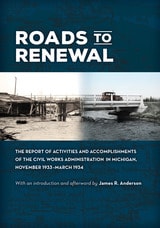
Roads to Renewal
The Report of Activities and Accomplishments of the Civil Works Administration in Michigan, November 1933–March 1934James R. Anderson
Michigan State University Press, 2020
Robert Ashley
Kyle Gann
University of Illinois Press, 2012
Robert C. Byrd
Child of the Appalachian CoalfieldsRobert C. Byrd
West Virginia University Press, 2010
This autobiography follows United States Senator Robert C. Byrd’s experiences from his boyhood in the early 1920s to his election in 2000, which won him an unprecedented eighth term in the Senate. Along the way, Senator Byrd offers commentary on national and international events that occurred throughout his long life in public service. Senator Byrd’s journey from the hardscrabble coalfields to the marbled halls of Congress has inspired generations of people in West Virginia and throughout the nation. From reading the stories of the Founding Fathers as a young boy by the light of a kerosene lamp to the swearing of an oath for more than a half-century to guard the United States Constitution, Senator Byrd’s life is legendary. Byrd always stands by his principles, earning the affection of the people of his home state and the respect of Americans from all walks of life. With his beloved Erma ever by his side, Robert C. Byrd has never forgotten his roots, harkening back to those early lessons that he learned as a child of the Appalachian coalfields.
Robert C. Byrd
Child of the Appalachian CoalfieldsROBERT C. BYRD
West Virginia University Press, 2015
This autobiography follows West Virginia senator Robert C. Byrd’s experiences from his boyhood in the early 1920s to his election in 2000, which won him an unprecedented eighth term in the Senate. Within these pages, Senator Byrd offers commentary on national and international events that occurred throughout his long life in public service.
His journey from the hardscrabble coalfields to the marbled halls of Congress has inspired generations of people in West Virginia and throughout the nation. From reading the stories of the Founding Fathers as a young boy by the light of a kerosene lamp to the swearing of an oath for more than a half-century to guard the US Constitution, Senator Byrd’s life is legendary.
Until his death on June 28, 2010, Byrd stood by his principles, earning the affection of the people of his home state and the respect of Americans from all walks of life. With his beloved Erma ever by his side, Robert C. Byrd never forgot his roots, harkening back to those early lessons that he learned as a child of the Appalachian coalfields.
This new paperback edition includes a foreword by Gaston Caperton, governor of West Virginia from 1989–1997.
Robert Clifton Weaver and the American City
The Life and Times of an Urban ReformerWendell E. Pritchett
University of Chicago Press, 2008
Tracing Weaver’s career through the creation, expansion, and contraction of New Deal liberalism, Wendell E. Pritchett illuminates his instrumental role in the birth of almost every urban initiative of the period, from public housing and urban renewal to affirmative action and rent control. Beyond these policy achievements, Weaver also founded racial liberalism, a new approach to race relations that propelled him through a series of high-level positions in public and private agencies working to promote racial cooperation in American cities. But Pritchett shows that despite Weaver’s efforts to make race irrelevant, white and black Americans continued to call on him to mediate between the races—a position that grew increasingly untenable as Weaver remained caught between the white power structure to which he pledged his allegiance and the African Americans whose lives he devoted his career to improving.
Robert E. Sherwood
The Playwright in Peace and WarHarriet Hyman Alonso
University of Massachusetts Press, 2007
One of the nation's first film critics, an acclaimed speechwriter on his own and for President Franklin D. Roosevelt, a propagandist during World War II, and a leading producer on Broadway, Robert E. Sherwood scripted some of the most popular plays and films of his day, including Waterloo Bridge, The Best Years of Our Lives, Idiot's Delight, Abe Lincoln in Illinois, and Rebecca. His work brought him four Pulitzer Prizes and an Oscar. In his personal life, however, he was driven by a deep conviction that war was a societal evil that must be eradicated and human rights a moral responsibility that all governments should protect. At times, his belief in pacifism and his commitment to defending freedom and justice came into conflict with each other, causing frustration and emotional trauma which found their way into his writings and actions.
In this book, Harriet Hyman Alonso unravels Sherwood's inner struggle and portrays his political journey. Relying largely on his letters, diaries, plays, films, essays, and biography of Roosevelt and Harry Hopkins, she traces Sherwood's obsession with the world of politics and its effects on his life and art, from his experience as a soldier in World War I to the Cold War. She also describes his participation in the Algonquin Round Table, his friendships and working relationships with such notables as Alfred Lunt, Lynn Fontanne, Edna Ferber, Spencer Tracy, Harry Hopkins, and Franklin D. Roosevelt, his two marriages and uneasy relationship with his daughter, and his leadership role in the Broadway community.
Alonso brings together history, theater and film studies, and peace studies in this interdisciplinary political biography. In the process, she illuminates major currents in U.S. foreign policy, society, and culture from 1896 to 1955—the years of the remarkable life of Robert E. Sherwood.
Robert Frost and Feminine Literary Tradition
Karen L. Kilcup
University of Michigan Press, 1998
Robert Frost and the Challenge of Darwin
Robert Faggen
University of Michigan Press, 2001
Combining both intellectual history and detailed analysis of Frost's poems, Robert Faggen shows how Frost's reading of Darwin reflected the significance of science in American culture from Emerson and Thoreau, through James and pragmatism. He provides fresh and provocative readings of many of Frost's shorter lyrics and longer pastoral narratives as they illustrate the impact of Darwinian thought on the concept of nature, with particular exploration of man's relationship to other creatures, the conditions of human equality and racial conflict, the impact of gender and sexual differences, and the survival of religion.
The book shows that Frost was neither a pessimist lamenting the uncertainties of the Darwinian worldview, nor a humanist opposing its power. Faggen draws on Frost's unpublished notebooks to reveal a complex thinker who willingly engaged with the difficult moral and epistemological implications of natural science, and showed their consonance with myths and traditions stretching back to Milton, Lucretius, and the Old Testament. Frost emerges as a thinker for whom poetry was not only artistic expression, but also a forum for the trial of ideas and their impact on humanity.
Robert Frost and the Challenge of Darwin provides a deeper understanding not only of Frost and modern poetry, but of the meaning of Darwin in the modern world, the complex interrelations of literature and science, and the history of American thought.
"A forceful, appealing study of the Frost-Darwin relation, which has gone little noted by previous scholars, and a fresh explanation of Frost's ambivalent relation to modernism, which he scorned but also influenced" --William Howarth, Princeton University
Robert Faggen is Associate Professor of Literature, Claremont McKenna College and Adjunct Associate Professor, Claremont Graduate School.
Robert Hayden in Verse
New Histories of African American Poetry and the Black Arts EraDerik Smith
University of Michigan Press, 2018
This book sheds new light on the work of Robert Hayden (1913–80) in response to changing literary scholarship. While Hayden’s poetry often reflected aspects of the African American experience, he resisted attempts to categorize his poetry in racial terms. This fresh appreciation of Hayden’s work recontextualizes his achievements against the backdrop of the Black Arts Movement and traces his influence on contemporary African American poets. Placing Hayden at the heart of a history of African American poetry and culture spanning the Harlem Renaissance to the Hip-Hop era, the book explains why Hayden is now a canonical figure in 20th-century American literature.
In deep readings that focus on Hayden’s religiousness, class consciousness, and historical vision, author Derik Smith inverts earlier scholarly accounts that figure Hayden as an outsider at odds with the militancy of the Black Arts movement. Robert Hayden in Verse offers detailed descriptions of the poet’s vigorous contributions to 1960s discourse about art, modernity, and blackness to show that the poet was, in fact, an earnest participant in Black Arts-era political and aesthetic debates.
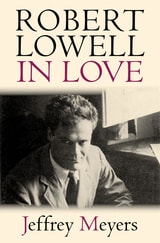
Robert Lowell in Love
Jeffrey Meyers
University of Massachusetts Press, 2016
Lowell's charismatic personality, compelling poetry, and literary fame attracted lovers and friends who were both frightened and excited by his aura of brilliance and danger. He loved the idea of falling in love, and in his recurring manic episodes he needed women at the center of his emotional and artistic life. Each affair became an intense dramatic episode. Though he idealized his loves and encouraged their talents, his frenetic affairs and tortured marriages were always conducted on his own terms. Robert Lowell in Love tells the story of the poet in the grip of love and gives voice to the women who loved him, inspired his poetry, and suffered along with him.
Robert Lowell's Life and Work
Damaged GrandeurRichard Tillinghast, Editor
University of Michigan Press, 1995
Robinson Crusoe after 300 Years
Andreas K. E. Mueller
Bucknell University Press, 2021
Robo Sacer
Necroliberalism and Cyborg Resistance in Mexican and Chicanx DystopiasDavid S. Dalton
Vanderbilt University Press, 2023
Harvey L. Johnson Publication Award, Southwest Council of Latin American Studies, 2026
Premio Alambique, Alambique: Revista Académica de Ciencia Ficción y Fantasía, 2025
Robo Sacer engages the digital humanities, critical race theory, border studies, biopolitical theory, and necropolitical theory to interrogate how technology has been used to oppress people of Mexican descent—both within Mexico and in the United States—since the advent of the North American Free Trade Agreement (NAFTA) in 1994. As the book argues, robo-sacer identity emerges as transnational flows of bodies, capital, and technology become an institutionalized state of exception that relegates people from marginalized communities to the periphery.
And yet the same technology can be utilized by the oppressed in the service of resistance. The texts studied here represent speculative stories about this technological empowerment. These texts theorize different means of techno-resistance to key realities that have emerged within Mexican and Chicano/a/x communities under the rise and reign of neoliberalism. The first three chapters deal with dehumanization, the trafficking of death, and unbalanced access to technology. The final two chapters deal with the major forms of violence—feminicide and drug-related violence—that have grown exponentially in Mexico with the rise of neoliberalism. These stories theorize the role of technology both in oppressing and in providing the subaltern with necessary tools for resistance.
Robo Sacer builds on the previous studies of Sayak Valencia, Irmgard Emmelhainz, Guy Emerson, Achille Mbembe, and of course Giorgio Agamben, but it differentiates itself from them through its theorization on how technology—and particularly cyborg subjectivity—can amend the reigning biopolitical and necropolitical structures of power in potentially liberatory ways. Robo Sacer shows how the cyborg can denaturalize constructs of zoē by providing an outlet through which the oppressed can tell their stories, thus imbuing the oppressed with the power to combat imperialist forces.
Rock 'n' Roll Movies
Sterritt, David
Rutgers University Press, 2018
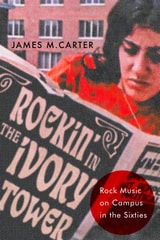
Rockin' in the Ivory Tower
Rock Music on Campus in the SixtiesJames M. Carter
Rutgers University Press, 2023
Histories of American rock music and the 1960s counterculture typically focus on the same few places: Woodstock, Monterey, Altamont. Yet there was also a very active college circuit that brought edgy acts like the Jefferson Airplane and the Velvet Underground to different metropolitan regions and smaller towns all over the country. These campus concerts were often programmed, promoted, and reviewed by students themselves, and their diverse tastes challenged narrow definitions of rock music.
Rockin’ in the Ivory Tower takes a close look at two smaller universities, Drew in New Jersey and Stony Brook on Long Island, to see how the culture of rock music played an integral role in student life in the late 1960s. Analyzing campus archives and college newspapers, historian James Carter traces connections between rock fandom and the civil rights protests, free speech activism, radical ideas, lifestyle transformations, and anti-war movements that revolutionized universities in the 1960s. Furthermore, he finds that these progressive students refused to segregate genres like folk, R&B, hard rock, and pop. Rockin’ in the Ivory Tower gives readers a front-row seat to a dynamic time for the music industry, countercultural politics, and youth culture.