Results by title
8113 books match the query 'Literary Criticism' and 415 start with r
Revising the Clinic
Vision and Representation in Victorian Medical Narrative and the NovelMeegan Kennedy
The Ohio State University Press, 2010
Critics have examined how novelists borrow from other genres—newspapers, legal cases, autobiographies. Medical writing likewise enriches the novel’s uniquely flexible and wide-ranging presentation of Victorian culture. In turn, the novel shapes medical narrative even as clinical science idealizes methodological rigor. Revising the Clinic shows how the wealth of scientific material in mainstream Victorian periodicals creates a productive literary “commons” where novelists and physicians can encounter each others’ strategies for seeing and stating. Novelists adapt physicians’ techniques to nonmedical scenes, and physicians echo the sentimental or sensational novel to gain sympathy or rhetorical force when medical knowledge falters.
Kennedy traces the development of the Victorian novel and the case history from eighteenth-century curious observation and curious sights through nineteenth-century clinical observation, mechanical observation, and speculation, to Freud’s labyrinthine mapping and speculative insight. These make new sense, read within the literary tradition of the case history. The lens of Kennedy’s argument clarifies and illuminates the preoccupation with genre and visuality that is common to Victorian medicine and the novel.

Revising the Word and the World
Essays in Feminist Literary CriticismEdited by Vèvè A. Clark, Ruth-Ellen Boetcher Joeres, and Madelon Sprengnether
University of Chicago Press, 1993
Three powerful interviews with writers of different nationalities (Audre Lorde, Simone de Beauvoir, and Carmen Naranjo) introduce topics echoed in the essays that follow: the interplay between women's writing and feminist theory, the politics of writing, and the roles of race, class, and sexual orientation in artistic production. These issues are engaged on a theoretical level by three essays that represent today's most prominent areas of concern for feminist literary criticism. The theoretical perspectives advanced in this anthology provide models for reading the traditional expressions of women worldwide including oratory and performance as well as literature in the more conventional sense.
Contributors include Jane Flax on "Postmodernism and Gender Relations in Feminist Theory," Evelyn Brooks Higginbotham on "African-American Women's History and the Metalanguage of Race," Paula Bennett on "Female Sexual Imagery and Feminist Psychoanalytic Theory," Leslie Rabine on "Social Gender and Symbolic Gender in the Writings of Maxine Hong Kingston," Joyce Zonana on "Feminist Orientalism and the Structure of Jane Eyre," Jane Desmond on "Cultural Imperialism and Ruth St. Denis's 'Radha' of 1906," Terri Brint Joseph on "Poetry as a Strategy of Power: The Case of Riffian Berber Women," Chikwenye Ogunyemi on "The Contemporary Black Female Novel in English," and Sandra Zagarell on "Narrative of Community."
This collection is especially appropriate for scholars and students of feminist literary criticism, women's studies, English, and ethnic studies.
Essays were originally published in Signs: Journal of Women in Culture and Society.
Revisionary Interventions into the Americanist Canon
Donald E. Pease
Duke University Press, 1994
Originally published as a special issue of boundary 2, the essays gathered here discuss writers as diverse as Kate Chopin, Frederick Douglass, Emerson, Melville, W. D. Howells, Henry James, W. E. B. DuBois, and Mark Twain, plus the historical figure John Brown. Two major sections devoted to the theory of romance and to cultural-historical analyses emphasize the political perspective of "New Americanist" literary and cultural study.
Contributors. William E. Cain, Wai-chee Dimock, Howard Horwitz, Gregory S. Jay, Steven Mailloux, John McWilliams, Susan Mizruchi, Donald E. Pease, Ivy Schweitzer, Priscilla Wald, Michael Warner, Robert Weimann
Revisiting Racialized Voice
African American Ethos in Language and LiteratureDavid G. Holmes
Southern Illinois University Press, 2004
Revisiting Racialized Voice:African American Ethos in Language and Literature argues that past misconceptions about black identity and voice, codified from the 1870s through the 1920s, inform contemporary assumptions about African American authorship and ethos. Tracing elements of racial consciousness in the works of Frederick Douglass, Charles Chesnutt, W. E. B. DuBois, Zora Neale Hurston, and others, David G. Holmes urges a revisiting of narratives from this period to strengthen and advance notions about racialized writing and to shape contemporary composition pedagogies.
Pointing to the intersection of African American identity, literature, and rhetoric, Revisiting Racialized Voice begins to construct rhetorically workable yet ideologically flexible definitions of black voice. Holmes maintains that political pressure to embrace“color blindness” endangers scholars’ ability to uncover links between racialized discourses of the past and those of the present, and he calls instead for a reassessment of the material realities and theoretical assumptions race represents and with which it has been associated.
Revisiting Richardson
Rebecca Anne Barr
Bucknell University Press, 2025
Published by Bucknell University Press. Distributed by Rutgers University Press.
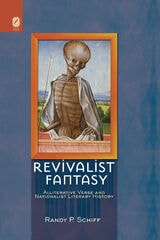
Revivalist Fantasy
Alliterative Verse and Nationalist Literary HistoryRandy P. Schiff
The Ohio State University Press, 2011
Schiff revises readings of alliterative poetry as Francophobic, exploring the transnational imperialist elitism in the translation William of Palerne. He contributes to the discussion of gender in Sir Gawain and the Green Knight by linking the poem’s powerful female players with anxieties about women’s control of wealth and property in militarized regions of England. The book also explores the emphatically pre-national, borderlands sensibilities informing the Awntyrs off Arthure and Golagros and Gawane, and it examines the exploitation of collaborative composition in the material legacy of the Piers Plowman tradition.
Revivalist Fantasy concludes that Revivalist nationalism obscures crucial continuities between late-medieval and post-national worlds and that critics’ interests should be channeled into the forging of connections between past and present rather than suspended in the scholarly pursuit of origins. The book will be of interest to scholars of editorial history and translation studies and to those interested in manuscript studies.
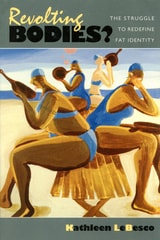
Revolting Bodies?
The Struggle to Redefine Fat IdentityKathleen LeBesco
University of Massachusetts Press, 2004
Viewed as both unhealthy and unattractive, fat people are widely represented in popular culture and in interpersonal interactions as revolting—as agents of abhorrence and disgust. Yet if we think about “revolting” in a different way, Kathleen LeBesco argues, we can recognize fatness as not simply an aesthetic state or a medical condition, but a political one. If we think of revolting in terms of overthrowing authority, rebelling, protesting, and rejecting, then corpulence carries a whole new weight as a subversive cultural practice that calls into question received notions about health, beauty, and nature.
Revolting Bodies examines a number of sites of struggle over the cultural meaning of fatness. The book is grounded in scholarship on identity politics, the social construction of beauty, and the subversion of hegemonic medical ideas about the dangers of fatness. It explains how the redefinition of fat identities has been undertaken by people who challenge conventional understandings of nature, health, and beauty and, in so doing, alter their individual and collective relationships to power.
LeBesco explores how the bearer of a fat body is marked as a failed citizen, inasmuch as her powers as a worker, shopper, and sexually “desirable” subject are called into question. At the same time, she highlights fat fashion, relations among fat, queer, and disability politics and activism, and online communities as opportunities for transforming these pejorative stereotypes of fatness. Her discussion of the long-term ramifications of denying bodily agency—in effect, letting biological determinism run rampant—has implications not only for our understanding of fatness but also for future political practice.
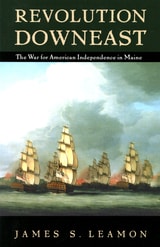
Revolution Downeast
The War for American Independence in MaineJames S. Leamon
University of Massachusetts Press, 1993
The history of the Revolution in Maine is the story of a people who did not really want a revolution—at least at first.
Since the middle of the seventeenth century, the powerful Massachusetts Bay Colony had exercised an increasing hegemony over the settlements downeast—a hegemony legalized in the Massachusetts royal charter of 1691. From then until 1820, when it became a state, Maine remained an integral part of Massachusetts. Geographically isolated from the Bay Colony by the province of New Hampshire, and dependent on Massachusetts for its very existence, Maine was indeed a colony, in every sense of the word.
The larger Massachusetts context has tended to obscure Maine as a legitimate object of study, nowhere more than in the period of the American Revolution. Even historians in Maine have slighted the period of the American Revolution. Where appropriate, town historians devote a chapter or so to the event, but only in the context of a particular community.
In his book, Leamon aims to meet that deficiency by drawing together town and general histories, specialized studies, and primary sources, both published and unpublished. He examines why and how Maine fought the Revolution and the changes that occurred in Maine during and after the war.
Revolution and Its Narratives
China's Socialist Literary and Cultural Imaginaries, 1949-1966Cai Xiang
Duke University Press, 2016
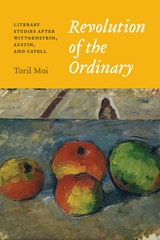
Revolution of the Ordinary
Literary Studies after Wittgenstein, Austin, and CavellToril Moi
University of Chicago Press, 2017
Moi first introduces Wittgenstein’s vision of language and theory, which refuses to reduce language to a matter of naming or representation, considers theory’s desire for generality doomed to failure, and brings out the philosophical power of the particular case. Contrasting ordinary language philosophy with dominant strands of Saussurean and post-Saussurean thought, she highlights the former’s originality, critical power, and potential for creative use. Finally, she challenges the belief that good critics always read below the surface, proposing instead an innovative view of texts as expression and action, and of reading as an act of acknowledgment. Intervening in cutting-edge debates while bringing Wittgenstein, Austin, and Cavell to new readers, Revolution of the Ordinary will appeal beyond literary studies to anyone looking for a philosophically serious account of why words matter.
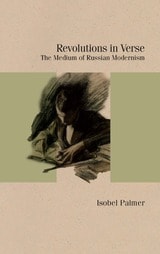
Revolutions in Verse
The Medium of Russian ModernismIsobel Palmer
Northwestern University Press, 2025
How modernist interartistic experimentation and the proliferation of new media technologies inspired fresh insights into poetry
Isobel Palmer spotlights Russian modernist poets’ and formalist theorists’ conscious engagement with formal convention, showing how their efforts were tied up with broader attempts in the early Soviet era to understand and articulate the nature of poetry and its most characteristic devices. Returning to critical debates around poetic encounters with three key aesthetic categories—rhythm, image, and voice—Palmer unpacks the period’s deeper interest in the material bases of poetic speech itself. Through fresh, incisive readings of canonical poets and theorists, from Andrei Bely and Vladimir Mayakovsky to Yury Tynianov and Viktor Shklovsky, Revolutions in Verse: The Medium of Russian Modernism explores the proliferation of interartistic experiments and the emergence of new media technologies that made poetry visible as a medium in its own right.
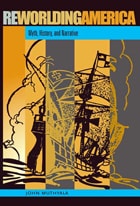
Reworlding America
Myth, History, and NarrativeJohn Muthyala
Ohio University Press, 2006
John Muthyala's Reworlding America moves beyond the U.S.-centered approach of traditional American literary criticism. In this groundbreaking book, Muthyala argues for a transgeographical perspective from which to study the literary and cultural histories of the Americas.
By emphasizing transnational migration, border crossing, and colonial modernity, Reworlding America exposes how national, ethnic, linguistic, religious, and cultural boundaries have been continually created and transgressed—with profound consequences for the peoples of the Americas.
Drawing from cultural studies, anthropology, literature, and history, Muthyala examines the literatures of the Americas in terms of their intimate relationship to questions of cultural survival, identity formation, and social power. He goes beyond nationalist, ethnocentric, and religious frameworks used to conceptualize American literary history and examines the connection between modernity and colonialism.
Reworlding America's significance extends into the realm of education, history, ethnography, and literary and cultural studies and contributes to the larger project of refashioning the role of English and American studies in a transborder, postnational global culture.
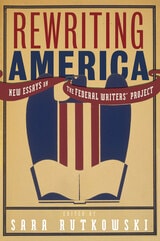
Rewriting America
New Essays on the Federal Writers' ProjectEdited by Sara Rutkowski
University of Massachusetts Press, 2022
Established in 1935, the Federal Writers’ Project (FWP) sent over 6,500 unemployed historians, teachers, writers, and librarians out to document America’s past and present in the midst of the Great Depression. The English poet W. H. Auden referred to this New Deal program as “one of the noblest and most absurd undertakings ever attempted by any state.”
Featuring original work by scholars from a range of disciplinary perspectives, this edited collection provides fresh insights into how this extraordinary program helped transform American culture. In addition to examining some of the major twentieth-century writers whose careers the FWP helped to launch—including Ralph Ellison, Richard Wright, and Margaret Walker—Rewriting America presents new perspectives on the role of African Americans, Mexican Americans, Asian Americans, and women on the project. Essays also address how the project’s goals continue to resonate with contemporary realities in the midst of major economic and cultural upheaval.
Along with the volume editor, contributors include Adam Arenson, Sue Rubenstein DeMasi, Racheal Harris, Jerrold Hirsch, Kathi King, Maiko Mine, Deborah Mutnick, Diane Noreen Rivera, Greg Robinson, Robert Singer, James Sun, and David A. Taylor.
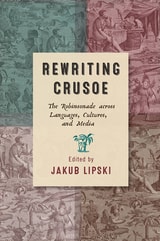
Rewriting Crusoe
The Robinsonade across Languages, Cultures, and MediaJakub Lipski
Bucknell University Press, 2020
Published by Bucknell University Press. Distributed worldwide by Rutgers University Press.
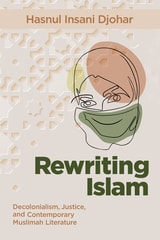
Rewriting Islam
Decolonialism, Justice, and Contemporary Muslimah LiteratureHasnul Insani Djohar
The Ohio State University Press, 2024
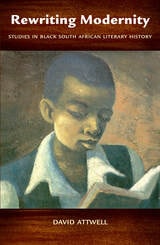
Rewriting Modernity
Studies in Black South African Literary HistoryDavid Attwell
Ohio University Press, 2006
Rewriting Modernity: Studies in Black South African Literary History connects the black literary archive in South Africa—from the nineteenth-century writing of Tiyo Soga to Zakes Mda in the twenty-first century—to international postcolonial studies via the theory of transculturation, a position adapted from the Cuban anthropologist Fernando Ortiz.
David Attwell provides a welcome complication of the linear black literary history—literature as a reflection of the process of political emancipation—that is so often presented. He focuses on cultural transactions in a series of key moments and argues that black writers in South Africa have used print culture to map themselves onto modernity as contemporary subjects, to negotiate, counteract, reinvent, and recast their positioning within colonialism, apartheid, and the context of democracy.
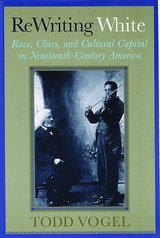
Rewriting White
Race, Class, and Cultural Capital in Nineteenth-Century AmericaTodd Vogel
Rutgers University Press, 2004
What did it mean for people of color in nineteenth-century America to speak or write "white"? More specifically, how many and what kinds of meaning could such "white" writing carry? In ReWriting White, Todd Vogel looks at how America has racialized language and aesthetic achievement. To make his point, he showcases the surprisingly complex interactions between four nineteenth-century writers of color and the "standard white English" they adapted for their own moral, political, and social ends. The African American, Native American, and Chinese American writers Vogel discusses delivered their messages in a manner that simultaneously demonstrated their command of the dominant discourse of their times-using styles and addressing forums considered above their station-and fashioned a subversive meaning in the very act of that demonstration.
The close readings and meticulous archival research in ReWriting White upend our conventional expectations, enrich our understanding of the dynamics of hegemony and cultural struggle, and contribute to the efforts of other cutting-edge contemporary scholars to chip away at the walls of racial segregation that have for too long defined and defaced the landscape of American literary and cultural studies.
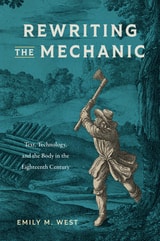
Rewriting the Mechanic
Text, Technology, and the Body in the Eighteenth CenturyEmily M. West
Bucknell University Press, 2027
In the eighteenth century, “technology” didn’t name a particular device or a process. It referred instead to written accounts of the mechanical arts, a now-obsolete category encompassing the wide range of work done by hand, from baking bread to building ships. Rewriting the Mechanic examines how these written descriptions, circulating across genres in eighteenth-century Britain, transformed certain mechanical arts by imagining them as newly innovative, authoritative, and able to make speculative possibilities real—as what we now call technological. Reversing the familiar story in which literature simply reflects technological change, West draws on the work of Robert Hooke, Aphra Behn, Daniel Defoe, Maria Edgeworth, and Jane Austen to demonstrate the influence of literary techniques on ideas about masculinity, power, and the body, and how these texts helped to bring the very idea of technological modernity into being.
Published by Bucknell University Press. Distributed worldwide by Rutgers University Press.
Rewriting the Word "God"
In the Arc of Converging Lines between Innovative Theory, Theology, and PoetryRomana Huk
University of Alabama Press, 2025
Innovative poetry, philosophy, theology and new sciences converge in the project of rewriting the word “God”
In Rewriting the Word “God,” Romana Huk examines the substantive connections between innovative poetry of the last century and contemporary theology and philosophy. Along the way, we encounter ten poets who have, without abandoning their inherited or chosen faith traditions, radically rethought conceptualizations of divinity, human ontology, and the real.
From the startlingly proto-phenomenological encounters with nature by Gerard Manley Hopkins to the post-deconstructive pursuit of “oracular” speech in Fanny Howe, these poets have found inspiration in a wide range of sources, from ancient religious texts to modern philosophical movements. But what unites them is their willingness to continually change, experiment and challenge the status quo, both in their religious beliefs and their poetic practice.
Huk shows how these poets have used their work to explore ultimate questions of life and death, meaning and purpose, and the relationship between humans and materiality, humans and other humans, which for these poets sheds light on humanity’s relationship with the divine. She also highlights the ways in which they have engaged with social and political issues in their poetry to speak out against injustice and oppression.
Rewriting the Word “God” is a thought-provoking and inspiring work that will challenge current perceptions of both religion and poetry from new positions at the intersection of faith, art, philosophy, science, literary theory, and culture.
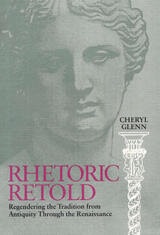
Rhetoric Retold
Regendering the Tradition from Antiquity Through the RenaissanceCheryl Glenn
Southern Illinois University Press, 1997
After explaining how and why women have been excluded from the rhetorical tradition from antiquity through the Renaissance, Cheryl Glenn provides the opportunity for Sappho, Aspasia, Diotima, Hortensia, Fulvia, Julian of Norwich, Margery Kempe, Margaret More Roper, Anne Askew, and Elizabeth I to speak with equal authority and as eloquently as Plato, Aristotle, Cicero, and Augustine. Her aim is nothing less than regendering and changing forever the history of rhetoric.
To that end, Glenn locates women’s contributions to and participation in the rhetorical tradition and writes them into an expanded, inclusive tradition. She regenders the tradition by designating those terms of identity that have promoted and supported men’s control of public, persuasive discourse—the culturally constructed social relations between, the appropriate roles for, and the subjective identities of women and men.
Glenn is the first scholar to contextualize, analyze, and follow the migration of women’s rhetorical accomplishments systematically. To locate these women, she follows the migration of the Western intellectual tradition from its inception in classical antiquity and its confrontation with and ultimate appropriation by evangelical Christianity to its force in the medieval Church and in Tudor arts and politics.
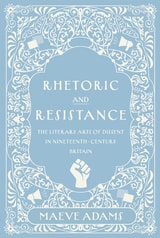
Rhetoric and Resistance
The Literary Arts of Dissent in Nineteenth-Century BritainMaeve Adams
Ohio University Press, 2025
A fresh perspective on the enduring relationship between literature, democracy, and dissent
Rhetoric and Resistance explores the transformative role of nineteenth-century literature in shaping modern concepts and practices of democratic dissent. By examining the works of Romantic and Victorian novelists, poets, and journalists, Maeve Adams identifies origins of modern theories and practices of resistance in nineteenth-century literary forms. Offering a literary history of dissent, the book recovers the intertwined development of democracy and aesthetics, revealing how narrative form became a potent tool for challenging authority.
Tracing the lineage of dissent from the radical fiction and journalism of the 1800s to contemporary movements like #MeToo, Adams offers a genealogy that highlights how literary texts experimented with political power, granting new and consequential voices to working-class individuals, women, colonized peoples, and other marginalized groups.
Adams takes an interdisciplinary approach, weaving together close readings of works by Thomas De Quincey, Walter Scott, Elizabeth Gaskell, and H. G. Wells, as well as lesser-known journalists, with insights from modern moral and political philosophy. Drawing on theories of democratic ethics and justice from scholars such as Miranda Fricker, Sharon Krause, Martha Nussbaum, and Philip Pettit, the book bridges literary history and contemporary debates about political agency and expression.
Rhetoric and the Digital Humanities
Edited by Jim Ridolfo and William Hart-Davidson
University of Chicago Press, 2015
Rhetoric and the Digital Humanities is a timely, multidisciplinary collection that is the first to bridge scholarship in rhetorical studies and the digital humanities. It offers much-needed guidance on how the theories and methodologies of rhetorical studies can enhance all work in digital humanities, and vice versa. Twenty-three essays over three sections delve into connections, research methodology, and future directions in this field. Jim Ridolfo and William Hart-Davidson have assembled a broad group of more than thirty accomplished scholars. Read together, these essays represent the cutting edge of research, offering guidance that will energize and inspire future collaborations.

Rhetoric in Tooth and Claw
Animals, Language, SensationDebra Hawhee
University of Chicago Press, 2017
Yet when you look at ancient and early modern treatises on rhetoric, what you find is surprising: they’re crawling with animals. With Rhetoric in Tooth and Claw, Debra Hawhee explores this unexpected aspect of early thinking about rhetoric, going on from there to examine the enduring presence of nonhuman animals in rhetorical theory and education. In doing so, she not only offers a counter-history of rhetoric but also brings rhetorical studies into dialogue with animal studies, one of the most vibrant areas of interest in humanities today. By removing humanity and human reason from the center of our study of argument, Hawhee frees up space to study and emphasize other crucial components of communication, like energy, bodies, and sensation.
Drawing on thinkers from Aristotle to Erasmus, Rhetoric in Tooth and Claw tells a new story of the discipline’s history and development, one animated by the energy, force, liveliness, and diversity of our relationships with our “partners in feeling,” other animals.
Rhetoric, Science, and Magic in Seventeenth-century England
Ryan J. Stark
Catholic University of America Press, 2009
Rhetorical Machines
Writing, Code, and Computational EthicsEdited by John Jones and Lavinia Hirsu
University of Alabama Press, 2019
Rhetorical Machines addresses new approaches to studying computational processes within the growing field of digital rhetoric. While computational code is often seen as value-neutral and mechanical, this volume explores the underlying, and often unexamined, modes of persuasion this code engages. In so doing, it argues that computation is in fact rife with the values of those who create it and thus has powerful ethical and moral implications. From Socrates’s critique of writing in Plato’s Phaedrus to emerging new media and internet culture, the scholars assembled here provide insight into how computation and rhetoric work together to produce social and cultural effects.
This multidisciplinary volume features contributions from scholar-practitioners across the fields of rhetoric, computer science, and writing studies. It is divided into four main sections: “Emergent Machines” examines how technologies and algorithms are framed and entangled in rhetorical processes, “Operational Codes” explores how computational processes are used to achieve rhetorical ends, “Ethical Decisions and Moral Protocols” considers the ethical implications involved in designing software and that software’s impact on computational culture, and the final section includes two scholars’ responses to the preceding chapters. Three of the sections are prefaced by brief conversations with chatbots (autonomous computational agents) addressing some of the primary questions raised in each section.
At the heart of these essays is a call for emerging and established scholars in a vast array of fields to reach interdisciplinary understandings of human-machine interactions. This innovative work will be valuable to scholars and students in a variety of disciplines, including but not limited to rhetoric, computer science, writing studies, and the digital humanities.
Rhetorical Renaissance
The Mistress Art and Her MasterworksKathy Eden
University of Chicago Press, 2022
Kathy Eden explores the intersection of early modern literary theory and practice. She considers the rebirth of the rhetorical art—resulting from the rediscovery of complete manuscripts of high-profile ancient texts about rhetoric by Plato, Aristotle, Cicero, Quintilian, and Tacitus, all unavailable before the early fifteenth century—and the impact of this art on early modern European literary production. This profound influence of key principles and practices on the most widely taught early modern literary texts remains largely and surprisingly unexplored.
Devoting four chapters to these practices—on status, refutation, similitude, and style—Eden connects the architecture of the most widely read classical rhetorical manuals to the structures of such major Renaissance works as Petrarch’s Secret, Castiglione’s Book of the Courtier, Erasmus’s Antibarbarians and Ciceronianus, and Montaigne’s Essays. Eden concludes by showing how these rhetorical practices were understood to work together to form a literary masterwork, with important implications for how we read these texts today.
Rhetorics of Literacy
The Cultivation of American Dialect PoetryNadia Nurhussein
The Ohio State University Press, 2013
Rhymes in the Flow
How Rappers Flip the BeatMacklin Smith and Aurko Joshi
University of Michigan Press, 2020
Despite its global popularity, rap has received little scholarly attention in terms of its poetic features. Rhymes in the Flow systematically analyzes the poetics (rap beats, rhythms, rhymes, verse and song structures) of many notable rap songs to provide new insights on rap artistry and performance. Defining and describing the features of what rappers commonly call flow, the authors establish a theory of the rap line as they trace rap’s deepest roots and stylistic evolution—from Anglo-Saxon poetry to Lil Wayne—and contextualize its complex poetics. Rhymes in the Flow helps explain rap’s wide appeal by focusing primarily on its rhythmic and thematic power, while also claiming its historical, cultural, musical, and poetic importance.
Rhythm
Form and DispossessionVincent Barletta
University of Chicago Press, 2020
Vincent Barletta explores rhythm through three historical moments, each addressing it as a phenomenon that transcends poetry, aesthetics, and even temporality. He reveals rhythm to be a power that holds us in place, dispossesses us, and shapes the foundations of our world. In these moments, Barletta encounters rhythm as a primordial and physical binding force that establishes order and form in the ancient world, as the anatomy of lived experience in early modern Europe, and as a subject of aesthetic and ethical questioning in the twentieth century.
A wide-ranging book covering a period spanning two millennia and texts from over ten languages, Rhythm will expand the conversation around this complex and powerful phenomenon.
Richard Ford and the Ends of Realism
Ian McGuire
University of Iowa Press, 2015
McGuire also uses this idea of pragmatic realism to mount a larger defense of contemporary realist writing and uses Ford’s example to argue that realism itself remains a useful and necessary critical category. Contemporary realism, rather than being merely conventional or reactionary, as some of its critics have called it, can offer its proponents an aesthetically and philosophically sophisticated way of engaging with and contesting the particularities of contemporary, even postmodern, experience.
In offering this new reading of Richard Ford’s fiction, as well as a fresh understanding of the realist impulse in contemporary American fiction, both become richer, more resonant, and more immediate—reaching both backward into the past and forward to involve themselves in important contemporary debates about history, postmodernity, and moral relativism.
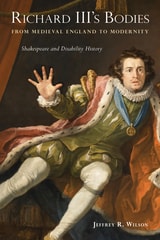
Richard III's Bodies from Medieval England to Modernity
Shakespeare and Disability HistoryJeffrey R. Wilson
Temple University Press, 2022
Richard III will always be central to English disability history as both man and myth—a disabled medieval king made into a monster by his nation’s most important artist.
In Richard III’s Bodies from Medieval England to Modernity, Jeffrey Wilson tracks disability over 500 years, from Richard’s own manuscripts, early Tudor propaganda, and x-rays of sixteenth-century paintings through Shakespeare’s soliloquies, into Samuel Johnson’s editorial notes, the first play produced by an African American Theater company, Freudian psychoanalysis, and the rise of disability theater. For Wilson, the changing meanings of disability created through shifting perspectives in Shakespeare’s plays prefigure a series of modern attempts to understand Richard’s body in different disciplinary contexts—from history and philosophy to sociology and medicine.
While theorizing a role for Shakespeare in the field of disability history, Wilson reveals how Richard III has become an index for some of modernity’s central concerns—the tension between appearance and reality, the conflict between individual will and external forces of nature and culture, the possibility of upward social mobility, and social interaction between self and other, including questions of discrimination, prejudice, hatred, oppression, power, and justice.

Richard Selzer and the Rhetoric of Surgery
Charles M. Anderson
Southern Illinois University Press, 1989
Anderson provides the context from which Selzer’s writing grows and a concept of language adequate to his purposes and accomplishments. He takes a careful look at Selzer’s writing to demonstrate that these abstract considerations do tell us why a surgeon would write. The works Anderson examines are "Jonah and the Whale" (an important early short story) and the first three essays in Mortal Lessons. These examples show the reader exactly how the symbols of literature interact directly with the world and the everyday communications of both writer and reader. According to Anderson, Mortal Lessons is also Selzer’s most artistic statement of his own sense of why and how he became a writer.
Selzer’s books include Rituals of Surgery, Mortal Lessons, Confessions of a Knife, Letters to a Young Doctor, and Taking the World in for Repairs.

Richard Wagner's Political Ecology
Kirsten S. Paige
University of Chicago Press, 2026
A study of the deep history of the Wagnerian environmental imagination.
Richard Wagner’s operas are bursting with environmental imagery, from tittering birds to flowing rivers to towering trees. In Richard Wagner’s Political Ecology, Kirsten S. Paige asks where Wagner’s environmental imagination came from, how it was received by audience members and reconceived by stage directors, and how it refracts his politics. By tracing the ecological dimensions of the composer’s essays and dramas, Paige reveals how Wagner’s environmental imagination was inextricable from broader political concerns of his time.
The book begins by examining the way Wagner’s political ecology shape-shifted across its rhetorical, musical, scenographic, and technological permutations. Although Wagner’s essays and dramas invite a range of interpretations, for Paige, they point to an all-encompassing image of opera-as-climate. The book then turns to the ways Wagnerian drama—and opera more generally—at once participates in the industrial-technological lineage of climate change and helps spectators grapple with the challenges of living in a warming world. In providing the first close examination of Wagner’s artistic thought, practice, and reception in relation to nineteenth-century climate theory and the early history of environmentalism, Richard Wagner’s Political Ecology considers what it might mean to reimagine opera around ethical mandates of sustainability.
Richard Wright'S Art Of Tragedy
Joyce Ann Joyce
University of Iowa Press, 1991
Because many scholars have approached the novel from naturalistic and existential perspectives, Joyce devotes her first chapter to a discussion of the novel's critical history. She compares previous criticism to her own perspective of the novel as tragedy, describing the features shared by each as well as their points of demarcation.
In the following chapters, Joyce explores the setting and structure of Native Son, its characterization and point of view, stylistic technique, and thematic unity. As she explores Wright's technique, she illuminates the ironies and interlocking relationships which embody the salient metaphors and images in the novel. In doing so, she illustrates how each detail of language composes the pattern that makes Native Son a tragedy.
In the same way that traditional critical readings of Native Son have impeded fresh insights into the novel, criticism based on biographical perspectives has resulted in numerous misconceptions about Wright's works. Richard Wright's Art of Tragedy rectifies these misconceptions by shifting the critical emphasis to the artistic vision and masterful crafting of Wright's major work. With this significant volume, students and teachers can discern the stylistic creativity that makes Native Son not only a tragedy but a work of art.
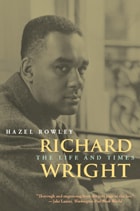
Richard Wright
The Life and TimesHazel Rowley
University of Chicago Press, 2008
Drawing on journals, letters, and eyewitness accounts, Richard Wright probes the author’s relationships with Langston Hughes and Ralph Ellison, his attraction to Communism, and his so-called exile in France. Skillfully interweaving quotes from Wright’s own writings, Rowley deftly portrays a passionate, courageous, and flawed man who would become one of our most enduring literary figures.
“Splendid. . . . Richard Wright is well written, prodigiously researched, and nicely paced, a compelling evocation of the man, his craft, and the different worlds through which he moved.”—Michael J. Ybarra, Wall Street Journal
“A welcome and illuminating work . . . [Rowley] does an outstanding job. . . . Rich and revealing.”—Megan Harlan, San Francisco Chronicle
“A magnificent biography, subtle and insightful. . . . Rowley writes with style and grace, and her research on Wright is prodigious.”—Howard Zinn, The Week
Richer Entanglements
Essays and Notes on Poetry and PoemsGregory Orr
University of Michigan Press, 1993
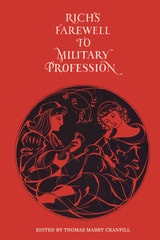
Rich’s Farewell to Military Profession, 1581
Edited by Thomas Mabry Cranfill
University of Texas Press, 1953
In a long and extraordinary career as captain, courier, privateer, real-estate agent, author, and informer, Barnaby Rich's principal achievement was the present volume—a collection of Elizabethan short stories despite its military title.
Unquestionably best sellers in Rich's own time, these tales continue to delight scholars, critics, and even casual readers today. One twentieth-century critic pronounces the Farewell "a landmark in Elizabethan short-story writing" and cites Rich's "romantic charm, gaiety and lightness of touch, good vivid dialogue, directness and ease." According to Henry Seidel Canby, Rich's "humor is of the gayest. . . . There is a suggestion of Chaucer about him, and not a little of the poet's merry humor." Yet the "stories themselves are diverse."
Certainly their charm and humor fetched Rich's contemporaries, who read out of existence all but one copy of the first edition and all but five of the subsequent three editions. Eight dramatists—including Shakespeare, Middleton, Shirley, and Marmion—immortalized several of the stories, however, by turning them into plays.
The present edition affords an opportunity to read Rich's tales in the form in which Elizabethans knew them. The text reproduced is that of the unique copy of the first edition, which appeared in 1581. The editor's scholarly, illuminating introduction and commentary display much of the liveliness, charm, and humor for which his subject was praised and in addition tell a great deal about the life and literature of that most fascinating of periods, the Age of Elizabeth I. Scholars will be especially interested in Cranfill's revelations of how an Elizabethan story maker operated, in the complex, checkered bibliographical history of the Farewell, and above all in the considerable use Shakespeare seems to have made of Rich's tales.
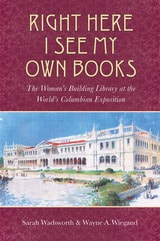
Right Here I See My Own Books
The Woman's Building Library at the World's Columbian ExpositionSarah Wadsworth
University of Massachusetts Press, 2012
By weaving together the behind-the-scenes story of the library's formation and the stories between the covers of books on display, Wadsworth and Wiegand firmly situate the Woman's Building Library within the historical context of the 1890s. Interdisciplinary in approach, their book demonstrates how this landmark collection helped consolidate and institutionalize women's writing in conjunction with the burgeoning women's movement and the professionalization of librarianship in late nineteenth-century America.
Americans in this period debated a wide range of topics, including women's rights, gender identity, racial politics, nationalism, regionalism, imperialism, and modernity. These debates permeated the cultural climate of the Columbian Exposition. Wadsworth and Wiegand's book illuminates the range and complexity of American women's responses to these issues within a public sphere to which the Woman's Building provided unprecedented access.
Rilke's Russia
A Cultural EncounterAnna A. Tavis
Northwestern University Press, 1996
Rimbaud
The Cost of GeniusNeal Oxenhandler
The Ohio State University Press, 2009
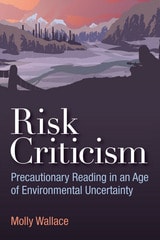
Risk Criticism
Precautionary Reading in an Age of Environmental UncertaintyMolly Wallace
University of Michigan Press, 2016
Taking inspiration from the questions raised by the Bulletin’s synecdochical “nuclear,” Risk Criticism aims to generate a hybrid form of critical practice that brings “nuclear criticism” into conversation with ecocriticism. Through readings of novels, films, theater, poetry, visual art, websites, news reports, and essays, Risk Criticism tracks the diverse ways in which environmental risks are understood and represented today.
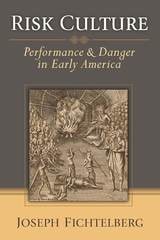
Risk Culture
Performance and Danger in Early AmericaJoseph Fichtelberg
University of Michigan Press, 2010
---David Shields, University of South Carolina
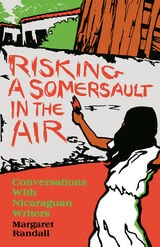
Risking a Somersault in the Air
Conversations with Nicaraguan WritersMargaret Randall
Northwestern University Press, 1995
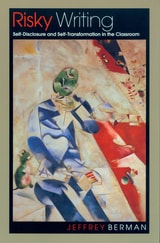
Risky Writing
Self-Disclosure and Self-Transformation in the ClassroomJeffrey Berman
University of Massachusetts Press, 2001
This is the final volume in a trilogy of works that examine the impact of writing and reading about traumatic subjects. Diaries to an English Professor (1994) explores the ways in which undergraduate students use psychoanalytic diaries to probe conflicted issues in their lives. Surviving Literary Suicide (1999) investigates how graduate students respond to suicidal literature—novels and poems that portray and sometimes glorify self-inflicted death.
In Risky Writing, Jeffrey Berman builds on those earlier studies, describing ways teachers can encourage college students to write safely on a wide range of subjects often deemed too personal or too dangerous for the classroom: grieving the loss of a beloved relative or friend, falling into depression, coping with the breakup of one's family, confronting sexual abuse, depicting a drug or alcohol problem, encountering racial prejudice. Berman points out that nearly everyone has difficulty talking or writing about such issues because they arouse shame and tend to be enshrouded in secrecy and silence. This is especially true for college students, who are just emerging from adolescence and find themselves at institutions that rarely promote self-disclosure.
Recognizing the controversial nature of his subject, Berman confronts academic opposition to personal writing head on. He also discusses the similarities between the “writing cure” and the “talking cure,” the role of the teacher and audience in the self-disclosing classroom, and the pedagogical strategies necessary to minimize risk, including the importance of empathy and other befriending skills.
Rita Dove's Cosmopolitanism
POEMSMalin Pereira
University of Illinois Press, 2003
Ritual, Myth, and Mysticism in the Work of Mary Butts
Between Feminism and ModernismFOY ROSLYN
University of Arkansas Press, 2000
Rival Praises
Ovid and the Metamorphosis of the Hymnic TraditionCelia M. Campbell
University of Wisconsin Press, 2024
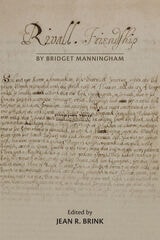
Rivall Friendship, by Bridget Manningham
Edited by Jean R. Brink
Arizona Center for Medieval and Renaissance Studies, 2021
The manuscript for Rivall Friendship was first acquired by the Newberry Library in 1937. At the time of the acquisition, the author of this seventeenth-century romance was anonymous. Scholar Jean R. Brink now suggests, based on dating of the manuscript and her analysis of its feminist themes, that the author was a woman. Specifically, Brink attributes the text to Bridget Manningham, who was the older sister of Thomas Manningham, a Jacobean and Caroline bishop, and the granddaughter of John Manningham, a diarist who recorded performances of Shakespeare’s plays.
Rivall Friendship is a post–English Civil War romance that examines proto-feminist issues, such as patriarchal dominance in the family and marriage. Manningham is scrupulous about maintaining verisimilitude, and unlike more fantastical romances of the period that feature monsters, giants, and magic, this text aspires to a level of probability in its historical and geographical details. The text of Rivall Friendship is accessible to most modern readers, particularly to students and scholars accustomed to working with seventeenth-century texts.
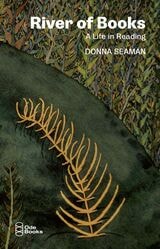
River of Books
Donna Seaman
Prickly Paradigm Press, 2024
With the infectious curiosity of an inveterate bibliophile and the prose of a fine stylist, Donna Seaman charts the course of her early reading years in a book-by-book chronicle of the significance books have held in her life. River of Books recounts Seaman’s journey in becoming an editor for Booklist, a reviewer, an author, and a literary citizen, and lays bare how she nourished both body and soul in working with books. Seaman makes palpable the power and self-recognition that she discovered in a life dedicated to reading.
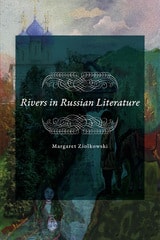
Rivers in Russian Literature
Margaret Ziolkowski
University of Delaware Press, 2011
Published by University of Delaware Press. Distributed worldwide by Rutgers University Press.