Results by title
8113 books match the query 'Literary Criticism' and 415 start with r

Road-Book America
Contemporary Culture and the New PicaresqueRowland A. Sherrill
University of Illinois Press, 2000
Road-Book America discloses how the old picaresque tradition, embodied in such novels as Henry Fielding's Tom Jones and Daniel Defoe's Moll Flanders, opens to include a number of new American texts, both fiction and nonfiction, that decisively share the characterizing form. Sherrill's discussion encompasses hundreds of American narratives published in the past four decades, including such examples of the genre as William Least Heat-Moon's Blue Highways, John Steinbeck's Travels with Charley, James Leo Herlihy's Midnight Cowboy, Bill Moyers's Listening to America, and E. L. Doctorow's Billy Bathgate.
Sketching the socially marginal, ingenuous, traveling characters common to both old and new versions, Sherrill shows how the "new American picaresque" transforms the satirical aims of the original into an effort to map and catalog the immensity and variety of America.
Open, resilient, perennially hopeful, and endowed with a protean adaptability, the protagonist of the new American picaresque follows a therapeutic path for the alienated modern self. Mining the relevance of the reformulated picaresque for American life, Road-Book America shows how this old form, adaptable as the picaro himself, lays the groundwork for spiritual renewal and a restoration of cultural confidence in some old ways of being American.
Robert Frost and Feminine Literary Tradition
Karen L. Kilcup
University of Michigan Press, 1998
Robert Frost and the Challenge of Darwin
Robert Faggen
University of Michigan Press, 2001
Combining both intellectual history and detailed analysis of Frost's poems, Robert Faggen shows how Frost's reading of Darwin reflected the significance of science in American culture from Emerson and Thoreau, through James and pragmatism. He provides fresh and provocative readings of many of Frost's shorter lyrics and longer pastoral narratives as they illustrate the impact of Darwinian thought on the concept of nature, with particular exploration of man's relationship to other creatures, the conditions of human equality and racial conflict, the impact of gender and sexual differences, and the survival of religion.
The book shows that Frost was neither a pessimist lamenting the uncertainties of the Darwinian worldview, nor a humanist opposing its power. Faggen draws on Frost's unpublished notebooks to reveal a complex thinker who willingly engaged with the difficult moral and epistemological implications of natural science, and showed their consonance with myths and traditions stretching back to Milton, Lucretius, and the Old Testament. Frost emerges as a thinker for whom poetry was not only artistic expression, but also a forum for the trial of ideas and their impact on humanity.
Robert Frost and the Challenge of Darwin provides a deeper understanding not only of Frost and modern poetry, but of the meaning of Darwin in the modern world, the complex interrelations of literature and science, and the history of American thought.
"A forceful, appealing study of the Frost-Darwin relation, which has gone little noted by previous scholars, and a fresh explanation of Frost's ambivalent relation to modernism, which he scorned but also influenced" --William Howarth, Princeton University
Robert Faggen is Associate Professor of Literature, Claremont McKenna College and Adjunct Associate Professor, Claremont Graduate School.
Robert Hayden in Verse
New Histories of African American Poetry and the Black Arts EraDerik Smith
University of Michigan Press, 2018
This book sheds new light on the work of Robert Hayden (1913–80) in response to changing literary scholarship. While Hayden’s poetry often reflected aspects of the African American experience, he resisted attempts to categorize his poetry in racial terms. This fresh appreciation of Hayden’s work recontextualizes his achievements against the backdrop of the Black Arts Movement and traces his influence on contemporary African American poets. Placing Hayden at the heart of a history of African American poetry and culture spanning the Harlem Renaissance to the Hip-Hop era, the book explains why Hayden is now a canonical figure in 20th-century American literature.
In deep readings that focus on Hayden’s religiousness, class consciousness, and historical vision, author Derik Smith inverts earlier scholarly accounts that figure Hayden as an outsider at odds with the militancy of the Black Arts movement. Robert Hayden in Verse offers detailed descriptions of the poet’s vigorous contributions to 1960s discourse about art, modernity, and blackness to show that the poet was, in fact, an earnest participant in Black Arts-era political and aesthetic debates.
Robert Hayden
Essays on the PoetryLaurence Goldstein and Robert Chrisman, Editors
University of Michigan Press, 2013
This collection of essays by leading critics and poets charts Robert Hayden’s growing reputation as a major writer of some of the twentieth century’s most important poems on African-American themes, including the famed “Middle Passage” and “Frederick Douglass.” The essays illuminate the themes and techniques that established Hayden as a modernist writer with affinities to T. S. Eliot, Federico Garcia Lorca, and W. B. Yeats, as well as to traditions of African-American writings that include such figures as Countee Cullen and Langston Hughes.
Robert Hayden: Essays on the Poetryis the first and only book to collect significant essays on this distinguished poet. Covering sixty years of commentary, book reviews, essays, and Hayden’s own published materials, this volume is an invaluable contribution to our understanding of the poet’s vision of experience, artistry, and influence. The book includes forty different works that examine the life and poetry of Hayden, the first African-American to serve as Consultant in Poetry to the Library of Congress (the post now called Poet Laureate) and to receive the Grand Prix de la Poesie at the First World Festival of Negro Arts, Dakar, Senegal, in 1966.
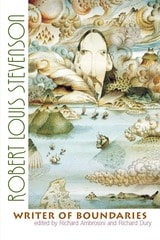
Robert Louis Stevenson
Writer of BoundariesEdited by Richard Ambrosini and Richard Dury
University of Wisconsin Press, 2006
Robert Louis Stevenson: Writer of Boundaries reinstates Stevenson at the center of critical debate and demonstrates the sophistication of his writings and the present relevance of his kaleidoscopic achievements. While most young readers know Robert Louis Stevenson (1850–1894) as the author of Treasure Island, few people outside of academia are aware of the breadth of his literary output. The contributors to Robert Louis Stevenson: Writer of Boundaries look, with varied critical approaches, at the whole range of his literary production and unite to confer scholarly legitimacy on this enormously influential writer who has been neglected by critics.
As the editors point out in their Introduction, Stevenson reinvented the “personal essay” and the “walking tour essay,” in texts of ironic stylistic brilliance that broke completely with Victorian moralism. His first full-length work of fiction, Treasure Island, provocatively combined a popular genre (subverting its imperialist ideology) with a self-conscious literary approach.
Stevenson, one of Scotland’s most prolific writers, was very effectively excluded from the canon by his twentieth-century successors and rejected by Anglo-American Modernist writers and critics for his play with popular genres and for his non-serious metaliterary brilliance. While Stevenson’s critical recognition has been slowly increasing, there have been far fewer published single-volume studies of his works than those of his contemporaries, Henry James and Joseph Conrad.
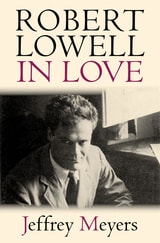
Robert Lowell in Love
Jeffrey Meyers
University of Massachusetts Press, 2016
Lowell's charismatic personality, compelling poetry, and literary fame attracted lovers and friends who were both frightened and excited by his aura of brilliance and danger. He loved the idea of falling in love, and in his recurring manic episodes he needed women at the center of his emotional and artistic life. Each affair became an intense dramatic episode. Though he idealized his loves and encouraged their talents, his frenetic affairs and tortured marriages were always conducted on his own terms. Robert Lowell in Love tells the story of the poet in the grip of love and gives voice to the women who loved him, inspired his poetry, and suffered along with him.
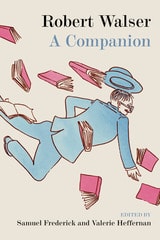
Robert Walser
A CompanionEdited by Samuel Frederick and Valerie Heffernan
Northwestern University Press, 2018
The Swiss writer Robert Walser (1878-1956) is now recognized as one of the most important European authors of the modernist period, having garnered high praise from such prominent voices as Susan Sontag, W. G. Sebald, and J. M. Coetzee. Robert Walser: A Companion is the first comprehensive guide to Walser’s work in English. The twelve essays in this collection examine Walser’s literary output, historical milieu, and idiosyncratic writing process, addressing aspects of his biography; discussing the various genres in which he wrote (the novel, short prose, drama, lyric poetry, and letters); and analyzing his best-known novels and short stories alongside lesser-known but no less fascinating poems, plays, and prose pieces.
An essential addition to the scholarship about this eccentric, prolific, and influential writer’s work, Robert Walser: A Companion will be of interest both to established scholars and to those coming to Walser for the first time.
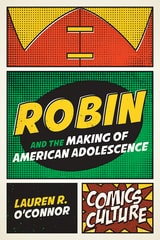
Robin and the Making of American Adolescence
Lauren R. O'Connor
Rutgers University Press, 2021
Robinson Crusoe after 300 Years
Andreas K. E. Mueller
Bucknell University Press, 2021
Robo Sacer
Necroliberalism and Cyborg Resistance in Mexican and Chicanx DystopiasDavid S. Dalton
Vanderbilt University Press, 2023
Harvey L. Johnson Publication Award, Southwest Council of Latin American Studies, 2026
Premio Alambique, Alambique: Revista Académica de Ciencia Ficción y Fantasía, 2025
Robo Sacer engages the digital humanities, critical race theory, border studies, biopolitical theory, and necropolitical theory to interrogate how technology has been used to oppress people of Mexican descent—both within Mexico and in the United States—since the advent of the North American Free Trade Agreement (NAFTA) in 1994. As the book argues, robo-sacer identity emerges as transnational flows of bodies, capital, and technology become an institutionalized state of exception that relegates people from marginalized communities to the periphery.
And yet the same technology can be utilized by the oppressed in the service of resistance. The texts studied here represent speculative stories about this technological empowerment. These texts theorize different means of techno-resistance to key realities that have emerged within Mexican and Chicano/a/x communities under the rise and reign of neoliberalism. The first three chapters deal with dehumanization, the trafficking of death, and unbalanced access to technology. The final two chapters deal with the major forms of violence—feminicide and drug-related violence—that have grown exponentially in Mexico with the rise of neoliberalism. These stories theorize the role of technology both in oppressing and in providing the subaltern with necessary tools for resistance.
Robo Sacer builds on the previous studies of Sayak Valencia, Irmgard Emmelhainz, Guy Emerson, Achille Mbembe, and of course Giorgio Agamben, but it differentiates itself from them through its theorization on how technology—and particularly cyborg subjectivity—can amend the reigning biopolitical and necropolitical structures of power in potentially liberatory ways. Robo Sacer shows how the cyborg can denaturalize constructs of zoē by providing an outlet through which the oppressed can tell their stories, thus imbuing the oppressed with the power to combat imperialist forces.
Robot Ghosts and Wired Dreams
Japanese Science Fiction from Origins to AnimeChristopher Bolton
University of Minnesota Press, 2007
Since the end of the Second World War—and particularly over the last decade—Japanese science fiction has strongly influenced global popular culture. Unlike American and British science fiction, its most popular examples have been visual—from Gojira (Godzilla) and Astro Boy in the 1950s and 1960s to the anime masterpieces Akira and Ghost in the Shell of the 1980s and 1990s—while little attention has been paid to a vibrant tradition of prose science fiction in Japan.
Robot Ghosts and Wired Dreams remedies this neglect with a rich exploration of the genre that connects prose science fiction to contemporary anime. Bringing together Western scholars and leading Japanese critics, this groundbreaking work traces the beginnings, evolution, and future direction of science fiction in Japan, its major schools and authors, cultural origins and relationship to its Western counterparts, the role of the genre in the formation of Japan’s national and political identity, and its unique fan culture.
Covering a remarkable range of texts—from the 1930s fantastic detective fiction of Yumeno Kyûsaku to the cross-culturally produced and marketed film and video game franchise Final Fantasy—this book firmly establishes Japanese science fiction as a vital and exciting genre.
Contributors: Hiroki Azuma; Hiroko Chiba, DePauw U; Naoki Chiba; William O. Gardner, Swarthmore College; Mari Kotani; Livia Monnet, U of Montreal; Miri Nakamura, Stanford U; Susan Napier, Tufts U; Sharalyn Orbaugh, U of British Columbia; Tamaki Saitô; Thomas Schnellbächer, Berlin Free U.
Christopher Bolton is assistant professor of Japanese at Williams College.
Istvan Csicsery-Ronay Jr. is professor of English at DePauw University.
Takayuki Tatsumi is professor of English at Keio University.
Rocking the Boat
Union Women's Voices, 1915-1975O'Farrell, Brigid
Rutgers University Press, 1996
Rocking the Boat is a celebration of strong, committed women who helped to build the American labor movement. Through the stories of eleven women from a wide range of backgrounds, we experience the turmoil, hardships, and accomplishments of thousands of other union women activists through the period spanning the Great Depression, the New Deal, World War II, the McCarthy era, the civil rights movement, and the women's movement. These women tell powerful stories that highlight and detail women's many roles as workers, trade unionists, and family members. They all faced difficulties in their personal lives, overcame challenges in their unions, and individually and collectively helped improve women's everyday working lives.
Maida Springer-Kemp came from New York City's Harlem, Local 22 of the International Ladies' Garment Workers' Union, to represent the AFL-CIO in Africa. In Chicago, Alice Peurala fought for her job in the steel mill and her place in the steel workers' union. Jessie De La Cruz organized farm workers in California. Esther Peterson, organizer, educator, and lobbyist, became an advisor to four U.S. presidents. In chapters based on oral history interviews, these women and others provide new perspectives and practical advice for today's working women. They share an idealistic and practical commitment to the labor movement. As Dorothy Haener of the United Auto Workers and a founding member of the National Organization of Women said, "You have to take a look at how to rock the boat. You don't want to spill yourself out if you can avoid it, but sometimes you have to rock the boat." From these women we, too, learn how to rock the boat.
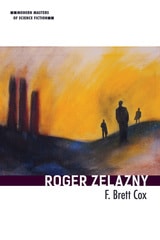
Roger Zelazny
F. Brett Cox
University of Illinois Press, 2021
Roger Zelazny combined poetic prose with fearless literary ambition to become one of the most influential science fiction writers of the 1960s. Yet many critics found his later novels underachieving and his turn to fantasy a disappointment. F. Brett Cox surveys the landscape of Zelazny's creative life and contradictions. Launched by the classic 1963 short story "A Rose for Ecclesiastes," Zelazny soon won the Hugo Award for Best Novel with …And Call Me Conrad and two years later won again for Lord of Light. Cox looks at the author's overnight success and follows Zelazny into a period of continued formal experimentation, the commercial triumph of the Amber sword and sorcery novels, and renewed acclaim for Hugo-winning novellas such as "Home Is the Hangman" and "24 Views of Mt. Fuji, by Hokusai." Throughout, Cox analyzes aspects of Zelazny's art, from his preference for poetically alienated protagonists to the ways his plots reflected his determined individualism.
Clear-eyed and detailed, Roger Zelazny provides an up-to-date reconsideration of an often-misunderstood SF maverick.
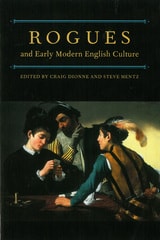
Rogues and Early Modern English Culture
Craig Dionne and Steve Mentz, Editors
University of Michigan Press, 2004
-Jonathan Dollimore, York University
"Rogues and Early Modern English Culture is an up-to-date and suggestive collection on a subject that all scholars of the early modern period have encountered but few have studied in the range and depth represented here."
-Lawrence Manley, Yale University
"A model of cross-disciplinary exchange, Rogues and Early Modern English Culture foregrounds the figure of the rogue in a nexus of early modern cultural inscriptions that reveals the provocation a seemingly marginal figure offers to authorities and various forms of authoritative understanding, then and now. The new and recent work gathered here is an exciting contribution to early modern studies, for both scholars and students."
-Alexandra W. Halasz, Dartmouth College
Rogues and Early Modern English Culture is a definitive collection of critical essays on the literary and cultural impact of the early modern rogue. Under various names-rogues, vagrants, molls, doxies, vagabonds, cony-catchers, masterless men, caterpillars of the commonwealth-this group of marginal figures, poor men and women with no clear social place or identity, exploded onto the scene in sixteenth-century English history and culture. Early modern representations of the rogue or moll in pamphlets, plays, poems, ballads, historical records, and the infamous Tudor Poor Laws treated these characters as harbingers of emerging social, economic, and cultural changes.
Images of the early modern rogue reflected historical developments but also created cultural icons for mobility, change, and social adaptation. The underclass rogue in many ways inverts the familiar image of the self-fashioned gentleman, traditionally seen as the literary focus and exemplar of the age, but the two characters have more in common than courtiers or humanists would have admitted. Both relied on linguistic prowess and social dexterity to manage their careers, whether exploiting the politics of privilege at court or surviving by their wits on urban streets.
Deftly edited by Craig Dionne and Steve Mentz, this anthology features essays from prominent and emerging critics in the field of Renaissance studies and promises to attract considerable attention from a broad range of readers and scholars in literary studies and social history.
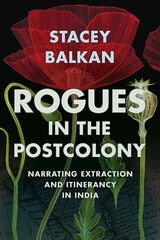
Rogues in the Postcolony
Narrating Extraction and Itinerancy in IndiaStacey Balkan
West Virginia University Press, 2022
Rogues in the Postcolony is a study of Anglophone Indian picaresque novels that dramatize the impacts of extractive capitalism and colonial occupation on local communities in several Indian states. In this materialist history of development on the subcontinent, Stacey Balkan considers works by Amitav Ghosh, Indra Sinha, and Aravind Adiga that critique violent campaigns of enclosure and dispossession at the hands of corporate entities like the English East India Company and its many legatees. By foregrounding the intersections among landscape ideology, agricultural improvement, extractive capitalism, and aesthetic expression, Rogues in the Postcolony also attends to the complicity of popular aesthetic forms with political and economic policy, as well as the colonial and extractivist logics that often frame discussions around the so-called Anthropocene epoch.
Bringing together questions about settler-colonial practices and environmental injustice, Rogues in the Postcolony concludes with an investigation of new extractivist frontiers, including solar capitalism, and considers the possibility of imagining life after extraction on the Indian subcontinent and beyond.
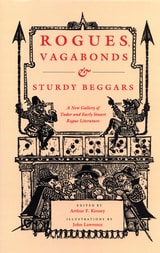
Rogues, Vagabonds, and Sturdy Beggars
A New Gallery of Tudor and Early Stuart Rogue Literature Exposing the Lives, Times, and Cozening Tricks of the Elizabethan UnderworldArthur F. Kinney
University of Massachusetts Press, 1990
In his introduction, Arthur F. Kinney discusses the significance of these works as protonovels and their influence on such writers as Shakespeare. He also explores the social, political, and economic conditions of a time that spawned a community of renegades who conned their way to fame, fortune, and, occasionally, the rope at Tyburn.
Rogues, Widows and Orphans
Mischief and Misadventures in the World of BooksRebecca Lee
Brandeis University Press, 2026
A publishing industry insider reveals the hilarious and fascinating mishaps, hoaxes, and gaffes behind your favorite books.
It’s a long journey from a writer’s mind to a finished book, and a lot needs to go right along the way. But isn’t it more interesting when things go wrong?
Rebecca Lee, a senior editorial manager at Penguin Random House, guides readers through the secrets of the book industry, a world fizzing with scandals, rivalries, catastrophes, and con jobs. Lee demonstrates how the tiniest of typos can have oversized consequences, unearths horrifying examples of bad taste and worse style, and peeks into tales of forgeries and feuds as dramatic as any thriller. She unredacts the most egregious cases of censorship, exposes hoarders and thieves, and asks whether AI is really an existential threat to the literary universe—or if we are our own worst enemies.
An irresistible tour of mistakes and misbehavior, Rogues, Widows and Orphans will make you cringe, crack you up, and renew your appreciation for the hard work of making books—and all the ways it can go sidewise.
Roman Cities
G. Michael Woloch
University of Wisconsin Press, 1984
Roman Cities provides the first comprehensive study in English of major Roman cities, including an excellent coverage of the Roman legacy which was transmitted to medieval and modern trends in architecture and urban planning..
Roman Holidays
American Writers and Artists in Nineteenth-Century ItalyRobert K. Martin
University of Iowa Press, 2001
Roman Tragedy
Theatre to TheatricalityBy Mario Erasmo
University of Texas Press, 2004
Roman tragedies were written for over three hundred years, but only fragments remain of plays that predate the works of Seneca in the mid-first century C.E., making it difficult to define the role of tragedy in ancient Roman culture. Nevertheless, in this pioneering book, Mario Erasmo draws on all the available evidence to trace the evolution of Roman tragedy from the earliest tragedians to the dramatist Seneca and to explore the role played by Roman culture in shaping the perception of theatricality on and off the stage.
Performing a philological analysis of texts informed by semiotic theory and audience reception, Erasmo pursues two main questions in this study: how does Roman tragedy become metatragedy, and how did off-stage theatricality come to compete with the theatre? Working chronologically, he looks at how plays began to incorporate a rhetoricized reality on stage, thus pointing to their own theatricality. And he shows how this theatricality, in turn, came to permeate society, so that real events such as the assassination of Julius Caesar took on theatrical overtones, while Pompey's theatre opening and the lavish spectacles of the emperor Nero deliberately blurred the lines between reality and theatre. Tragedy eventually declined as a force in Roman culture, Erasmo suggests, because off-stage reality became so theatrical that on-stage tragedy could no longer compete.
Roman and European Mythologies
Edited by Yves Bonnefoy
University of Chicago Press, 1992
early Christian and later European literature. Ninety-five entries
by leading scholars cover subjects such as sacrificial cults and rites
in pre-Roman Italy, Roman religion and its origins, the mythologies of
paganism, the survival of the ancient gods in the Middle Ages and the
Renaissance, gypsy myths and rituals, romanticism and myth in Blake,
Nerval, and Balzac, and myth in twentieth-century English literature.
Mythologies offers illuminating examples of the workings of
myth in the structure of societies past and present—how we create,
use, and are guided by systems of myth to answer fundamental questions
about ourselves and our world.
Many of the sections in Mythologies, originally published as a
two-volume cloth set, will soon be available in four paperback volumes
(two are announced here; two more are scheduled for 1993). These
volumes will reproduce the articles, introductory essays, and
illustrations as they appeared in the full Mythologies set.
Romance and the Erotics of Property
Mass-Market Fiction for WomenJan Cohn
Duke University Press, 1988
Cohn argues that a full understanding of the contemporary romance requires an investigation of its literary and historical sources and analogues. Three principal sources are examined in the context of women's history in bourgeois society. Pride and Prejudice, Jane Erye, and Gone With the Wind demonstrate the development of romance fiction's themes, yet in all three the central love story is complicated by issues of property, the sign of male power. Jan Cohn further considers the development of the genre n the fictions of Harriet Lewis and May Agnes Fleming, prolific and popular American romance writers of the late nineteenth century who developed the role of the villain, thereby bringing into focus the sexual and economic struggles faced by the heroine.
Romance and the Erotics of Property sets romance fiction against a historic and literary background, arguing that contemporary romance disguises as tales of love the subversive fantasies of female appropriation and male property and power.
Romances of the White Man's Burden
Race, Empire, and the Plantation in American Literature, 1880-1936Jeremy Wells
Vanderbilt University Press, 2011
Romances of the White Man's Burden takes on works in American literature in which the proverbial "old plantation" is made to seem not a relic but a harbinger, a sign that the South had arrived at a multiracial modernity and harmony before the rest of the United States. Focusing on writers such as Joel Chandler Harris, Thomas Nelson Page, Henry W. Grady, Thomas Dixon, and William Faulkner, Jeremy Wells reveals their shared fixation on the figure of the white southern man as specially burdened by history. Each of these writers, in his own way, presented the plantation South as an emblem, not an aberration, of America.
Romancing Modernism
The Poetics of Re-Enchantment in Polish and Russian Modernist FictionLukasz Wodzynski
University of Wisconsin Press, 2026
In the development of modernist fiction, perhaps no artistic product has had as vaunted a place as the novel, a genre theorized primarily with recourse to Western authors. Here, Łukasz Wodzyński challenges the primacy of the novel as the organizing principle of modernist prose in East-Central Europe, particularly in Poland and Russia. By carefully studying some of the most innovative texts in Polish and Russian from the early twentieth century, Wodzyński posits that the “novel” genre has hindered our understanding of long modernist narratives.
Instead, he proposes to read these pathbreaking works as a twentieth-century reclamation of the romance. Specifically, he argues that these latter-day romances channel early modernist apocalyptic and utopian ideals through popular genres like science fiction and adventure narratives—and thus imagine a human future freed from modern fixations on control, efficiency, and utility. The romance form, he suggests, was uniquely poised to address the deep civilizational anxieties underwriting modernist literary publications in East-Central Europe. Understanding these works and the ways in which they spoke to these anxieties thus informs not only the study of Polish and Russian literature but also the development of modernism itself.
Romantic Automata
Exhibitions, Figures, OrganismsMichael Demson
Bucknell University Press, 2020
Recent scholarship in post-humanism, post-colonialism, disability studies, post-modern feminism, eco-criticism, and radical Orientalism has significantly affected the critical discourse on this topic. In engaging with the work and thought of Coleridge, Poe, Hoffmann, Mary Shelley, and other Romantic luminaries, the contributors to this collection open new methodological approaches to understanding human interaction with technology that strives to simulate, supplement, or supplant organic life.
Published by Bucknell University Press. Distributed worldwide by Rutgers University Press.
Romantic Beasts
Pervasion, Eccentricity, ExhibitionMichael Demson
Bucknell University Press, 2025
Published by Bucknell University Press. Distributed worldwide by Rutgers University Press.
Romantic Complexity
Keats, Coleridge, and WordsworthJack Stillinger
University of Illinois Press, 2005
In Romantic Complexity, Jack Stillinger examines three of the most admired poets of English Romanticism--Keats, Coleridge, and Wordsworth--with a focus on the complexity that results from the multiple authorship, the multiple textual representation, and the multiple reading and interpretation of their best works.
Specific topics include the joint authorship of Wordsworth and Coleridge in the Lyrical Ballads, an experiment of 1798 that established the most essential characteristics of modern poetry; Coleridge's creation of eighteen or more different versions of The Ancient Mariner and how this textual multiplicity affects interpretation; the historical collaboration between Keats and his readers to produce fifty-nine separate but entirely legitimate readings of The Eve of St. Agnes; and a number of practical and theoretical matters bearing on the relationships among these writers and their influences on one another.
Stillinger shows his deep understanding of the poets' lives, works, and the history of their reception, in chapters rich with intriguing questions and answers sure to engage students and teachers of the world's greatest poetry.
Romantic Cyborgs
Authorship and Technology in the American RenaissanceKlaus Benesch
University of Massachusetts Press, 0

Romantic Globalism
British Literature and Modern World Order, 1750–1830Evan Gottlieb
The Ohio State University Press, 2014
Although modern media tend to represent globalization as an essentially contemporary phenomenon, many scholars now agree that its fundamental dynamics—especially its characteristic annulment of spatial and temporal differences—have been present for several centuries. Moreover, the last decades of the eighteenth century and the first of the nineteenth century saw the convergence of a number of world-changing socio-political developments in the Western world. Romantic Globalism is significant because it is the first extended scholarly study that brings together these lines of inquiry. In so doing, Romantic Globalism not only charts a new course of study for British Romanticism but also suggests how the Romantics’ visions of globality might still be valuable to us today.
Romantic Things
A Tree, a Rock, a CloudMary Jacobus
University of Chicago Press, 2012
Romantic Women Writers
Voices and CountervoicesPaula R. Feldman and Theresa M. Kelley
Brandeis University Press, 1995
Romanticism and Anthony Trollope
A Study in the Continuities of Nineteenth-Century Literary ThoughtL. J. Swingle
University of Michigan Press, 1990
Romanticism and Transcendence
Wordsworth, Coleridge, and the Religious ImaginationJ. Robert Barth, S.J.
University of Missouri Press, 2003
Romanticism and the Question of the Stranger
David Simpson
University of Chicago Press, 2012
Romanticism, Nationalism, and the Revolt against Theory
David Simpson
University of Chicago Press, 1993
Simpson demonstrates the close association between "theory" and "method" and shows that by the mid-eighteenth century, "method" had acquired distinctly subversive associations in England. Attributed increasingly to the French and the Germans, "method" paradoxically evoked images both of inhuman rationality and unbridled sentimentality; in either incarnation, it was seen as a threat to what was claimed to be authentically British. Simpson develops these paradigms in relation to feminism, the gendering of Anglo-American culture, and the emergence of literature and literary criticism as antitheoretical discourses. He then looks at the Romantic poets' response to this confining ideology of the cultural role of literature. Finally, Simpson considers postmodern theory's claims for the radical energy of nonrational or antirationalist positions.
This is an essential book not only for students of the Romantic period and intellectual historians concerned with the idea of "method," but for anyone interested in the historical background of today's debates over the excesses and possibilities of "theory."
Romanticism
A German AffairRüdiger Safranski Translated from the German by Robert E. Goodwin
Northwestern University Press, 2014
Romanticism: A German Affair is essential reading for anyone interested in the power of art, culture, and ideas in the life of a nation.
Romanticism’s Other Minds
Poetry, Cognition, and the Science of SociabilityJohn Savarese
The Ohio State University Press, 2020
Ronald Harwood's Tragic Vision
A Critical Analysis of His Novels, Plays, and ScreenplaysAnn C. Hall
University of Iowa Press, 2024
Ronald Harwood’s Tragic Vision offers the first critical analysis of prolific and award-winning British author Ronald Harwood (1934–2020). Though he received an Oscar for The Pianist, a knighthood, and numerous other awards and nominations, Harwood worked as a ghostwriter, script doctor, and veritable unknown for many years. As he became successful, many critics still misread his works and positioned him as a less-fashionable counterpart to his lifelong friend Harold Pinter. This study proposes a conceptual framework to approach his, and others’, work based on the genre of tragedy, offering a greater appreciation for and understanding of the Harwood canon.

Room for Maneuver
Reading (the) Oppositional (in) NarrativeRoss Chambers
University of Chicago Press, 1991
Rooms with a View
The Stages of Community in the Modern TheaterRichard L. Barr
University of Michigan Press, 1998
Rooted
Seven Midwest Writers of PlaceDavid R. Pichaske
University of Iowa Press, 2006
Rootedness
The Ramifications of a MetaphorChristy Wampole
University of Chicago Press, 2016
Wampole examines both the philosophical implications of this metaphor and its political evolution. From the root as home to the root as genealogical origin to the root as the past itself, rootedness has survived in part through its ability to subsume other compelling metaphors, such as the foundation, the source, and the seed. With a focus on this concept’s history in France and Germany, Wampole traces its influence in diverse areas such as the search for the mystical origins of words, land worship, and nationalist rhetoric, including the disturbing portrayal of the Jews as an unrooted, and thus unrighteous, people. Exploring the works of Martin Heidegger, Simone Weil, Jean-Paul Sartre, Paul Celan, and many more, Rootedness is a groundbreaking study of a figure of speech that has had wide-reaching—and at times dire—political and social consequences.
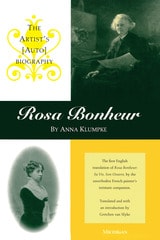
Rosa Bonheur
The Artist's (Auto)biographyAnna Klumpke
University of Michigan Press, 2001
Rosa Bonheur: The Artist's (Auto)Biography brings this extraordinary woman to life in a unique blend of biography and autobiography. Coupling her own memories with Bonheur's first-person account, Anna Klumpke, a young American artist who was Bonheur's lover and chosen portraitist, recounts how she came to meet and fall in love with Bonheur. Bonheur's account of her own life story, set nicely within Klumpke's narrative, sheds light on such topics as gender formation, institutional changes in the art world, governmental intervention in the arts, the social and legal regulation of dress codes, and the perceived transgressive nature of female sexual companionship in a repressive society, all with the distinctive flavor of Bonheur's artistic personality.
Gretchen van Slyke's translation provides a rare glimpse into the unconventional life of this famous French painter, and renders accessible for the first time in English this public statement of Bonheur's artistic credo. More importantly, whether judged by her century's standards (or perhaps even our own), it details a story of lesbian love that is bold, unconventional, and courageous.
"The remarkable life of Rosa Bonheur, one of the most highly decorated artists and certainly the best known female artist of her time in nineteenth-century France, is long overdue for further scrutiny." --Therese Dolan, Temple University
Gretchen van Slyke is Associate Professor of French, University of Vermont.

Rousing the Nation
Radical Culture in Depression AmericaLaura Browder
University of Massachusetts Press, 0

Rousseau, Judge of Jean-Jacques
DialoguesJean-Jacques Rousseau
Dartmouth College Press, 2012
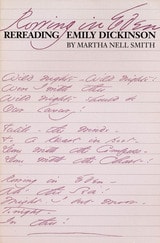
Rowing in Eden
Rereading Emily DickinsonBy Martha Nell Smith
University of Texas Press, 1992
Emily Dickinson wrote a "letter to the world" and left it lying in her drawer more than a century ago. This widely admired epistle was her poems, which were never conventionally published in book form during her lifetime. Since the posthumous discovery of her work, general readers and literary scholars alike have puzzled over this paradox of wanting to communicate widely and yet apparently refusing to publish. In this pathbreaking study, Martha Nell Smith unravels the paradox by boldly recasting two of the oldest and still most frequently asked questions about Emily Dickinson: Why didn't she publish more poems while she was alive? and Who was her most important contemporary audience?
Regarding the question of publication, Smith urges a reconception of the act of publication itself. She argues that Dickinson did publish her work in letters and in forty manuscript books that circulated among a cultured network of correspondents, most important of whom was her sister-in-law, Susan Huntington Gilbert Dickinson. Rather than considering this material unpublished because unprinted, Smith views its alternative publication as a conscious strategy on the poet's part, a daring poetic experiment that also included Dickinson's unusual punctuation, line breaks, stanza divisions, calligraphic orthography, and bookmaking—all the characteristics that later editors tried to standardize or eliminate in preparing the poems for printing.
Dickinson's relationship with her most important reader, Sue Dickinson, has also been lost or distorted by multiple levels of censorship, Smith finds. Emphasizing the poet-sustaining aspects of the passionate bonds between the two women, Smith shows that their relationship was both textual and sexual. Based on study of the actual holograph poems, Smith reveals the extent of Sue Dickinson's collaboration in the production of poems, most notably "Safe in Their Alabaster Chambers." This finding will surely challenge the popular conception of the isolated, withdrawn Emily Dickinson.
Well-versed in poststructuralist, feminist, and new textual criticism, Rowing in Eden uncovers the process by which the conventional portrait of Emily Dickinson was drawn and offers readers a chance to go back to original letters and poems and look at the poet and her work through new eyes. It will be of great interest to a wide audience in literary and feminist studies.

Roy Pascal and Georg Lukács
Towards a Re-Evaluation of the History of Marxist Literary Criticism in Britain?Helmut Peitsch
University of London Press, 2018
Royal Apologetic in the Ancient Near East
Andrew Knapp
SBL Press, 2015
A fresh exploration of apologetic material that pushes beyond form criticism
Andrew Knapp applies modern genre theory to seven ancient Near Eastern royal apologies that served to defend the legitimacy of kings who came to power under irregular circumstances. Knapp examines texts and inscriptions related to Telipinu, Hattusili III, David, Solomon, Hazael, Esarhaddon, and Nabonidus to identify transhistorical common issues that unite each discourse.
Features:
- Compares Hittite, Israelite, Aramean, Assyrian, and Babylonian apologies
- Examination of apologetic as a mode instead of a genre
- Charts and illustrations
Ruben Dario Centennial Studies
Edited by Miguel Gonzalez-Gerth and George D. Schade
University of Texas Press, 1970
Rubén Darío (1867–1916), the undisputed standard-bearer of the Modernist movement in Hispanic letters, was born in Nicaragua. In 1886 he went to Chile, where he published Azul (1888), his first important book of poems and stories. Later he lived for extended periods in Argentina, Spain, and France, and in these countries produced his best work: compelling poems of beauty, style, and dignity, especially Cantos de vida y esperanza (1905). The perfection of form, exotic essences, and rich ornamentation of his earlier work give way in his most mature poems to self-probings and doubts, the anguish so characteristic of twentieth-century literature. But the hedonistic note, the quenchless appetite for life, dominating Azul and Prosas profanas (1896) never die out, and are magnificently present in El poema del otoño (1910). Darío has had a tremendous impact on Hispanic literature. He is one of the best examples of the poet who is true to his art as determined by his innermost impulses. His poetry has fertilized a whole generation of writers in Spanish America and in Spain, and even now his influence continues to be felt.