342 books match the query '16th century' and 25 start with s
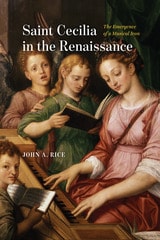
cover of Saint Cecilia in the Renaissance: The Emergence of a Musical Icon

Saint Cecilia in the Renaissance

The Emergence of a Musical Icon

John A. Rice

University of Chicago Press, 2022

This study uncovers how Saint Cecilia came to be closely associated with music and musicians.

Until the fifteenth century, Saint Cecilia was not connected with music. She was perceived as one of many virgin martyrs, with no obvious musical skills or interests. During the next two centuries, however, she inspired many musical works written in her honor and a vast number of paintings that depicted her singing or playing an instrument.
 
In this book, John A. Rice argues that Cecilia’s association with music came about in several stages, involving Christian liturgy, visual arts, and music. It was fostered by interactions between artists, musicians, and their patrons and the transfer of visual and musical traditions from northern Europe to Italy. Saint Cecilia in the Renaissance explores the cult of the saint in Medieval times and through the sixteenth century when musicians’ guilds in the Low Countries and France first chose Cecilia as their patron. The book then turns to music and the explosion of polyphonic vocal works written in Cecilia’s honor by some of the most celebrated composers in Europe. Finally, the book examines the wealth of visual representations of Cecilia especially during the Italian Renaissance, among which Raphael’s 1515 painting, The Ecstasy of Saint Cecilia, is but the most famous example. Thoroughly researched and beautifully illustrated in color, Saint Cecilia in the Renaissance is the definitive portrait of Saint Cecilia as a figure of musical and artistic inspiration.
[more]
cover of Samuel Johnson and Moral Discipline

Samuel Johnson and Moral Discipline

Paul Kent Alkon

Northwestern University Press, 1967
Paul Kent Alkon’s Samuel Johnson and Moral Discipline provides reading of Johnson that emphasizes his moral discourse.  Shortly after its publication, Alkon’s book became first of all the standard reading of Johnson’s essays, contrasting them with the moral ideas Johnson discussed in his sermons, as moral writings, and second, as one of the first books on Johnson to explore the essayist’s focus on moral thinking as central to his writing.

 
[more]
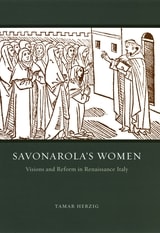
cover of Savonarola's Women: Visions and Reform in Renaissance Italy

Savonarola's Women

Visions and Reform in Renaissance Italy

Tamar Herzig

University of Chicago Press, 2007

Girolamo Savonarola (1452–1498), the religious reformer, preacher, and Florentine civic leader, was burned at the stake as a false prophet by the order of Pope Alexander VI. Tamar Herzig here explores the networks of Savonarola’s female followers that proliferated in the two generations following his death. Drawing on sources from the fifteenth and sixteenth centuries, many never before studied, transcribed, or contextualized in Savonarolan scholarship and religious history, Herzig shows how powerful public figures and clerics continued to ally themselves with these holy women long after the prophet’s death.

In their quest to stay true to their leader’s teachings, Savonarola’s female followers faced hostile superiors within their orders, local political pressures, and the deep-rooted misogynistic assumptions of the Church establishment. This unprecedented volume demonstrates how reform circles throughout the Italian peninsula each tailored Savonarola’s life and works to their particular communities’ regionally specific needs. Savonarola’s Women is an important reconstruction of women’s influence on one of the most important and controversial religious movements in premodern Europe.
[more]
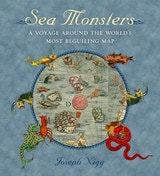
cover of Sea Monsters: A Voyage around the World's Most Beguiling Map

Sea Monsters

A Voyage around the World's Most Beguiling Map

Joseph Nigg

University of Chicago Press, 2013

Smart phones and GPS give us many possible routes to navigate our daily commute, warn us of traffic and delays, and tell us where to find a cup of coffee. But what if there were sea serpents and giant man-eating lobsters waiting just off course if we were to lose our way? Would there be an app for that? In the sixteenth century, these and other monsters were thought to swim the northern waters, threatening seafarers who ventured too far from shore. Thankfully, Scandinavian mariners had Olaus Magnus, who in 1539 charted these fantastic marine animals in his influential map of the Nordic countries, the Carta Marina. In Sea Monsters, well-known expert on magical beasts Joseph Nigg brings readers face-to-face with these creatures, alongside the other magnificent components of Magnus’s map.

Nearly two meters wide in total, the map’s nine wood-block panels comprise the largest and first realistic portrayal of Northern Europe. But in addition to these important geographic elements, Magnus’s map goes beyond cartography to scenes both domestic and mystic. Close to shore, Magnus shows humans interacting with common sea life—boats struggling to stay afloat, merchants trading, children swimming, and fisherman pulling lines. But from the offshore deeps rise some of the most magical and terrifying sea creatures imaginable at the time or thereafter—like sea swine, whales as large as islands, and the Kraken. In this book, Nigg provides a thorough tour of the map’s cartographic details, as well as a colorful look at its unusual pictorial and imaginative elements. He draws on Magnus’s own text to further describe and illuminate the inventive scenes and to flesh out the stories of the monsters.

Sea Monsters is a stunning tour of a world that still holds many secrets for us land dwellers, who will forever be fascinated by reports of giant squid and the real-life creatures of the deep that have proven to be as bizarre and otherworldly as we have imagined for centuries. It is a gorgeous guide for enthusiasts of maps, monsters, and the mythic.
[more]
cover of Selected Letters

Selected Letters

Isabella d’Este

Iter Press, 2017

Isabella d’Este (1474–1539), daughter of the Este dukes of Ferrara and wife of Marchese Francesco II Gonzaga of Mantua, co-regent of the Gonzaga state, art collector, musician, diplomat, dynastic mother, traveler, reader, gardener, fashion innovator, and consummate politician, was also, as this volume attests, a prolific letter writer with a highly developed epistolary network. Presented here for the first time in any language is a representative selection from over 16,000 letters sent by Isabella to addressees across a wide social spectrum. Together, they paint a nuanced and colorful portrait of a brilliant and influential female protagonist of early modern European society.
[more]
cover of Selected Poetry, Prose, and Translations, with Contextual Materials

Selected Poetry, Prose, and Translations, with Contextual Materials

Anne Vaughan Lock

Iter Press, 2021

Born to merchant-class parents who served in the court of Henry VIII and his queens, Anne Vaughan Lock lived in London and Exeter, spent time in Geneva as a religious exile, belonged to the Cooke sisters’ political-religious circle, maintained friendships with prominent Protestant leaders, and engaged the issues of her day. As a recognized public figure, she took on the roles of reformer, poet, translator, correspondent, spiritual counselor, and political advocate. During her lifetime, she published two books, both of which were reprinted several times.

This volume provides a collection of Lock’s works presented in modern spelling, and it includes additional contemporary materials that place her voice in the larger context of the Tudor period, offering insight into the intertwined complexities of political, social, and religious life in sixteenth-century England.
 
[more]
cover of Sephardi Family Life in the Early Modern Diaspora

Sephardi Family Life in the Early Modern Diaspora

Edited by Julia R. Lieberman

Brandeis University Press, 2010
This collection of essays examines an important and under-studied topic in early modern Jewish social history”—the family life of Sephardi Jewish families in the Ottoman Empire as well as in communities in Western Europe. At the height of its power in the sixteenth and seventeenth centuries, the Ottoman Empire spanned three continents, controlling much of southeastern Europe, western Asia, and North Africa. Thousands of Jewish families that had been expelled from Spain and Portugal at the end of the fifteenth century created communities in these far-flung locations. Later emigrants from Iberia, who converted to Christianity at the time of the expulsion or before, created communities in Western European cities such as Amsterdam, Hamburg, and Livorno. Sephardi communities were very different from those of Ashkenazi Jews in the same period. The authors of these essays use the lens of domestic life to illuminate the diversity of the post-Inquisition Sephardi Jewish experience, enabling readers to enter into little-known and little-studied Jewish historical episodes. Contributors include: Tirtsah Levie Bernfeld, Hannah Davidson, Cristina Galasso, David Graizbord, Ruth Lamdan, and Julia Lieberman
[more]
cover of Sexuality and Form: Caravaggio, Marlowe, and Bacon

Sexuality and Form

Caravaggio, Marlowe, and Bacon

Graham Hammill

University of Chicago Press, 2000
This ambitious, wide-ranging study of sexuality, aesthetics, and epistemology covers everything from the aesthetics of war to the works of Caravaggio, Michaelangelo, Christopher Marlowe, and Francis Bacon, synthesizing queer theory and psychoanalysis and demonstrating the role of the body and the flesh as both a problem and a promise within the narrative arts.
[more]
cover of Shakespeare from the Margins: Language, Culture, Context

Shakespeare from the Margins

Language, Culture, Context

Patricia Parker

University of Chicago Press, 1996

In the interpretation of Shakespeare, wordplay has often been considered inconsequential, frequently reduced to a decorative "quibble." But in Shakespeare from the Margins: Language, Culture, Context, Patricia Parker, one of the most original interpreters of Shakespeare, argues that attention to Shakespearean wordplay reveals unexpected linkages, not only within and between plays but also between the plays and their contemporary culture.

Combining feminist and historical approaches with attention to the "matter" of language as well as of race and gender, Parker's brilliant "edification from the margins" illuminates much that has been overlooked, both in Shakespeare and in early modern culture. This book, a reexamination of popular and less familiar texts, will be indispensable to all students of Shakespeare and the early modern period.

[more]
cover of Shakespeare the Actor and the Purposes of Playing

Shakespeare the Actor and the Purposes of Playing

Meredith Anne Skura

University of Chicago Press, 1993

For the Renaissance, all the world may have been a stage and all its people players, but Shakespeare was also an actor on the literal stage. Meredith Anne Skura asks what it meant to be an actor in Shakespeare's England and shows why a knowledge of actual theatrical practices is essential for understanding both Shakespeare's plays and the theatricality of everyday life in early modern England.

Despite the obvious differences between our theater and Shakespeare's, sixteenth-century testimony suggests that the experience of acting has not changed much over the centuries. Beginning with a psychoanalytically informed account of acting today, Skura shows how this intense and ambivalent experience appears not only in literal references to acting in Shakespearean drama but also in recurring narrative concerns, details of language, and dramatic strategies used to engage the audience. Looking at the plays in the context of both public and private worlds outside the theater, Skura rereads the canon to identify new configurations in the plays and new ways of understanding theatrical self-consciousness in Renaissance England. Rich in theatrical, psychoanalytic, biographical, and historical insight, this book will be invaluable to students of Shakespeare and instructive to all readers interested in the dynamics of performance.
[more]
cover of Shakespeare's Dramatic Transactions

Shakespeare's Dramatic Transactions

Michael Mooney

Duke University Press, 1990

Shakespeare’s Dramatic Transactions uses conventions of performance criticism—staging and theatrical presentation—to analyze seven major Shakespearean tragedies: Hamlet, Othello, King Lear, Macbeth, Antony and Cleopatra, Richard II, and Richard III. As scholars and readers increasingly question the theoretical models used to describe the concepts of “mimesis” and “representation,” this book describes how the actor’s stage presentation affects the actor’s representational role and the ways in which viewers experience Shakespearean tragedy.
Michael Mooney draws on the work of East German critic Robert Weimann and his concept of figurenposition—the correlation between an actor’s stage location and the speech, action, and stylization associated with that position—to understand the actor/stage location relationship in Shakespeare’s plays. In his examination of the original staging of Shakespeare’s tragedies, Mooney looks at the traditional interplay between a downstage “place” and upstage “location” to describe the difference between non-illusionistic action (often staged near the audience) and the illusionistic, localized action that characterizes mimetic art.
The innovative and insightful approach of Shakespeare’s Dramatic Transactions brings together the techniques of performance criticism and the traditional literary study of Shakespearean tragedy. In showing how the distinctions of stage location illuminate the interaction among language, representation, Mooney’s compelling argument enhances our understanding of Shakespeare and the theater.
[more]
cover of Shakespeare's Folktale Sources

Shakespeare's Folktale Sources

Charlotte Artese

University of Delaware Press, 2015

Shakespeare’s Folktale Sources argues that seven plays—The Taming of the Shrew, Titus Andronicus, The Merry Wives of Windsor, The Merchant of Venice, All’s Well that Ends Well, Measure for Measure, and Cymbeline—derive one or more of their plots directly from folktales. In most cases, scholars have accepted one literary version of the folktale as a source. Recognizing that the same story has circulated orally and occurs in other medieval and early modern written versions allows for new readings of the plays. By acknowledging that a play’s source story circulated in multiple forms, we can see how the playwright was engaging his audience on common ground, retelling a story that may have been familiar to many of them, even the illiterate. We can also view the folktale play as a Shakespearean genre, defined by source as the chronicle histories are, that spans and traces the course of Shakespeare’s career. The fact that Shakespeare reworked folktales so frequently also changes the way we see the history of the literary folk- or fairy-tale, which is usually thought to bypass England and move from Italian novella collections to eighteenth-century French salons. Each chapter concludes with a bibliography listing versions of each folktale source as a resource for further research and teaching.

Published by University of Delaware Press. Distributed worldwide by Rutgers University Press.
 
[more]
cover of Shakespeare's Politics

Shakespeare's Politics

Allan Bloom

University of Chicago Press, 1981

Taking the classical view that the political shapes man's consciousness, Allan Bloom considers Shakespeare as a profoundly political Renaissance dramatist. He aims to recover Shakespeare's ideas and beliefs and to make his work once again a recognized source for the serious study of moral and political problems.

In essays looking at Julius Caesar, Othello, and The Merchant of Venice, Bloom shows how Shakespeare presents a picture of man that does not assume privileged access for only literary criticism. With this claim, he argues that political philosophy offers a comprehensive framework within which the problems of the Shakespearean heroes can be viewed. In short, he argues that Shakespeare was an eminently political author. Also included is an essay by Harry V. Jaffa on the limits of politics in King Lear.

"A very good book indeed . . . one which can be recommended to all who are interested in Shakespeare." —G. P. V. Akrigg

"This series of essays reminded me of the scope and depth of Shakespeare's original vision. One is left with the impression that Shakespeare really had figured out the answers to some important questions many of us no longer even know to ask."-Peter A. Thiel, CEO, PayPal, Wall Street Journal

Allan Bloom was the John U. Nef Distinguished Service Professor on the Committee on Social Thought and the co-director of the John M. Olin Center for Inquiry into the Theory and Practice of Democracy at the University of Chicago. Harry V. Jaffa is professor emeritus at Claremont McKenna College and Claremont Graduate School.
[more]
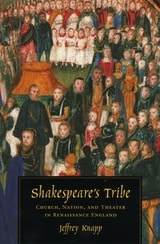
cover of Shakespeare's Tribe: Church, Nation, and Theater in Renaissance England

Shakespeare's Tribe

Church, Nation, and Theater in Renaissance England

Jeffrey Knapp

University of Chicago Press, 2004

Most contemporary critics characterize Shakespeare and his tribe of fellow playwrights and players as resolutely secular, interested in religion only as a matter of politics or as a rival source of popular entertainment. Yet as Jeffrey Knapp demonstrates in this radical new reading, a surprising number of writers throughout the English Renaissance, including Shakespeare himself, represented plays as supporting the cause of true religion.

To be sure, Renaissance playwrights rarely sermonized in their plays, which seemed preoccupied with sex, violence, and crime. During a time when acting was regarded as a kind of vice, many theater professionals used their apparent godlessness to advantage, claiming that it enabled them to save wayward souls the church could not otherwise reach. The stage, they argued, made possible an ecumenical ministry, which would help transform Reformation England into a more inclusive Christian society.

Drawing on a variety of little-known as well as celebrated plays, along with a host of other documents from the English Renaissance, Shakespeare's Tribe changes the way we think about Shakespeare and the culture that produced him.

Winner of the Best Book in Literature and Language from the Association of American Publishers' Professional/Scholarly division, the Conference on Christianity and Literature Book Award, and the Roland H. Bainton Prize for Literature from the Sixteenth Century Society and Conference.
[more]
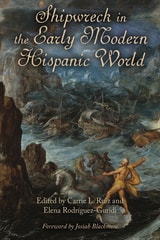
cover of Shipwreck in the Early Modern Hispanic World

Shipwreck in the Early Modern Hispanic World

Carrie L. Ruiz

Bucknell University Press, 2022
Seafaring activity for trade and travel was dominant throughout the Spanish Empire, and in the worldview and imagination of its inhabitants, the specter of shipwreck loomed large. Shipwreck in the Early Modern Hispanic World probes this preoccupation by examining portrayals of nautical disasters in sixteenth- and seventeenth-century Spanish literature and culture. The essays collected here showcase shipwreck’s symbolic deployment to question colonial expansion and transoceanic trade; to critique the Christian enterprise overseas; to signal the collapse of dominant social order; and to relay moral messages and represent socio-political debates. The contributors find examples in poetry, theater, narrative fiction, and other print artifacts, and approach the topic variously through the lens of historical, literary, and cultural studies. Ultimately demonstrating how shipwrecks both shaped and destabilized perceptions of the Spanish Empire worldwide, this analytically rich volume is the first in Hispanic studies to investigate the darker side of mercantile and imperial expansion through maritime disaster.
[more]
cover of Sidney's Poetics: Imitating Creation

Sidney's Poetics

Imitating Creation

Michael Mack

Catholic University of America Press, 2005
Sidney's Poetics is essential reading not only for students and scholars of Renaissance literature and literary theory but also for all who want to understand how human beings write and read creatively.
[more]
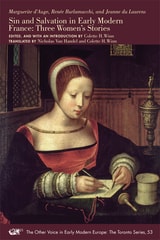
cover of Sin and Salvation in Early Modern France: Three Women’s Stories

Sin and Salvation in Early Modern France

Three Women’s Stories

Marguerite d'Auge, Renée Burlamacchi, and Jeanne du Laurens

Iter Press, 2017

The texts available here in English for the first time open a window into the lives of three early modern Frenchwomen as they explore the common themes of family, memory, sin, and salvation. The Regrets of Marguerite d’Auge (1600), the Memoirs of Renée Burlamacchi (1623), and the Genealogy of Jeanne du Laurens (1631), taken from different genres of historical writings, raise important questions: Why and how did female authorship find its way into the historical record? How did these voices escape the censorship and prejudice against female publication? In a time of extreme religious conflict, how did these women convey their views on controversial issues such as primacy of grace, indulgences, and salvation without disrupting the gender expectations of the era?
[more]
cover of Sixteenth Century Maiolica Pottery in the Valley of Mexico

Sixteenth Century Maiolica Pottery in the Valley of Mexico

Florence C. Lister and Robert H. Lister

University of Arizona Press, 1982

The Anthropological Papers of the University of Arizona is a peer-reviewed monograph series sponsored by the School of Anthropology. Established in 1959, the series publishes archaeological and ethnographic papers that use contemporary method and theory to investigate problems of anthropological importance in the southwestern United States, Mexico, and related areas.
[more]
cover of Song of Tides

Song of Tides

Tom Joseph

University of Alabama Press, 2008
Beginning with their battle against the forces of Ponce de Leon, the Calusa Indians of southwest Florida entered a dark period of European invasion and native resistance, which changed the nature and course of life on the North American continent.
 
Song of the Tides is a work of anthropological fiction that is set during the period of the Spanish entrada into southwest Florida and their encounters with the Calusa. Relying on letters and memoirs, especially those of explorer Pedro Menendez de Aviles, shipwrecked captive Escalante Fontaneda, and the Jesuit priest Juan Rogel, Joseph has woven a tale of vivid historical detail and compelling human drama. Working with Calusa scholars, the author has created a superbly written account of the clash of two proud and dominant cultures. Told through the voice of Aesha, daughter of the great Calusa chief Caalus, as well as those of other political and spiritual leaders, the fictional narrative spans half a century of conflict with Spanish soldiers and Jesuits, infighting between bands, struggle to preserve their culture, and eventual defeat of the Spanish through wit and deceit.
[more]
cover of Southwell's Sphere: The Influence of England's Secret Poet

Southwell's Sphere

The Influence of England's Secret Poet

Gary M. Bouchard

St. Augustine's Press, 2016
Once feared by Queen Elizabeth I and admired by William Shakespeare, Robert Southwell, s.j. (1561–1595), clings today to a thinning canonical presence in English literature among a sphere of other writers incongruously called the metaphysical poets. Southwell’s Sphere lifts this sixteenth century Jesuit priest and prolific writer from the obscurity in which he too often resides and places him instead at the center of a sphere of English poets upon whom his life and works exerted an observable influence. As he weaved his religious content into the familiar loom of Elizabethan form and style, this young missionary priest was seeking not just to catechize those whom he regarded as the faithful and the fallen, but to intentionally reform the verse of his native England. Remarkably, during his brief six-year mission, he actually managed in many respects to do so. Surviving for six years by successfully navigating and fostering a complicated underground Catholic network in and around London before being captured, tortured and imprisoned, Southwell was brought to trial and executed at Tyburn at age 33. He therefore never knew most of the “skillfuller wits” that he called upon to direct their poetic skills to the service of God. And like the marks upon his tortured body, the poetic marks of influence that his work left upon individual writers of this era were in many cases deliberately concealed. Southwell’s Sphere seeks to rediscover those marks and offer the reader a renewed appreciation for this subverted and subverting literary force in Early Modern England. In individual explicative chapters this book examines works by six poets whose verse may be appreciated differently in light of Robert Southwell’s life and work. The author makes the case that Southwell’s works, posthumously and prolifically published, instructed William Alabaster, provoked Edmund Spenser, prompted George Herbert, haunted John Donne, inspired Richard Crashaw and — two and a half centuries later — consoled Gerard Manley Hopkins, s.j. With the exception of Spenser, all of these poets were, like Southwell, ordained ministers. The particular personal, political and religious complexities of each of their lives notwithstanding, what they most shared in common with Southwell was their priestly vocation, their talent as English poets and the inevitable and inextricable joining of these two activities in their lives. While it would have made little sense for any of these poets to acknowledge Southwell as a poetic peer, each of them authored important verse that can best be appreciated within the sphere of this improbably successful and influential English poet.
[more]
cover of Spanish Peru, 1532–1560: A Social History

Spanish Peru, 1532–1560

A Social History

James Lockhart

University of Wisconsin Press, 1994

When Spanish Peru, 1532–1560 was published in 1968, it was acclaimed as an innovative study of the early Spanish presence in Peru.  It has since become a classic of the literature in Spanish American social history, important in helping to introduce career-pattern history to the field and notable for its broad yet intimate picture of the functioning of an entire society.  In this second edition, James Lockhart provides a new conclusion and preface, updated terminology, and additional footnotes.
[more]
cover of Spenser, Milton, and the Redemption of the Epic Hero

Spenser, Milton, and the Redemption of the Epic Hero

Christopher Bond

University of Delaware Press, 2011
This book studies the interplay of theology and poetics in the three great epics of early-modern England: the Faerie Queene, Paradise Lost, and Paradise Regained. Bond examines the relationship between the poems’ primary heroes, Arthur and the Son, who are godlike, virtuous, and powerful, and the secondary heroes, Redcrosse and Adam, who are human, fallible, and weak. He looks back at the development of this pattern of dual heroism in classical, Medieval, and Italian Renaissance literature, investigates the ways in which Spenser and Milton adapted the model, and demonstrates how the Jesus of Paradise Regained can be seen as the culmination of this tradition. Challenging the opposition between “Calvinist,” “allegorical” Spenser and “Arminian,” “dramatic” Milton, this book offers a new account of their doctrinal and literary affinities within the European epic tradition. Arguing that Spenser influenced Milton in fundamental ways, Bond establishes a firmer structural and thematic link between the two authors, and shows how they transformed a strongly antifeminist genre by the addition of a crucial, although at times ambivalent, heroine. He also proposes solutions to some of the most difficult and controversial theological cruxes posed by these poems, in particular Spenser’s attitude to free will and Milton’s to the Trinity. By providing a deeper understanding of the religious agendas of these epics, this book encourages a rapprochement between scholarly approaches that are too narrowly concerned with either theology or poetics.
[more]
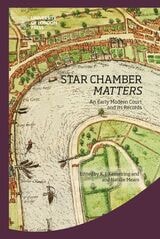
cover of Star Chamber Matters: The Court and Its Records

Star Chamber Matters

The Court and Its Records

Edited by Natalie Mears and Krista Kesselring

University of London Press, 2021

A comprehensive historical study into the birth of the law and legal courts in early modern Britain.
 
Star Chamber Matters details some of the fascinating, tragic, and startling cases brought before the Star Chamber, an English court that sat at the Royal Palace of Westminster from the late fifteenth century to the mid-seventeenth century. Through close examination of the breadth and depth of cases brought before the court in its day, readers will experience the trials and tribulations of life, love, and death in Tudor Britain. These cases touch on changing gender roles, shifting religious views, and more. Star Chamber Matters witnesses the birth of English common and civil law as we know it today.
[more]
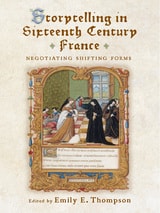
cover of Storytelling in Sixteenth-Century France: Negotiating Shifting Forms

Storytelling in Sixteenth-Century France

Negotiating Shifting Forms

Emily E. Thompson

University of Delaware Press, 2022

Storytelling in Sixteenth-Century France is an innovative, interdisciplinary examination of parallels between the early modern era and the world in which we live today. Readers are invited to look to the past to see how then, as now, people turned to storytelling to integrate and adapt to rapid social change, to reinforce or restructure community, to sell new ideas, and to refashion the past. This collection explores different modalities of storytelling in sixteenth-century France and emphasizes shared techniques and themes rather than attempting to define narrow kinds of narrative categories. Through studies of storytelling in tapestries, stone, and music as well as distinct genres of historical, professional, and literary writing (addressing both erudite and more common readers), the contributors to this collection evoke a society in transition, wherein traditional techniques and materials were manipulated to express new realities. 

Published by the University of Delaware Press. Distributed worldwide by Rutgers University Press. 
[more]
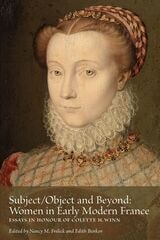
cover of Subject/Object and Beyond: Women in Early Modern France

Subject/Object and Beyond

Women in Early Modern France

Edited by Nancy M. Frelick and Edith Benkov

Iter Press, 2023

A collection of essays on early modern women from a collection of leading figures in the field.

Subject/Object and Beyond brings together essays by established and emerging scholars to honor the exceptionally rich contributions and career of scholar Colette H. Winn. It also celebrates fifty years of sustained scholarship on early modern women, along with the foundation of Women’s Studies as a recognized academic discipline in North America. The collection comprises seventeen articles that explore multiple perspectives on early modern women, including their writings, translations, reception, and contributions to various fields, including literature, music, politics, religion, and science.
[more]