Results by title
805 books match the query '18th Century' and 43 start with s
Sade
A Biographical EssayLaurence L. Bongie
University of Chicago Press, 1998
"A valuable correction to the perception of Sade as a profound thinker, a great writer, and a martyr to liberty. Drawing on original archival work, Bongie tries to illuminate Sade's childhood and his relationship with his parents. . . . Fluent and well-informed."—Library Journal
"Mr. Bongie . . . has written an investigation focusing on one aspect of Sade's character and development, his heretofore neglected relationship with his aristocratic mother. . . . A profitable selection."—Richard Bernstein, New York Times
"A welcome corrective. Bongie's book . . . aims to deflate the exalted claims made about the marquis by demonstrating that he was a monstrous character."—Scott Stossel, Boston Phoenix Literary Supplement

Sappho in Early Modern England
Female Same-Sex Literary Erotics, 1550-1714Harriette Andreadis
University of Chicago Press, 2001
Science in the Age of Sensibility
The Sentimental Empiricists of the French EnlightenmentJessica Riskin
University of Chicago Press, 2002
Riskin argues that sentimental empiricism brought together ideas and institutions, practices and politics. She shows, for instance, how the study of blindness, led by ideas about the mental and moral role of vision and by cataract surgeries, shaped the first school for the blind; how Benjamin Franklin's electrical physics, ascribing desires to nature, engaged French economic reformers; and how the question of the role of language in science and social life linked disputes over Antoine Lavoisier's new chemical names to the founding of France's modern system of civic education.
Recasting the Age of Reason by stressing its conjunction with the Age of Sensibility, Riskin offers an entirely new perspective on the development of modern science and the history of the Enlightenment.
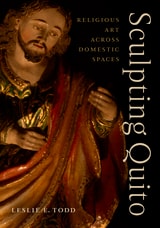
Sculpting Quito
Religious Art across Domestic SpacesLeslie E. Todd
University of Texas Press, 2026
A study of domestic religious sculptures in Quito.
During the eighteenth century, the colonial capital of Quito established itself as a prolific producer of wooden polychrome sculpture. With large glass eyes, smooth shiny surfaces, and minute attention to detail, the sculptures possessed an artistic refinement that enchanted contemporaries. While these objects depicted Christian sacred personages, they were not always sequestered in churches and shrines. They filled domestic spaces, becoming signifiers not only of holiness but also of a distinctive Quitenian culture.
Devotional sculpture was, on its face, an aesthetic reifiction of the colonial project, commissioned by creole elites. However, drawing on published accounts and archival evidence, including wills and dowries, Leslie Todd shows that sculpture was diffused across society, contributing to a complex localized identity. As makers, viewers, and owners of sculpture, Quiteños of Indigenous and mixed heritage and varying socioeconomic backgrounds took active roles in creating the city’s visual culture. In doing so, Todd argues, they simultaneously underscored and challenged colonial class and power systems, investing a European form with styles that revealed and reinforced specifically Spanish American subjectivity.
Selected Drama and Verse
Franciszka Urszula Radziwillowa
Iter Press, 2015
Selected Letters of Edmund Burke
Edmund Burke
University of Chicago Press, 1984

Selected Philosophical, Scientific, and Autobiographical Writings
Marie-Geneviève-Charlotte Thiroux d’Arconville
Iter Press, 2018
Edited and translated by Julie Candler Hayes
The Other Voice in Early Modern Europe: The Toronto Series, volume 58
Separate Paths
Lenapes and Colonists in West New JerseyJean R. Soderlund
Rutgers University Press, 2022
Separate Paths: Lenapes and Colonists in West New Jersey is the first cross-cultural study of European colonization in the region south of the Falls of the Delaware River (now Trenton). Lenape men and women welcomed their allies, the Swedes and Finns, to escape more rigid English regimes on the west bank of the Delaware, offering land to establish farms, share resources, and trade. In the 1670s, Quaker men and women challenged this model with strategies to acquire all Lenape territory for their own use and to sell as real estate to new immigrants. Though the Lenapes remained sovereign and “old settlers” retained their Swedish Lutheran religion and ethnic autonomy, the West Jersey proprietors had considerable success in excluding Lenapes from their land. The Friends believed God favored their endeavor with epidemics of smallpox and other European diseases that destroyed Lenape families and communities. Affluent Quakers also introduced enslavement of imported Africans and Natives—and the violence that sustained it—to a colony they had promoted with the liberal West New Jersey Concessions of 1676-77. Thus, they defied their prior experience of religious persecution and their principles of peaceful resolution of conflict, equality of everyone before God, and the golden rule to treat others as you wish to be treated. Despite mutual commitment to peace by Lenapes, old settlers, and Friends, Quaker colonization had similar results to military conquests of Natives by English in Virginia and New England, and Dutch in the Hudson Valley and northern New Jersey. Still, in alliance with old settlers, Lenape communities survived in areas outside the focus of English colonization, in the Pine Barrens, upper reaches of streams, and Atlantic shore.
Serious Reflections During the Life and Surprising Adventures of Robinson Crusoe with his Vision of the Angelick World
The Stoke Newington EditionDaniel Defoe
Bucknell University Press, 2022

Seven Gothic Dramas, 1789–1825
1789-1825Jeffrey N. Cox
Ohio University Press, 1994
The Gothic drama came at a critical moment in the history of the theater, of British culture, and of European politics in the shadow of France’s revolution and the fall of Napoleon. It offered playwrights a medium to express the prevailing ideological tensions of romanticism and revolution, and also responded to a growing and changing theater audience.
In a wide-ranging introduction, Cox explores Gothic drama’s links with romanticism and its relation to other social and ideological shifts of the day. The texts are presented so as to reflect the dual life of dramatic works—on the stage and on the page. The plays are annotated and accompanied by biographic and bibliographic sketches.
Includes The Kentish Barons, by Francis North; Julia of Louvain; or, Monkish Cruelty, by J.C. Cross; The Castle Spectre, by Matthew G. Lewis; The Captive, by Matthew G. Lewis; De Monfort, by Joanna Baillie; Bertram; or, The Castle of St. Aldobrand, by C.R. Maturin; and Presumption; or, The Fate of Frankenstein, by R.B. Peake.
Sex Changes with Kleist
Katrin Pahl
Northwestern University Press, 2019
Focusing on the theatricality of Kleist’s interventions in the performance of gender, sexuality, and emotion and examining how his dramatic texts unhinge major tenets of classical European theater, Sex Changes with Kleist is vital reading for anyone interested in queer studies, feminist studies, performance studies, literary studies, or emotion studies. This book changes our understanding of Kleist and breathes new life into queer thought.

Sex and the Gender Revolution, Volume 1
Heterosexuality and the Third Gender in Enlightenment LondonRandolph Trumbach
University of Chicago Press, 1998
In Sex and the Gender Revolution, Randolph Trumbach reconstructs the worlds of eighteenth-century prostitution, illegitimacy, sexual violence, and adultery. In those worlds the majority of men became heterosexuals by avoiding sodomy and sodomite behavior.
As men defined themselves more and more as heterosexuals, women generally experienced the new male heterosexuality as its victims. But women—as prostitutes, seduced servants, remarrying widows, and adulterous wives— also pursued passion. The seamy sexual underworld of extramarital behavior was central not only to the sexual lives of men and women, but to the very existence of marriage, the family, domesticity, and romantic love. London emerges as not only a geographical site but as an actor in its own right, mapping out domains where patriarchy, heterosexuality, domesticity, and female resistance take vivid form in our imaginations and senses.
As comprehensive and authoritative as it is eloquent and provocative, this book will become an indispensable study for social and cultural historians and delightful reading for anyone interested in taking a close look at sex and gender in eighteenth-century London.

Sex, Death, and Minuets
Anna Magdalena Bach and Her Musical NotebooksDavid Yearsley
University of Chicago Press, 2019
Sex, Death, and Minuets offers the first in-depth study of these notebooks and their owner, reanimating Anna Magdalena as a multifaceted historical subject—at once pious and bawdy, spirited and tragic. In these pages, we follow Magdalena from young and flamboyant performer to bereft and impoverished widow—and visit along the way the coffee house, the raucous wedding feast, and the family home. David Yearsley explores the notebooks’ more idiosyncratic entries—like its charming ditties on illicit love and searching ruminations on mortality—against the backdrop of the social practices and concerns that women shared in eighteenth-century Lutheran Germany, from status in marriage and widowhood, to fulfilling professional and domestic roles, money, fashion, intimacy and sex, and the ever-present sickness and death of children and spouses. What emerges is a humane portrait of a musician who embraced the sensuality of song and the uplift of the keyboard, a sometimes ribald wife and oft-bereaved mother who used her cherished musical notebooks for piety and play, humor and devotion—for living and for dying.
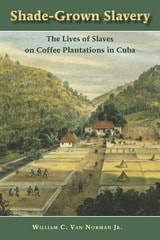
Shade-Grown Slavery
The Lives of Slaves on Coffee Plantations in CubaWilliam C. Van Norman
Vanderbilt University Press, 2013
In this broad, interdisciplinary study, William Van Norman describes how each type of plantation and the amount of manual labor it required directly influenced the nature of slave life in that community. Slaves on coffee plantations lived in a unique context in comparison to that of their fellow slaves on sugar plantations, one that gave them greater flexibility in cultural and artistic creativity. To gain a deeper understanding of plantation slavery in Cuba, Van Norman explores what life and labor was like for coffee slaves and how it was different from what sugar slaves experienced. Shade-Grown Slavery reconstructs their world and in turn deconstructs the picture we now have of Cuba in the late eighteenth and early nineteenth centuries.
Ultimately, Shade-Grown Slavery reveals the lives of enslaved Africans on Cuban coffee plantations and shows how they were able to maintain and transform their cultural traditions in spite of slavery.
Shadow Puppets, Songs, and Sacred Feasts
Celebrations of the Indo-Portuguese Nuns in the Eighteenth-Century Real Convento de Santa Mónica, Goa, India. A Bilingual EditionEdited by Daniel Michon
Iter Press, 2025
The Entrada de Bonifrate para Festa dos Reis, a shadow puppet play for the feast of the Kings, and the Cartepaço da Muzica, a songbook for the feast of St. John, showcase the imaginative minds of the nuns at the Indo-Portuguese Real Convento de Santa Mónica, Goa, India. Composed for private convent audiences, these texts blend Portuguese and Spanish baroque elements with local Goan traditions. The uncensored verses celebrate convent life, critique local social norms, and affirm the nuns’ community identity, exhibiting the Mónicas’ musical talents and literary sensibilities.
Shadows of the Enlightenment
Tragic Drama during Europe’s Age of ReasonEdited by Blair Hoxby
The Ohio State University Press, 2022
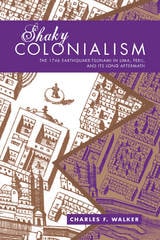
Shaky Colonialism
The 1746 Earthquake-Tsunami in Lima, Peru, and Its Long AftermathCharles F. Walker
Duke University Press, 2008
Through his ambitious rebuilding plan, the Viceroy sought to assert the power of the colonial state over the Church, the upper classes, and other groups. Agreeing with most inhabitants of the fervently Catholic city that the earthquake-tsunami was a manifestation of God’s wrath for Lima’s decadent ways, he hoped to reign in the city’s baroque excesses and to tame the city’s notoriously independent women. To his great surprise, almost everyone objected to his plan, sparking widespread debate about political power and urbanism. Illuminating the shaky foundations of Spanish control in Lima, Walker describes the latent conflicts—about class, race, gender, religion, and the very definition of an ordered society—brought to the fore by the earthquake-tsunami of 1746.

Shareholder Democracies?
Corporate Governance in Britain and Ireland before 1850Mark Freeman, Robin Pearson, and James Taylor
University of Chicago Press, 2011
Understanding the challenges of corporate governance is central to our comprehension of the economic dynamics driving corporations today. Among the most important institutions in capitalism today, corporations and joint-stock companies had their origins in Europe during the seventeenth and eighteenth centuries. And as they became more prevalent, the issue of internal governance became more pressing. At stake—and very much contested—was the allocation of rights and obligations among shareholders, directors, and managers.
This comprehensive account of the development of corporate governance in Britain and Ireland during its earliest stages highlights the role of political factors in shaping the evolution of corporate governance as well as the important debates that arose about the division of authority and responsibility. Political and economic institutions confronted similar issues, including the need for transparency and accountability in decision making and the roles of electors and the elected, and this book emphasizes how political institutions—from election procedures to assemblies to annual reporting—therefore provided apt models upon which companies drew readily. Filling a gap in the literature on early corporate economy, this book provides insight into the origins of many ongoing modern debates.
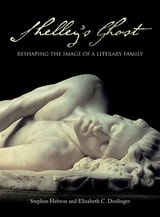
Shelley's Ghost
Reshaping the Image of a Literary FamilyStephen Hebron and Elizabeth C. Denlinger
Bodleian Library Publishing, 2010
It is difficult to think of a family more endowed with literary genius than the Shelley family—from the Romantic poet Percy Bysshe Shelley and his wife, novelist Mary Shelley, to Mary’s parents, William Godwin and Mary Wollstonecraft—all were authors in their own right. Using extensive archival material, Shelley’s Ghost explores the making of this remarkable literary family’s reputation.
Drawing on the Bodleian Library’s outstanding collection of letters, poetry manuscripts, rare printed books, portraits, and other personalia—including Shelley’s working notebooks, Keats’s letters to Shelley, William Godwin’s diary, and the original manuscript of Mary Shelley’s Frankenstein—Stephen Hebron charts the history of this talented yet troubled family. After Percy Bysshe Shelley’s drowning in 1822, Mary published various manuscripts relating to both her husband’s and her father’s lives, and passed this historical legacy to her son, Sir Percy Florence Shelley and his wife, Lady Jane Shelley. As guardians of the archive until they bequeathed it to the Bodleian in 1892, Sir Percy Florence and Lady Jane helped shape the posthumous reputations of these writers. An afterword by Elizabeth Denlinger of the New York Public Library offers an additional perspective, exploring material relating to the Shelley family that slipped beyond the family’s control.
An unparalleled look at one of the most significant families of British Romantic literature, Shelley’s Ghost will be welcomed by scholars and the many fans of this enduring literacy legacy.
Situation Critical
Critique, Theory, and Early American StudiesMax Cavitch and Brian Connolly, editors
Duke University Press, 2024
Contributors. Max Cavitch, Brian Connolly, Matthew Crow, John J. Garcia, Christopher Looby, Michael Meranze, Mark J. Miller, Justine S. Murison, Britt Rusert, Ana Schwartz, Joan W. Scott, Jordan Alexander Stein
Slavery in American Children's Literature, 1790-2010
Paula T. Connolly
University of Iowa Press, 2013
Slavery, Emancipation and Colonial Rule in South Africa
Wayne Dooling
Ohio University Press, 2008
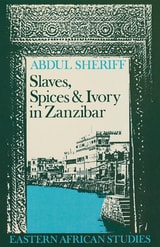
Slaves, Spices and Ivory in Zanzibar
Integration of an East African Commercial Empire into the World Economy, 1770–1873Abdul Sheriff
Ohio University Press, 1987
The rise of Zanzibar was based on two major economic transformations. Firstly slaves became used for producing cloves and grains for export. Previously the slaves themselves were exported.
Secondly, there was an increased international demand for luxuries such as ivory. At the same time the price of imported manufactured gods was falling. Zanzibar took advantage of its strategic position to trade as far as the Great Lakes.
However this very economic success increasingly subordinated Zanzibar to Britain, with its anti-slavery crusade and its control over the Indian merchant class.
Professor Sheriff analyses the early stages of the underdevelopment of East Africa and provides a corrective to the dominance of political and diplomatic factors in the history of the area.
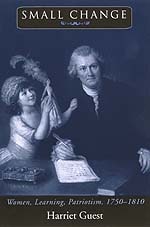
Small Change
Women, Learning, Patriotism, 1750-1810Harriet Guest
University of Chicago Press, 2000
During the second half of the eighteenth century, the social role of educated women and the nature of domesticity were the focus of widespread debate in Britain. The emergence of an identifiably feminist voice in that debate is the subject of Harriet Guest's new study, which explores how small changes in the meaning of patriotism and the relations between public and private categories permitted educated British women to imagine themselves as political subjects.
Small Change considers the celebration of learned women as tokens of national progress in the context of a commercial culture that complicates notions of gender difference. Guest offers a fascinating account of the women of the bluestocking circle, focusing in particular on Elizabeth Carter, hailed as the paradigmatic learned and domestic woman. She discusses the importance of the American war to the changing relation between patriotism and gender in the 1770s and 1780s, and she casts new light on Mary Wollstonecraft's writing of the 1790s, considering it in relation to the anti-feminine discourse of Hannah More, and the utopian feminism of Mary Hays.
Smollett's Britain
Jeremy Black
St. Augustine's Press, 2022
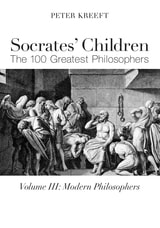
Socrates' Children
Modern: The 100 Greatest PhilosophersPeter Kreeft
St. Augustine's Press, 2016
This is the third of a four-volume history of philosophy . . . on ancient, medieval, modern, and contemporary philosophy. After the fourth volume is produced in paper, a one-volume clothbound edition, containing all four paperbound editions, will be published.
Kreeft focuses on the “big ideas” that have influenced present people and present times, and includes relevant biographical data, proportionate to its importance for each thinker. Moreover, the aim of the work is to stimulate philosophizing, controversy, and argument. It uses ordinary language and logic, not jargon and symbolic logic, and it is commonsensical (like Aristotle) and existential in the sense that it sees philosophy as something to be lived and experienced in life. Philosophy, after all, is not about philosophy but reality . . . about wisdom, life and death, good
and evil, and God.
Kreeft seeks to be simple and direct and clear. But it is not dumbed down and patronizing. It will stretch the reader, but it is meant for beginnings, not just scholars. It can be used for college classes or do-it-yourselfers. It emphasizes surprises; remember, “philosophy begins in wonder.” And it includes visual aids: charts, cartoons, line drawings, and drawings of each philosopher.

Soldiers of the French Revolution
Alan Forrest
Duke University Press, 1989
Revolutionary idealists thought of the French soldier as a willing volunteer sacrificing himself for the principles of the Revolution; Forrest examines the convergence of these ideals with the ordinary, and often dreadful, experience of protracted warfare that the soldier endured.
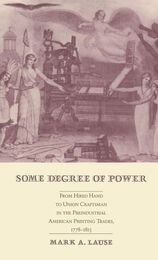
Some Degree of Power
From Hired Hand to Union Craftsman in the Preindustrial American Printing Trades 1778-1815Mark Lause
University of Arkansas Press, 1991
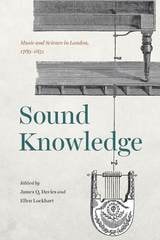
Sound Knowledge
Music and Science in London, 1789-1851Edited by J. Q. Davies and Ellen Lockhart
University of Chicago Press, 2017
Sound Knowledge examines how scientific truth was accrued by means of visual and aural experience, and, in turn, how musical knowledge was located in relation to empirical scientific practice. James Q. Davies and Ellen Lockhart gather work by leading scholars to explore a crucial sixty-year period, beginning with Charles Burney’s ambitious General History of Music, a four-volume study of music around the globe, and extending to the Great Exhibition of 1851, where musical instruments were assembled alongside the technologies of science and industry in the immense glass-encased collections of the Crystal Palace. Importantly, as the contributions show, both the power of science and the power of music relied on performance, spectacle, and experiment. Ultimately, this volume sets the stage for a new picture of modern disciplinarity, shining light on an era before the division of aural and visual knowledge.

Sound Sentiment
Peter Kivy
Temple University Press, 1989
Sowing Empire
Landscape And ColonizationJill H. Casid
University of Minnesota Press, 2005

Spectacular Disappearances
Celebrity and Privacy, 1696-1801Julia H. Fawcett
University of Michigan Press, 2016
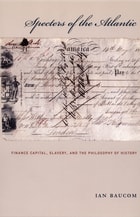
Specters of the Atlantic
Finance Capital, Slavery, and the Philosophy of HistoryIan Baucom
Duke University Press, 2005
Baucom contends that the massacre and the trials that followed it bring to light an Atlantic cycle of capital accumulation based on speculative finance, an economic cycle that has not yet run its course. The extraordinarily abstract nature of today’s finance capital is the late-eighteenth-century system intensified. Yet, as Baucom highlights, since the late 1700s, this rapacious speculative culture has had detractors. He traces the emergence and development of a counter-discourse he calls melancholy realism through abolitionist and human-rights texts, British romantic poetry, Scottish moral philosophy, and the work of late-twentieth-century literary theorists. In revealing how the Zong tragedy resonates within contemporary financial systems and human-rights discourses, Baucom puts forth a deeply compelling, utterly original theory of history: one that insists that an eighteenth-century atrocity is not past but present within the future we now inhabit.

Spies in the Continental Capital
Espionage Across Pennsylvania During the American RevolutionJohn A. Nagy
Westholme Publishing, 2011
The Critical Role of British, French, and American Intelligence Operations in Colonial Pennsylvania
It did not take long after the Seven Years’ War—the French and Indian War in North America—for France to return spies to America in order to determine the likelihood of regaining the territory they lost to Britain. One of the key places of French espionage was the colony of Pennsylvania since its frontier had been an important crossroads of French influence in North America. The French recognized then that there was a real possibility that the colonies would seek their independence from Britain. Against this backdrop, award-winning historian John A. Nagy begins his investigation of espionage in colonial Pennsylvania.
Philadelphia played a key role in the history of spying during the American Revolution because it was the main location for the Continental Congress, was occupied by the British Command, and then returned to Continental control. Philadelphia became a center of spies for the British and Americans—as well as double agents. George Washington was a firm believer in reliable military intelligence; after evacuating New York City, he neglected to have a spy network in place: when the British took over Philadelphia, he did not make the same mistake, and Washington was able to keep abreast of British troop strengths and intentions. Likewise, the British used the large Loyalist community around Philadelphia to assess the abilities of their Continental foes, as well as the resolve of Congress. In addition to describing techniques used by spies and specific events, such as the Major André episode, Nagy has scoured rare primary source documents to provide new and compelling information about some of the most notable agents of the war, such as Lydia Darragh, a celebrated American spy.
An important contribution to Revolutionary War history, Spies in the Continental Capital: Espionage Across Pennsylvania During the American Revolution demonstrates that intelligence operations on both sides emanating from Pennsylvania were vast, well-designed, and critical to understanding the course and outcome of the war.
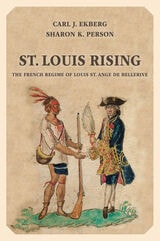
St. Louis Rising
The French Regime of Louis St. Ange de BelleriveCarl J. Ekberg and Sharon K. Person
University of Illinois Press, 2015
Drawing on new source materials, the authors delve into the complexities of politics, Indian affairs, slavery, and material culture that defined the city's founding period. Their alternative version of the oft-told tale uncovers the imperial realities--as personified by St. Ange--that truly governed in the Illinois Country of the time, and provide a trove of new information on everything from the fur trade to the arrival of the British and Spanish after the Seven Years' War.
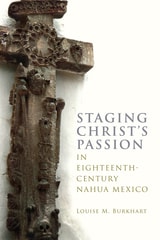
Staging Christ's Passion in Eighteenth-Century Nahua Mexico
Louise M. Burkhart
University Press of Colorado, 2023
A cast with over fifty distinct roles acted out events extending from Palm Sunday to Christ’s death on the cross. One actor became a localized embodiment of Jesus through a process of investiture and mimesis that carried aspects of pre-Columbian materialized divinity into the later colonial period. The play told afar richer version of the Passion story than what later colonial Nahuas typically learned from their priests or catechists. And by assimilating Jesus to an Indigenous, or macehualli, identity, the players enacted a protest against colonial rule.
The situation in eighteenth-century New Spain presents both a unique confrontation between Indigenous communities and Enlightenment era religious reformers and a new chapter in an age-old power game between popular practice and religious orthodoxy. By focusing on how Nahuas localized the universalizing narrative of Christ’s Passion, Staging Christ’s Passion in Eighteenth-Century Nahua Mexico offers an unusually in-depth view of religious life under colonial rule.
Burkhart’s accompanying website also makes available transcriptions and translations of the six Nahuatl-language plays, four Spanish-language plays composed in response to the suppression of the Nahuatl practice, and related documentation, providing a valuable resource for anyone interested in consulting the original material.
Comments restricted to single page
plays composed in response to the suppression of the Nahuatl practice, and related documentation,
providing a valuable resource for anyone interested in consulting the original material
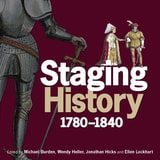
Staging History
1780-1840Edited by Michael Burden, Wendy Heller, Jonathan Hicks, and Ellen Lockhart
Bodleian Library Publishing, 2016
Drawing on copious new research, Staging History reexamines extraordinary theatrical works of the period to show the role they played in shaping popular interpretations of history. Editors Michael Burden, Wendy Heller, Jonathan Hicks, and Ellen Lockhart are joined by other experts in the field in analyzing theatrical documents, including playbills, set designs, and musical scores, as well as paintings, prints, and other illustrations, in order to explore what counted as historical truth for the writers, performers, and audiences of these plays.
Statesmanship and Party Government
A Study of Burke and BolingbrokeHarvey C. Mansfield
University of Chicago Press, 1965
Mansfield points out that while parties have always existed, the party government that we know today is possible only because parties are now considered respectable. In Burke’s day, however, they were thought by detractors to be a cancer in a free polity. Even many supporters of the parties viewed them as a dangerous instrument, only to be used cautiously by statesmen in dire times. Burke, however, was an early champion of the party system in Britain and made his arguments with a clear-eyed realism. In Statesmanship and Party Government, Mansfield provides a skillful evaluation of Burke’s writings and sheds light present-day party politics through a profound understanding of the historical background of the their inception.
Subverting Colonial Authority
Challenges to Spanish Rule in Eighteenth-Century Southern AndesSergio Serulnikov
Duke University Press, 2003
Drawing on court records, government papers, personal letters, census documents, and other testimonies from Bolivian and Argentine archives, Subverting Colonial Authority addresses issues that illuminate key aspects of indigenous rebellion, European colonialism, and Andean cultural history. Serulnikov analyzes long-term patterns of social conflict rooted in local political cultures and regionally based power relations. He examines the day-to-day operations of the colonial system of justice within the rural villages as well as the sharp ideological and political strife among colonial ruling groups. Highlighting the emergence of radical modes of anticolonial thought and ethnic cooperation, he argues that Andean peasants were able to overcome entrenched tendencies toward internal dissension and fragmentation in the very process of marshaling both law and force to assert their rights and hold colonial authorities accountable. Along the way, Serulnikov shows, they not only widened the scope of their collective identities but also contradicted colonial ideas of indigenous societies as either secluded cultures or pliant objects of European rule.
Sukeroku’s Double Identity
The Dramatic Structure of Edo KabukiBarbara E. Thornbury
University of Michigan Press, 1982
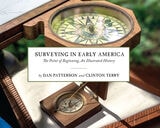
Surveying in Early America
The Point of Beginning, An Illustrated HistoryDan Patterson; Clinton Terry
Ohio University Press, 2020
Published by the University of Cincinnati Press
In Surveying in Early America: The Point of Beginning, An Illustrated History, award-winning photographer Dan Patterson and American historian Clinton Terry vividly examine the profession of surveying in the eighteenth century. Retracing the steps Washington and other surveyors took to map the Ohio River Valley, readers are immersed in historically accurate details of early surveying techniques and practices. Terry's narrative describes the practice of land and survey measurement—methods that did not substantially change until the invention of GPS technology 200 years later. Over 100 full color photographs exclusively shot for the book depict authentic and historically accurate reproductions of tools along with early American reenactors to provide an interpretive look at surveying as a primary means to building the American nation. Working with the Department of the Geographer, Patterson restages actual expeditions, brilliantly displaying the techniques and instruments Washington would have employed 260 years ago. Through the lens of Patterson's camera and Terry's accompanying narrative, readers see what Washington saw as he learned his trade, explored the vast American wilderness, and occasionally laid personal claim to great expanses of land along the way.
Sweet Science
Romantic Materialism and the New Logics of LifeAmanda Jo Goldstein
University of Chicago Press, 2017
Goldstein puts apparently literary projects, such as William Blake’s poetry of embryogenesis, Goethe’s journals On Morphology, and Percy Shelley’s “poetry of life,” back into conversation with the openly poetic life sciences of Erasmus Darwin, J. G. Herder, Jean-Baptiste Lamarck, and Étienne Geoffroy Saint-Hilaire. Such poetic sciences, Goldstein argues, share in reviving Lucretius’s De rerum natura to advance a view of biological life as neither self-organized nor autonomous, but rather dependent on the collaborative and symbolic processes that give it viable and recognizable form. They summon De rerum natura for a logic of life resistant to the vitalist stress on self-authorizing power and to make a monumental case for poetry’s role in the perception and communication of empirical realities. The first dedicated study of this mortal and materialist dimension of Romantic biopoetics, Sweet Science opens a through-line between Enlightenment materialisms of nature and Marx’s coming historical materialism.
Symbolic Space
French Enlightenment Architecture and Its LegacyRichard A. Etlin
University of Chicago Press, 1994
For Etlin, the eighteenth-century city was a place in which actual physical space was subjected to a complex mental layering of conceptual spaces. He focuses on the design theory of Boullée and Durand and charts their legacy through the architecture of Paul Philippe Cret, Frank Lloyd Wright, and Louis Kahn. He defines the distinctive features of neoclassicism and outlines the new grammar for classical architecture articulated by theorists and architects such as Laugier, Leroy, and Ledoux.
After discussing the eighteenth-century hôtel, revolutionary space, and the transformation of the image of the cemetery, Etlin examines the space of absence as embodied in commemorative architecture from Boullée and Gilly to Cret, Wright, and Terragni. His book provides an accessible introduction to a century of architecture that transformed the classical forms of the Renaissance and Baroque periods into building types still familiar today.