Results by title
93 books match the query '1946-' and 8 start with s
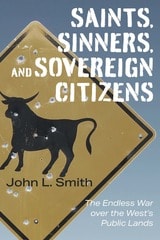
Saints, Sinners, and Sovereign Citizens
The Endless War over the West's Public LandsJohn L. Smith
University of Nevada Press, 2026
The grazing rights battle between Nevada rancher Cliven Bundy and the federal government, resulting in a tense, armed standoff between Bundy’s supporters and federal law enforcement officers, garnered international media attention in 2014. Saints, Sinners, and Sovereign Citizens places the Bundy conflict into the larger context of the Sagebrush Rebellion and the long struggle over the use of federal public lands in the American West.
Author John L. Smith skillfully captures the drama of the Bundy legal tangle amid the current political climate. Although no shots were fired during the standoff itself, just weeks later self-proclaimed Bundy supporters murdered two Las Vegas police officers and a civilian. In Eastern Oregon, other Bundy supporters occupied the federal offices of the Malheur National Wildlife Refuge, and one of them died in a hail of bullets.
While examining the complex history of federal public land policies, Smith exposes both sides of this story. He shows that there are passionate true believers on opposite sides of the insurrection, along with government agents and politicians in Washington complicit in efforts to control public lands for their wealthy allies and campaign contributors. With the promise of billions of dollars in natural resource profits and vast tracts of environmentally sensitive lands hanging in the balance, the West’s latest range war is the most important in the nation’s history. This masterful exposé raises serious questions about the fate of America’s public lands and the vehement arguments that are framing the debate from all sides.

San Juan
Memoir of a CityEdgardo Rodriguez Julia; Translated by Peter Grandbois
University of Wisconsin Press, 2007
In the allusive cityscape he recreates, Rodríguez Juliá invokes the ghosts of his childhood, of San Juan's elder literati, and of characters from his own novels. On the most tangible level, the city is a place of cabarets and cockfighting clubs, flâneurs and beach bums, smoke-filled bars and honking automobiles. Poised between a colonial past and a commercial future, the San Juan he portrays feels at times perilously close to the pitfalls of modernization. Tenement houses and fading mansions yield to strip malls and Tastee Freezes; asphalt hems in jacarandas and palm trees. "In Puerto Rico," he muses, "life is not simply cruel, it is also busy erasing our tracks." Through this book—available here in English for the first time—Rodríguez Juliá resists that erasure, thoughtfully etching a palimpsest that preserves images of the city where he grew up and rejoicing in the one where he still lives.
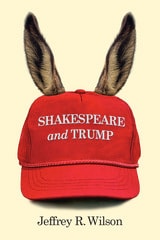
Shakespeare and Trump
Jeffrey R. Wilson
Temple University Press, 2020
Should we draw an analogy between Shakespeare’s tyrants—Richard III, Julius Caesar, Macbeth, and King Lear—and Donald Trump? In Shakespeare and Trump, Jeffrey Wilson applies literary criticism to real life, examining plot, character, villainy, soliloquy, tragedy, myth, and metaphor to identify the formal features of the Trump phenomenon, and its hidden causes, structure, and meanings.
Wilsonapproaches his comparison prismatically. He first considers two high-concept (read: far-fetched) Shakespeare adaptations penned by Trump’s former chief political strategist Steve Bannon. He looks at University of Pennsylvania students protesting Trump by taking down a monument to Shakespeare. He reads Trump’s first 100 days in office against Netflix’s House of Cards. Wilson also addresses the summer 2017 Shakespeare in the Park production of Julius Caesar wherein an assassination of a Trump-ian leader caused corporations to withdraw sponsorship.
These stories reveal a surprising—and bizarre—relationship between the provincial English playwright and the billionaire President of the United States, ostensibly a medieval king living in a modern world. The comparison reveals a politics that blends villainy and comedy en route to tragedy.
Soldiers Once and Still
Ernest Hemingway, James Salter, and Tim O'BrienAlex Vernon
University of Iowa Press, 2007
Hemingway, Salter, and O’Brien form the core of Soldiers Once and Still because each represents a different warring generation of twentieth-century America: World War I with Hemingway, World War II and Korea with Salter, and Vietnam with O’Brien. Each author also represents a different literary voice of the twentieth century, from modern to mid-century to postmodern, and each presents a different battlefield experience: Hemingway as noncombatant, Salter as air force fighter pilot, and O’Brien as army grunt.
War’s pervasive influence on the individual means that, for veterans-turned-writers like Hemingway, Salter, and O’Brien, the war experience infiltrates their entire body of writing—their works can be seen not only as war literature but also as veterans’ literature. As such, their entire postwar oeuvre, regardless of whether an individual work explicitly addresses the war or the military, is open to Vernon’s exploration of war, society, gender, and literary history.
Vernon’s own experiences as a soldier, a veteran, a writer, and a critic inform this enlightening critique of American literature, offering students and scholars of American literature and war studies an invaluable tool for understanding war’s effects on the veteran writer and his society.
Soul Covers
Rhythm and Blues Remakes and the Struggle for Artistic Identity (Aretha Franklin, Al Green, Phoebe Snow)Michael Awkward
Duke University Press, 2007
Awkward sees Franklin’s early album Unforgettable: A Tribute to Dinah Washington, released shortly after Washington’s death in 1964, as an attempt by a struggling young singer to replace her idol as the acknowledged queen of the black female vocal tradition. He contends that Green’s album Call Me (1973) reveals the performer’s attempt to achieve formal coherence by uniting seemingly irreconcilable aspects of his personal history, including his career in popular music and his religious yearnings, as well as his sense of himself as both a cosmopolitan black artist and a forlorn country boy. Turning to Snow’s album Second Childhood (1976), Awkward suggests that through covers of blues and soul songs, Snow, a white Jewish woman from New York, explored what it means for non-black enthusiasts to perform works considered by many to be black cultural productions. The only book-length examination of the role of remakes in American popular music, Soul Covers is itself a refreshing new take on the lives and work of three established soul artists.
Sovereignty, Inc.
Three Inquiries in Politics and EnjoymentWilliam Mazzarella, Eric L. Santner, and Aaron Schuster
University of Chicago Press, 2020
Drawing on anthropology, political theory, philosophy, psychoanalysis, and theater, William Mazzarella, Eric L. Santner, and Aaron Schuster show how politics in the age of Trump functions by mobilizing a contradictory and convoluted enjoyment, an explosive mixture of drives and fantasies that eludes existing portraits of our era. The current political moment turns out to be not so much exceptional as exceptionally revealing of the constitutive tension between enjoyment and economy that has always been a key component of the social order. Santner analyzes the collective dream-work that sustains a new sort of authoritarian charisma or mana, a mana-facturing process that keeps us riveted to an excessively carnal incorporation of sovereignty. Mazzarella examines the contemporary merger of consumer brand and political brand and the cross-contamination of politics and economics, warning against all too easy laments about the corruption of politics by marketing. Schuster, focusing on the extreme theatricality and self-satirical comedy of the present, shows how authority reasserts itself at the very moment of distrust and disillusionment in the system, profiting off its supposed decline. A dazzling diagnostic of our present, Sovereignty, Inc., forces us to come to terms with our complicity in Trump’s political presence and will immediately take its place in discussions of contemporary politics.
Steven Spielberg's Children
Linda Ruth Williams
Rutgers University Press, 2025
Steven Spielberg’s Children presents children and childhood in some surprising ways, not only analyzing boyhood and girlhood according to Spielberg, but considering children as alien, adult-children who refuse to grow up, and children who aren’t even human. It discusses the way in which children have served to cast Spielberg as a sentimentalist, but also how they are more frequently framed as complex, cruel, and canny. The child might be dangled as bait in an exploitation horror scenario (Jaws), might become the image of universal higher beings (Close Encounters of the Third Kind), or might be a young cultural creator like the director was himself (The Fabelmans), "born with a camera glued to [his] eye." The child, on both sides of the camera, is a resonant image, signifying all that adult culture wants it to be, yet resisting this through authorship of their own stories. The book also looks at Spielberg's young actors in the long history of child stars in theater and cinema, and how Spielberg’s children have fared as performers and celebrities.
Sugar Bush Babies
Stories of My Ojibwe GrandmotherJanis A. Fairbanks
University of Minnesota Press, 2025
A memoir of lessons learned from an Ojibwe grandmother during the time of Relocation
Why, her mother asked, did Janis keep running away from kindergarten? She wanted to go home. But not to the house they had just moved to in Duluth, with its gravel yard and traffic noise. She was a country girl, and home was the log cabin among the wildflowers on the Leech Lake Indian Reservation in Bena, Minnesota. Knowing they were now going to stay in the city, Janis’s parents offered her a compromise: during the summer, Janis could leave the bustle of Duluth and live with her grandmother on the Fond du Lac Reservation, listening to stories, learning Ojibwe, and finding her place in the world. In Sugar Bush Babies, Janis A. Fairbanks returns to that time of Relocation, dislocation, and discovery, taking us home with her through stories of childhood and lessons learned at her grandmother’s knee, enveloped in love and tradition.
Through the eyes of a child and the teachings of an elder, Fairbanks revisits her life during Indian Relocation from reservations to urban areas, from Ojibwe villages to white communities whose ideas about Indians came from Hollywood Westerns. Recalling her early childhood at Leech Lake, her school days in Duluth, and her summers in Fond du Lac, Janis brings the gifts of living history full circle, continuing the traditions of carrying family lore, women’s wisdom, and Indigenous culture from generation to generation.
There are tales told at nighttime or during thunderstorms; lessons in Native medicine; stories of Grandma’s recollections of boarding school, Daddy’s days as a lumberjack, and Mother’s special powers; memories of wash days and dancing, of powwows and Girl Scout camp, of snaring rabbits, selling lilacs, and attending the circus. A lyrical memoir, Sugar Bush Babies conveys the eloquence of women speaking and sharing through generations and the lasting power of tradition.