Results by title
81 books match the query '1980-' and 3 start with s
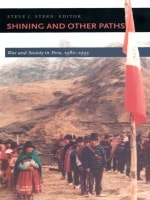
Shining and Other Paths
War and Society in Peru, 1980-1995Steve J. Stern, ed.
Duke University Press, 1998
The contributors—a team of Peruvian and U.S. historians, social scientists, and human rights activists—explore the origins, social dynamics, and long-term consequences of the effort by Shining Path to effect an armed communist revolution. The book begins by interpreting Shining Path’s emergence and decision for war as one logical culmination, among several competing culminations, of trends in oppositional politics and social movements. It then traces the experiences of peasants and refugees to demonstrate how human struggle and resilience came together in grassroots determination to defeat Shining Path, and explores the unsuccessful efforts of urban shantytown dwellers, as well as rural and urban activists, to build a “third path” to social justice. Integral to this discussion is an examination of women’s activism and consciousness during the years of the crisis. Finally, this book analyzes the often paradoxical and unintended legacies of this tumultuous period for social and human rights movements, and for presidential and military leadership in Peru.
Extensive field research, broad historical vision, and strong editorial coordination enable the authors to write a coherent and deeply humanistic account, one that draws out the inner tragedies, ambiguities, and conflicts of the war.
Providing historically grounded explication of the conflicts that reshaped contemporary Peru, Shining and Other Paths will be widely read by Latin Americanists, historians, anthropologists, gender theorists, sociologists, political scientists, and human rights activists.
Contributors. Jo-Marie Burt, Marisol de la Cadena, Isabel Coral Cordero, Carlos Iván Degregori, Iván Hinojosa, Carlos Basombrío Iglesias, Florencia E. Mallon, Nelson Manrique, Hortensia Muñoz, Enrique Obando, Patricia Oliart, Ponciano del Pino H., José Luis Rénique, Orin Starn, Steve J. Stern
Somebody Told Me
The Newspaper Stories of Rick BraggRick Bragg
University of Alabama Press, 2000
Over the past twenty years, writer Rick Bragg has earned legions of fans with his award-winning newspaper stories and with his critically aclaimed memoir All Over but the Shoutin'. His unique storytelling talent and his sympathy for the day-to-day struggles of everyday people set him apart from journalists who focus on political intrigue and the foibles of the rich and famous.
This collection showcases Bragg's talent for turning seemingly ordinary situations into extraordinary stories by bringing together more than sixty of his most recent feature articles, most of them written for the New York Times. Bragg explores such questions as: What happens to someone released from prison for a crime he didn't commit? Who takes care of the graves of poor people? What keeps an elderly woman from selling her land for a tidy profit? Bragg's curiosity often leads him to society's margins, where he wins the confidence of those who have good reason to mistrust others.
Bragg has reported on some of the most newsworthy tragedies in the nation, and his unfolding coverage of events such as the Oklahoma City bombing and the Susan Smith child murders is included here. Once again, though, his special ability to connect with people allows him accesss and perspectives that many other reporters do not achieve.
Whether he's profiling the sheriff who broke the Smith case or relating the efforts of Alabama churchgoers to understand a Sunday morning tornado strike, Bragg writes with genuine compassion and sentiment but without being sensationalist. He looks where others don’t and gets behind the headlines to the people standing there stunned and often, until he finds them, voiceless. When asked how he came up with his remarkable stories, Bragg has his answer down pat: “Somebody told me.”
Symbiotic Antagonisms
Competing Nationalisms in TurkeyAyse Kadioglu
University of Utah Press, 2011
Utah Series in Middle East Studies
Today, nationalism and nationalist sentiments are becoming more and more pronounced, creating a global emergence of ethno-nationalist and religious fundamentalist identity conflicts. In the post-9/11 era of international terrorism, it is appropriate to suggest that nationalism will retain its central place in politics and local and world affairs for the foreseeable future. It is in this vein that there has been a recent upsurge of interest concerning the power of nationalist tendencies as one of the dominant ideologies of modern times.
Symbiotic Antagonisms looks at the state-centric mode of modernization in Turkey that has constituted the very foundation on which nationalism has acquired its ideological status and transformative power. The book documents a symposium held at Sabanci University, presenting nationalism as a multidimensional, multiactor-based phenomenon that functions as an ideology, a discourse, and a political strategy. Turkish, Kurdish, and Islamic nationalisms are systematically compared in this timely and significant work.