Results by title
56 books match the query 'Actors' and 3 start with s

Shakespeare the Actor and the Purposes of Playing
Meredith Anne Skura
University of Chicago Press, 1993
Despite the obvious differences between our theater and Shakespeare's, sixteenth-century testimony suggests that the experience of acting has not changed much over the centuries. Beginning with a psychoanalytically informed account of acting today, Skura shows how this intense and ambivalent experience appears not only in literal references to acting in Shakespearean drama but also in recurring narrative concerns, details of language, and dramatic strategies used to engage the audience. Looking at the plays in the context of both public and private worlds outside the theater, Skura rereads the canon to identify new configurations in the plays and new ways of understanding theatrical self-consciousness in Renaissance England. Rich in theatrical, psychoanalytic, biographical, and historical insight, this book will be invaluable to students of Shakespeare and instructive to all readers interested in the dynamics of performance.
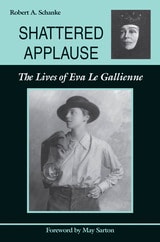
Shattered Applause
The Lives of Eva Le GallienneRobert A. Schanke. Foreword by May Sarton
Southern Illinois University Press, 1992
This comprehensive biography of the actress film critic Rex Reed called “a national treasure” draws on Robert A. Schanke’s interviews and correspondence not only with Eva Le Gallienne but also with more than one hundred of her colleagues and friends, including Glenda Jackson, Burgess Meredith, Eli Wallach, Peter Falk, Ellen Burstyn, Anne Jackson, Farley Granger, Jane Alexander, Uta Hagen, and Rosemary Harris. Forty-two illustrations offer highlights of Le Gallienne’s many notable performances in such plays as Hedda Gabler, Liliom, The Cherry Orchard, Peter Pan, Camille, Mary Stuart, The Royal Family,and The Dream Watcher.
Behind her public role as a famous actress and as the founding and maintaining force of the first civic repertory theatre in the United States, Eva Le Gallienne led a private life complicated by her identity as a lesbian. Schanke considers Le Gallienne’s sexuality and how it played a role in the struggles, defeats, and triumphs that combined to inspire her greatness. Shattered Applause, a finalist for the Lambda Literary Award for Lesbian Nonfiction, tells a fascinating story that also serves as a barometer of the changing values, tastes, and attitudes of American society.
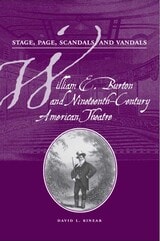
Stage, Page, Scandals, & Vandals
William E. Burton and Nineteenth-Century American TheatreDavid L. Rinear
Southern Illinois University Press, 2004
In this first modern book-length biography of native Englander William E. Burton, theatre historian David L. Rinear explores Burton’s diary, letters, published reviews, and various reminiscences to reveal the tumultuous personal and professional lives of the mid-nineteenth-century actor/manager and his role in American literary history. Stage, Page, Scandals, and Vandals: William E. Burton and Nineteenth-Century American Theatre also provides insight into the cultural and artistic climate of an early period in American history when the country was still forming a national identity.
Burton fled England in 1834 and came to America in the wake of a public scandal caused by his marriage to a sixteen-year-old orphan. Burton was then already married with a ten-year-old son. Settling in Philadelphia, the thirty-two-year-old actor rapidly established himself in the city’s theatrical productions and quickly became an audience favorite.
In 1837, while continuing to act, Burton founded and edited The Gentleman’s Magazine, a monthly literary publication later called Burton’s Gentleman’s Magazine. Burton hired struggling author Edgar Allan Poe as coeditor, and the journal achieved literary acclaim as it first published many of Poe’s short stories and poems.
Burton sold the journal in 1841 and used the money to build a new theatre, which he managed, although the depression of the early 1840s soon drove his venture out of business. After declaring bankruptcy the following year, Burton worked as a touring actor before returning to theatre management in 1845. For the next thirteen years, Burton managed a succession of theatres in Philadelphia, Baltimore, and New York.
Burton’s work as a producer of Shakespearean comedies and romances marks him as the first of the intellectual theatre managers to raise the theatrical experience from mere popular culture to high art. Burton made a fortune in his ventures, amassed the finest private Shakespearean library in the country, and built a grand seaside estate in Glen Cove, Long Island. Shrewd in his personal affairs and in business, Burton also had a violent temper, which led him to viciously attack his competitors. His peculiar domestic relationships marred his brilliant career as an actor, manager, and man of letters; he may have been married to three women at once and lived with two of these women simultaneously.
Fully revealing Burton’s contributions to American culture, Rinear traces Burton’s personal and professional pursuits from his emigration to his death in 1860. Bolstered by twenty-two illustrations, Stage, Page, Scandals, and Vandals sheds light on the history of American entertainment during the antebellum era, exposes the ruthless business practices required to succeed in theatre and literary magazine publishing, and reveals a sense of what constituted celebrity status in mid-nineteenth-century America.