Results by title
51 books match the query 'American Sign Language' and 12 start with s

Seeing Language in Sign
The Work of William C. StokoeJane Maher
Gallaudet University Press, 1996
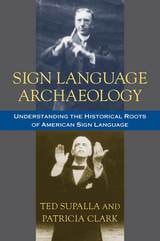
Sign Language Archaeology
Understanding the Historical Roots of American Sign LanguageTed Supalla
Gallaudet University Press, 2014
By tracing the writings of selected individuals, this study reconstructs the historical context for early ASL grammar. It describes the language used in each century and how it changed, and focuses on the rediscovery of the literary legacy of the Deaf American voice. Sign Language Archaeology reveals the contrast between folk etymology and scientific etymology and allows readers to see ASL in terms of historical linguistics.
Sign Language Interpreting
Deconstructing the Myth of NeutralityMelanie Metzger
Gallaudet University Press, 1998
Sign Language Interpreting relies upon an interactional sociolinguistic approach to ask fundamental questions regarding interpreter neutrality. First, do interpreters influence discourse, and if so, how? Also, what kind of expectations do the participants bring to the event, and what do the interpreters bring to discussions? Finally, how do their remarks affect their alignment with participants in the interaction? Using careful assessments of how these interviews were framed, and also re-interviewing the participants for their perspectives, this penetrating book discloses the ways in which interpreters influence these situations. It also addresses the potential implications of these findings regarding sign language interpretation in medical, educational, and all other general interactions. Interpreter trainers and their students will join certified interpreters and Deaf studies scholars in applauding and benefiting from the fresh ground broken by this provocative study.
Sign-Me-Fine
Laura Greene
Gallaudet University Press, 1989

Signing Fun
American Sign Language Vocabulary, Phrases, Games, and ActivitiesPenny Warner
Gallaudet University Press, 2006
Here’s a great book for every young adult age 11 up, Signing Fun: American Sign Language Vocabulary, Phrases, Games, and Activities. Signing is visual, easy to learn, and fun to use. Author Penny Warner offers 441 useful signs on a variety of favorite topics: activities, animals, fashion, food, holidays, home, outdoors, parties, people, places, play, emotions, school, shopping, travel, plus extra fun signs for especially popular words. Each chapter includes practice sentences using everyday phrases to help new signers learn in a fun way.
Signing Fun provides dozens of entertaining games and activities, too, such as Alphabet Sign, Finger Fun Gesture Guess, Match Signs, Mime and Sign, Oppo-Sign, Picture Hand, Secret Sign, Sign-A-Gories, Signo Bingo, Snap and Sign, and Truth or Sign. It also features a list of tips on how to sign, including how to fingerspell, use numbers, and communicate with deaf people. Whimsical drawings clearly illustrate all of the signs, and a full index lists all of their English meanings for quick reference. Signing Fun is a terrific first book for learning sign while having a great time.

Signing With Your Clients
Florence Vold
Gallaudet University Press, 2001
Especially for use with deaf and hard-of-hearing clients, Signing with Your Clients shows how to sign the questions and statements most frequently used by clinicians.
More than 500 line drawings illustrate the signs for 237 sentences with translations printed below. Each sentence begins and ends on the same page, and the spiral binding allows pages to be flipped easily, to leave hands free for signing. A special glossary with technical terms allows the creation of original sentences.
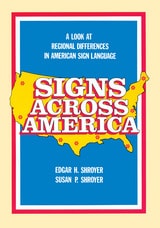
Signs Across America
Edgar H. Shroyer
Gallaudet University Press, 1984
Signs and Voices
Deaf Culture, Identity, Language, and ArtsKristin A. Lindgren
Gallaudet University Press, 2008
Cochlear implants, mainstreaming, genetic engineering, and other ethical dilemmas confronting deaf people mandated a new, wide-ranging examination of these issues, fulfilled by Signs and Voices: Deaf Culture, Identity, Language, and Arts. This collection, carefully chosen from the 2004 Signs and Voices Conference, the Presidential Forum on American Sign Language at the Modern Language Association Convention, and other sources, addresses all of the factors now changing the cultural landscape for deaf people. To ensure quality and breadth of knowledge, editors Kristin A. Lingren, Doreen DeLuca, and Donna Jo Napoli selected the work of renowned scholars and performers Shannon Allen, H-Dirksen L. Bauman, Adrian Blue, Brenda Jo Brueggemann, Teresa Blankmeyer Burke, Peter Cook, David P. Corina, Michael Davidson, Kristen Harmon, Tom Humphries, Sotaro Kita, Heather Knapp, Robert G. Lee, Irene W. Leigh, Kenny Lerner, Carole Neidle, Peter Novak, AslI Özyürek, David M. Perlmutter, Anne Senghas, and Ronnie Wilbur.
Signs and Voices is divided into three sections—Culture and Identity, Language and Literacy, and American Sign Language in the Arts—each of which focuses on a particular set of theoretical and practical concerns. Also, the included DVD presents many of the performances from the Arts section. Taken together, these essays and DVD point to new directions in a broad range of fields, including cognitive science, deaf studies, disability studies, education, linguistics, literary criticism, philosophy, and psychology. This extraordinary showcase of innovative and rigorous cross-disciplinary study will prove invaluable to everyone interested in the current state of the Deaf community.

Signs and Wonders
Religious Rhetoric and the Preservation of Sign LanguageTracy Ann Morse
Gallaudet University Press, 2014
In Chapter One, Morse analyzes Thomas Hopkins Gallaudet’s use of religious references in his 1817 maiden address at the first American school for deaf students. She examines his and other speeches as examples of the intersection of education for deaf Americans and Protestant missionary efforts to convert them. In the second chapter, she presents the different religious perspectives of the two deaf education camps: Manualists argued that sign language was a gift from God, while Oralists viewed hand gestures as animal-like, indicative of lower evolutionary development.
Chapter Three explores the religious rhetoric in churches, sanctuaries where sign language flourished and deaf members formed relationships. In the fourth chapter, Morse shows how Deaf activist George Veditz signed using religious themes in his political films. She also comments on the impact of the bilingual staging of Big River: The Adventures of Huckleberry Finn, which began to change the hearing world’s opinion about the Deaf community. Morse concludes with speculation on the shifting terrain for deaf people due to technological innovations that might supplant religious rhetoric as a tool to support the Deaf community.
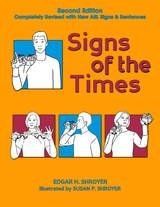
Signs of the Times
Edgar H. Shroyer
Gallaudet University Press, 2011
•Completely Revised with New Signs and Lessons
•Each Sign Illustration Features Sentences in English and ASL Order
•New Class Activities and New Student Activities for Homework or Quizzes
•New Facts about American Sign Language Grammar and Deaf Culture
Now, the bestselling American Sign Language textbook Signs of the Times has been completely revised and updated. The new, second edition is an excellent beginner’s American Sign Language textbook designed for use in the classroom or at home. Organized into 44 lessons, it presents more than 1,300 signs representing 3,500 English glosses. Each lesson contains clear illustrations of all signs, English equivalent words and synonyms, sample sentences to define vocabulary context, and practice sentences to display and reinforce ASL usage.
Signs of the Times is a complete text that includes new class activities for teachers, plus new student activities that can be done in class, as homework, or as quizzes. The new edition features the Contextual Sign/Word Appendix, which displays groups of sentences using the same English word to show different meanings along with the corresponding ASL signs. It also provides an expanded index, vocabulary lists, and a reading reference list. The new edition offers facts on ASL grammar and Deaf culture and includes mind ticklers that enliven the lessons with hints, tips, and mnemonic devices.
The new Signs of the Times expands the features that made it a standard, easy-to-use ASL textbook. Signs are repeated in sentences throughout the book to provide excellent practice for the students. The clear, easy-to-understand sign illustrations facilitates the learning process, enhancing students’ success while also making ASL fun.
Sociolinguistic Pathways in Sign Languages
Studies in Honor of Ceil LucasJoseph C. Hill
Gallaudet University Press, 2026
Sociolinguistic Variation in American Sign Language
Ceil Lucas
Gallaudet University Press, 2001