64 books match the query 'American prose literature' and 3 start with s
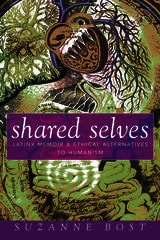
cover of Shared Selves: Latinx Memoir and Ethical Alternatives to Humanism

Shared Selves

Latinx Memoir and Ethical Alternatives to Humanism

Suzanne Bost

University of Illinois Press, 2019
Memoir typically places selfhood at the center. Interestingly, the genre's recent surge in popularity coincides with breakthroughs in scholarship focused on selfhood in a new way: as an always renewing, always emerging entity. Suzanne Bost draws on feminist and posthumanist ideas to explore how three contemporary memoirists decenter the self. Latinx writers John Rechy, Aurora Levins Morales, and Gloria E. Anzaldúa work in places where personal history intertwines with communities, environments, animals, plants, and spirits. This dedication to interconnectedness resonates with ideas in posthumanist theory while calling on indigenous worldviews. As Bost argues, our view of life itself expands if we look at how such frameworks interact with queer theory, disability studies, ecological thinking, and other fields. These webs of relation in turn mediate experience, agency, and lift itself.A transformative application of posthumanist ideas to Latinx, feminist, and literary studies, Shared Selves shows how memoir can encourage readers to think more broadly and deeply about what counts as human life.
[more]
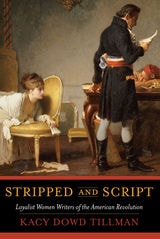
cover of Stripped and Script: Loyalist Women Writers of the American Revolution

Stripped and Script

Loyalist Women Writers of the American Revolution

Kacy Dowd Tillman

University of Massachusetts Press, 2019

Female loyalists occupied a nearly impossible position during the American Revolution. Unlike their male counterparts, loyalist women were effectively silenced—unable to officially align themselves with either side or avoid being persecuted for their family ties. In this book, Kacy Dowd Tillman argues that women's letters and journals are the key to recovering these voices, as these private writings were used as vehicles for public engagement. Through a literary analysis of extensive correspondence by statesmen's wives, Quakers, merchants, and spies, Stripped and Script offers a new definition of loyalism that accounts for disaffection, pacifism, neutralism, and loyalism-by-association. Taking up the rhetoric of violation and rape, this archive repeatedly references the real threats rebels posed to female bodies, property, friendships, and families. Through writing, these women defended themselves against violation, in part, by writing about their personal experiences while knowing that the documents themselves may be confiscated, used against them, and circulated.
[more]
cover of Style as Argument: Contemporary American Nonfiction

Style as Argument

Contemporary American Nonfiction

Chirs Anderson

Southern Illinois University Press, 1987

Taking the position that style has a value in its own right, that language forms a major component of the story a nonfiction writer has to tell, Anderson analyzes the work of America’s foremost practitioners of New Journalism—Tom Wolfe, Truman Capote, Norman Mailer, and Joan Didion.

Anderson does for nonfiction what insightful critics have long been doing for fiction and poetry. His approach is rhetorical, and his message is that the rhetoric of Wolfe, Capote, Mailer, and Didion is a direct response to the problem of trying to convey to a general audience the sublime, inexplicable, or private and intuitive experiences that conventional rhetoric cannot evoke.

The emphasis in this book is on style, not genre, and the analysis characterizes the distinctive styles of four American writers, showing how the richness and complexity of their prose discloses an important argument about the value of language itself. Their prose is complex, nuanced, layered, affecting, always aware of itself as style. This self-consciousness, Anderson contends, prepares the reader to regard style as argument, a “tacit but powerful statement about the value of form as form, style as style.”

[more]