Results by title
234 books match the query 'Americas (North, Central, South, West Indies)' and 20 start with s

Safety Net
Welfare and Social Security, 1929-1979Coll, Blanche D
Rutgers University Press, 1995
Beginning with the stock market crash of 1929, Blanche Coll documents the evolution of the federal and state government policymaking for welfare and Social Security, our "safety net." As Coll points out, the policies that determine who is "entitled" to aid, how standard dollar amounts are set, child support responsibilities, the equitable fiscal division between state, federal, and local governments, and the resulting impact on the poorÐÐparticularly women and children of all racesÐÐhave fluctuated throughout the history of welfare.
Coll shows how demographic patterns, the definition of a family, the relative health of the economy, and Presidents' political agendas all deeply affect the system of entitlements to Social Security and welfare, the kernal of the American welfare state.
Safety Net is the only comprehensive history of modern welfare in the United States. Clearly written and unpolemical, it is based on a wealth of primary sources, interviews with key policymakers, and the authoritative analysis of a trained historian who served as a research administrator in the federal government through Democractic and Republican administrations. Saftey Net will be indispensable reading for everyone concerned with contemporary debates about welfare and Social Security.

Screening Out the Past
The Birth of Mass Culture and the Motion Picture IndustryLary May
University of Chicago Press, 1983
"It is impossible to follow a narrow trail through the movies. The vistas keep opening, and May, linking movies to mass society, finds and makes new perceptions on emerging women, the rise of the studios, the special growth and appeal of Los Angeles, the nature of studio leadership and the early and persistent imputed corrupting power of film."—Charles Champlin, Los Angeles Times
"Lary May . . . has provided a set of new and rich insights into the changing patterns of American culture, 1890-1929. . . . His concentration on social and cultural history indirectly provides answers to questions which have baffled political historians for several decades."—David W. Noble, Minneapolis Tribune
"[Screening Out the Past is] a scrupulously argued, clearly written account of Hollywood's role in bringing America skipping and giggling from the Victorian world into the twentieth century. May is splendid on the psychology of the immigrant movie moguls, on Douglas Fairbanks and Mary Pickford as post Great War role models, and many other things."—Philip French, London Sunday Observor
"Altogether, the book represents the most successful blending of movie and cultural history to date."—Benjamin McArthur, Journal of Social History

Sea Drift
Rafting Adventures in the Wake of Kon-TikiCapelotti, P. J
Rutgers University Press, 2001
It was the original Survivor series, only without the omnipresent cameras, paramedics, and faux tribal rituals. Between the spring of 1947 and the summer of the year 2000, more than forty expeditions sought to drift across the oceans of the world on rafts made from straw, from bamboo, and from the same kinds of wood that children use to make model airplanes. These audacious raft voyages began with the legendary Kon-Tiki expedition, under the leadership of the renowned Norwegian explorer Thor Heyerdahl. The Kon-Tiki balsa wood raft drifted more than four thousand miles from Peru to Polynesia, and remained afloat months after experts predicted it would sink to the bottom of the Pacific. Heyerdahl’s radical thesis of a prehistoric world where ancient mariners drifted between continents on ocean currents electrified the postwar world. His Kon-Tiki: Across the Pacific by Raft sold twenty million copies in sixty-five languages.
Sea Drift is the first and only book to document all of the transoceanic raft expeditions that were organized and carried out in the half century after Kon-Tiki. But it is much more than a simple history of exploration. Readers learn of the Mormon who drifted to Hawaii to prove that wise men from Israel had colonized America, and the Frenchman who squeezed fresh water from the entrails of fish as he drifted alone across the Atlantic in a rubber boat. Then there was the anthropologist who put five men and six women on a raft to see who would make love to whom first.
Spanning more than fifty years and recounting more than forty expeditions, Sea Drift is a riveting chronicle of human daring, endurance, and folly.
Searching for Their Places
Women in the South across Four CenturiesEdited by Thomas H. Appleton, Jr. & Angela Boswell
University of Missouri Press, 2003

Settlement Folk
Social Thought and the American Settlement Movement, 1885-1930Mina Carson
University of Chicago Press, 1990
These extraordinary individuals left an enduring legacy of beliefs about professional and voluntary responsibility for welfare services. As Carson shows, however, their genius for image creation and their myriad connections with other intellectual and social leaders extended the influence of the settlement ideology in many directions: fostering new attitudes toward the American city and the equality of the sexes, initiating a new social-scientific approach to social problems, and shaping the self-definition of the American educated middle class.

Seventeen Years in Alaska
A Depiction of Life Among the Indians of YakutatAlbin Johnson
University of Alaska Press, 2014
Seventeen Years in Alaska is Johnson’s eyewitness account of this tumultuous time. It is a captivating narrative of an ancient people facing rapid change and of the missionaries working to stem a corrupting tide. His journals offer a candid look at the beliefs and lives of missionaries, and they ultimately reveal the profound effect that he and other missionaries had on the Tlingit. Tracing nearly two decades of spiritual hopes and earthbound failures, Johnson’s memoir is a fascinating portrait of a rapidly changing world in one of the most far-flung areas of the globe.

Sixties Going on Seventies
Sayre, Nora
Rutgers University Press, 1996
Nora Sayre guides us through our nation’s transformation during an explosive decade. She explores the landscapes of the era--student strikes at Harvard and Yale, anti-war veterans, John Birchers, Timothy Leary, Yippies and Aquarians, utopias gone wrong, George McGovern, Spiro Agnew, Richard Nixon, George Wallace, black anger in Watts, the media at work, policemen in college, off-off Broadway, the 1972 Democratic and Republican Conventions, and the rebirth of feminism. Sixties Going on Seventies, nominated for a 1974 National Book Award, is also a chronicle of the shattering of cities, the problems of the left, the momentum of the right--and above all, the authentic voices of the people concerned. Sayre recorded all of these events and personalities in exhilarating prose; her witty observations are remarkably fresh today.
Now back in print, this revised edition contains the best of the original volume and brings the commentary up to date, allowing us to view the period with hindsight from the nineties.

Slavery's End In Tennessee
John Cimprich
University of Alabama Press, 1985
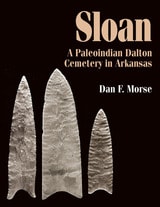
Sloan
A Paleoindian Dalton Cemetery in ArkansasDan Morse
University of Arkansas Press, 1997
New in Paper!
Excavated in 1974, the Sloan site in northeast Arkansas is the earliest recognized cemetery in the New World, containing the graves of a small group of Native Americans who died over ten thousand years ago. Although no skeletons were found in the acidic soil, the number, size, and quality of its artifacts attest to the presence of a far more complicated and sophisticated culture than had previously been thought to exist during the Dalton period.
Bringing together the work of thirteen eminent scholars, Dan F. Morse describes and assesses the assemblage of points, adzes, scrapers, abraders, and other stone artifacts as an indicator of the territorial stability of late Pleistocene peoples. The tools show that hunter-gatherer-fisher populations lived in small, semipermanent villages, hunted and butchered white-tailed deer, processed and ate vegetables, and made dugout canoes. And they buried their dead in cemeteries, a practice previously associated only with the rise of horticultural societies. Many of the tools are unused, suggesting ritual interments and a well-developed system of trade with groups in rockier areas.
Including an overview of the Dalton period in the southeastern United States and a discussion of the region’s geologic and vegetal prehistory—and newly supported by extensive high-quality image galleries now available at the website of the Arkansas Archeological Survey (see inside cover)—this comprehensive study of the Sloan artifacts provides a multifaceted assessment of a site rich in information about the technology of a single prehistoric society.
Sold American
The Story of Alaska Natives and Their Land 1867-1959Donald Craig Mitchell
University of Alaska Press, 2003
Don Mitchell's companion volume, Take My Land, Take My Life, concludes that story by describing the events that in 1971 resulted in Congress's enactment of the Alaska Native Claims Settlement Act, the most generous aboriginal land claims settlement in the nation's history. Insightful and drawn from years of painstaking research of primary source materials, Sold American and Take My Land, Take My Life are an indispensable resource for readers who are interested in the history of the nation's largest state and of the federal government's involvement with Alaska's indigenous peoples.

Solidarity
Latin America and the US Left in the Era of Human RightsSteve Striffler
Pluto Press, 2018
In Solidarity, Steve Striffler addresses these key questions, offering the first history of US-Latin American solidarity from the Haitian Revolution to the present day. Striffler traces the history of internationalism through the Cold War, exploring the rise of human rights as the dominant current of international solidarity. He also considers the limitations of a solidarity movement today that inherited its organisational infrastructure from the human rights movements.
Moving beyond conventionally ahistorical analyses of solidarity, here Striffler provides a distinctive intervention in the history of progressive politics in both the US and Latin America, the past and present of US imperialism and anti-imperialism, and the history of human rights and labour internationalism.

Sorcery in the Black Atlantic
Edited by Luis Nicolau Parés and Roger Sansi
University of Chicago Press, 2011
Most scholarship on sorcery and witchcraft has narrowly focused on specific times and places, particularly early modern Europe and twentieth-century Africa. And much of that research interprets sorcery as merely a remnant of premodern traditions. Boldly challenging these views, Sorcery in the Black Atlantic takes a longer historical and broader geographical perspective, contending that sorcery is best understood as an Atlantic phenomenon that has significant connections to modernity and globalization.
A distinguished group of contributors here examine sorcery in Brazil, Cuba, South Africa, Cameroon, and Angola. Their insightful essays reveal the way practices and accusations of witchcraft spread throughout the Atlantic world from the age of discovery up to the present, creating an indelible link between sorcery and the rise of global capitalism. Shedding new light on a topic of perennial interest, Sorcery in the Black Atlantic will be provocative, compelling reading for historians and anthropologists working in this growing field.
Spearheads for Reform
The Social Settlements and the Progressive Movement, 1890-1914Davis, Allen
Rutgers University Press, 1985
Specters of the Atlantic
Finance Capital, Slavery, and the Philosophy of HistoryIan Baucom
Duke University Press, 2005
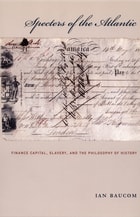
Baucom contends that the massacre and the trials that followed it bring to light an Atlantic cycle of capital accumulation based on speculative finance, an economic cycle that has not yet run its course. The extraordinarily abstract nature of today’s finance capital is the late-eighteenth-century system intensified. Yet, as Baucom highlights, since the late 1700s, this rapacious speculative culture has had detractors. He traces the emergence and development of a counter-discourse he calls melancholy realism through abolitionist and human-rights texts, British romantic poetry, Scottish moral philosophy, and the work of late-twentieth-century literary theorists. In revealing how the Zong tragedy resonates within contemporary financial systems and human-rights discourses, Baucom puts forth a deeply compelling, utterly original theory of history: one that insists that an eighteenth-century atrocity is not past but present within the future we now inhabit.

Storefront Revolution
Food Co-ops and the CountercultureCox, Craig
Rutgers University Press, 1994
In the 1960s, the cooperative networks of food stores, restaurants, bakeries, bookstores, and housing alternatives were part counterculture, part social experiment, part economic utopia, and part revolutionary political statement. The co-ops gave activists a place where they could both express themselves and accomplish at least some small-scale changes. By the mid-1970s, dozens of food co-ops and other consumer- and work-owned enterprises were operating throughout the Twin Cities, and an alternative economic network - with a People's Warehouse at its hub - was beginning to transform the economic landscape of the metropolitan Minneapolis-St. Paul area.
However, these co-op activists could not always agree among themselves on their goals. Craig Cox, a journalist who was active in the co-op movement, here provides the first book to look at food co-ops during the 1960s and 1970s. He presents a dramatic story of hope and conflict within the Minneapolis network, one of the largest co-op structures in the country. His "view from the front" of the "Co-op War" that ensued between those who wanted personal liberation through the movement and those who wanted a working-class revolution challenges us to re-thing possiblities for social and political change. Cox provides not a cynical portrait of sixties idealism, but a moving insight into an era when anything seemed possible.
Strangers in the Land
Patterns of American Nativism, 1860-1925Higham, John
Rutgers University Press, 1988

Suburban Lives
Marsh, Margaret
Rutgers University Press, 1990

Survival Pending Revolution
The History of the Black Panther PartyPaul Alkebulan
University of Alabama Press, 2007
Surviving Spanish Conquest
Indian Fight, Flight, and Cultural Transformation in Hispaniola and Puerto RicoKaren F. Anderson-Córdova
University of Alabama Press, 2017
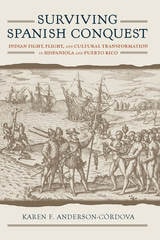
In Surviving Spanish Conquest: Indian Fight, Flight, and Cultural Transformation in Hispaniola and Puerto Rico, Karen F. Anderson-Córdova draws on archaeological, historical, and ethnohistorical sources to elucidate the impacts of sixteenth-century Spanish conquest and colonization on indigenous peoples in the Greater Antilles. Moving beyond the conventional narratives of the quick demise of the native populations because of forced labor and the spread of Old World diseases, this book shows the complexity of the initial exchange between the Old and New Worlds and examines the myriad ways the indigenous peoples responded to Spanish colonization.
Focusing on Hispaniola and Puerto Rico, the first Caribbean islands to be conquered and colonized by the Spanish, Anderson-Córdova explains Indian sociocultural transformation within the context of two specific processes, out-migration and in-migration, highlighting how population shifts contributed to the diversification of peoples. For example, as the growing presence of “foreign” Indians from other areas of the Caribbean complicated the variety of responses by Indian groups, her investigation reveals that Indians who were subjected to slavery, or the “encomienda system,” accommodated and absorbed many Spanish customs, yet resumed their own rituals when allowed to return to their villages. Other Indians fled in response to the arrival of the Spanish.
The culmination of years of research, Surviving Spanish Conquest deftly incorporates archaeological investigations at contact sites copious use of archival materials, and anthropological assessments of the contact period in the Caribbean. Ultimately, understanding the processes of Indian-Spanish interaction in the Caribbean enhances comprehension of colonization in many other parts of the world. Anderson-Córdova concludes with a discussion regarding the resurgence of interest in the Taíno people and their culture, especially of individuals who self-identify as Taíno. This volume provides a wealth of insight to historians, anthropologists, archaeologists, and those interested in early cultures in contact.

Sweatshop
The History of an American IdeaHapke, Laura
Rutgers University Press, 2004
Arguing that the sweatshop is as American as apple pie, Laura Hapke surveys over a century and a half of the language, verbal and pictorial, in which the sweatshop has been imagined and its stories told. Not seeking a formal definition of the sort that policymakers are concerned with, nor intending to provide a strict historical chronology, this unique book shows, rather, how the “real” sweatshop has become intertwined with the “invented” sweatshop of our national imagination, and how this mixture of rhetoric and myth has endowed American sweatshops with rich and complex cultural meaning.
Hapke uncovers a wide variety of tales and images that writers, artists, social scientists, reformers, and workers themselves have told about “the shop.” Adding an important perspective to historical and economic approaches, Sweatshop draws on sources from antebellum journalism, Progressive era surveys, modern movies, and anti-sweatshop websites. Illustrated chapters detail how the shop has been a facilitator of assimilation, a promoter of upward mobility, the epitome of exploitation, a site of ethnic memory, a venue for political protest, and an expression of twentieth-century managerial narratives.
An important contribution to the real and imagined history of garment industry exploitation, this book provides a valuable new context for understanding contemporary sweatshops that now represent the worst expression of an unregulated global economy.