76 books match the query 'Animal rights' and 5 start with s

cover of Sailing with Noah: Stories from the World of Zoos

Sailing with Noah

Stories from the World of Zoos

Jeffrey P. Bonner

University of Missouri Press, 2013
Written by the president of the nation’s number-one zoo, Sailing with Noah is an intensely personal, behind-the-scenes look at modern zoos. Jeffrey P. Bonner, who was trained as an anthropologist and came to the zoo world quite by accident, shares some of the most compelling stories ever told about contemporary zoos. The stories jump between zoos in different cities and between countries on different continents. Some are fun and funny. Others are sad, even tragic. Pete Hoskins, the director of the Philadelphia Zoo, is in bed, sound asleep, when his phone rings. . . . “There’s been a fire in the World of Primates,” he is told. “You’ve got to get over here.” Whatever he has been dreaming, it is nothing like the nightmare he will find now that he is awake. . . . “They’re all gone. They’re all gone.” All of the animals in the building—the gorillas, the lemurs, the orangutans, and the gibbons—all twenty-three of them are dead.
Written in a lively, accessible style, Sailing with Noah explores the role of zoos in today’s society and their future as institutions of education, conservation, and research. Along the way, Bonner relates a variety of true stories about animals and those who care for them (or abuse them), offering his perspective on heavily publicized incidents and describing less-well-known events with compassion and humor in turn. By bringing the stories of the animals’ lives before us, Bonner gives them a voice. He strongly believes that zoos must act for living things, and he argues that conservation is a shared responsibility of all mankind. This book helps us to understand why biodiversity is important and what it means to be a steward of life on earth.
From the day-to-day aspects of caring for some of the world’s most exotic creatures to the role of zoos as field conservation organizations, saving wild things in wild places, this book takes the reader on an incredible journey—a journey that begins within the zoo and continues around the globe. Everyone—from zoo visitors to animal lovers to professional conservationists, the young and old alike—will be fascinated by this extraordinary book.
[more]
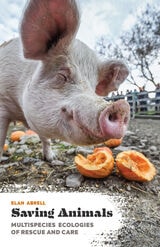
cover of Saving Animals: Multispecies Ecologies of Rescue and Care

Saving Animals

Multispecies Ecologies of Rescue and Care

Elan Abrell

University of Minnesota Press, 2021

A fascinating and unprecedented ethnography of animal sanctuaries in the United States
 

In the past three decades, animal rights advocates have established everything from elephant sanctuaries in Africa to shelters that rehabilitate animals used in medical testing, to homes for farmed animals, abandoned pets, and entertainment animals that have outlived their “usefulness.” Saving Animals is the first major ethnography to focus on the ethical issues animating the establishment of such places, where animals who have been mistreated or destined for slaughter are allowed to live out their lives simply being animals.   

Based on fieldwork at animal rescue facilities across the United States, Elan Abrell asks what “saving,” “caring for,” and “sanctuary” actually mean. He considers sanctuaries as laboratories where caregivers conceive and implement new models of caring for and relating to animals. He explores the ethical decision making around sanctuary efforts to unmake property-based human–animal relations by creating spaces in which humans interact with animals as autonomous subjects. Saving Animals illustrates how caregivers and animals respond by cocreating new human–animal ecologies adapted to the material and social conditions of the Anthropocene.

Bridging anthropology with animal studies and political philosophy, Saving Animals asks us to imagine less harmful modes of existence in a troubled world where both animals and humans seek sanctuary.
[more]
cover of Sister Species: Women, Animals and Social Justice

Sister Species

Women, Animals and Social Justice

Edited by Lisa A. Kemmerer

University of Illinois Press, 2011

Sister Species: Women, Animals, and Social Justice addresses interconnections between speciesism, sexism, racism, and homophobia, clarifying why social justice activists in the twenty-first century must challenge intersecting forms of oppression.
 
This anthology presents bold and gripping--sometimes horrifying--personal narratives from fourteen activists who have personally explored links of oppression between humans and animals, including such exploitative enterprises as cockfighting, factory farming, vivisection, and the bushmeat trade. Sister Species asks readers to rethink how they view "others," how they affect animals with their daily choices, and how they might bring change for all who are abused. These essays remind readers that women have always been important to social justice and animal advocacy, and they urge each of us to recognize the links that continue to bind all oppressed individuals. The astonishing honesty of these contributors demonstrates with painful clarity why every woman should be an animal activist and why every animal activist should be a feminist.
 
Contributors are Carol J. Adams, Tara Sophia Bahna-James, Karen Davis, Elizabeth Jane Farians, Hope Ferdowsian, Linda Fisher, Twyla François, Christine Garcia, A. Breeze Harper, Sangamithra Iyer, Pattrice Jones, Lisa Kemmerer, Allison Lance, Ingrid Newkirk, Lauren Ornelas, and Miyun Park.
[more]
cover of Space Monkeys!: Remembering the Nonhuman Astronauts in US Space Exploration

Space Monkeys!

Remembering the Nonhuman Astronauts in US Space Exploration

John A. Lynch

University of Alabama Press, 2026

Exposes how emotion, memory, and national pride shape the stories we tell about science, animals, and the history of the “race to space”

Before humans ever left Earth’s atmosphere, a handful of primates paved the way—earning fame and fascination but leaving behind a complicated and often highly debated legacy. As the Cold War intensified, the US space program turned to monkeys—Able, Baker, Ham, and Enos—to test and explore the limits of human survival in space. These animals became media sensations, museum exhibits, and symbols of American ingenuity, even as their suffering was often overlooked.

With insight and empathy, Lynch unpacks the stories we tell about these primates and how they are remembered through culture and time, both modern and historically. Lynch argues that the public memory of these animals often justifies their use in the name of scientific progress. Sometimes they are portrayed as tools, other times as human stand-ins, and frequently as objects of sympathy—but rarely as subjects of critique.

Lynch shows how feelings—compassion, cuteness, patriotism, and the technological sublime—shape the stories we tell about these animals and the ethical frameworks we build around them. Each chapter focuses on a different genre of memory-making, from newspaper and photojournalism to museum exhibits, children’s literature, and fictional films.

By reframing these animal pioneers, Lynch uncovers the ethical and emotional narratives that shape how we remember science. Space Monkeys! is a vital reflection on memory, identity, and the more-than-human costs of progress. 
 

[more]
cover of Spanish Thinking about Animals

Spanish Thinking about Animals

Margarita Carretero-González

Michigan State University Press, 2020

Traditional cultural practices involving animals are being seriously questioned, heavily regulated, and, in some cases, even abolished in Spain. This essential and timely text brings together prominent scholars working in the ever-expanding field of animal studies in Spain, drawing from a variety of disciplines within the humanities and social sciences to provide an interdisciplinary look at the animal question. In choosing an angle to approach the study of ethical, aesthetic considerations, and cultural  representations of animals, this collection moves away from the ideology of human exceptionalism that is still predominant but progressively losing force in the field of animal ethics in Spain. It instead includes contributions by scholars who have chosen to look at animals, to a lesser or greater degree, through an antispeciesist lens, displaying the committed attention to and respect for animal life that characterizes critical animal studies.
[more]