Results by title
226 books match the query 'Anthologies (multiple authors)' and 16 start with s
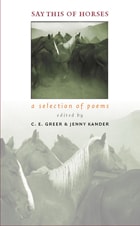
Say This of Horses
A Selection of PoemsC.E. Greer
University of Iowa Press, 2007
Divided into six sections, Say This of Horses considers horses in a multitude of times and places. “Antiquity” explores the forging of the earliest mythical ties between horses and humans. “Here, Now” places horses in the present, where their physical presence is most acutely felt. “Esssence” explores the metaphysical qualities of horses. “Harnessed” contains a selection of poems about horses in war, at work, and in sport and recreation. “Mirrors” shows them as imaginative symbols. Finally, “Lenses” moves into the realm of abstraction and fantasy.
The selections within this far-reaching collection are joyous, moving, erudite, and at times profoundly sad. Poems by Henry Wadsworth Longfellow, W. S. Merwin, Tess Gallagher, Yusef Komunyakaa, Pablo Neruda, Anne Sexton, Wallace Stevens, May Sarton, Jane Kenyon, and James Dickey, among many others, are sure to delight and surprise readers familiar with or just exploring the rich literature on horses.
Contributors include:
Guillaume Apollinaire, Gwendolyn Brooks, Lawrence Ferlinghetti, C.E. Greer, Donald Hall, Joy Harjo, Imru’ al-Qays, Ted Kooser, Philip Larkin, Ann McCarthy de Zavala, Rainer Maria Rilke, Patiann Rogers, William Carlos Williams
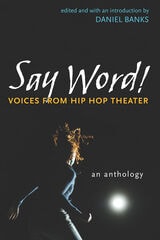
Say Word!
Voices from Hip Hop TheaterAn Anthology Edited and with an Introduction by Daniel Banks
University of Michigan Press, 2011
The phenomenon known as Hip Hop encompasses a global, multiethnic, grassroots culture committed to social justice and self-expression through performance. Hip Hop Theater emerged from that culture, mixing spoken-word performance with music and dance and marked by Hip Hop's strong sense of activism and resistance. Hip Hop Theater is engaged with questions of identity – culture, heritage, ethnicity, class, gender, sexuality, and difference—narrating the experiences of historically marginalized peoples and putting them in dialogue with other oppressed communities.
Say Word! Voices from Hip Hop Theater collects eight works by contemporary artists who confront today's compelling issues, ranging from racial profiling and police brutality to women's empowerment and from the commercial exploitation of Hip Hop to identity politics. Editor Daniel Banks has assembled work by Abiola Abrams, Zakiyyah Alexander, Chadwick Boseman, Kristoffer Diaz, Rha Goddess, Antoy Grant, Joe Hernandez-Kolski, Rickerby Hinds, and Ben Snyder, augmented with an extensive introduction and other informative commentary. The book also includes a roundtable moderated by Holly Bass and featuring Hip Hop pioneers Eisa Davis, Danny Hoch, Sarah Jones, and Will Power, a conversation that traces the roots of Hip Hop Theater and imagines its future directions.

School for Pagan Lovers
Keeley, Edmund
Rutgers University Press, 1993

Secrets Need Words
Indonesian Poetry, 1966–1998Harry Aveling
Ohio University Press, 2001
Short listed for the 2007 New South Wales Premier's Translation Prize
The period from 1966 to 1999 represents a distinct era in Indonesian history. Throughout the “New Order” regime of President Suharto, the policies of economic development and political stability were dominant. However, the public opinion of personal expression was consistently under suspicion, and indeed dissent was severely punished.
Secrets Need Words traces the development of Indonesian poetry throughout this entire period. Texts are presented both in the original Indonesian and in careful, stylistically sensitive English translations.
In this anthology of contemporary work by Indonesian poets, the renowned translator and editor Harry Aveling presents a series of ongoing analyses detailing the political and social shifts that have influenced the work of particular poets.
Professor Aveling's analyses, along with the poems themselves, demonstrate how the poets responded to the power of the state in a variety of ways ranging from direct confrontation to withdrawal into personal and private realms characterized by fantasy and the use of heavily rhythmic language.
Secrets Need Words will be of interest to scholars of Indonesia and comparative literature, and will be for many years to come a basic text for scholarship and teaching. But it also offers all readers of poetry an opportunity to explore a new, complex, and exciting body of literature from one of the world's largest nations.
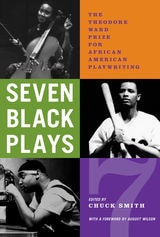
Seven Black Plays
The Theodore Ward Prize for African American PlaywritingChuck Smith
Northwestern University Press, 2004
These seven plays, which span the Ward Prize's history, represent a wide range of talents, experience, and perspectives brought to bear on diverse themes, from a unique moment in the history of baseball's Negro League to a working-class couple contending with a neighborhood bully; from a child's memories of negotiating desegregation to coming of age amidst the ravages of racism, child abuse, and AIDS. By turns poetic and moving, brave and rousing, uproarious and unsettling, these works written by established and emerging playwrights allow actors, directors, theatergoers, and readers to sample the multifarious dramatic experience being limned by African American playwrights today.
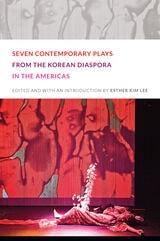
Seven Contemporary Plays from the Korean Diaspora in the Americas
Esther Kim Lee, ed.
Duke University Press, 2012

Seven Irish Plays, 1946-1964
Robert Hogan
University of Minnesota Press, 1967
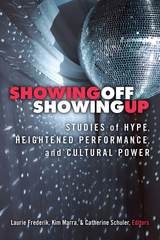
Showing Off, Showing Up
Studies of Hype, Heightened Performance, and Cultural PowerLaurie Frederik, Kim Marra, and Catherine Schuler, Editors
University of Michigan Press, 2017
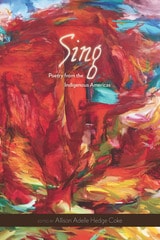
Sing
Poetry from the Indigenous AmericasEdited by Allison Adelle Hedge Coke
University of Arizona Press, 2011
They write from disparate zones and parallel experience, from lands of mounded earthwork long-since paved, from lands of ancient ball courts and the first great cities on the continents, from places of cold, from places of volcanic loam, from zones of erased history and ongoing armed conflict, where “postcolonial” is not an academic concept but a lived reality. As befits a volume of such geographical inclusivity, many poems here appear in multiple languages, translated by fellow poets and writers like Juan Felipe Herrera and Cristina Eisenberg.
Hedge Coke’s thematic organization of the poems gives them an added resonance and continuity, and readers will appreciate the story of the genesis of this project related in Hedge Coke’s deeply felt introduction, which details her experiences as an invited performer at several international poetry festivals. Sing is a journey compelled by the exploration of kinship and the desire for songs that open “pathways of return.”
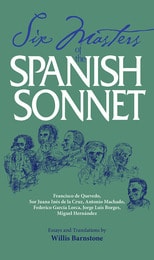
Six Masters of the Spanish Sonnet
Francisco de Quevedo, Sor Juana Ines de la Cruz, Antonio Machado, Federico Garcia Lorca, Jorge Luis Borges, Miguel HernandezEssays and Translations by Willis Barnstone
Southern Illinois University Press, 1997
With poems selected and translated by one of the preeminent translators of our day, this bilingual collection of 112 sonnets by six Spanish-language masters of the form ranges in time from the seventeenth to the twentieth centuries and includes the works of poets from Spanish America as well as poets native to Spain. Willis Barnstone’s selection of sonnets and the extensive historical and biographical background he supplies serve as a compelling survey of Spanish-language poetry that should be of interest both to lovers of poetry in general and to scholars of Spanish-language literature in particular.
Following an introductory examination of the arrival of the sonnet in Spain and of that nation’s poetry up to Francisco de Quevedo, Barnstone takes up his six masters in chronological turn, preceding each with an essay that not only presents the sonneteer under discussion but also continues the carefully delineated history of Spanish-language poetry. Consistently engaging and informative and never dull or pedantic, these essays stand alone as appreciations—in the finest sense of that word—of some of the greatest poets ever to write. It is, however, Barnstone’s subtle, musical, clear, and concise translations that form the heart of this collection. As Barnstone himself says, "In many ways all my life has been some kind of preparation for this volume."
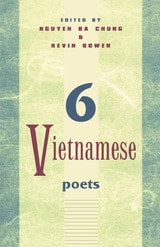
Six Vietnamese Poets
Bilingual EditionEdited by Kevin Bowen and Nguyen Ba Chung
Northwestern University Press, 2001
Speaking to the Heart
After a long night up writing poems,a streak of sunlight leapt into my room.
I ran to the yard,
running as if I were a child,
footprints breaking the earth's first dew,
chest brushing softly the short grass.
Earth and sky seeped into me like wine.
Startled,
I saw my heart in the shape of a ploughshare<
resting on the earth's shoulder,
the heart thumping, steadily ploughing into time.
—Lam Thi My Da
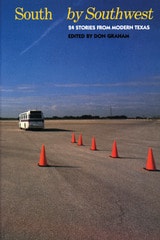
South by Southwest
24 Stories from Modern TexasEdited by Don Graham
University of Texas Press, 1986
These Texas stories are among the best produced by the state's writers in the mid-twentieth century. Selected above all for their artistic excellence and their narrative mastery, they also present a vital picture of the Southwest in microcosm, as revealed in its largest state.
Texas and Texas writing moved from a Southern orientation in the 1940s—reflected here in works by William Goyen, William Humphrey, and others—to the strong Southwestern flavor of stories by such authors as Larry McMurtry and A. C. Greene to, finally, urban or Sunbelt Texas, mirrored in the edgy, sometimes experimental prose of Doug Crowell, William Harrison, and Peter LaSalle.
Here are stories by such celebrated authors as Paul Horgan and William A. Owens, as well as startling, in some cases previously unpublished work by writers like Harryette Mullen, Naomi Shihab Nye, Pat Ellis Taylor, and Thomas Zigal. A few stories may already be favorites—Larry McMurtry's "There Will Be Peace in Korea," Amado Muro's "Cecilia Rosas." Many others have become classics, such as Vassar Miller's poignantly autobiographical "Pact," Hughes Rudd's hilarious record of grade school fieldtrips, R. E. Smith's gripping story of a Houstonian's life-changing encounter with nature, and Dave Hickey's astonishing account of an old cowboy's imprisonment . . . in a bathtub.
Bill Brett, James Crumley, Linda West Eckhardt, Robert Flynn, Mary Gray Hughes, Carolyn Osborn—all are represented here by stories guaranteed to banish stereotypes and boredom and to enlarge one's vision of the Lone Star State. Anyone who thinks that oil wells and big hair define Texas will find out differently in the dazzling short fiction presented in South by Southwest.
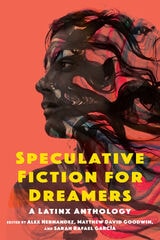
Speculative Fiction for Dreamers
A Latinx AnthologyEdited by Alex Hernandez, Matthew David Goodwin, and Sarah Rafael García with a Preface by Frederick Luis Aldama
The Ohio State University Press, 2021
Finalist, 2022 World Fantasy Awards
Finalist, 2022 Ignyte Awards
Finalist, 2022 Utopia Awards
In a tantalizing array of new works from some of the most exciting Latinx creators working in the speculative vein today, Speculative Fiction for Dreamers extends the project begun with a previous anthology, Latinx Rising (The Ohio State University Press, 2020), to showcase a new generation of writers. Spanning diverse forms, settings, perspectives, and styles, but unified by their drive to imagine new Latinx futures, these stories address the breadth of contemporary Latinx experiences and identities while exuberantly embracing the genre’s ability to entertain and surprise. With new work for new audiences in their teens and up, and especially for Latinx people navigating their identities in the ever-shifting, sometimes perilous, but always promising cultural landscape of the US, this book is for dreamers—and DREAMers—everywhere.
Contributors: Grisel Y. Acosta, Stephanie Adams-Santos, Frederick Luis Aldama, William Alexander, Nicholas Belardes, Louangie Bou-Montes, Lisa M. Bradley, Eliana Buenrostro, Diana Burbano, Pedro Cabiya, Steve Castro, Fernando de Peña, Scott Russell Duncan, Samy Figaredo, Tammy Melody Gomez, J. M. Guzman, Ernest Hogan, Pedro Iniguez, Ezzy G. Languzzi, Patrick Lugo, Roxanne Ocasio, Daniel Parada, Stephanie Nina Pitsirilos, Reyes Ramirez, Julia Rios, Sara Daniele Rivera, Roman Sanchez, Tabitha Sin, Alex Temblador, Rodrigo Vargas, Laura Villareal, Sabrina Vourvoulias, Karlo Yeager Rodriguez
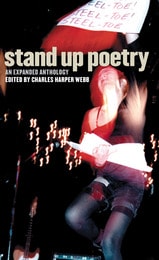
Stand Up Poetry
An Expanded AnthologyCharles Harper Webb
University of Iowa Press, 2002
Contributors:
Kim Addonizio
Dorothy Barresi
Charles Bukowski
Maxine Chernoff
Lucille Clifton
Billy Collins
Philip Dacey
Stephen Dunn
Deborah Harding
Edward Hirsch
Tony Hoagland
Allison Joseph
Jesse Lee Kercheval
Lisa Lewis
Bill Mohr
Ed Ochester
Lawrence Raab
Maureen Seaton
James Tate
Rafael Zepeda
plus many more
Witty, sexy, gritty, outrageous, emotional, hilarious, honest, courageous. What do these words describe? A growing movement in American literary circles: Stand Up Poetry.
Over twenty years ago, Charles Harper Webb discovered a vibrant and invigorating poetry scene in southern California. Featuring some of America's best contemporary poets, this scene, according to Webb, “showed insight, imagination, craft, philosophical depth, but most of all, it was funny, and it was fun.” Stand Up Poetry: The Poetry of Los Angeles and Beyond (1990) was the result of Webb's enthusiasm for this poetic genre.
A decade later, the popularity of performance poetry, poetry slams, and poetry readings is on the rise, and Webb has expanded his anthology to include a greater sampling of poets from across the country. From Charles Bukowski to Billy Collins and Allison Joseph, the poets included in this collection are popular and emerging, classical and experimental, young and old; yet all exhibit the characteristics so important to Stand Up Poetry—humor, performability, accessibility, individuality. Most important, these poems are enjoyable when read silently or aloud, on the page or on the stage.
Stand Up Poetry: An Expanded Anthology is at its core a celebration of poetry offering readers a wonderful lesson in the power of words to entertain and inspire.
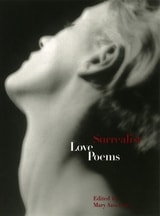
Surrealist Love Poems
Edited by Mary Ann Caws
University of Chicago Press, 2005
Surrealist Love Poems brings together sixty poems by Surrealists who charged their work with all forms of eroticism. Expertly and energetically edited by Mary Ann Caws, this collection seeks to demonstrate the truth of Breton's words, that "the embrace of poetry like that of bodies / As long as it lasts / Shuts out all the woes of the world."
"Erotic, impassioned and necrophilic, the sixty works gathered in Surrealist Love Poems celebrate the idea of obsessive and transformative love. 'I want to sleep with you side by side. . . . Stretched out on your shadow / Hammered by your tongue / To die in a rabbit's rotting teeth / Happy' writes Joyce Mansour. . . . Caws places poems by major surrealist writers like André Breton and Paul Eluard, along with the poetry of Picasso, Dalí, and Frida Kahlo, side by side with fourteen lushly printed and alluring black-and-white photos by the likes of Man Ray, Lee Miller, and Claude Cahun."—Publishers Weekly
Sweeping Beauty
Contemporary Women Poets Do HouseworkPamela Gemin
University of Iowa Press, 2005