59 books match the query 'Antiques & Collectibles' and 3 start with s

cover of Secrets of the Great Ocean Liners

Secrets of the Great Ocean Liners

John G. Sayers

Bodleian Library Publishing, 2020
In the heyday of ocean travel—between the late nineteenth century and World War II—ocean liners were a home away from home. Passengers prepared for voyages that could last as long as three months, and shipping companies ensured their guests were as comfortable as possible, providing entertainment, dining, sleeping quarters, and smoking lounges to accommodate passengers of all ages and budgets. Secrets of the Great Ocean Liners leads the reader through each stage of ocean liner travel, from booking a ticket and choosing a cabin to shore excursions, on-board games, social events, and even romances. This book dives into a vast, unique collection of ephemera to reveal the scandals, glamour, challenges, and tragedies of ocean liner travel. Shipping companies produced glitzy brochures, sailing schedules, voyage logs, passenger lists, postcards, and menus, all of which help us to enjoy daily life on board. Diaries, letters, and journals written by passengers also reveal a host of fascinating insights into the experience of traveling by sea.
[more]
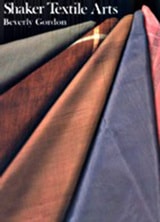
cover of Shaker Textile Arts

Shaker Textile Arts

Beverly Gordon

University Press of New England, 1982

Today we witness a steadily growing interest in the Shakers and their way of life, especially their crafts. Although Shaker furniture, architecture, and herbs, for example, have been written about repeatedly, there are no other studies in depth of another all-important element in Shaker lives--Shaker textiles. Beverly Gordon, an experienced craftswoman and teacher, presents a comprehensive, illustrated book on the kinds of textiles the Shakers used, how they were produced, and their cultural and economic importance to the communities. She shows how Shaker beliefs were manifested in the actual artifacts and integrates detailed technical information in a way that will appeal to the nonprofessional admirers of these crafts as well as to experts. Professional dealers may use the book to verify the authenticity of a variety of items. An introductory chapter is followed by sections on the general characteristics of the textiles, their importance in Shaker lives, and the types of textile activities they undertook. Textile production, including fiber preparation, spinning, weaving, dyeing, knitting, crocheting, and sewing, is examined. Detailed descriptions of rugs and floor coverings, chair and seat tapes and cushions, clothing and personal accessories, popular cloth, and fancywork are followed by appendices on original Shaker weaving drafts, analyses of rugs and chair seat tapes, dye recipes, and instructions for knitting and constructing “fancy” items. This indispensable reference work results in part from the author’s close association with Shaker textiles between 1973 and 1977, when she was a textile interpreter at Hancock Shaker Village. Since then she has had access to artifacts and original manuscripts and documents throughout the country, works that are reflected in her full bibliography. A study from the procurement and processing of materials to the uses of finished products, this is a book of lasting value to collectors and antique dealers, museum curators, home economists, historians, weavers, and fiber artists with related specialties.
[more]
cover of Stability and Change in Guale Indian Pottery, A.D. 1300-1702

Stability and Change in Guale Indian Pottery, A.D. 1300-1702

Rebecca Saunders

University of Alabama Press, 2000

Through a comprehensive study of changing pottery attributes, Saunders documents the clash of Spanish and Native American cultures in the 16th-century southeastern United States.

By studying the ceramic traditions of the Guale Indians, Rebecca Saunders provides evidence of change in Native American lifeways from prehistory through European contact and the end of the Mission period. The Guale were among the first southeastern groups to come into contact with Spanish and French colonists, and they adapted various strategies in order to ensure their own social survival. That adaptation is reflected, Saunders shows, in the changing attributes of pottery recovered on archaeological sites on the coasts of Georgia and Florida.

Saunders traces the evolution of Guale pottery from the late prehistoric Irene phase through the Mission period at the three archaeological sites. She uses both technological and stylistic attributes to monitor change, paying particular attention to changes in execution and frequency of the filfot cross—a stylized cross that is a symbol of Guale cosmology. The frequency of this symbol in different ceramic components, according to Saunders, is a measure of change in the worldview of the missionized Guale. Although the symbol abruptly changed after the first Spanish contact, it showed remarkable stability through the Mission period, suggesting that traditional craft training and production remained strong despite high mortality rates and frequent relocation.

Only after 1684, when the Guale were relocated to Amelia Island in present-day Florida, did the use of the cross motif decline, suggesting that the Guale who remained in Spanish territory may have conceived of their place in the cosmos differently from their forebears or their contemporaries who fled to the interior.

[more]