Results by title
95 books match the query 'Arab-Israeli conflict' and 4 start with s
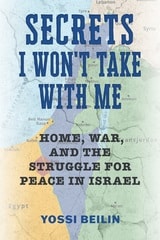
Secrets I Won't Take with Me
Home, War, and the Struggle for Peace in IsraelYossi Beilin
University of Alabama Press, 2025
An Israeli political leader’s riveting first-hand account of pivotal moments from recent Israeli history, including the Oslo Peace Accords, the founding of the Birthright Initiative, the assassination of Yitzhak Rabin, the rise of the Israeli far right, and more
In Secrets I Won't Take with Me, Yossi Beilin, a key Israeli political and ministerial leader, offers an intimate and candid memoir that chronicles pivotal events in the nation’s recent history. From the crucible of its founding to the complexities of the modern era, Beilin reveals an insider’s perspective and previously undocumented insights about the events that have and continue to shape Israel.
Beginning his career as an academic and a journalist, Beilin became the spokesperson of the Labor Party in 1977. Among his many career highlights include the chairmanship of the Meretz-Yachad Party, Minister of Justice, Minister of Religious Affairs, and Deputy Finance Minister, and perhaps most significantly, as Deputy Foreign Minister during the Israel-PLO Oslo Peace Accords. As a key architect of the Oslo Peace Accords, he shares unprecedented details of the negotiations that defined an era.
Beyond diplomacy, Beilin illuminates his role in shaping Israel’s identity, from steering Israel away from its alliance with apartheid South Africa to the foundation of the influential Birthright program. With unflinching honesty, Beilin navigates the triumphs and tragedies of a nation, from the euphoria of the Six-Day War to the heartbreak of Yitzhak Rabin’s assassination. A deeply personal memoir of one man’s life interwoven with a nation’s, Beilin’s stunning account of his career serves as a masterful tour d’horizon of Israel’s recent past and evolving future.
Seeking Mandela
Peacemaking Between Israelis And PalestiniansHeribert Adam and Kogila Moodley
Temple University Press, 2005
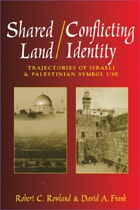
Shared Land/Conflicting Identity
Trajectories of Israeli & Palestinian Symbol UseRobert C. Rowland
Michigan State University Press, 2002
Shared Land/Conflicting Identity: Trajectories of Israeli and Palestinian Symbol Use argues that rhetoric, ideology, and myth have played key roles in influencing the development of the 100-year conflict between first the Zionist settlers and the current Israeli people and the Palestinian residents in what is now Israel. The Israeli-Palestinian conflict is usually treated as an issue of land and water. While these elements are the core of the conflict, they are heavily influenced by the symbols used by both peoples to describe, understand, and persuade each other. The authors argue that symbolic practices deeply influenced the Oslo Accords, and that the breakthrough in the peace process that led to Oslo could not have occurred without a breakthrough in communication styles.
Rowland and Frank develop four crucial ideas on social development: the roles of rhetoric, ideology, and myth; the influence of symbolic factors; specific symbolic factors that played a key role in peace negotiations; and the identification and value of criteria for evaluating symbolic practices in any society.

Sharing the Land of Canaan
Human Rights and the Israeli-Palestinian StruggleMazin B. Qumsiyeh
Pluto Press, 2004
There is no more compelling and dramatic unfolding story, with more profound international ramifications, than the conflict in the Middle East.
Sharing the Land of Canaan is a critical examination of the core issues of the conflict that dares to put forward a radical but logical solution: that a shared state is the best way to achieve justice and peace for Israelis and Palestinians.
Mazin B. Qumsiyeh, a human rights activist based at Yale University, offers an overview of the issues at stake, and outlines his vision for a lasting peace based on upholding the principles of human rights for all. Tackling taboo subjects, myths and obstacles, he argues convincingly that apartheid in the form of a two-state solution is no longer a feasible way to achieve enduring peace.
At this critical time, when the 'road map' to peace looks more uncertain than ever, this book provides a refreshing counterpoint to the failed strategies of the past. It is a direct and accessible account of the history - and mythology - of the fabled 'Land of Canaan', which lays out hopeful ideas for the future of this truly multiethnic and multicultural region.