133 books match the query 'Argentina' and 9 start with s
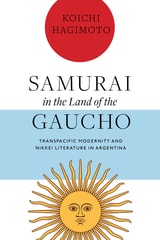
cover of Samurai in the Land of the Gaucho: Transpacific Modernity and Nikkei Literature in Argentina

Samurai in the Land of the Gaucho

Transpacific Modernity and Nikkei Literature in Argentina

Koichi Hagimoto

Vanderbilt University Press, 2023

Winner of the 2024 Marysa Navarro Best Book Prize, New England Council for Latin American Studies (NECLAS)

In the early twentieth century, historical imaginings of Japan contributed to the Argentine vision of “transpacific modernity." Intellectuals such as Eduardo Wilde and Manuel Domecq García celebrated Japanese customs and traditions as important values that can be integrated into Argentine society. But a new generation of Nikkei or Japanese Argentines is rewriting this conventional narrative in the twenty-first century. Nikkei writers such as Maximiliano Matayoshi and Alejandra Kamiya are challenging the earlier, unapologetic view of Japan based on their own immigrant experiences.

Compared to the experience of political persecution against Japanese immigrants in Brazil and Peru, the Japanese in Argentina generally lived under a more agreeable sociopolitical climate. In order to understand the "positive" perception of Japan in Argentine history and literature, Samurai in the Land of the Gaucho turns to the current debate on race in Argentina, particularly as it relates to the discourse of whiteness. One of the central arguments is that Argentina's century-old interest in Japan represents a disguised method of (re)claiming its white, Western identity.

Through close readings of diverse genres (travel writing, essay, novel, short story, and film) Samurai in the Land of the Gaucho yields a multi-layered analysis in order to underline the role Japan has played in both defining and defying Argentine modernity from the twentieth century to the present.  

[more]
cover of Scenes From Postmodern Life

Scenes From Postmodern Life

Beatriz Sarlo

University of Minnesota Press, 2001
[more]
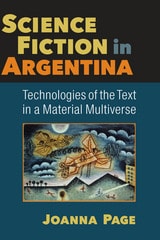
cover of Science Fiction in Argentina: Technologies of the Text in a Material Multiverse

Science Fiction in Argentina

Technologies of the Text in a Material Multiverse

Joanna Page

University of Michigan Press, 2016
It has become something of a critical commonplace to claim that science fiction does not actually exist in Argentina. This book puts that claim to rest by identifying and analyzing a rich body of work that fits squarely in the genre. Joanna Page explores a range of texts stretching from 1875 to the present day and across a variety of media-literature, cinema, theatre, and comics-and studies the particular inflection many common discourses of science fiction (e.g., abuse of technology by authoritarian regimes, apocalyptic visions of environmental catastrophe) receive in the Argentine context. A central aim is to historicize these texts, showing how they register and rework the contexts of their production, particularly the hallmarks of modernity as a social and cultural force in Argentina. Another aim, held in tension with the first, is to respond to an important critique of historicism that unfolds in these texts. They frequently unpick the chronology of modernity, challenging the linear, universalizing models of development that underpin historicist accounts. They therefore demand a more nuanced set of readings that work to supplement, revise, and enrich the historicist perspective.
[more]
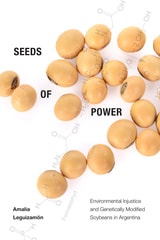
cover of Seeds of Power: Environmental Injustice and Genetically Modified Soybeans in Argentina

Seeds of Power

Environmental Injustice and Genetically Modified Soybeans in Argentina

Amalia Leguizamón

Duke University Press, 2020
In 1996 Argentina adopted genetically modified (GM) soybeans as a central part of its national development strategy. Today, Argentina is the third largest global grower and exporter of GM crops. Its soybeans—which have been modified to tolerate being sprayed with herbicides—now cover half of the country's arable land and represent a third of its total exports. While soy has brought about modernization and economic growth, it has also created tremendous social and ecological harm: rural displacement, concentration of landownership, food insecurity, deforestation, violence, and the negative health effects of toxic agrochemical exposure. In Seeds of Power Amalia Leguizamón explores why Argentines largely support GM soy despite the widespread damage it creates. She reveals how agribusiness, the state,  and their allies in the media and sciences deploy narratives of economic redistribution, scientific expertise, and national identity as a way to elicit compliance among the country’s most vulnerable rural residents. In this way, Leguizamón demonstrates that GM soy operates as a tool of power to obtain consent, to legitimate injustice, and to quell potential dissent in the face of environmental and social violence.
[more]
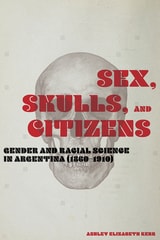
cover of Sex, Skulls, and Citizens: Gender and Racial Science in Argentina (1860-1910)

Sex, Skulls, and Citizens

Gender and Racial Science in Argentina (1860-1910)

Ashley Elizabeth Kerr

Vanderbilt University Press, 2020

PROSE Awards Subject Category Finalist—Biological Anthropology, Ancient History, and Archaeology, 2021

Best Nineteenth-Century Book Award, Latin American Studies Association Nineteenth-Century Section, 2021​

Analyzing a wide variety of late-nineteenth-century sources, Sex, Skulls, and Citizens argues that Argentine scientific projects of the era were not just racial encounters, but were also conditioned by sexual relationships in all their messy, physical reality.

The writers studied here (an eclectic group of scientists, anthropologists, and novelists, including Estanislao Zeballos, Lucio and Eduarda Mansilla, Ramón Lista, and Florence Dixie) reflect on Indigenous sexual practices, analyze the advisability and effects of interracial sex, and use the language of desire to narrate encounters with Indigenous peoples as they try to scientifically pinpoint Argentina's racial identity and future potential.

Kerr's reach extends into history of science, literary studies, and history of anthropology, illuminating a scholarly time and place in which the lines betwixt were much blurrier, if they existed at all.

[more]
cover of Sideways Selves: Travesti and Jotería Struggles Across the Américas

Sideways Selves

Travesti and Jotería Struggles Across the Américas

PJ DiPietro

University of Texas Press, 2025

2026 Sylvia Rivera Award in Transgender Studies, The Center for LGBTQ Studies (CLAGS), CUNY

How trans and non-binary networks engage in decoloniality across hemispheres. 

A deeply informed, theoretically rich work of inquiry and critique, Sideways Selves learns from two communities of migrants as they contest their marginalization under the colonial regime of gender—colonial because, as PJ DiPietro affirms, Indigenous and Afro-diasporic conceptions of embodiment have been displaced by the European-Christian order of gender. Following gender-nonconforming Aymara, Kolla, and mixed-race exiles in Buenos Aires and K’iche’, Nahua, and Central American migrants in the San Francisco Bay Area, DiPietro takes stock of a collective, transnational effort to reimagine ideas of personhood and kinship that gender makes unthinkable.

The communities DiPietro studies create new kinds of identities, collective and genderless in nature. Their ways of thinking and doing, though radical, are motivated by old wisdom, storytelling, healing, and religion—brujería, curanderismo, Voudoun, and other practices that colonialism, capitalism, and the nation-state have unsuccessfully tried to erase. In equal measures philosophical and ethnographic, Sideways Selves witnesses and listens as these displaced people—displaced from their homes and from the moral geography of the West—show us what a just, decolonial world could actually be.
[more]
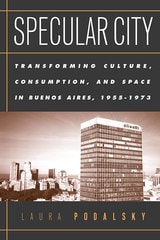
cover of Specular City: The Transformation Of Culture, Consumption

Specular City

The Transformation Of Culture, Consumption

Laura Podalsky

Temple University Press, 2004

A sweeping account of one of the cultural centers of Latin America, Specular City tells the history of Buenos Aires during the interregnum after Juan Perón's fall from power and before his restoration. During those two decades, the city experienced a rapid metamorphosis at the behest of its middle class citizens, who were eager to cast off the working-class imprint left by the Perónists. Laura Podalsky discusses the ways in which the proliferation of skyscrapers, the emergence of car culture, and the diffusion of an emerging revolution in the arts helped transform Buenos Aires, and, in so doing, redefine Argentine collective history.More than a cultural and material history of this city, this book also presents Buenos Aires as a crucible for urban life. Examining its structures through films, literatures, new magazines, advertising and architecture, Specular City reveals the prominent place of Buenos Aires in the massive changes that Latin America underwent for a new, modern definition of itself.
[more]
cover of Squatter Life: Persistence at the Urban Margins of Buenos Aires

Squatter Life

Persistence at the Urban Margins of Buenos Aires

Javier Auyero and Sofía Servián

Duke University Press, 2025
In Squatter Life, sociologist Javier Auyero and anthropologist Sofía Servián detail the diverse and often precarious strategies that Argentina’s urban poor rely on to survive. Blending three years of ethnographic fieldwork and anthropological theory with personal narratives of Servián’s experience growing up and living in a squatter settlement, the authors examine how Argentina’s squatter communities contend with violence and secure necessities like food, land, and housing despite inadequate state support and protection. Auyero and Servián recount the bricolage of tactics these individuals employ to make ends meet, such as relying on highly exploitative jobs, patronage, and networks of reciprocal exchange that can involve illicit activities. Analyzing how these survival strategies intersect with class, gender, and political domination, the authors present a nuanced account of marginality in Argentinian squatter settlements while maintaining a deeply human portrait of survival and persistence.
[more]
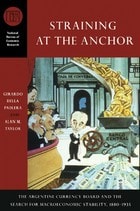
cover of Straining at the Anchor: The Argentine Currency Board and the Search for Macroeconomic Stability, 1880-1935

Straining at the Anchor

The Argentine Currency Board and the Search for Macroeconomic Stability, 1880-1935

Gerardo della Paolera and Alan M. Taylor

University of Chicago Press, 2001

The "Argentine disappointment"—why Argentina persistently failed to achieve sustained economic stability during the twentieth century—is an issue that has mystified scholars for decades. In Straining the Anchor, Gerardo della Paolera and Alan M. Taylor provide many of the missing links that help explain this important historical episode. Written chronologically, this book follows the various fluctuations of the Argentine economy from its postrevolutionary volatility to a period of unprecedented prosperity to a dramatic decline from which the country has never fully recovered. The authors examine in depth the solutions that Argentina has tried to implement such as the Caja de Conversión, the nation's first currency board which favored a strict gold-standard monetary regime, the forerunner of the convertibility plan the nation has recently adopted.

With many countries now using—or seriously contemplating—monetary arrangements similar to Argentina's, this important and persuasive study maps out one of history's most interesting monetary experiments to show what works and what doesn't.
[more]