Results by title
99 books match the query 'Art, Modern' and 5 start with s
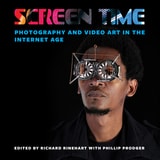
Screen Time
Photography and Video Art in the Internet AgeRichard Rinehart
Bucknell University Press, 2022
Published by Bucknell University Press for the Samek Art Museum.
Distributed worldwide by Rutgers University Press.

Seeing Witness
Visuality and the Ethics of TestimonyJane Blocker
University of Minnesota Press, 2009
Unearthing the meaning of witnessing in contemporary art and politics
The act of bearing witness can reveal much, but what about the figure of the witness itself? As contemporary culture is increasingly dominated by surveillance, the witness—whether artist, historian, scientist, government official, or ordinary citizen—has become empowered in realms from art to politics.
In Seeing Witness, Jane Blocker challenges the implicit authority of witnessing through the examination of a series of contemporary artworks, all of which make the act of witnessing visible, open to inspection and critique. Considering such artists as Marina Abramović, James Luna, Felix Gonzalez-Torres, Eduardo Kac, and Ann Hamilton, Blocker investigates the artists and spectators who look, the technologies they look with, and the forms of power and moral authority that permit their viewing. Going beyond particular traumatic or sensational events, Blocker contemplates the politics of witnessing and argues that the witness represents a morally unique—and even problematic—position of privilege. Separating Seeing Witness from previous literature on the subject, she finds that the visual is inherent in witnessing and asserts that contemporary art is integral to questioning and understanding how witnessing is mobilized in culture today.
Sewn in the Sweatshops of Marx
Beuys, Warhol, Klein, DuchampThierry de Duve
University of Chicago Press, 2012
Surface Encounters
Thinking with Animals and ArtRon Broglio
University of Minnesota Press, 2011
What it is like to be an animal? Ron Broglio wants to know from the inside, from underneath the fur and feathers. In examining this question, he bypasses the perspectives of biology or natural history to explore how one can construct an animal phenomenology, to think and feel as an animal other—or any other.
Until now phenomenology has grappled with how humans are embedded in their world. According to philosophical tradition, animals do not practice the self-reflexive thought that provides humans with depth of being. Without human interiority, philosophers have believed, animals live on the surface of things. But, Broglio argues, the surface can be a site of productive engagement with the world of animals, and as such he turns to humans who work with surfaces: contemporary artists.
Taking on the negative claim of animals living only on the surface and turning the premise into a positive set of possibilities for human–animal engagement, Broglio considers artists—including Damien Hirst, Carolee Schneemann, Olly and Suzi, and Marcus Coates—who take seriously the world of the animal on its own terms. In doing so, these artists develop languages of interspecies expression that both challenge philosophy and fashion new concepts for animal studies.
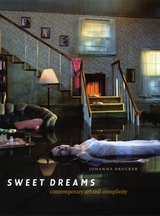
Sweet Dreams
Contemporary Art and ComplicityJohanna Drucker
University of Chicago Press, 2005
Drucker shows that artists today are aware of working within the ideologies of mainstream culture and have replaced avant-garde defiance with eager complicity. Finding their materials at flea markets or exploring celebrity culture, contemporary artists have created a vibrantly participatory movement that exudes enthusiasm and affirmation—all while critics continue to cling to an outmoded vocabulary of opposition and radical negativity that defined modernism's avant-garde. At the cutting edge of new media research, Drucker surveys a wide range of exciting contemporary artists, demonstrating their clear departure from the past and petitioning viewers and critics to shift their terms and sensibilities as well. Sweet Dreams is a testament to the creative processes and self-conscious heterogeneity of art today as well as a revolutionary effort to solicit collaboration that will encourage the production of imaginative thought and contribute to contemporary life.