197 books match the query 'Arts' and 15 start with s

cover of Scattering the Seed: A Guide through Balthasar's Early Writings on Philosophy and the Arts

Scattering the Seed

A Guide through Balthasar's Early Writings on Philosophy and the Arts

Aidan Nichols

Catholic University of America Press, 2006
[more]
cover of Scenes From Postmodern Life

Scenes From Postmodern Life

Beatriz Sarlo

University of Minnesota Press, 2001
[more]
cover of Selected Writings of Richard McKeon, Volume Two: Culture, Education, and the Arts

Selected Writings of Richard McKeon, Volume Two

Culture, Education, and the Arts

Richard P. McKeon

University of Chicago Press, 2005

Richard McKeon was a philosopher of extraordinary creativity who brought profoundly original ideas to bear on more standard ways of thinking and learning. A classicist, medievalist, and revolutionary intellectual, he fashioned an approach to philosophy as a plural conversation among varied traditions of thought, epochs, and civilizations. This second volume of McKeon's selected works demonstrates his approach to inquiry and practice in culture, education, and the arts.

Together, the writings in this book show how McKeon reinvented the ancient arts of rhetoric, grammar, logic, and dialectic for the new circumstances of a global culture. In essays on creation and criticism, for instance, rhetoric is distinguished from grammar and shown to be the master art of invention, judgment, and pluralistic interpretation. Writings on themes of culture, meanwhile, explore the self-invention of mankind as justification for the arts, the development of the humanities, and the organization of the sciences. In the closing essays on education and philosophy, McKeon considers the implications of his ideas for the future of the liberal arts and higher learning.
[more]
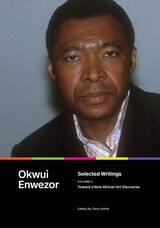
cover of Selected Writings, Volume 1: Toward a New African Art Discourse

Selected Writings, Volume 1

Toward a New African Art Discourse

Okwui Enwezor. Edited by Terry Smith.

Duke University Press, 2025
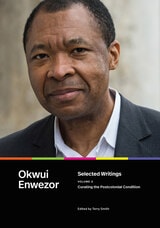
Okwui Enwezor is widely regarded as a leader among the brilliant curators who emerged in the 1990s to set agendas for understanding the global expansiveness of contemporary art. Among his pathfinding exhibitions were the second Johannesburg Biennale (1997), the paradigm-shifting Documenta11 (2002), Archive Fever (2008), and Postwar (2016). In addition to breaking ground as a curator, Enwezor was also a prolific critic, essayist, and theorist. Selected Writings—a landmark two-volume set—brings together Enwezor’s most influential and foundational works. Spanning a quarter-century, these selections reflect the depth and breadth of Enwezor’s writing and its role in his tireless efforts to decolonize the art world. Volume 1, Toward a New African Art Discourse, includes fifteen essays written between 1994 and 2006. Drawn from exhibition catalogs, art journals, interviews with artists, art reviews, curatorial statements, historical studies, and book chapters, these texts show him striving to fulfil the first main ambition that drove his career: to found and sustain what he called a “New African Art Discourse.” Demonstrating that his writing helped fulfill this goal, this collection reaffirms Enwezor’s status as a transformational figure in the global contemporary art world.
[more]
cover of Selected Writings, Volume 2: Curating the Postcolonial Condition, Volume 2

Selected Writings, Volume 2

Curating the Postcolonial Condition, Volume 2

Okwui Enwezor. Edited by Terry Smith.

Duke University Press, 2025
Okwui Enwezor is widely regarded as a leader among the brilliant curators who emerged in the 1990s to set agendas for understanding the global expansiveness of contemporary art. Among his pathfinding exhibitions were the second Johannesburg Biennale (1997), the paradigm-shifting Documenta 11 (2002), Archive Fever (2008), and Postwar (2016). In addition to breaking ground as a curator, Enwezor was also a prolific critic, essayist, and theorist. Selected Writings—a landmark two-volume set—brings together Enwezor’s most influential and foundational works. Spanning a quarter-century, these selections reflect the depth and breadth of Enwezor’s writing and its role in his tireless efforts to decolonize the art world. Volume 2, Curating the Postcolonial Condition, includes seventeen essays written between 2006 and 2019. Drawn from exhibition catalogs, art journals, interviews with artists, art reviews, curatorial statements, historical studies, and book chapters, these texts show him striving to fulfil the second main ambition that drove his career: enabling a critical, diasporic imagining of postcoloniality that would become pervasive within global art discourse. Demonstrating that his writing helped fulfill this goal, this collection reaffirms Enwezor’s status as a transformational figure in the global contemporary art world.
[more]
cover of Sensing the Future: Experiments in Art and Technology (E.A.T.)

Sensing the Future

Experiments in Art and Technology (E.A.T.)

Nancy Perloff

J. Paul Getty Trust, The, 2024

In the 1960s and '70s, collaborations between artists and engineers led to groundbreaking innovations in multisensory performance art that continue to resonate today.

In 1966, Billy Klüver and Fred Waldhauer, engineers at Bell Labs in Murray Hill, New Jersey, teamed up with artists Robert Rauschenberg and Robert Whitman to form a nonprofit organization, Experiments in Art and Technology (E.A.T.). E.A.T.’s debut event, 9 Evenings: Theatre & Engineering, integrated art, theater, and groundbreaking technology in a series of performances at the 69th Regiment Armory in Manhattan. Its second major event, the Pepsi Pavilion at Expo ’70 in Osaka, Japan, presented a multisensory environment for the first world exposition held in Asia. At these events, and in the hundreds of collaborations E.A.T. facilitated in between, the participants—including John Cage, Lucinda Childs, Deborah Hay, Steve Paxton, Yvonne Rainer, and David Tudor—imagined innovative ways for art and science to intersect and enrich society.

Sensing the Future tells the story of these collaborations between artists and engineers and how they led to new installations and technology-based artworks. Through the examination of films, photographs, diagrams, and artists’ records from the E.A.T. archive at the Getty Research Institute, this volume provides a new perspective on multimedia art in the 1960s and ’70s and highlights the ways E.A.T. pushed the role of the artist beyond the traditional art world.

This volume is published to accompany an exhibition on view at the Getty Research Institute at the Getty Center from September 10, 2024, to February 23, 2025.
[more]
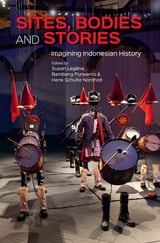
cover of Sites, Bodies and Stories: Imagining Indonesian History

Sites, Bodies and Stories

Imagining Indonesian History

Edited by Susan Legêne, Bambang Purwanto, and Henk Schulte Nordholt

National University of Singapore Press, 2015

Sites, Bodies and Stories examines the intimate links between history and heritage as they have developed in postcolonial Indonesia. Sites discussed in the book include Borobudur in Central Java, a village in Flores built around megalithic formations, and ancestral houses in Alor. Bodies refers to legacies of physical anthropology, exhibition practices and Hollywood movies. The Stories are accounts of the Mambesak movement in Papua, the inclusion of wayang puppetry in UNESCO’s List of the Intangible Cultural Heritage of Humanity, and subaltern history as written by the people of Blambangan in their search for national heroes. Throughout the book, citizenship entitlement figures as a leitmotif in heritage initiatives.


           Contemporary heritage formation in Indonesia is intrinsically linked to a canon of Indonesian art and culture developed during Dutch colonial rule, institutionalized within Indonesia’s heritage infrastructure and in the Netherlands, and echoed in museums and exhibitions throughout the world. The authors in this volume acknowledge colonial legacies but argue against a colonial determinism, considering instead how contemporary heritage initiatives can lead to new interpretations of the past.
[more]
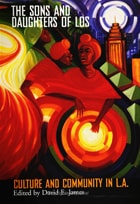
cover of Sons And Daughters Of Los: Culture And Community In L.A.

Sons And Daughters Of Los

Culture And Community In L.A.

David James

Temple University Press, 2003
Los Angeles. A city that is synonymous with celebrity and mass-market culture, is also, according to David James, synonymous with social alienation and dispersal. In the communities of Los Angeles, artists, cultural institutions and activities exist in ways that are often concealed from sight, obscured by the powerful presence of Hollywood and its machinations. In this significant collection of original essays, The Sons and Daughters of Los reconstructs the city of Los Angeles with new cultural connections. Explored here are the communities that offer alternatives to the picture of L..A. as a conglomeration of studios and mass media. Each essay examines a particular piece of, or place in, Los Angeles cultural life: from the Beyond Baroque Poetry Foundation, the Woman's Building, to Highways, and LACE, as well as the achievements of these grassroots initiatives. Also included is critical commentary on important artists, including Harry Gamboa, Jr., and others whose work have done much to shape popular culture in L.A. The cumulative effect of reading this book is to see a very different city take shape, one whose cultural landscape is far more innovative and reflective of the diversity of the city's people than mainstream notions of it suggest. The Sons and Daughters of Los offers a substantive and complicated picture of the way culture plays itself it out on the smallest scale—in one of the largest metropolises on earth—contributing to a richer, more textured understanding of the vibrancy of urban life and art.
[more]
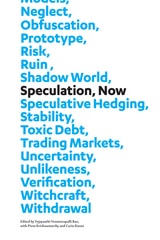
cover of Speculation, Now: Essays and Artwork

Speculation, Now

Essays and Artwork

Vyjayanthi Venuturupalli Rao, with Prem Krishnamurty and Carin Kuoni, eds.

Duke University Press, 2014

Interdisciplinary in design and concept, Speculation, Now illuminates unexpected convergences between images, concepts, and language. Artwork is interspersed among essays that approach speculation and progressive change from surprising perspectives. A radical cartographer asks whether "the speculative" can be represented on a map. An ethnographer investigates religious possession in Islam to contemplate states between the divine and the seemingly human. A financial technologist queries understandings of speculation in financial markets. A multimedia artist and activist considers the relation between social change and assumptions about the conditions to be changed, and an architect posits purposeful neglect as political strategy. The book includes an extensive glossary with more than twenty short entries in which scholars contemplate such speculation-related notions as insurance, hallucination, prophecy, the paradox of beginnings, and states of half-knowledge. The book's artful, nonlinear design mirrors and reinforces the notion of contingency that animates it. By embracing speculation substantively, stylistically, seriously, and playfully, Speculation, Now reveals its subversive and critical potential.

Artists and essayists include William Darity Jr., Filip De Boeck, Boris Groys, Hans Haacke, Darrick Hamilton, Laura Kurgan, Lin + Lam, Gary Lincoff, Lize Mogel, Christina Moon, Stefania Pandolfo, Satya Pemmaraju, Mary Poovey, Walid Raad, Sherene Schostak, Robert Sember, and Srdjan Jovanović Weiss.

Published by Duke University Press and the Vera List Center for Art and Politics at The New School
 
[more]
cover of Speculative Light: The Arts of Beauford Delaney and James Baldwin

Speculative Light

The Arts of Beauford Delaney and James Baldwin

Amy J. Elias, editor

Duke University Press, 2025

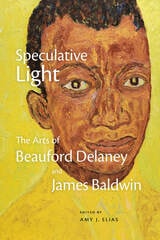
Over the course of a thirty-eight-year friendship, painter Beauford Delaney and writer James Baldwin shared their private lives and shaped one another’s artistic values. Speculative Light brings together scholars, critics, and artists who analyze the stylistic and historical import of Delaney's and Baldwin’s works and examine how this friendship fundamentally shaped the pair's ideas about art and life. The book’s contributors explore how the two men, sharing identities as queer Black American artists, first in New York and then as expatriates in France, created a speculative space in their work to think about more just and creative Black futures. Essay topics and issues range from masculinity, queerness, Blackness, and Americanness to the relationship between jazz, painting, and writing. Throughout, the contributors establish a positive history for Delaney's and Baldwin’s arts that refuses a subordinate role to white artists of the modernist avant-garde. Ultimately, Speculative Light demonstrates that Delaney and Baldwin's bond provides revolutionary grounds for theorizing contemporary Black art and life.

Contributors. Hilton Als, Nicholas Boggs, Indie A. Choudhury, Shawn Anthony Christian, Rachel Cohen, Amy J. Elias, Monika Gehlawat, David Leeming, D. Quentin Miller, Fred Moten, Walton M. Muyumba, Robert O’Meally, Ed Pavlić, Levi Prombaum, Robert Reid-Pharr, Tyler T. Schmidt, Abbe Schriber, Jered Sprecher, Stephen C. Wicks, Magdalena Zaborowska

[more]
cover of Sri Lanka at the Crossroads of History

Sri Lanka at the Crossroads of History

Edited by Zoltán Biedermann and Alan Strathern

University College London, 2017
Sri Lanka has been at the center of far-flung networks for millennia—a key part of trade routes, the spread of religions, and Asian and European empires. This book sets out to use contemporary scholarship that focuses on that role as a crossroads to set Sri Lanka more firmly in the fields of Asian and global history. Contributors draw on the archaeology, history, literature, and art of the island from 500 BCE to 1850 CE to explore a number of pressing scholarly debates. Showing the subtle ways in which foreign elements can be simultaneously resisted and embraced, the book presents a distinctive, but deeply connected, Sri Lanka, one that is defined by its openness to movement across the Indian Ocean.
[more]
cover of Strategic Planning in the Arts: A Practical Guide

Strategic Planning in the Arts

A Practical Guide

Michael M. Kaiser

Brandeis University Press, 2018
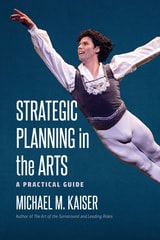
Planning today is more important than ever. Both acquisition and allocation of resources are increasingly difficult for arts organizations as a result of emerging technologies, reduced arts education, aging donors, and the advent of new forms of entertainment. It is essential for arts organizations to take a coherent approach to these issues to remain vibrant over time. In fact, most arts organizations do periodically attempt some kind of planning exercise. But a review of hundreds of such plans suggests that most contain merely a wish list, rather than concrete plans for the future: “We will increase ticket sales!” is a common “strategy” expressed in too many arts plans. In the absence of details about how ticket sales will be increased, it’s an empty promise. In Strategic Planning in the Arts, Michael M. Kaiser, the former head of the Kennedy Center in Washington, DC, and an arts management guru, has produced a clear, concise guide for staff or board members of not-for-profit arts organizations who are responsible for developing, evaluating, or implementing plans. Relying on real-world cases and examples, Kaiser shows how to conceive, assess, and act on every part of the strategic plan, from the mission statement to the financial statement; from managing the board to marketing. Praise for Michael Kaiser: “A rich yet tidy cornucopia of solutions for the challenges facing the American arts scene.”—Washington Post
[more]
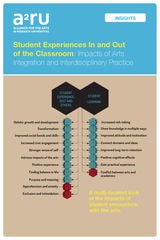
cover of Student Experiences In and Out of the Classroom: Impacts of Arts Integration and Interdisciplinary Practice

Student Experiences In and Out of the Classroom

Impacts of Arts Integration and Interdisciplinary Practice

Gabriel Harp

A2RU Intervals, 2020

[more]
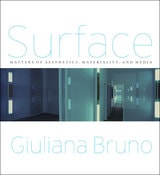
cover of Surface: Matters of Aesthetics, Materiality, and Media

Surface

Matters of Aesthetics, Materiality, and Media

Giuliana Bruno

University of Chicago Press, 2014

What is the place of materiality—the expression or condition of physical substance—in our visual age of rapidly changing materials and media? How is it fashioned in the arts or manifested in virtual forms? In Surface, cultural critic and theorist Giuliana Bruno deftly explores these questions, seeking to understand materiality in the contemporary world.
 
Arguing that materiality is not a question of the materials themselves but rather the substance of material relations, Bruno investigates the space of those relations, examining how they appear on the surface of different media—on film and video screens, in gallery installations, or on the skins of buildings and people. The object of visual studies, she contends, goes well beyond the image and engages the surface as a place of contact between people and art objects. As Bruno threads through these surface encounters, she unveils the fabrics of the visual—the textural qualities of works of art, whether manifested on canvas, wall, or screen. Illuminating the modern surface condition, she notes how façades are becoming virtual screens and the art of projection is reinvented on gallery walls. She traverses the light spaces of artists Robert Irwin, James Turrell, Tacita Dean, and Anthony McCall; touches on the textured surfaces of Isaac Julien’s and Wong Kar-wai’s filmic screens; and travels across the surface materiality in the architectural practices of Diller Scofidio + Renfro and Herzog & de Meuron to the art of Doris Salcedo and Rachel Whiteread, where the surface tension of media becomes concrete. In performing these critical operations on the surface, she articulates it as a site in which different forms of mediation, memory, and transformation can take place.
 
Surveying object relations across art, architecture, fashion, design, film, and new media, Surface is a magisterial account of contemporary visual culture.
[more]
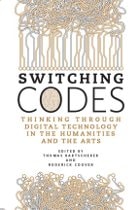
cover of Switching Codes: Thinking Through Digital Technology in the Humanities and the Arts

Switching Codes

Thinking Through Digital Technology in the Humanities and the Arts

Edited by Thomas Bartscherer and Roderick Coover

University of Chicago Press, 2011


Half a century into the digital era, the profound impact of information technology on intellectual and cultural life is universally acknowledged but still poorly understood. The sheer complexity of the technology coupled with the rapid pace of change makes it increasingly difficult to establish common ground and to promote thoughtful discussion. 

Responding to this challenge, Switching Codes brings together leading American and European scholars, scientists, and artists—including Charles Bernstein, Ian Foster, Bruno Latour, Alan Liu, and Richard Powers—to consider how the precipitous growth of digital information and its associated technologies are transforming the ways we think and act. Employing a wide range of forms, including essay, dialogue, short fiction, and game design, this book aims to model and foster discussion between IT specialists, who typically have scant training in the humanities or traditional arts, and scholars and artists, who often understand little about the technologies that are so radically transforming their fields. Switching Codes will be an indispensable volume for anyone seeking to understand the impact of digital technology on contemporary culture, including scientists, educators, policymakers, and artists, alike.

[more]